



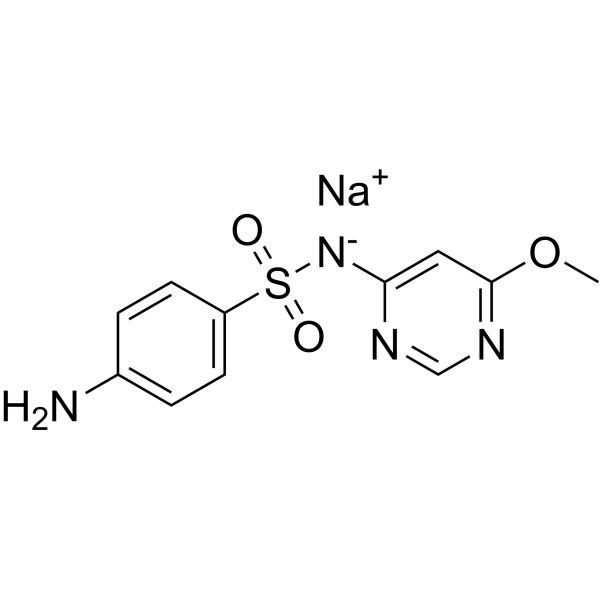
Sulfamonomethoxine sodium
Based on 1 publication(s) in Google Scholar
Sulfamonomethoxine sodium is an orally active broad-spectrum synthetic sulfonamide antibiotic that inhibits dihydropteroate synthetase. Sulfamonomethoxine sodium increases blood glucose levels, induces anxiety-related activities and impairs spatial learning and memory. Sulfamonomethoxine sodium can be used for the research of anxiety, spatial memory impairment, colisepticemia, salmonellosis, and staphylococcus infection.
For research use only. We do not sell to patients.
- Purity : 99.88%
- CAS No.: 38006-08-5
- Formula: C11H11N4NaO3S
- Molecular Weight:302.29
-
Storage:
4°C, sealed storage, away from moisture
* In solvent : -80°C, 6 months; -20°C, 1 month (sealed storage, away from moisture)

To place orders, for customer services and technical support, please contact: MedChemExpress USA
Tel: 609-228-6898 E-mail: [email protected] [email protected]


-
 Biological Activity
-
Chemical Information
-
Solvent & Solubility
- Purity & Documentation
- References
-
 Help & FAQs


Publications Citing Use of MedChemExpress (MCE) Sulfamonomethoxine sodium
MoreAll Antibiotic Isoforms
More

Biological Activity
Description
IC50 & Target
IC50: antibacterial[1]
In Vivo
Sulfamonomethoxine sodium (43.6-65.5 mg/kg; p.o.; daily for 7 days) results in prolonged residue retention in laying hen eggs, with maximal concentrations reached 2 days post-treatment[2].
MedChemExpress (MCE) has not independently confirmed the accuracy of these methods. They are for reference only.
-
Animal Model:ICR (female)[1]
-
Dosage:10 mg/kg/day; 50 mg/kg/day; 200 mg/kg/day
-
Administration:p.o.; daily; GD 1-18
-
Result:Increased blood glucose levels in both male (p < 0.05) and female (p < 0.01) offspring at PND 22 with 200 mg/kg/day exposure.
Reduced kidney coefficients in male offspring (p < 0.05) at PND 22 with 200 mg/kg/day exposure.
Reduced serum BH4 levels to 5.7 pg/mL (p < 0.05) and BDNF levels to 162.5 pg/mL (p < 0.01) in male offspring at PND 22 with 200 mg/kg/day exposure.
Reduced body weight in male offspring at PND 35 (p < 0.05) with 10 mg/kg/day exposure compared to controls.
Reduced body weight in female offspring at PND 28 (p < 0.01) with 10 mg/kg/day exposure compared to controls.
Reduced total distance traveled (p < 0.05) and number of squares crossed (p < 0.05) in both male and female offspring at PND 50 with 50 mg/kg/day exposure.
Reduced entries into the central area in male offspring (p < 0.05) at PND 50 with 50 mg/kg/day exposure.
Reduced entries into the central area (p < 0.05) and time spent in the central area (p < 0.05) in female offspring at PND 50 with 10 mg/kg/day exposure.
Increased number of closed arm entries (p < 0.05) and time spent in closed arms (p < 0.05) in male offspring at PND 50 with 200 mg/kg/day exposure.
Increased time spent in closed arms in female offspring (p < 0.05) at PND 50 with 200 mg/kg/day exposure.
Increased escape latency on training days 2 (p < 0.001) and 3 (p < 0.05) in male offspring at PND 50 with 200 mg/kg/day exposure.
Reduced time spent in the target quadrant in male offspring during probe trial (p < 0.05) with 10 mg/kg/day and 50 mg/kg/day exposure.
-
Animal Model:ISA Brown laying hens (female, ~21 weeks of age, average weight 1.65 kg)[2]
-
Dosage:43.6 mg/kg body weight/day; 65.5 mg/kg body weight/day
-
Administration:p.o. via drinking water; daily; 7 days
-
Result:Reached concentrations in yolk ranging from 257-5358 μg/kg and in egg white ranging from 778-4737 μg/kg during treatment at 43.6 mg/kg/day dose.
Reached maximal concentrations of 5920 μg/kg in yolk and 4831 μg/kg in white on day 2 post-treatment at 43.6 mg/kg/day dose.
Had elimination half-life of 4.58 days in yolk and 8.04 days in white at 43.6 mg/kg/day dose.
Dropped below limit of detection (1.9 μg/kg) in yolk by day 16 post-treatment, and remained above limit of detection in white through day 37 post-treatment at 43.6 mg/kg/day dose.
Fell concentrations below 100 μg/kg in yolk between days 11-13 post-treatment, and in white between days 19-22 post-treatment at 43.6 mg/kg/day dose.
Reached concentrations in yolk ranging from 358-8101 μg/kg and in egg white ranging from 1025-6018 μg/kg during treatment at 65.5 mg/kg/day dose.
Reached maximal concentrations of 9453 μg/kg in yolk and 6050 μg/kg in white on day 2 post-treatment at 65.5 mg/kg/day dose.
Had elimination half-life of 5.37 days in yolk and 9.94 days in white at 65.5 mg/kg/day dose.
Dropped below limit of detection (1.9 μg/kg) in yolk by day 19 post-treatment, and remained above limit of detection in white through day 37 post-treatment at 65.5 mg/kg/day dose.
Fell concentrations below 100 μg/kg in yolk between days 11-13 post-treatment, and in white between days 19-22 post-treatment at 65.5 mg/kg/day dose.
Observed significant differences in concentrations between yolk and white during post-treatment period (p ≤ 0.05): for 43.6 mg/kg/day dose, higher concentrations were measured in white on days 7, 10, 13, and 16; for 65.5 mg/kg/day dose, higher concentrations were measured in white on days 1-19 (except day 4).


Chemical Information
-
CAS No. 38006-08-5
-
Appearance Solid
-
Molecular Weight 302.29
-
Formula C11H11N4NaO3S
-
Color White to off-white
-
SMILES
COC1=NC=NC(=C1)[N-]S(=O)(=O)C2=CC=C(C=C2)N.[Na+]
-
Shipping
Room temperature in continental US; may vary elsewhere.
-
Storage
4°C, sealed storage, away from moisture
* In solvent : -80°C, 6 months; -20°C, 1 month (sealed storage, away from moisture)


Publications (1)
-
Journal Impact Factor
-
Most Recent
-
Antibiotics (Basel)
Revitalizing Trimethoprim/Sulfamethoxazole via Nanotechnology for Improved Pharmacokinetics and Antibacterial Efficacy. [Abstract]2026 Mar 10;15(3):283. PMID: 41892445


Solvent & Solubility
In Vitro:
H2O : 175 mg/mL (578.91 mM; Need ultrasonic)
DMSO : 100 mg/mL (330.81 mM; Need ultrasonic; Hygroscopic DMSO has a significant impact on the solubility of product, please use newly opened DMSO)
Please refer to the solubility information to select the appropriate solvent. Once prepared, please aliquot and store the solution to prevent product inactivation from repeated freeze-thaw cycles.
Storage method and period of stock solution: -80°C, 6 months; -20°C, 1 month (sealed storage, away from moisture). When stored at -80°C, please use it within 6 months. When stored at -20°C, please use it within 1 month.
* Note: If you choose water as the stock solution, please dilute it to the working solution, then filter and sterilize it with a 0.22 μm filter before use.
Please refer to the solubility information to select the appropriate solvent. Once prepared, please aliquot and store the solution to prevent product inactivation from repeated freeze-thaw cycles.
Storage method and period of stock solution: -80°C, 6 months; -20°C, 1 month (sealed storage, away from moisture). When stored at -80°C, please use it within 6 months. When stored at -20°C, please use it within 1 month.
* Note: If you choose water as the stock solution, please dilute it to the working solution, then filter and sterilize it with a 0.22 μm filter before use.
Concentration (start) × Volume (start) = Concentration (final) × Volume (final)
In Vivo:
Select the appropriate dissolution method based on your experimental animal and administration route.
- For the following dissolution methods, please ensure to first prepare a clear stock solution using an In Vitro approach and then sequentially add co-solvents:
- To ensure reliable experimental results, the clarified stock solution can be appropriately stored based on storage conditions. As for the working solution for In Vivo experiments, it is recommended to prepare freshly and use it on the same day.
- The percentages shown for the solvents indicate their volumetric ratio in the final prepared solution. If precipitation or phase separation occurs during preparation, heat and/or sonication can be used to aid dissolution.
Add each solvent one by one: 10% DMSO 40% PEG300 5% Tween-80 45% Saline
Solubility: ≥ 2.5 mg/mL (8.27 mM); Clear solution
This protocol yields a clear solution of ≥ 2.5 mg/mL (saturation unknown).
Taking 1 mL working solution as an example, add 100 μL DMSO stock solution (25.0 mg/mL) to 400 μL PEG300, and mix evenly; then add 50 μL Tween-80 and mix evenly; then add 450 μL Saline to adjust the volume to 1 mL.
Preparation of Saline: Dissolve 0.9 g sodium chloride in ddH₂O and dilute to 100 mL to obtain a clear Saline solution.
Add each solvent one by one: 10% DMSO 90% (20% SBE-β-CD in Saline)
Solubility: ≥ 2.5 mg/mL (8.27 mM); Clear solution
This protocol yields a clear solution of ≥ 2.5 mg/mL (saturation unknown).
Taking 1 mL working solution as an example, add 100 μL DMSO stock solution (25.0 mg/mL) to 900 μL 20% SBE-β-CD in Saline, and mix evenly.
Preparation of 20% SBE-β-CD in Saline (4°C, storage for one week): 2 g SBE-β-CD powder is dissolved in 10 mL Saline, completely dissolve until clear.
In Vivo Dissolution Calculator
Please enter the basic information of animal experiments:
-
-
-
-
Recommended: Prepare an additional quantity of animals to account for potential losses during experiments.
Working solution concentration: 0.22 mg/mL
This product has good water solubility, please refer to the measured solubility data in water/PBS/Saline for details.


Purity & Documentation
-
Data Sheet (279 KB)
-
SDS (396 KB)
- English - EN (396 KB)
- Français - FR (396 KB)
- Deutsch - DE (396 KB)
- Norwegian - NO (396 KB)
- Español - ES (396 KB)
- Swedish - SV (396 KB)
- Italian - IT (396 KB)
- Korean - KR (396 KB)
- Portuguese - PT (396 KB)
-
Handling Instructions (2659 KB)
References
[1]. Zhang Q, et al. Physiological and behavioral responses in offspring mice following maternal exposure to sulfamonomethoxine during pregnancy. Neurosci Lett. 2016;624:8-16. [Content Brief]
[2]. Bilandžić N, et al. Distribution of sulfamonomethoxine and trimethoprim in egg yolk and white. Food Chem. 2015;178:32-37. [Content Brief]
[3]. Huang DJ, et al. Toxicity of the veterinary sulfonamide antibiotic sulfamonomethoxine to five aquatic organisms. Environ Toxicol Pharmacol. 2014;38(3):874-880. [Content Brief]


Complete Stock Solution Preparation Table
Please refer to the solubility information to select the appropriate solvent. Once prepared, please aliquot and store the solution to prevent product inactivation from repeated freeze-thaw cycles.
Storage method and period of stock solution: -80°C, 6 months; -20°C, 1 month (sealed storage, away from moisture). When stored at -80°C, please use it within 6 months. When stored at -20°C, please use it within 1 month.
| Optional Solvent | Concentration Solvent Mass | 1 mg | 5 mg | 10 mg | 25 mg |
|---|---|---|---|---|---|
| DMSO / H2O | 1 mM | 3.3081 mL | 16.5404 mL | 33.0808 mL | 82.7020 mL |
| 5 mM | 0.6616 mL | 3.3081 mL | 6.6162 mL | 16.5404 mL | |
| 10 mM | 0.3308 mL | 1.6540 mL | 3.3081 mL | 8.2702 mL | |
| 15 mM | 0.2205 mL | 1.1027 mL | 2.2054 mL | 5.5135 mL | |
| 20 mM | 0.1654 mL | 0.8270 mL | 1.6540 mL | 4.1351 mL | |
| 25 mM | 0.1323 mL | 0.6616 mL | 1.3232 mL | 3.3081 mL | |
| 30 mM | 0.1103 mL | 0.5513 mL | 1.1027 mL | 2.7567 mL | |
| 40 mM | 0.0827 mL | 0.4135 mL | 0.8270 mL | 2.0676 mL | |
| 50 mM | 0.0662 mL | 0.3308 mL | 0.6616 mL | 1.6540 mL | |
| 60 mM | 0.0551 mL | 0.2757 mL | 0.5513 mL | 1.3784 mL | |
| 80 mM | 0.0414 mL | 0.2068 mL | 0.4135 mL | 1.0338 mL | |
| 100 mM | 0.0331 mL | 0.1654 mL | 0.3308 mL | 0.8270 mL |
* Note: If you choose water as the stock solution, please dilute it to the working solution, then filter and sterilize it with a 0.22 μm filter before use.


Sulfamonomethoxine sodium Related Classifications
HY-W097570 Related Classifications
 Powered by Bioz