



AZD9750

Based on 1 Customer Validation
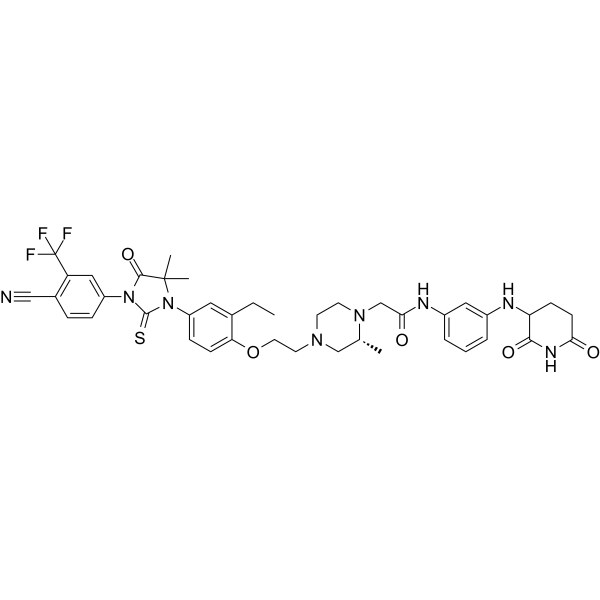
AZD9750 is an orally active, Cereblon (CRBN)-recruiting, androgen receptor (AR)-targeted PROTAC degrader. AZD9750 induces the proteasome-dependent degradation of both wild-type AR and the drug-resistant mutant ARL702H, thereby inhibiting the AR signaling pathway. AZD9750 suppresses tumor growth in mouse prostate cancer xenograft models and has been utilized in prostate cancer research.
(Pink: Adenosine Receptor ligand (HY-175653); Blue: Cereblon ligand (HY-175654); Black: linker).
For research use only. We do not sell to patients.
- Purity : 98.15%
- CAS No.: 3056515-10-4
- Formula: C43H48ClN9O2
- Molecular Weight:758.35
-
Storage:Powder -20°C, 3 years , 4°C, 2 years ; In solvent -80°C, 6 months , -20°C, 1 month


To place orders, for customer services and technical support, please contact: MedChemExpress USA
Tel: 609-228-6898 E-mail: [email protected] [email protected]


-
 Biological Activity
-
Chemical Information
-
Solvent & Solubility
- Purity & Documentation
- References
-
 Help & FAQs




Biological Activity
Description
IC50 & Target
|
Cereblon |
In Vitro
AZD9750 (compound 3n) (0.010-0.012 μM; 24 h) potently degrades wild-type ARWT (with a DC50 of 0.010 μM) in LNCaP cells, as well as mutant ARL702H (with a DC50 of 0.012 μM) in LNCaPL702H cells, after 24 h of treatment.
AZD9750 (0.01-1 μM; 24 h) dose-dependently inhibits the expression of AR-regulated genes (PSA and TMPRSS2) in LNCaP cells[1].
AZD9750 (0.001-1 μM; 10 d) inhibits the proliferation of LNCaP cells in a dose-dependent manner, with the strongest effect observed at the concentration of 1 μM[1].
AZD9750 shows no mitochondrial toxicity in HepG2 cells, with an IC50 as high as 85 μM under galactose conditions and no significant cytotoxicity[1].
AZD9750 (1 μM; 24 h) does not induce the degradation of Ikaros or Aiolos in NB4 cells[1].
MedChemExpress (MCE) has not independently confirmed the accuracy of these methods. They are for reference only.
-
Cell Line:LNCaP
-
Concentration:0.0001-1 μM
-
Incubation Time:24 h
-
Result:Dose-dependently inhibited mRNA expression of PSA (KLK3) and TMPRSS2, with statistically significant suppression at concentrations ≥0.01 μM.
-
Cell Line:LNCaP
-
Concentration:0.001-1 μM
-
Incubation Time:10 days
-
Result:Dose-dependently inhibited LNCaP cell proliferation, with maximum suppression observed at 1 μM, resulting in ~30% confluence after 10 days compared to ~95% for DMSO-treated cells.
-
Cell Line:NB4
-
Concentration:1 μM
-
Incubation Time:24 h
-
Result:Did not degrade Ikaros or Aiolos, as protein expression levels remained similar to DMSO-treated controls.
Parmacokinetics
In Vivo
AZD9750 (30 mg/kg; p.o.; daily; 25 days) achieves 85% tumor growth inhibition and an 86% reduction in AR protein levels in the ST1273 prostate cancer PDX model[1].
MedChemExpress (MCE) has not independently confirmed the accuracy of these methods. They are for reference only.
-
Animal Model:Crl:NU-(NCr)-Foxn1nu mice with Prostate cancer (male, ST1273 prostate cancer PDX model)[1]
-
Dosage:30 mg/kg
-
Administration:p.o.; daily; 25 days
-
Result:Inhibited tumor growth by 85% relative to vehicle control.
Reduced androgen receptor (AR) protein levels in tumor samples by an average 86% compared to vehicle control.


Chemical Information
-
CAS No. 3056515-10-4
-
Appearance Solid
-
Molecular Weight 758.35
-
Formula C43H48ClN9O2
-
Color Off-white to light yellow
-
SMILES
N#CC1=NNC2=C(N3C[C@H](C4=CC=C(N5CCC(CC5)CN6CCC(C7=CC8=CC=C(N9C(NC(CC9)=O)=O)C=C8N7C)CC6)C=C4)CCC3)C=CC(Cl)=C12
-
Shipping
Room temperature in continental US; may vary elsewhere.
-
Storage
Powder -20°C 3 years 4°C 2 years In solvent -80°C 6 months -20°C 1 month


Solvent & Solubility
In Vitro:
DMSO : 25 mg/mL (32.97 mM; ultrasonic and warming and heat to 60°C; Hygroscopic DMSO has a significant impact on the solubility of product, please use newly opened DMSO)
Please refer to the solubility information to select the appropriate solvent. Once prepared, please aliquot and store the solution to prevent product inactivation from repeated freeze-thaw cycles.
Storage method and period of stock solution: -80°C, 6 months; -20°C, 1 month. When stored at -80°C, please use it within 6 months. When stored at -20°C, please use it within 1 month.
Please refer to the solubility information to select the appropriate solvent. Once prepared, please aliquot and store the solution to prevent product inactivation from repeated freeze-thaw cycles.
Storage method and period of stock solution: -80°C, 6 months; -20°C, 1 month. When stored at -80°C, please use it within 6 months. When stored at -20°C, please use it within 1 month.
Concentration (start) × Volume (start) = Concentration (final) × Volume (final)


Purity & Documentation
-
Data Sheet (275 KB)
-
SDS (254 KB)
- English - EN (254 KB)
- Français - FR (254 KB)
- Deutsch - DE (254 KB)
- Norwegian - NO (254 KB)
- Español - ES (254 KB)
- Swedish - SV (254 KB)
- Italian - IT (254 KB)
- Korean - KR (254 KB)
- Portuguese - PT (254 KB)
-
Handling Instructions (2659 KB)
References


Complete Stock Solution Preparation Table
Please refer to the solubility information to select the appropriate solvent. Once prepared, please aliquot and store the solution to prevent product inactivation from repeated freeze-thaw cycles.
Storage method and period of stock solution: -80°C, 6 months; -20°C, 1 month. When stored at -80°C, please use it within 6 months. When stored at -20°C, please use it within 1 month.
| Optional Solvent | Concentration Solvent Mass | 1 mg | 5 mg | 10 mg | 25 mg |
|---|---|---|---|---|---|
| DMSO | 1 mM | 1.3187 mL | 6.5933 mL | 13.1865 mL | 32.9663 mL |
| 5 mM | 0.2637 mL | 1.3187 mL | 2.6373 mL | 6.5933 mL | |
| 10 mM | 0.1319 mL | 0.6593 mL | 1.3187 mL | 3.2966 mL | |
| 15 mM | 0.0879 mL | 0.4396 mL | 0.8791 mL | 2.1978 mL | |
| 20 mM | 0.0659 mL | 0.3297 mL | 0.6593 mL | 1.6483 mL | |
| 25 mM | 0.0527 mL | 0.2637 mL | 0.5275 mL | 1.3187 mL | |
| 30 mM | 0.0440 mL | 0.2198 mL | 0.4396 mL | 1.0989 mL |


AZD9750 Related Classifications
HY-175652 Related Classifications
 Powered by Bioz