



1. Search Result
Search Result
Results for "

phosphodiester

" in MedChemExpress (MCE) Product Catalog:

41

Inhibitors & Agonists

3

Biochemical Assay Reagents

2

Peptides

1

MCE Kits

1

Oligonucleotides

Cat. No. Product Name Target Research Areas Chemical Structure
  • HY-129046
    RNase A, Bovine pancreas
    5 Publications Verification

    Ribonuclease A; EC 4.6.1.18; RNase A

    Endonuclease DNA/RNA Synthesis Others
    RNase A (Bovine pancreatic RNase) is a widely used Endonuclease in DNA purification by specifically hydrolyzing cytosine or uracil residues of RNA. RNase A degrades the RNA in the RNA/DNA duplex. RNase A catalyses the breakdown of 3',5'-phosphodiester linkages of single stranded RNA. RNase A family members in organisms are tightly involved in various physiological and pathological processes including cell growth and development, proliferation, differentiation and migration. Dysregulation of RNase A activity or expression level is closely related to pancreatic, ovarian, bladder and thyroid cancer. RNase A has tumor cell-killing ability .
    RNase A, Bovine pancreas
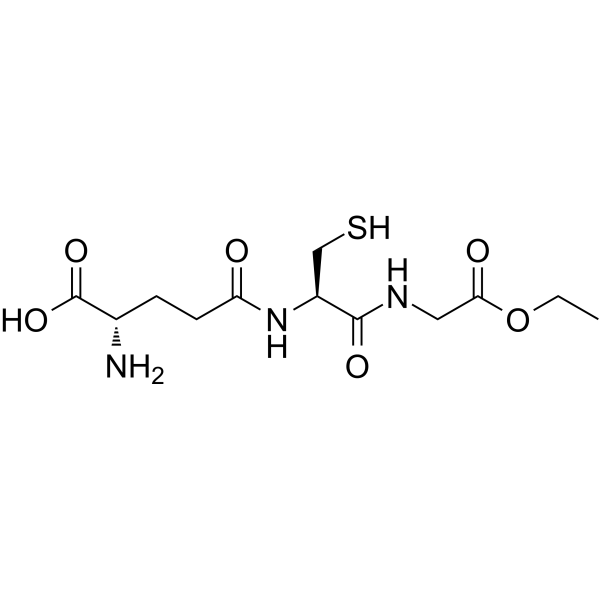
  • HY-134124

    Reactive Oxygen Species (ROS) Metabolic Disease
    Glutathione ethyl ester is a cell-permeable GSH donor and provides an efficient supply of GSH to the oocyte. Glutathione ethyl ester shows positive effect on the in vitro production of embryos by enhancement of the antioxidative defense .
    Glutathione ethyl ester
  • HY-P2812

    PLD

    Phospholipase Neurological Disease Inflammation/Immunology Endocrinology Cancer
    Phospholipase D, Streptomyces chromofuscus (PLD) is an enzyme of the phospholipase superfamily, which widely exists in bacteria, yeast, plants, animals and viruses, and is often used in biochemical research. Phospholipase D can catalyze the hydrolysis of phosphodiester bonds in glycerophospholipids to produce phosphatidic acid and soluble choline. Phospholipase D is involved in a variety of disease-related processes, including diabetes, atherogenesis, obesity, tumorigenesis, immune response, and neuroendocrine function .
    Phospholipase D, Streptomyces chromofuscus
  • HY-P2863
    Deoxyribonuclease II
    2 Publications Verification

    DNase II

    Endonuclease Others
    Deoxyribonuclease II (DNase II) is an endonuclease that hydrolyzes the phosphodiester bonds of deoxyribonucleotides in native and denatured DNA, producing 3' phosphate and 5'-hydroxyl termini. Deoxyribonuclease II works best at acidic pH and is commonly used in biochemical research .
    Deoxyribonuclease II
  • HY-129046C

    Ribonuclease B, Bovine Pancreas

    Endonuclease DNA/RNA Synthesis Endocrinology Cancer
    RNase A (Bovine pancreatic RNase) is a widely used Endonuclease in DNA purification by specifically hydrolyzing cytosine or uracil residues of RNA. RNase A degrades the RNA in the RNA/DNA duplex. RNase A catalyses the breakdown of 3',5'-phosphodiester linkages of single stranded RNA. RNase A family members in organisms are tightly involved in various physiological and pathological processes including cell growth and development, proliferation, differentiation and migration. Dysregulation of RNase A activity or expression level is closely related to pancreatic, ovarian, bladder and thyroid cancer. RNase A has tumor cell-killing ability. RNase B, Bovine Pancreas (Ribonuclease B, Bovine Pancreas) is the N-glycosylated form of RNase A. RNase B, Bovine Pancreas can promote the folding of polypeptide chains and play a role similar to molecular chaperones .
    RNase B, Bovine Pancreas
  • HY-129046I

    DNA/RNA Synthesis Endonuclease Endocrinology Cancer
    RNase A (Bovine pancreatic RNase) is a widely used Endonuclease in DNA purification by specifically hydrolyzing cytosine or uracil residues of RNA. RNase A degrades the RNA in the RNA/DNA duplex. RNase A catalyses the breakdown of 3',5'-phosphodiester linkages of single stranded RNA. RNase A family members in organisms are tightly involved in various physiological and pathological processes including cell growth and development, proliferation, differentiation and migration. Dysregulation of RNase A activity or expression level is closely related to pancreatic, ovarian, bladder and thyroid cancer. RNase A has tumor cell-killing ability. RNase A, Recombinant (animal free) is recombinant RNase A with no animal-derived components .
    RNase A, Recombinant (animal free)
  • HY-108882B
    DNase I RNase & Protease free
    Maximum Cited Publications
    29 Publications Verification

    DNA/RNA Synthesis Inflammation/Immunology
    DNase I is an enzyme that degrades DNA. DNase I is mainly produced by digestive system organs, such as the pancreas and parotid gland. Three types of DNase I are known in mammals: pancreatic type, parotid type, and pancreatico-parotid type. DNase I plays a key role in the cleavage of extracellular DNA, and is critical for limiting inflammatory responses and maintaining homeostasis. DNase I is responsible for digesting extracellular nucleoproteins, which may be essential for preventing autoimmune responses. Decreased DNase I activity may be associated with the onset and progression of systemic lupus erythematosus (SLE). DNase I (RNase & Protease free) is a molecular biology-grade DNase I purified by chromatography to remove RNase and protease .
    DNase I RNase & Protease free
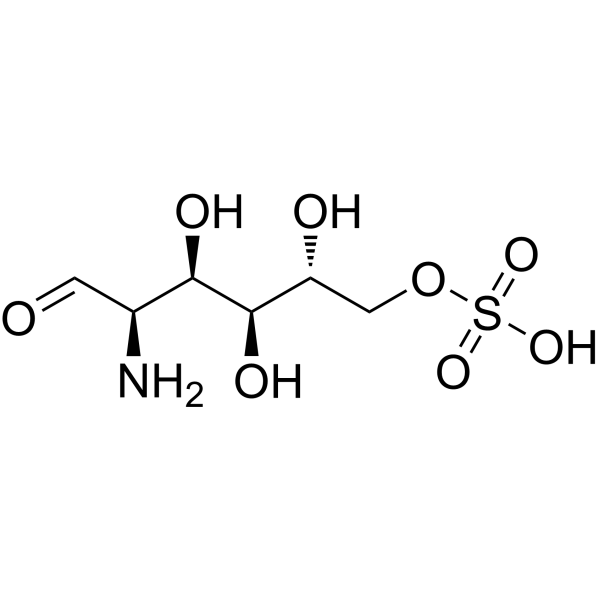
  • HY-W009439

    GlcN6P; D-Glucosamine-6-sulfate

    Biochemical Assay Reagents Others
    Glucosamine 6-sulfate (GlcN6P) is an organic cofactor that splits phosphodiester bonds. Glucosamine 6-sulfate plays a variety of catalytic roles in glmS ribozymes .
    Glucosamine 6-sulfate
  • HY-129046D

    Ribonuclease A, Recombinant

    Endonuclease DNA/RNA Synthesis Endocrinology Cancer
    RNase A (Bovine pancreatic RNase) is a widely used Endonuclease in DNA purification by specifically hydrolyzing cytosine or uracil residues of RNA. RNase A degrades the RNA in the RNA/DNA duplex. RNase A catalyses the breakdown of 3',5'-phosphodiester linkages of single stranded RNA. RNase A family members in organisms are tightly involved in various physiological and pathological processes including cell growth and development, proliferation, differentiation and migration. Dysregulation of RNase A activity or expression level is closely related to pancreatic, ovarian, bladder and thyroid cancer. RNase A has tumor cell-killing ability. RNase A, Recombinant (Ribonuclease A, Recombinant) is a recombinant form of RNase A .
    RNase A, Recombinant
  • HY-148161

    DNA/RNA Synthesis Cancer
    L82-G17 is an uncompetitive DNA ligase I (Lig I)-selective inhibitor. L82-G17 inhibits the third step of the ligation reaction, phosphodiester bond formation. L82-G17can be used as a probe of the catalytic activity .
    L82-G17
  • HY-P0229

    Rnase T1

    DNA/RNA Synthesis Others
    Ribonulease T1, Aspergillus oryzae (Rnase T1), is commonly used in biochemical research. Ribonuclease T1 is an endonuclease that can specifically degrade single stranded RNA. Ribonuclease T1 can form nucleoside 2 ', 3 '-cyclic phosphoric acid intermediates to cut the phosphodiester bond between 3' -guanosine residues and adjacent nucleoside 5 '-OH groups to produce 3' -GMP terminal oligonucleotides .
    Ribonuclease T1, Aspergillus oryzae
  • HY-P2936

    Phospholipase Cardiovascular Disease Infection
    Sphingomyelin phosphodiesterase, Streptomyces sp. is a sphingomyelin phosphodiesterase derived from the genus Streptomyces, which cleaves the phosphodiester bond of sphingomyelin. Sphingomyelin phosphodiesterase, Streptomyces sp. catalyzes the hydrolysis of sphingomyelin in micelles, synthetic substrates, erythrocyte ghost membranes and liposomes, as well as the hydrolysis of the substrate HNP. In the presence of Mg 2+ or Mn 2+ , Sphingomyelin phosphodiesterase, Streptomyces sp. induces hemolysis of bovine erythrocytes through the hydrolysis of membrane sphingomyelin .
    Sphingomyelin phosphodiesterase, Streptomyces sp.
  • HY-129046E

    Ribonuclease A DNase & Protease Free, Recombinant

    Endonuclease DNA/RNA Synthesis Endocrinology Cancer
    RNase A (Bovine pancreatic RNase) is a widely used Endonuclease in DNA purification by specifically hydrolyzing cytosine or uracil residues of RNA. RNase A degrades the RNA in the RNA/DNA duplex. RNase A catalyses the breakdown of 3',5'-phosphodiester linkages of single stranded RNA. RNase A family members in organisms are tightly involved in various physiological and pathological processes including cell growth and development, proliferation, differentiation and migration. Dysregulation of RNase A activity or expression level is closely related to pancreatic, ovarian, bladder and thyroid cancer. RNase A has tumor cell-killing ability. RNase A (DNase & Protease Free), Recombinant is recombinant RNase A, which does not contain DNase and protease .
    RNase A DNase & Protease Free, Recombinant
  • HY-129046B

    Ribonuclease A DNase & Protease Free

    Endonuclease DNA/RNA Synthesis Others Endocrinology Cancer
    RNase A (Bovine pancreatic RNase) is a widely used Endonuclease in DNA purification by specifically hydrolyzing cytosine or uracil residues of RNA. RNase A degrades the RNA in the RNA/DNA duplex. RNase A catalyses the breakdown of 3',5'-phosphodiester linkages of single stranded RNA. RNase A family members in organisms are tightly involved in various physiological and pathological processes including cell growth and development, proliferation, differentiation and migration. Dysregulation of RNase A activity or expression level is closely related to pancreatic, ovarian, bladder and thyroid cancer. RNase A has tumor cell-killing ability. RNase A, Bovine Pancreas (DNase & Protease Free) is RNase A derived from bovine pancreas and does not contain DNase or protease .
    RNase A, Bovine Pancreas DNase & Protease Free
  • HY-W013741

    Biochemical Assay Reagents DNA Alkylator/Crosslinker DNA/RNA Synthesis Others
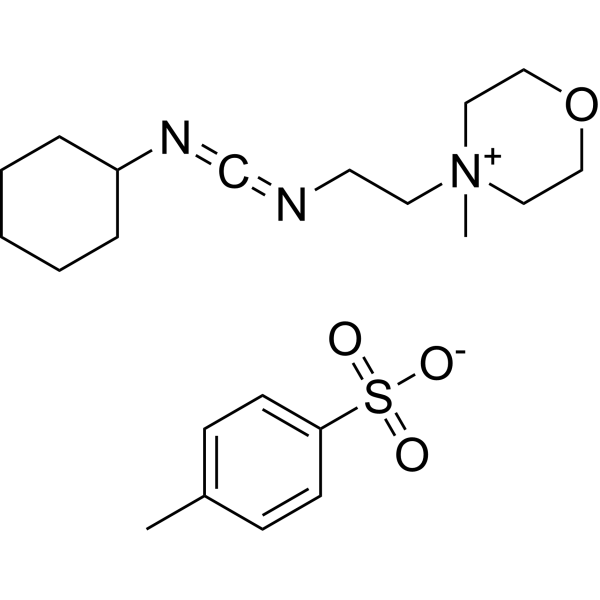
    CME-carbodiimide is a nucleic acid modification reagent. CME-carbodiimide reacts specifically with uracil and guanine residues of RNA, as well as guanine and thymine residues of denatured DNA; it does not react with native DNA. Modification of DNA by CME-carbodiimide inhibits phosphodiester bond cleavage or DNA hydrolysis mediated by pancreatic ribonuclease, snake venom phosphodiesterase and deoxyribonuclease .
    CME-carbodiimide
  • HY-129046H

    DNA/RNA Synthesis Endonuclease Endocrinology Cancer
    RNase A (Bovine pancreatic RNase) is a widely used Endonuclease in DNA purification by specifically hydrolyzing cytosine or uracil residues of RNA. RNase A degrades the RNA in the RNA/DNA duplex. RNase A catalyses the breakdown of 3',5'-phosphodiester linkages of single stranded RNA. RNase A family members in organisms are tightly involved in various physiological and pathological processes including cell growth and development, proliferation, differentiation and migration. Dysregulation of RNase A activity or expression level is closely related to pancreatic, ovarian, bladder and thyroid cancer. RNase A has tumor cell-killing ability. RNase A, Recombinant (Protease & DNase free, animal free) is recombinant RNase A that does not contain protease and DNase and does not contain animal components .
    RNase A, Recombinant Protease & DNase free, animal free
  • HY-164770A

    ApU sodium

    DNA/RNA Synthesis Others
    Adenosyl-(3′→5′)-uridine (ApU) sodium is a nucleotide, which is composed of an adenine base and a uracil sugar molecule through a 3'-5' phosphodiester bond. Adenosyl-(3′→5′)-uridine (ApU) sodium participates in the biological processes, such as gene expression regulation, signal transduction, and protein synthesis .
    Adenosyl-(3′→5′)-uridine sodium
  • HY-E70579

    DNA/RNA Synthesis Others
    Exonuclease III is a nuclease for specifically targeting double-stranded DNA (dsDNA). Exonuclease III is a DNA repair-associated nuclease with apurinic/apyrimidinic (AP)-endonuclease and 3'→5' exonuclease activities. Exonuclease III cleaves the ssDNA at 5'-bond of phosphodiester from 3' to 5' end by both exonuclease and endonuclease activities .
    Exonuclease III
  • HY-P2878A

    PDE, Rattlesnake venom

    Phosphodiesterase (PDE) Metabolic Disease
    Phosphodiesterase l, Rattlesnake venom (PDE, Rattlesnake venom) is a non-selective phosphodiester bond hydrolase targeting phosphodiester bonds in oligonucleotides, catalyzing their hydrolysis into mononucleotides. Phosphodiesterase l, Rattlesnake venom cleaves phosphodiester linkages in DNA fragments digested by DNase I. Phosphodiesterase l, Rattlesnake venom is promising for research of nucleic acid structure and metabolism .
    Phosphodiesterase l, Rattlesnake venom
  • HY-P2812B

    Phospholipase Cardiovascular Disease Neurological Disease Inflammation/Immunology Cancer
    Phospholipase D, cabbage is an enzyme of the phospholipase superfamily. Phospholipase D, cabbage is widely found in bacteria, yeast, plants, animals and viruses and is often used in biochemical research. Phospholipase D, cabbage can catalyze the hydrolysis of the phosphodiester bond of glycerophospholipids to produce phosphatidic acid and soluble choline. Phospholipase D, cabbage is involved in a variety of disease-related processes, including diabetes, atherosclerosis, obesity, tumorigenesis, immune response and neuroendocrine function .
    Phospholipase D, cabbage
  • HY-134894A

    GroPEtn sodium

    Amyloid-β Neurological Disease
    Glycerophosphorylethanolamine (GroPEtn) sodium is an active phosphodiester metabolite of Phosphatidylethanolamine. Glycerophosphorylethanolamine sodium promotes the aggregation of amyloid β-protein (Aβ (1-40)) in vitro. Glycerophosphorylethanolamine sodium can be used in the field of neurodegenerative diseases, such as Alzheimer’s disease research .
    Glycerophosphorylethanolamine sodium
  • HY-164770

    ApU

    DNA/RNA Synthesis Others
    Adenosyl-(3′→5′)-uridine (ApU) is a nucleotide, which is composed of an adenine base and a uracil sugar molecule through a 3'-5' phosphodiester bond. Adenosyl-(3′→5′)-uridine (ApU) participates in the biological processes, such as gene expression regulation, signal transduction, and protein synthesis .
    Adenosyl-(3′→5′)-uridine
  • HY-P2424

    CCK-J

    Calcium Channel Others
    Cholecystokinin-J (CCK-J), a cholecystokinin, stimulates Ca 2+ release .
    Cholecystokinin-J
  • HY-E70091

    DNA/RNA Synthesis Others
    T4 RNA ligase is an ATP-dependent RNA ligase that can catalyze the formation of phosphodiester bonds between the 5'-P end and the 3'-OH end of single-stranded RNA, single-stranded DNA or single nucleotides between molecules or within molecules. T4 RNA ligase is used for enzymatic low ribonucleotide synthesis and 3′ end labeling of RNA. It is mainly used for RNA and RNA, but can also be used for RNA and single nucleotides .
    T4 RNA ligase
  • HY-145065

    Phosphodiesterase (PDE) Infection Cancer
    Enpp-1-IN-7 is a potent inhibitor of ectonucleotide pyrophosphatase-phosphodiesterase 1 (enpp-1). The ENPP 1 has broad specificity and can cleave a variety of substrates, including phosphodiester bonds of nucleotides and nucleotide sugars and pyrophosphate bonds nucleotides and nucleotide sugars. Enpp-1-IN-7 has the potential for the research of cancer and infectious diseases (extracted from patent WO2021203772A1, compound 51) .
    Enpp-1-IN-7
  • HY-145064

    Phosphodiesterase (PDE) Infection Cancer
    Enpp-1-IN-6 is a potent inhibitor of ectonucleotide pyrophosphatase-phosphodiesterase 1 (enpp-1). The ENPP 1 has broad specificity and can cleave a variety of substrates, including phosphodiester bonds of nucleotides and nucleotide sugars and pyrophosphate bonds nucleotides and nucleotide sugars. Enpp-1-IN-6 has the potential for the research of cancer and infectious diseases (extracted from patent WO2021203772A1, compound 51) .
    Enpp-1-IN-6
  • HY-145070

    Phosphodiesterase (PDE) Infection Cancer
    Enpp-1-IN-9 is a potent inhibitor of ectonucleotide pyrophosphatase-phosphodiesterase 1 (enpp-1). The ENPP 1 has broad specificity and can cleave a variety of substrates, including phosphodiester bonds of nucleotides and nucleotide sugars and pyrophosphate bonds nucleotides and nucleotide sugars. Enpp-1-IN-9 has the potential for the research of cancer and infectious diseases (extracted from patent WO2021203772A1, compound 51) .
    Enpp-1-IN-9
  • HY-145069

    Phosphodiesterase (PDE) Cancer
    Enpp-1-IN-8 is a potent inhibitor of ectonucleotide pyrophosphatase-phosphodiesterase 1 (enpp-1). The ENPP 1 has broad specificity and can cleave a variety of substrates, including phosphodiester bonds of nucleotides and nucleotide sugars and pyrophosphate bonds nucleotides and nucleotide sugars. Enpp-1-IN-8 has the potential for the research of cancer and infectious diseases (extracted from patent WO2021203772A1, compound 51) .
    Enpp-1-IN-8
  • HY-145063

    Phosphodiesterase (PDE) Infection Inflammation/Immunology Cancer
    Enpp-1-IN-5 is a potent inhibitor of ectonucleotide pyrophosphatase-phosphodiesterase 1 (enpp-1). The ENPP 1 has broad specificity and can cleave a variety of substrates, including phosphodiester bonds of nucleotides and nucleotide sugars and pyrophosphate bonds nucleotides and nucleotide sugars. Enpp-1-IN-5 has the potential for the research of cancer and infectious diseases (extracted from patent WO2019046778A1/WO2021203772A1, compound 1) .
    Enpp-1-IN-5
  • HY-W1008609

    Biochemical Assay Reagents Others
    (R)-GNA-A(Bz) phosphoramidite is a monophosphate nucleoside similar to DNA or RNA but differing in the composition of its sugar-phosphodiester backbone, using propylene glycol in place of ribose or deoxyribose.
    (R)-GNA-A(Bz) phosphoramidite
  • HY-E70604

    DNA/RNA Synthesis Others
    E. coli DNA ligase is a NAD +-dependent DNA ligase that catalyzes the formation of a phosphodiester bond between the complementary 3′-OH and 5′-P ends of dsDNA .
    E. coli DNA ligase
  • HY-167993

    Biochemical Assay Reagents Others
    (R)-GNA-T phosphoramiditec (compound 7a) is a monophosphate nucleoside similar to DNA or RNA but differing in the composition of its sugar-phosphodiester backbone, using propylene glycol in place of ribose or deoxyribose .
    (R)-GNA-T phosphoramidite
  • HY-W127423

    Biochemical Assay Reagents Others
    Methyl (+/-)-2-hydroxystearateis a hydroxylated fatty acid methyl ester that broadens phase transitions in dimyristoylphosphatidylcholine (DMPC) lipid membranes. It has been used in the synthesis of lipid-nucleotide conjugated anti-HIV agents to increase the cleavage of phosphodiester bonds and the number of released intracellular nucleotides.
    Methyl 2-hydroxyoctadecanoate
  • HY-164771

    UpA

    DNA/RNA Synthesis Others
    Uridylyl-(3′→5′)-adenosine (UpA) is a dinucleotide, which is composed of a unrail base and an adenosine suger molecule through a 3'-5' phosphodiester bond. Uridylyl-(3′→5′)-adenosine participates in the biological processes, such as gene expression regulation, signal transduction, and protein synthesis .
    Uridylyl-(3′→5′)-adenosine
  • HY-P0229A

    Rnase T1 (animal free)

    DNA/RNA Synthesis Others
    Ribonuclease T1 (animal free) (Rnase T1 (animal free)) (EC 4.6.1.24) is an endonuclease that specifically degrades single-stranded RNA. Ribonuclease T1 forms a nucleoside 2′, 3′-cyclic phosphate intermediate to cleave the phosphodiester bond between the 3′-guanosine residue and the 5′-OH group of the adjacent nucleoside to produce a 3′-GMP-terminated oligonucleotide. This product does not contain ingredients of animal origin .
    Ribonuclease T1 (animal free)
  • HY-W1008626

    Biochemical Assay Reagents Others
    (S)-GNA-U-phosphoramidite is a monophosphate nucleoside similar to DNA or RNA but differing in the composition of its sugar-phosphodiester backbone, using propylene glycol in place of ribose or deoxyribose.
    (S)-GNA-U-phosphoramidite
  • HY-P2878B

    Biochemical Assay Reagents Metabolic Disease
    Phosphodiesterase I, Bothrops atrox (EC 3.1.4.1) breaks phosphodiester bonds and catalyzes the hydrolysis of various nucleotide polyphosphates. Phosphodiesterase I is released from eucaryotic plasma membranes by phosphatidylinositol-specific phospholipase C.
    Phosphodiesterase I, Bothrops atrox
  • HY-137678A

    Biochemical Assay Reagents Others
    GTP-γ-AmNS (trisodium) is a fluorescent derivative of GTP (λexc 320 nm; λem 460 nm). GTP-γ-AmNS (trisodium) can be used in assays of enzymes specialized to cleave α-β-phosphodiester bonds .
    GTP-γ-AmNS trisodium
  • HY-E71020

    Biochemical Assay Reagents Metabolic Disease
    Topoisomerase I, Human (EC 5.99.1.2) relaxes supercoiled DNA molecules. Topoisomerase I, Human (EC 5.99.1.2) initiates transient breakages and rejoins of phosphodiester bonds in superhelical turns of closed-circular DNA.
    Topoisomerase I, Human
  • HY-P2878C

    Biochemical Assay Reagents Metabolic Disease
    Phosphodiesterase I, Crotalus atrox (Western Diamondback Rattlesnake) (EC 3.1.4.1) breaks phosphodiester bonds and catalyzes the hydrolysis of various nucleotide polyphosphates. Phosphodiesterase I is released from eucaryotic plasma membranes by phosphatidylinositol-specific phospholipase C.
    Phosphodiesterase I, Crotalus atrox (Western Diamondback Rattlesnake)
  • HY-P2863A

    Endogenous Metabolite Metabolic Disease
    Deoxyribonuclease II, Bovine (EC 3.1.22.1) hydrolyzes deoxyribonucleotide linkages in native and denatured DNA yielding products with 3'-phosphates. In vitro, its optimum pH range is 4.5-5.0. Deoxyribonuclease II, Bovine (EC 3.1.22.1) also acts upon p-nitrophenyl-phosphodiesters at pH 5.6-5.9.
    Deoxyribonuclease II, Bovine

Inquiry Online

Your information is safe with us. * Required Fields.

Salutation


Country or Region *

Applicant Name *


Organization Name *

Department *


Email Address *


Product Name *

Cat. No.


Requested quantity *

Phone Number *


Remarks

Inquiry Online

Inquiry Information

Product Name:
Cat. No.:
Quantity:
MCE Japan Authorized Agent:

