



PROTACs
PROTAC (PROteolysis-TArgeting Chimera) is a heterobifunctional nanomolecule containing two different ligands, ligand for ubiquitin E3 and ligand for target protein. The two parts are connected by linker to form a "three-unit" polymer, target protein ligand-linker-E3 ligase ligand. Building blocks of PROTAC molecules include PROTAC Linker, Ligand for Target Protein for PROTAC, Ligand for E3 Ligase, E3 Ligase Ligand-Linker Conjugate, Target Protein Ligand-Linker Conjugate, etc.
PROTACs Isoform Specific Products
All Product Categories
-
PROTACs Related Products (1353)
Related Products (1353)

-
Antibodies (1)
-
PROTACs Isoform Comparison
-
PROTAC PTPN2 degrader-2 TFA
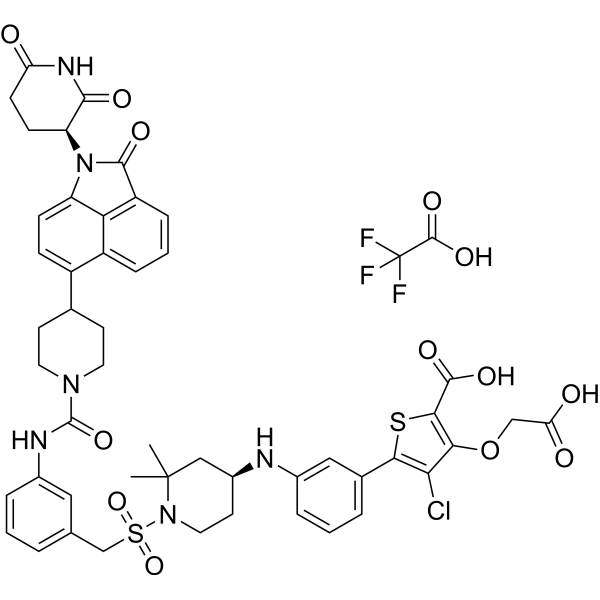 0 ImagesCat. No.: HY-153938ACAS No.: 2912307-39-0
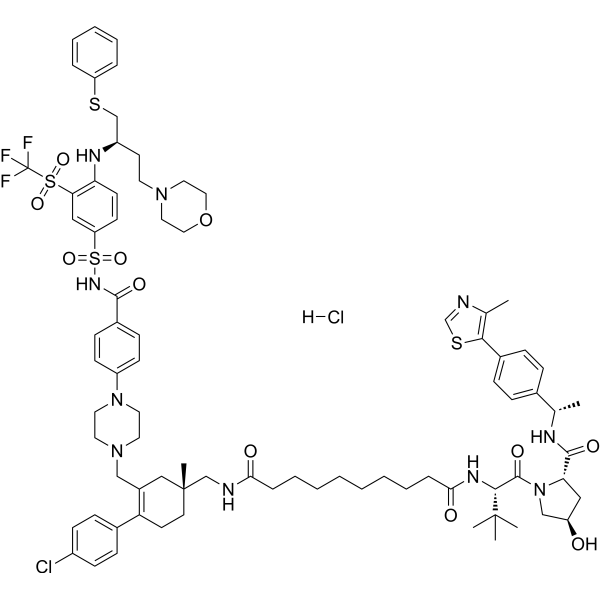
-
PROTAC BRD4 Degrader-41
 0 ImagesCat. No.: HY-179734PROTAC BRD4 Degrader-41 (Compound A5) is a BRD4 PROTAC degrader with a DC50 of 0.97 nM. PROTAC BRD4 Degrader-41 exhibits potent anti-proliferative activity against various types of cancer cells such as AML, lymphoma, breast cancer, ovarian cancer, and non-small cell lung cancer. PROTAC BRD4 Degrader-41 can induce G0/G1 phase arrest and apoptosis in MV4-11 cells. PROTAC BRD4 Degrader-41 downregulates the transcriptional level of c-Myc.
-
Gly-PEG3-BA
 0 ImagesCat. No.: HY-180966CAS No.: 3057939-66-6Gly-PEG3-BA is an EML4-ALK PROTAC degrader. Gly-PEG3-BA effectively reduces EML4-ALK with a DC50 value of 0.50 μM in H3122 (EML4-ALK) cells. Gly-PEG3-BA effectively reduces EGFR mutant (L858R/T790M) levels with a DC50 of 20.15 μM in H1975 (EGER-L858R/T790M) cells. Gly-PEG3-BA exerts potent antiproliferation activity in H3122 (EML4-ALK) and H1975 (EGER-L858R/T790M) cells with IC50s value of 0.84 and 20.74 μM. Gly-PEG3-BA can be used for non-small lung cancer research.
-
PROTAC BRD4 Degrader-35
 0 ImagesCat. No.: HY-177041CAS No.: 2503035-53-6PROTAC BRD4 Degrader-35 (Compound 17) is a PROTAC degrader of BRD4. PROTAC BRD4 Degrader-35 can be studied in anticancer research.
-
KB03-SLF
 0 ImagesCat. No.: HY-147196CAS No.: 2384184-42-1KB03-SLF is a bifunctional PROTAC, formed by conjugating the cysteine-targeting KB03 exploratory fragment with SLF (HY-114872), an FKBP12 ligand that does not support the degradation of FKBP12NLS. KB03-SLF fails to degrade nuclear-localized FKBP12NLS in cells, nor can it mediate the interaction between DCAF16 and FKBP12NLS in a manner similar to KB02-SLF (HY-129610).
-
PROTAC HDAC6 degrader 4
 0 ImagesCat. No.: HY-172359PROTAC HDAC6 degrader 4 (Compound 17c) is the PROTAC degrader for HDAC6 with a DC50 of 14 nM. PROTAC HDAC6 degrader 4 exhibits inhibitory activit against HDAC1, HDAC2, HDAC3 and HDAC6 with IC50s of 2.2, 2.37, 0.61 and 0.295 μM, respectively. (Pink: ligand for target protein HDAC6 ligand-3 (HY-172360); Black: linker (HY-138387); Blue: ligand for cereblon E3 ligase (HY-W093272))
-
P22D
 0 ImagesCat. No.: HY-180979CAS No.: 2635386-51-3P22D is a BCR-ABL PROTAC degrader based on Dasatinib (HY-10181), with a DC50 value of approximately 10 nM for the wild-type BCR-ABL protein. P22D cannot degrade the BCR-ABL T315I mutant. P22D has inhibitory activity against K562 cells (wild type), but is ineffective against BaF3-BCR-ABL (T315I) cells. P22D can be used for research on chronic myeloid leukemia and acute lymphocytic leukemia.
-
PROTAC BRD4 Degrader-39
 0 ImagesCat. No.: HY-175767PROTAC BRD4 Degrader-39 is a selective targeting Bromodomain protein 4 (BRD4) degrader with an DC50 value of 24.66 nM. PROTAC BRD4 Degrader-39 conjugates BRD PROTAC (ARV-771) (HY-100972) with carbohydrate. PROTAC BRD4 Degrader-39 selectively delivers to tumor cells with high GLUT1 expression, followed by GSH-triggered release of ARV-771 and degrades BRD4. PROTAC BRD4 Degrader-39 can inhibit tumor growth and show no significant toxicity. PROTAC BRD4 Degrader-39 can be used for the research of cancer, such as breast cancer.
-
C199
 0 ImagesCat. No.: HY-174445CAS No.: 3107801-96-4C199 is a PROTAC degrader targeting PRMT4 (DC50 = 106 nM). C199 shows high selectivity for PRMT4 over other protein arginile methyltransferases. C199 exhibits strong cell degradation ability. C199 induces apoptosis in MM cell lines. C199 efficiently clears PRMT4 protein via the VHL-proteasome pathway. C199 has a relatively long half-life and shows strong anti-multiple myeloma (MM) tumor activity.
-
PROTAC HDAC6/ERα degrader 1
 0 ImagesCat. No.: HY-187387CAS No.: 3092711-76-4PROTAC HDAC6/ERα degrader 1 is a dual-target PROTAC that targets HDAC6/ERα, with DC50 values of 1.21 μM (HDAC6), 0.28 μM (ERα) in MCF-7 cells and 0.67 μM (HDAC6), 0.14 μM (ERα) in LCC2 cells, respectively. PROTAC HDAC6/ERα degrader 1 selectively degrades ERα and HDAC6 via the proteasomal pathway, inhibits the transcriptional activation of ERα and blocks the estrogen signaling pathway. PROTAC HDAC6/ERα degrader 1 inhibits the function of HDAC6, attenuates hormone responses, and disrupts autophagy-lysosome function. PROTAC HDAC6/ERα degrader 1 induces cell cycle arrest, apoptosis and ferroptosis, and exhibits antiproliferative activity in breast cancer cells. PROTAC HDAC6/ERα degrader 1 can be used for breast cancer research.
-
Dth
 0 ImagesCat. No.: HY-175397Synonyms: DFHBI-thalidomideDth (DFHBI-thalidomide) is an RNA aptamer-based PROTAC degrader. Dth can degrade a variety of endogenous proteins (such as mCherry, p50, p65 and E2F1) by replacing the 3′ module on the RNA scaffold with the RNA aptamer corresponding to the target protein. Dth upregulates IκB-α and Bax, and downregulates Bcl-2 and VEGF. Dth generates green fluorescence upon binding to the Broccoli RNA aptamer, enabling the tracing of RNA scaffolds. Dth can be used in cancer-related research.
-
PROTAC c-Met degrader-5
 0 ImagesCat. No.: HY-175320PROTAC c-Met degrader-5 is an orally active c-Met PROTAC degrader. PROTAC c-Met degrader-5 induces c-Met degradation via Cullin-CRBN, with a DC50 value of 0.32 nM, and inhibits the phosphorylation of c-Met and its downstream signaling molecule STAT3. PROTAC c-Met degrader-5 inhibits cancer cell proliferation, migration and invasion, induces apoptosis, alters cell cycle distribution, and suppresses the growth of EBC-1 xenograft tumors. PROTAC c-Met degrader-5 can be used to study MET-driven cancers as well as Tepotinib (HY-14721)-resistant cancers harboring c-MetD1228N and c-MetY1230H mutations.
-
PROTAC SMARCA2 degrader-6
 0 ImagesCat. No.: HY-159450CAS No.: 2568523-72-6
-
PROTAC 20S proteasome subunit β5 degrader 2
 0 ImagesCat. No.: HY-169135PROTAC 20S proteasome subunit β5 degrader 2 is a PROTAC degrader targeting the 20S proteasome subunit β5, with a DC50 of 0.16 μM. PROTAC 20S proteasome subunit β5 degrader 2 forms a ternary complex with the CRBN E3 ligase, induces ubiquitination of the 20S proteasome subunit β5, and promotes its degradation via the proteasome. PROTAC 20S proteasome subunit β5 degrader 2 exerts antiproliferative effects in cancer cells and exhibits antitumor activity both in vitro and in vivo. It can be used for the research of pharyngeal cancer and drug-resistant multiple myeloma.
-
PROTAC 11β-HSD1 Degrader 1
 0 ImagesCat. No.: HY-179602PROTAC 11β-HSD1 Degrader 1 is a highly efficient PROTAC targeting 11β-HSD1 (Hydroxysteroid 11-beta dehydrogenase 1). PROTAC 11β-HSD1 Degrader 1 demonstrates ubiquitin-proteasome-dependent degradation of 11β-HSD1. PROTAC 11β-HSD1 Degrader 1 can be used for the study of type 2 diabetes mellitus (T2DM).
-
PROTAC sEH degrader-5
 0 ImagesCat. No.: HY-187425CAS No.: 3123230-60-1PROTAC sEH degrader-5 is a highly efficient PROTAC degrader that targets and degrades soluble epoxide hydrolase (sEH) by recruiting cereblon. PROTAC sEH degrader-5 directly inhibits the hydrolase activity of human and mouse sEH, with pIC50 values of 10.36 and 8.41, respectively. PROTAC sEH degrader-5 alleviates LPS (HY-D1056)-induced acute inflammation in vivo. PROTAC sEH degrader-5 can be used in studies related to LPS-induced acute inflammation.
-
LC-MI-3
 0 ImagesCat. No.: HY-162538CAS No.: 3053823-69-8LC-MI-3 is an orally active IRAK4 degrader with an IC50 of 57.2 nM and high selectivity among human protein kinases.LC-MI-3 eliminates IRAK4 kinase and scaffolding functions via the cereblon E3 ubiquitin ligase and ubiquitin-proteasome systems.LC-MI-3 inhibits downstream nuclear factor-κB and IRAK4-mediated inflammatory signaling pathways.LC-MI-3 exerts anti-inflammatory activity in lipopolysaccharide-, Escherichia coli-, TLR4-, and TLR7-induced inflammatory models.LC-MI-3 can be used for the research of acute lung injury, sepsis, psoriasis, and inflammatory diseases.
-
PROTAC TEAD degrader-2
 0 ImagesCat. No.: HY-186021CAS No.: 2918762-17-9PROTAC TEAD degrader-2 (Compound 31) is an efficient TEAD1 PROTAC degrader with a DC50 of 0.6 nM. PROTAC TEAD degrader-2 inhibits the YAP/TAZ-TEAD interaction, with a IC50 of 1.8 nM. PROTAC TEAD degrader-2 exhibits significant selective inhibitory activity against YAP-dependent cancer cells and effectively suppresses the transcriptional activity mediated by YAP. PROTAC TEAD degrader-2 can be used for research on mesothelioma and glioma.
-
PROTAC RIPK2 Degrader-1
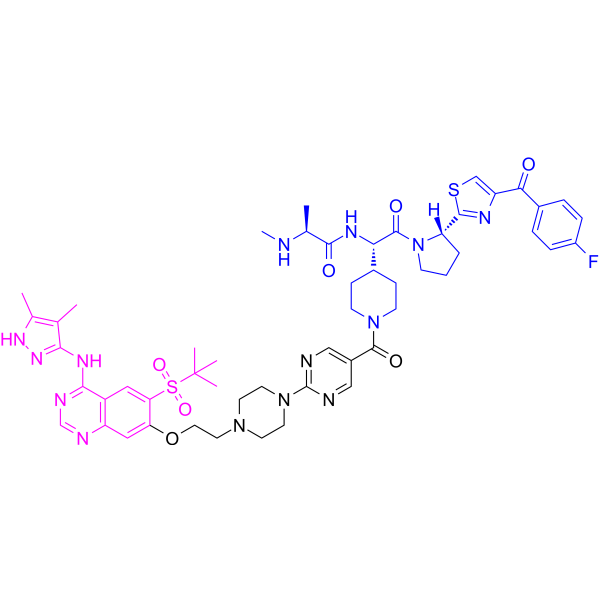 0 ImagesCat. No.: HY-147235CAS No.: 2143956-20-9RIPK2-IN-2 (example 25) is a RIP2 kinase PROTAC inhibitor. RIPK2-IN-2 can block RIP2-dependent proinflammatory signaling, regulated RIP2 kinase activity in auto inflammatory diseases.




