



VEGFR
Vascular endothelial growth factor receptor
VEGFRs consist of three subtypes, the fms-like tyrosine kinase Flt-1 (VEGFR1/Flt-1), the kinase domain region, also referred to as fetal liver kinase (VEGFR2/KDR/Flk-1), and Flt-4 (VEGFR3). Each receptor has seven immunoglobulinlike domains in the extracellular domain, a single transmembrane region, and a consensus tyrosine kinase sequence interrupted by a kinase insert domain. VEGFR1 and 2 are expressed on vascular endothelial cells, whereas VEGFR3 is expressed on lymphatic endothelial. The VEGF family members VEGF-A, -B, -C, -D, -E, and PlGF, and the human immunodeficiency (HIV) Tat protein bind in specific patterns to three related receptor protein tyrosine kinases, VEGFR1, 2, and 3, and induce the formation of homo- and heteromeric receptor complexes. Binding of VEGF to VEGFR causes dimerization and autophosphorylation of the receptor. Intracellular proteins such as VEGFR-associated protein (VRAP), PLC, and Sck that associate with specific tyrosine residues of VEGFR are phosphorylated upon receptor activation. Several signal transduction pathways are activated by the binding of VEGF to its receptor, leading to increased proliferation, survival, permeability, and migration of cells.
VEGFR Isoform Specific Products
All Product Categories
-
VEGFR Inhibitors
(719)
View all products
-
VEGFR Agonists
(7)
View all products
-
VEGFR Antagonists
(6)
View all products
-
VEGFR Activators
(15)
View all products
-
VEGFR Modulators
(6)
View all products
-
VEGFR Chemical
(1)
View all products
-
VEGFR Inducer
(1)
View all products
-
VEGFR Degraders
(4)
View all products
-
VEGFR Ligands
(6)
View all products
-
VEGFR Proteins
(36)
View all products
-
VEGFR-1 Proteins
(10)
View all products
-
VEGFR-3 Proteins
(7)
View all products
-
VEGFR Related Products (811)
Related Products (811)

-
Recombinant Proteins (36)
-
Antibodies (9)
-
VEGFR Isoform Comparison
-
TRK II-IN-1
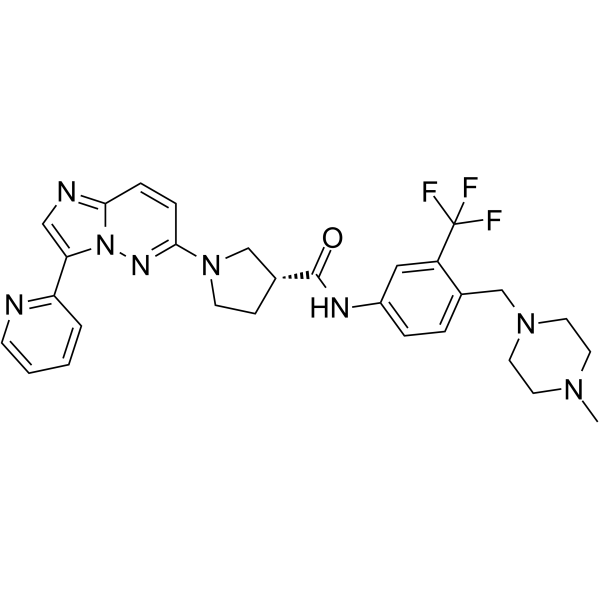 0 ImagesCat. No.: HY-151945CAS No.: 2904690-41-9
-
VEGFR-2-IN-81
 0 ImagesCat. No.: HY-181493VEGFR-2-IN-81 is a thiazole-based isoquinolin-1(2H)-one derivative and an VEGFR-2 inhibitor with IC50 of 1.94 μM. VEGFR-2-IN-81 exhibits significant selective cytotoxicity against colorectal cancer cells (IC50 = 7.75 μM). VEGFR-2-IN-81 exerts anti-colorectal cancer effects by inducing apoptosis, elevating intracellular ROS levels and reducing mitochondrial transmembrane potential. VEGFR-2-IN-81 can be used for the research of colorectal cancer, lung cancer, breast cancer, liver cancer.
-
Angiogenesis inhibitor 6
 0 ImagesCat. No.: HY-161695CAS No.: 2752466-36-5Angiogenesis inhibitor 6 (Compound 8) is a non-tyrosine kinase inhibitor with effective antiangiogenic properties. Angiogenesis inhibitor 6 has antitumor activity.

-
MW02
 0 ImagesCat. No.: HY-P991418MW02 is a human monoclonal antibody (mAb) targeting VEGFA. MW02 can be used in Wet age-related macular degeneration research.
-
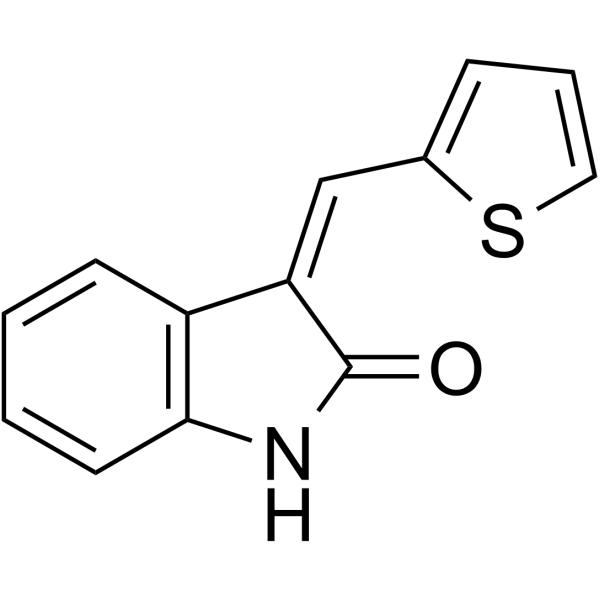
FGFR1/VEGFR2-IN-2
 0 ImagesCat. No.: HY-161995FGFR1/VEGFR2-IN-2 (compound 6l) is a VEGFR2/FGFR1 dual inhibitor. The IC50 values for VEGFR2 and FGFR1 are 0.025 µM and 0.026 µM respectively, and for EGFR and PDGFR-β, the IC50 values are 0.106 µM and 0.077 µM. FGFR1/VEGFR2-IN-2 showes significant anti-cancer activity (GI=60.38%) on NCI-60 cell line, with an IC50 of 8.51 µM in T-47D cell line and anti-migration. FGFR1/VEGFR2-IN-2 acts to arrest cells in the G1 phase and promote apoptosis and necrosis; the IC50 for MCF-7 cell line exceeds 100 µM, and the IC50 for MDA-MB-231 is 69.17 µM, non-toxic to normal cells.
-
CS2009
 0 ImagesCat. No.: HY-P992511CS2009 is a trispecific antibody targeting PD-1, CTLA-4 and VEGFA. CS2009 blocks the interactions of PD-1/PD-L1, CTLA-4/CD80 and VEGFA/VEGFR2, mediates checkpoint inhibition, and suppresses tumor angiogenesis. CS2009 reactivates PD-1/CTLA-4 double-positive tumor-infiltrating T lymphocytes, induces T cell activation, enhances tumor growth inhibition, promotes vascular normalization, improves T lymphocyte infiltration, and converts the immunosuppressive tumor microenvironment into an immunocompetent one. CS2009 can be used for the research of various advanced solid tumors.
-
(Z)-SU14813
 0 ImagesCat. No.: HY-10501BCAS No.: 452105-23-6(Z)-SU14813 is an analog of SU14813 (HY-10501). SU14813 is a multi-targeted receptor tyrosine kinases inhibitor with IC50s of 50, 2, 4, 15 nM for VEGFR2, VEGFR1, PDGFRβ and KIT.
-
Multi-kinase-IN-3
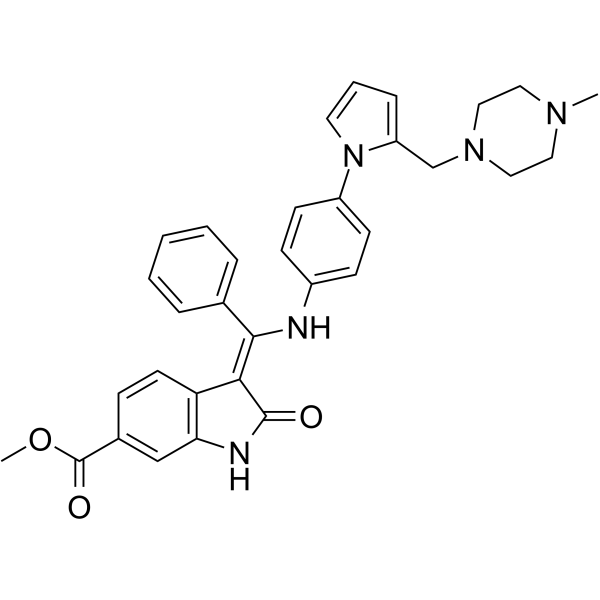 0 ImagesCat. No.: HY-150027CAS No.: 2091950-43-3Multi-kinase-IN-3 (compound 2) is a potent angiokinase inhibitor. Multi-kinase-IN-3 shows inhibition activity against VEGFR-2 and PDGFRβ, with IC50 values of 58.3 and 55 nM, respectively.
-
CA IX/VEGFR-2-IN-3
 0 ImagesCat. No.: HY-170551CA IX/VEGFR-2-IN-3 (Compound 6i) is an inhibitor of Carbonic Anhydrase IX and VEGFR-2, with IC50 values of 41 and 48 nM, respectively. CA IX/VEGFR-2-IN-3 exhibits anticancer activity, inhibiting the growth of MCF-7 breast cancer cells (with an IC50 of 22.33 μM) and mouse fibroblast cell line 3T3 (where cell viability is less than 40% at a concentration of 100 μM). CA IX/VEGFR-2-IN-3 can be used for research in the field of cancer treatment.
-
Peptide HRH
 0 ImagesCat. No.: HY-P11775CAS No.: 1228536-06-8


-
VS 8
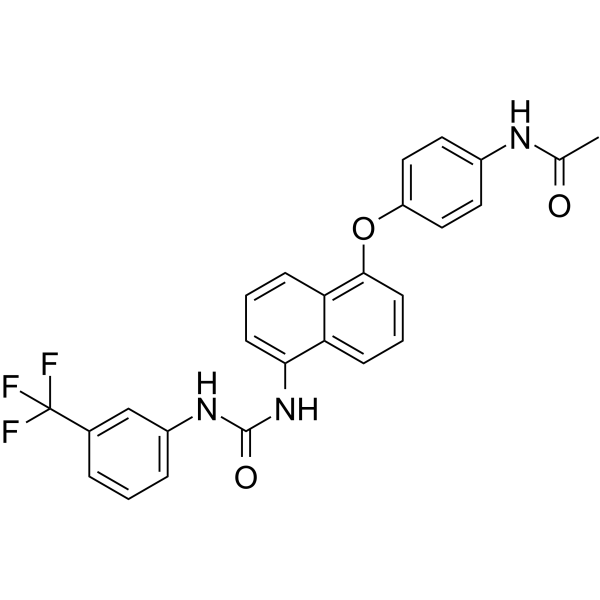 0 ImagesCat. No.: HY-143491CAS No.: 2471865-38-8VS 8 (Compound VS 8) is a potent, orally active VEGFR-2 inhibitor with significant anti-angiogenic effects. VS 8 induces cancer cell apoptosis and migration. VS 8 is active against CSCs (Cancer stem cells).
-
CEP-7055
 0 ImagesCat. No.: HY-13590CAS No.: 402857-58-3CEP-7055 (compound 21) is a novel vascular endothelial growth factor R2 (VEGF-R2) tyrosine kinase inhibitor with potent inhibitory activity. Studies have found that the inhibitor activity can be significantly improved by optimizing the R9 substituent. Compound 21 has potent low nanomolar inhibition of human VEGF-R tyrosine kinase and shows good selectivity against multiple tyrosine and serine/threonine kinases. N,N-dimethylglycine ester 40 was prepared to improve its water solubility and oral bioavailability. In animal pharmacokinetic studies, a significant increase in the plasma level of 21 was observed after oral administration of 40. Compound 21 showed significant in vivo antitumor activity in multiple tumor models and has entered phase I clinical trials as a water-soluble N,N-dimethylglycine ester proagent of 40 (CEP-7055).

-
VEGFR-2-IN-14
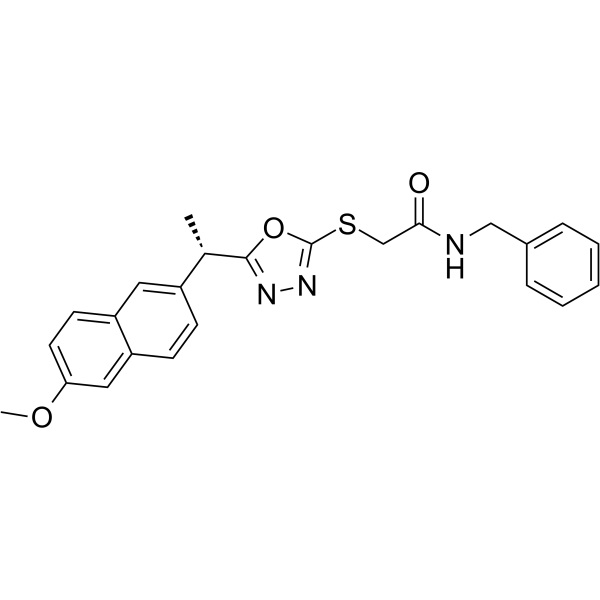 0 ImagesCat. No.: HY-144795CAS No.: 3033032-26-4VEGFR-2-IN-14 (Compound 5) is a potent VEGFR-2 inhibitor. VEGFR-2-IN-14 arrests the HepG2 cell growth at the Pre-G1 phase and induces apoptosis.
-
Monosialoganglioside GM3 (bovine)
 0 ImagesCat. No.: HY-W342441CAS No.: 54827-14-4Monosialoganglioside GM3 (bovine) is a monosialoganglioside and an inhibitor of VEGFR2 and Akt. At a concentration of 20 μM, Monosialoganglioside GM3 inhibits angiogenesis and reduces the proliferation and migration of human umbilical vein endothelial cells (HUVECs) by inhibiting VEGFR2 and Akt phosphorylation. Ganglioside GM3 also inhibits ferroptosis, providing protective effects during the formation of abdominal aortic aneurysms. Additionally, Monosialoganglioside GM3 (bovine) acts as an inhibitor of insulin signaling, inducing the dissociation of the insulin receptor (IR)-Caveolin-1 complex from lipid microdomains and causing insulin resistance in adipocytes. Monosialoganglioside GM3 (bovine) can be used in cancer and metabolic disease research.
-
VX70
 0 ImagesCat. No.: HY-P991625VX70 is a humanized monoclonal antibody inhibitor targeting VEGF-A. VX70 can be used for cancers research.




