



Hck
Hck, a member of the Src family non-receptor tyrosine kinases, functions as a critical regulator of intracellular signaling, modulating protein tyrosine phosphorylation and downstream effector activation[1][2]. Mechanistically, Hck participates in immune cell migration and monocyte chemotaxis through Src-MAPK and ERK1/2 signaling pathways, integrating extracellular adhesion cues into cytoskeletal reorganization[2]. In disease models, Hck activity contributes to inflammatory processes in rheumatoid arthritis and atherosclerosis, and is implicated in malignancies through dysregulated Src family kinase signaling[1][2]. Compared with related isoforms, such as Src and Lyn, Hck exhibits selective expression in hematopoietic lineages and unique responsiveness to chemotactic and adhesion stimuli, enabling differential regulation of monocyte versus general leukocyte signaling[3][2]. Pharmacologically, small-molecule inhibitors targeting Hck’s inactive conformation demonstrate selective suppression of Hck-mediated signaling without affecting closely related kinases, providing tools for dissecting its role in immune and cancer models[1]. These inhibitors exploit structural features of Hck to reduce promiscuity and cytotoxicity, supporting their application in both experimental and potential therapeutic contexts[1]. Collectively, these findings establish Hck as a functionally distinct kinase within the Src family, mediating critical signaling in immunity and disease, and amenable to isoform-specific pharmacological intervention[1][2].
References:
- [1]. Chakraborty MP, et al. Selective targeting of the inactive state of hematopoietic cell kinase (Hck) with a stable curcumin derivative. J Biol Chem. 2021 Jan-Jun;296:100449. [Content Brief]
- [2]. Lalancette C, et al. Bull testicular haploid germ cells express a messenger encoding for a truncated form of the protein tyrosine kinase HCK. Mol Reprod Dev. 2006 Apr;73(4):520-30. [Content Brief]
- [3]. Kumar P, et al. Soluble E-selectin induces monocyte chemotaxis through Src family tyrosine kinases. J Biol Chem. 2001 Jun 15;276(24):21039-45. [Content Brief]
All Product Categories
-
Hck Related Products (10)
Related Products (10)

-
GLPG3312
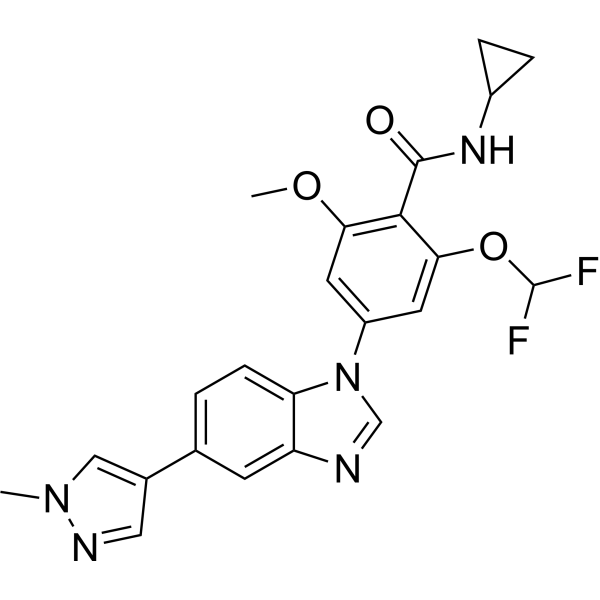 0 ImagesGLPG3312 (Compound 28) is an orally active SIK inhibitor with IC50 values of 2.0 nM, 0.7 nM and 0.6 nM for SIK1, SIK2 and SIK3, respectively. GLPG3312 exhibits anti-inflammatory and immunomodulatory activity in vitro on human primary myeloid cells and in vivo in mouse models. GLPG3312 has good oral bioavailability and can be used for research on inflammatory and immune diseases.

-
DFCI-002-06
 0 ImagesCat. No.: HY-181050CAS No.: 3092208-36-8DFCI-002-06 is an orally active dual-target HCK/BTK PROTAC degrader with DC₅₀ values for HCK and BTK of 1.3 and 4.5 nM respectively. DFCI-002-06 retains higher anti-tumor activity than the HCK/BTK dual-target inhibitor (HY-15805), inducing apoptosis in cancer cells. DFCI-002-06 can be used for the study of MYD88 mutant B-cell malignancies.
-
PP124
 0 ImagesCat. No.: HY-134468CAS No.: 1092788-95-8PP124 is a multi-kinase inhibitor. PP124 inhibits the phosphoinositide 3-kinase (PI3K) catalytic isoforms p110α, p110β, p110δ, and p110γ (IC50 = 4 μM, 7 μM, 0.966 μM, and 1.5 μM), mTOR and DNAPK (IC50 = 0.493 μM and 0.054 μM), as well as the tyrosine kinases Abl, Hck, Src, mutant Src (T/I), VEGFR, EGFR, and EphB4 (IC50 = 0.165 μM, 0.005 μM, 0.017 μM, 0.25 μM, 0.134 μM, 0.085 μM, and 0.17 μM). PP124 can be used for cancer research.
-
Hck-IN-3
 0 ImagesCat. No.: HY-178950CAS No.: 3115216-60-6Hck-IN-3 (compound 2D) is an orally effective inhibitor targeting HCK (KD = 3.92 μM). Hck-IN-3 can inhibit the release of NO. Hck-IN-3 has an IC50 of 6.52 μM in RAW264.7 cells. Hck-IN-3 can inhibit the release of TNF-α, IL-6, and IL-1β in a concentration dependent manner. Hck-IN-3 downregulates the protein expression of NLRP3, ASC, pro-caspase-1, and pro-IL-1β in a concentration dependent manner. Hck-IN-3 can be used for research on acute non traumatic inflammatory conditions.

-
PP162
 0 ImagesCat. No.: HY-134469CAS No.: 1092788-97-0PP162 is a selective DNA-dependent protein kinase (DNA-PK) inhibitor with an IC50 of 53 nM. PP162 selectively inhibits DNA-PK by binding to a conserved hydrophobic pocket. PP162 exhibits weak inhibitory activity against various tyrosine kinases and PI3K family members. PP162 can be used for research on selective kinase targeting.

-
Antifibrotic agent 1
 0 ImagesCat. No.: HY-176194Antifibrotic agent 1 is an orally active anti-idiopathic pulmonary fibrosis (IPF) agent. Antifibrotic agent 1 effectively attenuates IPF-related processes, including TGF-β induced EMT and FMT processes, as well as pro-fibrotic M2 polarization. Antifibrotic agent 1 selectively inhibits CSF-1R, PDGFR-α and Src family kinases (SFKs), while sparing VEGFRs, FGFRs and Abl to minimize off-target toxicity. Antifibrotic agent 1 has potent anti-fibrotic activity in Bleomycin (BLM) (HY-108345)-induced pulmonary fibrosis mice model.
-
SIK1-IN-1
 0 ImagesCat. No.: HY-178014SIK1-IN-1 (Compound 27) is a selective Salt-inducible kinase 1 (SIK1) inhibitor with an IC50 of 0.7 nM for SIK1 over SIK2 and SIK3. SIK1-IN-1 has no cytotoxicity against HEK293 cells and PBMCs (maximum concentration of 30 μM). SIK1-IN-1 also has potent inhibitory activities for 392 kinases, in particular tyrosine kinases, such as FGR, HCK and LYN).



