1. Search Result
Search Result
Results for "

NCI-H1299

" in MedChemExpress (MCE) Product Catalog:

21

Inhibitors & Agonists

2

Peptides

3

Natural
Products

Cat. No. Product Name Target Research Areas Chemical Structure
  • HY-15995
    Tubulysin A
    1 Publications Verification

    TubA

    Antibiotic Microtubule/Tubulin ADC Payload Mitosis Cancer
    Tubulysin A (TubA) is an anticancer and antiangiogenic agent with anti-microtubule, anti-mitosis and anti-proliferative activity against a variety of cancer cells with IC50 values in the pmol range. It can induce apoptosis of cancer cells and has no effect on normal cells. Tubulysins are a group of potent cytotoxins consisting of nine members (A-I). Tubulysin A can synthesize ADC as ADC Cytotoxin .
    Tubulysin A
  • HY-122639
    ZINC05007751
    3 Publications Verification

    NEKs Cancer
    ZINC05007751 is a potent NIMA-related kinase NEK6 inhibitor with an IC50 of 3.4 μM. ZINC05007751 shows antiproliferative activity against a panel of human cancer cell lines, and displays a synergistic effect with Cisplatin and Paclitaxel in a BRCA2 mutated ovarian cancer cell line. ZINC05007751 is very selective against NEK1 and NEK6 with no significant activity was observed against NEK2, NEK7, and NEK9 .
    ZINC05007751
  • HY-N1988
    Cucurbitacin IIa
    1 Publications Verification

    Hemslecin A

    Survivin Apoptosis EGFR Caspase p38 MAPK Autophagy MEK Raf ERK STAT CaMK Inflammation/Immunology Cancer
    Cucurbitacin IIa (Hemslecin A) is an orally active, blood-brain barrier-permeable EGFR inhibitor with an IC50 of 1.455 nM against human EGFR. Cucurbitacin IIa induces caspase-3-dependent apoptosis, downregulates survivin expression, enhances autophagy levels, disrupts the actin cytoskeleton via actin aggregation, arrests the cell cycle at the G2/M phase, and exerts anti-inflammatory activity by inhibiting the EGFR-MAPK signaling pathway. Cucurbitacin IIa can be used in the research of inflammation-related diseases, depression, and cancers such as non-small cell lung cancer .
    Cucurbitacin IIa
  • HY-P5005

    CMV PD-1/PD-L1 Infection Inflammation/Immunology Cancer
    VIPhyb is a vasoactive intestinal polypeptide (VIP) receptor antagonist. VIPhyb can inhibit VIP signaling, increase T-cell immunity and downregulate PD1. VIPhyb can inhibit cancer cell proliferation. VIPhyb can reduce inflammatory cytokine expression. VIPhyb can enhance viral clearance. VIPhyb can be used for the researches of cancer, infection and inflammation and immunology, such as non-small cell lung cancer (NSCLC), cytomegalovirus infection and colitis .
    VIPhyb
  • HY-N2359

    Beta-lactamase PKC Bcl-2 Family Apoptosis Autophagy Metabolic Disease Inflammation/Immunology Cancer
    Chelerythrine is a natural alkaloid, acts as a potent and selective Ca 2+/phospholopid-dependent PKC antagonist, with an IC50 of 0.7 μM . Chelerythrine has antitumor, antidiabetic and anti-inflammatory activity . Chelerythrine inhibits the BclXL-Bak BH3 peptide binding with IC50 of 1.5 μM and displaces Bax from BclXL. Chelerythrine triggers apoptosis and autophagy .
    Chelerythrine
  • HY-153937

    E1/E2/E3 Enzyme Cancer
    Skp2 inhibitor 2 is a Skp2-Cks1 protein-protein interaction inhibitor with a human IC50 of 0.57 μM. Skp2 inhibitor 2 binds to Skp2 at the interaction interface to block Skp2-Cks1 complex formation. Skp2 inhibitor 2 can be used for the research of gastric cancer, non-small cell lung cancer, breast cancer, prostate cancer .
    Skp2 inhibitor 2
  • HY-162645

    TAM Receptor Inflammation/Immunology Cancer
    BPR5K230 is a dual inhibitor for the receptor tyrosine kinase MER and AXL, with IC50 of 4.1 nM and 9.2 nM. BPR5K230 inhibits the proliferation of Ba/F3-MER with IC50 of 5 nM. BPR5K230 exhibits good pharmacokinetic characteristics in mice, exhibits anti-inflammatory and antitumor against 4T1, MDA-MB-231, MC38 and Hepa1?6 in mouse models .
    BPR5K230
  • HY-170995

    PROTACs ROR Apoptosis Cancer
    PROTAC ROR1 degrader-1 is a ROR1 PROTAC degrader with DC50 values of 40.88 nM (NCI-H23), 69.0 nM (NCI-H460), 83.35 nM (NCI-H1299) and 42.07 nM (NCI-H1975), respectively. PROTAC ROR1 degrader-1 inhibits the proliferation of lung cancer cells and induces apoptosis. PROTAC ROR1 degrader-1 can be used in research related to non-small cell lung cancer .
    PROTAC ROR1 degrader-1
  • HY-P10759

    Peptide-Drug Conjugates (PDCs) Aminopeptidase Cancer
    DTS-201 sodium (CPI-0004Na) is a peptidic prodrug of Doxorubicin (HY-15142A). DTS-201, comprising the tetrapeptide portion, is cleaved by endopeptidases in the tumor environment to produce metabolites that subsequently enter the cell and are converted to active Doxorubicin. DTS-201 shows antitumoral efficacy in tumor xenograft models of prostate, breast, and lung cancer .
    DTS-201 sodium
  • HY-N15614

    Others Cancer
    Cassamine is a diterpenoid compound that can be isolated from the bark of Erythrophleum fordii. Cassamine exhibits certain cytotoxicity against non-small cell lung cancer cell lines, with IC50 values of 3.4, 2.1, and 1.9 μM against A549, NCI-H1975, and NCI-H1299, respectively. Cassamine has antitumor activity and can be used in the research of lung cancer and other tumors .
    Cassamine
  • HY-115949

    HSP Cancer
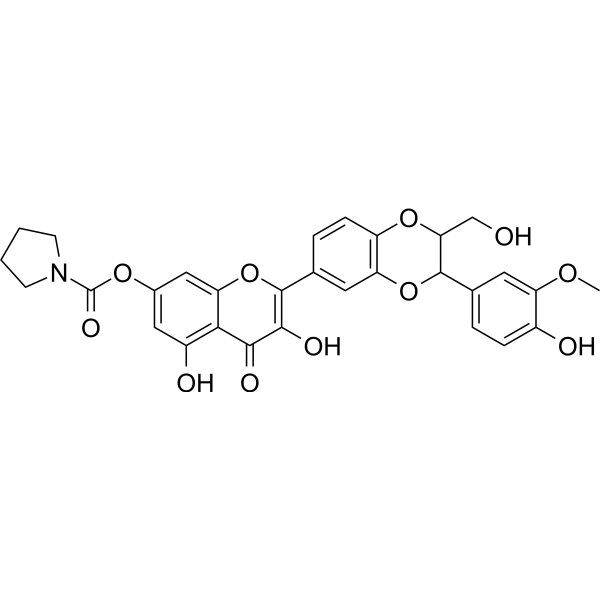
    Antitumor agent-47 (Compound 3e) is a silibinin derivative with an antitumor activity. Antitumor agent-47 shows cytotoxic activity against NCI-H1299 and HT29 cells with IC50 values of 8.07 µM and 6.27 µM, respectively .
    Antitumor agent-47
  • HY-115950

    Drug Derivative Cancer
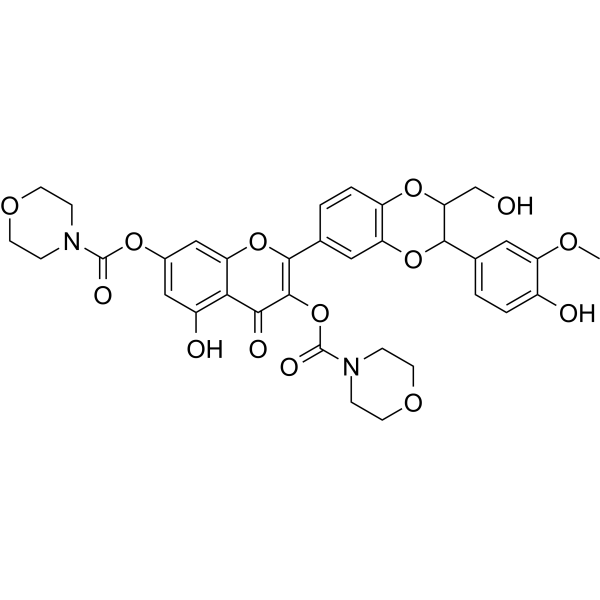
    Antitumor agent-48 (Compound 4a) is a 2,3-dehydrosilybin derivative with an antitumor activity. Antitumor agent-48 shows cytotoxic activity against MCF-7, NCI-H1299, HepG2 and HT29 cells with IC50 values of 8.06 µM, 13.1 µM, 16.51 µM and 12.44 µM, respectively .
    Antitumor agent-48
  • HY-169921

    c-Myc Apoptosis Cancer
    c-Myc inhibitor 15 (Compound A5) is a selective c-Myc inhibitor that exerts anticancer effects by disrupting the interaction between c-Myc and Max, leading to the degradation of c-Myc protein and the induction of apoptosis. Its IC50 values are 4.08 μM and 7.86 μM in A549 and NCI-H1299 lung cancer cell lines, respectively, demonstrating strong cytotoxic activity. In a syngeneic tumor model, c-Myc inhibitor 15 exhibited outstanding antitumor efficacy, achieving a tumor growth inhibition rate of 76.4% and significantly reducing c-Myc protein expression levels. c-Myc inhibitor 15 holds promise for research related to c-Myc-driven lung cancers .
    c-Myc inhibitor 15
  • HY-106035

    YSV

    P-glycoprotein Cancer
    Tyroservatide (YSV) is an active, low-molecular-weight polypeptide that has been shown to have antitumor effects on hepatocellular carcinoma and lung cancer cell .
    Tyroservatide
  • HY-106154

    Peptide-Drug Conjugates (PDCs) Aminopeptidase Cancer
    DTS-201 (CPI-0004) is a peptidic prodrug of Doxorubicin (HY-15142A). DTS-201, comprising the tetrapeptide portion, is cleaved by endopeptidases in the tumor environment to produce metabolites that subsequently enter the cell and are converted to active Doxorubicin. DTS-201 shows antitumoral efficacy in tumor xenograft models of prostate, breast, and lung cancer .
    DTS-201
  • HY-162481

    Apoptosis Cancer
    Anticancer agent 210 (Compound 7a) is a Gefitinib (HY-50895) derivative. Anticancer agent 210 inhibits proliferation, migration and colony formation of cancer cells. Anticancer agent 210 induces apoptosis in cells H1299 .
    Anticancer agent 210
  • HY-183257

    Autophagy Beclin1 Reactive Oxygen Species (ROS) p97 Cancer
    ATI-1 is an autophagy initiation inhibitor. ATI-1 targets valosin-containing protein (VCP/p97, disrupts its interaction with UFL1, impairs UFMylation homeostasis associated with VCP, promotes polyubiquitination and degradation of Beclin1, and blocks the formation of early autophagosomes. ATI-1 induces synergistic death of autophagy-dependent malignant tumor cells under nutrient deprivation conditions, accompanied by decreased mitochondrial membrane potential, reduced ROS levels and lysosomal stress. ATI-1 exhibits anti-tumor efficacy in a pancreatic adenocarcinoma xenograft mouse model. ATI-1 can be used for the research of pancreatic adenocarcinoma and lung cancer .
    ATI-1
  • HY-186118

    Ligands for Target Protein for PROTAC YAP Neurological Disease Cancer
    TEAD ligand 6 is a TEAD ligand. TEAD ligand 6 serves as a ligand for target protein for PROTAC (Ligands for Target Protein for PROTAC) and is used to develop and design PROTAC-based TEAD degraders, such as KG-FP-003 (HY-186117). TEAD ligand 6 applies to glioblastoma research .
    TEAD ligand 6
  • HY-182638

    Phosphodiesterase (PDE) mAChR Potassium Channel Neurological Disease
    CPL500036 is an orally active, blood-brain barrier permeable phosphodiesterase 10A (PDE10A) inhibitor with IC50 values of 1 nM (Reference 1) and 35 nM (Reference 2). CPL500036 acts as a negative allosteric modulator of the M2 muscarinic receptor with an IC50 of 9.2 μM. CPL500036 alters cyclic nucleotide levels in basal ganglia circuits, inhibits the hydrolysis of cAMP and cGMP, and suppresses hERG potassium channel tail currents. CPL500036 induces catalepsy in rats and reverses injury-induced contralateral forelimb use impairment. CPL500036 can be used in research related to schizophrenia, Parkinson's disease, and levodopa-induced dyskinesia .
    CPL500036
  • HY-183635

    Autophagy Cancer
    ELMO2-IN-1 is an ELMO2 inhibitor with a human target Kd of 1.0 µM. ELMO2-IN-1 binds to ELMO2, disrupting its function. ELMO2-IN-1 induces autophagy-dependent cell death. ELMO2-IN-1 can be used for the research of non-small cell lung cancer .
    ELMO2-IN-1
  • HY-181440

    DNA Glycosylase DNA/RNA Synthesis Cancer
    TDG-IN-1 is an orally active, selective small-molecule inhibitor of thymine DNA glycosylase (TDG) with a Ka of 1.46 nM. TDG-IN-1 impairs the DNA-binding ability of TDG, induces downregulated expression of DHX9, accumulation of double-stranded RNA, and activation of the RIG-I/MDA5-MAVS pathway, while acting as a tumor suppressor, innate immune activator and immunostimulant. TDG-IN-1 inhibits the growth of p53-deficient tumor cells and xenograft tumors, and exerts a synthetic lethal effect with p53. TDG-IN-1 is applicable to the research of p53-deficient cancers .
    TDG-IN-1

Inquiry Online

Your information is safe with us. * Required Fields.

Salutation


Country or Region *

Applicant Name *


Organization Name *

Department *


Email Address *


Product Name *

Cat. No.


Requested quantity *

Phone Number *


Remarks

Inquiry Online

Inquiry Information

Product Name:
Cat. No.:
Quantity:
MCE Japan Authorized Agent:

