



Bactenecin
Bactenecin (Bactenecin, bovine) is a potent 12-aa looped antimicrobial peptide isolated from bovine neutrophils. Bactenecin inhibits the growth of bacteria and yeast, and kills the fungus Trichophyton rubrum. Bactenecin increass membrane permeability, inhibits the growth and biofilm formation of B. pseudomallei.
For research use only. We do not sell to patients.
- CAS No.: 116229-36-8
- Formula: C63H118N24O13S2
- Molecular Weight:1483.89
-
Storage:
Please store the product under the recommended conditions in the Certificate of Analysis.

To place orders, for customer services and technical support, please contact: MedChemExpress USA
Tel: 609-228-6898 E-mail: [email protected] [email protected]


-
 Biological Activity
-
Chemical Information
- Protocols
- Purity & Documentation
- References
-
 Help & FAQs


All Antibiotic Isoforms
More

Biological Activity
Description
IC50 & Target
Bacteria; Yeast; Fungus[1]
In Vitro
Bactenecin is synthesized by solid-phase peptide synthesis and renatured to a fully disulfide bonded form. Bactenecin inhibits the growth of Escherichia coli and Staphylococcus aureus at the same concentration reported for the peptide purified from bovine neutrophils. Bactenecin inhibits the growth of other medically important bacteria and yeast, and it kills the fungus Trichophyton rubrum[1].
Bactenecin, a dodecapeptide, is strongly cytotoxic to rat embryonic neurons, fetal rat astrocytes and human glioblastoma cells[2].
Bactenecin exhibits stronger binding to LPS and induces perturbation of the inner membrane of live cells. Interaction of Bactenecin with model membranes results in changes in membrane fluidity and permeability, leading to leakage of dye across the membrane[3].
MedChemExpress (MCE) has not independently confirmed the accuracy of these methods. They are for reference only.


Chemical Information
-
CAS No. 116229-36-8
-
Molecular Weight 1483.89
-
Formula C63H118N24O13S2
-
Synonyms
Bactenecin, bovine
-
Sequence
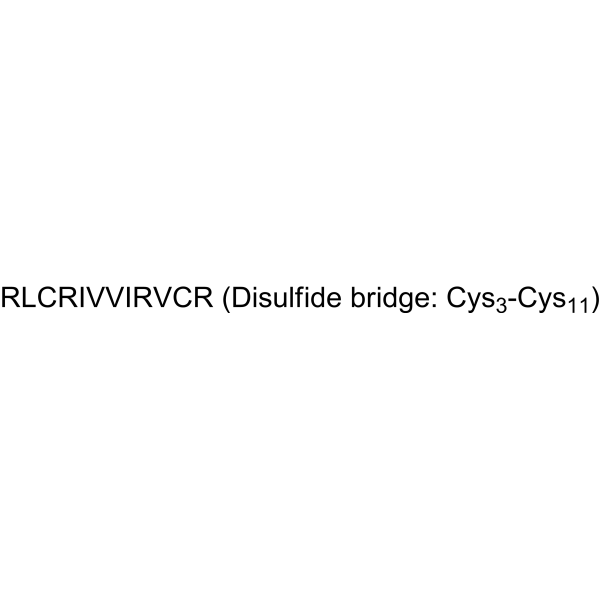
Arg-Leu-Cys-Arg-Ile-Val-Val-Ile-Arg-Val-Cys-Arg (Disulfide bridge: Cys3-Cys11)
-
Sequence Shortening
RLCRIVVIRVCR (Disulfide bridge: Cys3-Cys11)
-
Structure Classification
-
Initial Source
bovine neutrophils
-
Shipping
Room temperature in continental US; may vary elsewhere.
-
Storage
Please store the product under the recommended conditions in the Certificate of Analysis.


Purity & Documentation
References
[1]. Gallis B, et al. Antimicrobial activity of synthetic bactenecin. Biotechnol Ther. 1989-1990;1(4):335-46. [Content Brief]
[2]. Radermacher SW, et al. Bactenecin, a leukocytic antimicrobial peptide, is cytotoxic to neuronal and glial cells. J Neurosci Res. 1993 Dec 15;36(6):657-62. [Content Brief]
[3]. Kanjana Madhongsa, et al. Antimicrobial Action of the Cyclic Peptide Bactenecin on Burkholderia Pseudomallei Correlates With Efficient Membrane Permeabilization. PLoS Negl Trop Dis. 2013 Jun 13;7(6):e2267. [Content Brief]

Calculators
Concentration (start) × Volume (start) = Concentration (final) × Volume (final)


Bactenecin Related Classifications
HY-P1508 Related Classifications
 Powered by Bioz