



Ethynylcytidine
Based on 3 publication(s) in Google Scholar
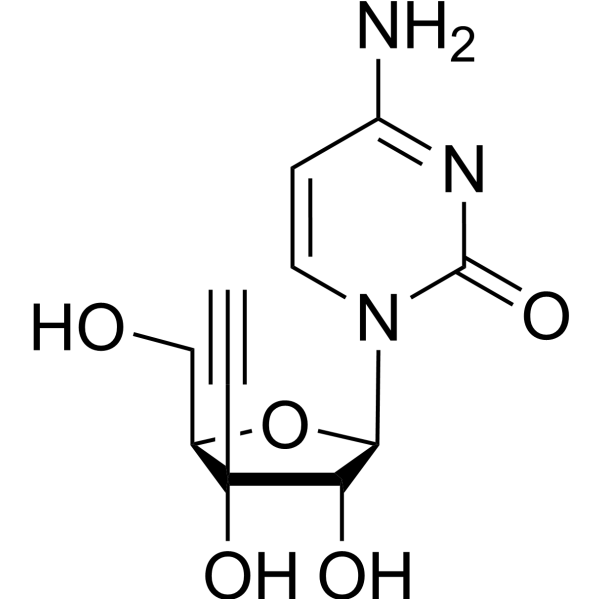
Ethynylcytidine (ECyD), a nucleoside analog and a potent inhibitor of RNA synthesis, inhibits RNA polymerases I, II and II. Ethynylcytidine has robust antitumor activity in a wide range of models of cancer. Ethynylcytidine is a click chemistry reagent, it contains an Alkyne group and can undergo copper-catalyzed azide-alkyne cycloaddition (CuAAc) with molecules containing Azide groups.
For research use only. We do not sell to patients.
- Purity : 99.86%
- CAS No.: 180300-43-0
- Formula: C11H13N3O5
- Molecular Weight:267.24
-
Storage:Powder -20°C, 3 years , 4°C, 2 years ; In solvent -80°C, 2 years , -20°C, 1 year

To place orders, for customer services and technical support, please contact: MedChemExpress USA
Tel: 609-228-6898 E-mail: [email protected] [email protected]


-
 Biological Activity
-
Chemical Information
-
Solvent & Solubility
- Protocols
- Purity & Documentation
- References
-
 Help & FAQs



Publications Citing Use of MedChemExpress (MCE) Ethynylcytidine
MoreAll DNA/RNA Synthesis Isoforms
More

Biological Activity
Description
IC50 & Target
|
RNA Polymerase |
Cellular Effect
|
Cell Line

|
Type | Value | Description | References |
|---|---|---|---|---|
| BHK-21 | CC50 |
>100 μM
Compound: NM 176
|
Cytotoxicity against hamster BHK21 cells assessed as reduction in cell viability after 48 to 96 hrs by MTT assay
Cytotoxicity against hamster BHK21 cells assessed as reduction in cell viability after 48 to 96 hrs by MTT assay
|
[PMID: 19482481] |
| BHK-21 | EC50 |
>100 μM
Compound: NM 176
|
Antiviral activity against Reovirus-1 infected in BHK-21 cells assessed as inhibition of virus-induced cytopathicity after 3 to 4 days by MTT assay
Antiviral activity against Reovirus-1 infected in BHK-21 cells assessed as inhibition of virus-induced cytopathicity after 3 to 4 days by MTT assay
|
[PMID: 19482481] |
| BHK-21 | EC50 |
>100 μM
Compound: NM 176
|
Antiviral activity against Yellow fever virus infected in BHK-21 cells assessed as inhibition of virus-induced cytopathicity after 3 to 4 days by MTT assay
Antiviral activity against Yellow fever virus infected in BHK-21 cells assessed as inhibition of virus-induced cytopathicity after 3 to 4 days by MTT assay
|
[PMID: 19482481] |
| BHK-21 | CC50 |
>100 μM
Compound: NM 176
|
Cytotoxicity against mock-infected BHK21 cells after 48 to 96 hrs by MTT assay
Cytotoxicity against mock-infected BHK21 cells after 48 to 96 hrs by MTT assay
|
[PMID: 25082514] |
| BHK-21 | EC50 |
>100 μM
Compound: NM 176
|
Antiviral activity against Reovirus type-1 infected in BHK21 cells assessed as inhibition of virus-induced cytopathogenicity after 3 to 4 days by MTT assay
Antiviral activity against Reovirus type-1 infected in BHK21 cells assessed as inhibition of virus-induced cytopathogenicity after 3 to 4 days by MTT assay
|
[PMID: 25082514] |
| BHK-21 | EC50 |
>100 μM
Compound: NM 176
|
Antiviral activity against Yellow fever virus infected in BHK21 cells assessed as inhibition of virus-induced cytopathogenicity after 3 to 4 days by MTT assay
Antiviral activity against Yellow fever virus infected in BHK21 cells assessed as inhibition of virus-induced cytopathogenicity after 3 to 4 days by MTT assay
|
[PMID: 25082514] |
| MT4 | CC50 |
≥100 μM
Compound: NM 176
|
Cytotoxicity against human MT4 cells after 96 hrs by MTT assay
Cytotoxicity against human MT4 cells after 96 hrs by MTT assay
|
[PMID: 19482481] |
| MT4 | CC50 |
>100 μM
Compound: NM 176
|
Cytotoxicity against mock-infected human MT4 cells after 96 hrs by MTT assay
Cytotoxicity against mock-infected human MT4 cells after 96 hrs by MTT assay
|
[PMID: 25082514] |
| Vero | CC50 |
>100 μM
Compound: NM 176
|
Cytotoxicity against african green monkey Vero 76 cells by crystal violet staining
Cytotoxicity against african green monkey Vero 76 cells by crystal violet staining
|
[PMID: 19482481] |
| Vero | EC50 |
>100 μM
Compound: NM 176
|
Antiviral activity against HSV1 infected in african green monkey Vero 76 cells assessed as reduction in plaque number after 3 days by plaque reduction assay
Antiviral activity against HSV1 infected in african green monkey Vero 76 cells assessed as reduction in plaque number after 3 days by plaque reduction assay
|
[PMID: 25082514] |
| Vero | EC50 |
>100 μM
Compound: NM 176
|
Antiviral activity against Respiratory syncytial virus infected in african green monkey Vero 76 cells assessed as reduction in plaque number after 5 days by plaque reduction assay
Antiviral activity against Respiratory syncytial virus infected in african green monkey Vero 76 cells assessed as reduction in plaque number after 5 days by plaque reduction assay
|
[PMID: 25082514] |
| Vero | EC50 |
>100 μM
Compound: NM 176
|
Antiviral activity against Vaccinia Virus infected in african green monkey Vero 76 cells assessed as reduction in plaque number after 3 days by plaque reduction assay
Antiviral activity against Vaccinia Virus infected in african green monkey Vero 76 cells assessed as reduction in plaque number after 3 days by plaque reduction assay
|
[PMID: 25082514] |
| Vero | EC50 |
>100 μM
Compound: NM 176
|
Antiviral activity against Vesicular stomatitis virus infected in african green monkey Vero 76 cells assessed as reduction in plaque number after 2 days by plaque reduction assay
Antiviral activity against Vesicular stomatitis virus infected in african green monkey Vero 76 cells assessed as reduction in plaque number after 2 days by plaque reduction assay
|
[PMID: 25082514] |
| Vero | EC50 |
25 μM
Compound: NM 176
|
Antiviral activity against Poliovirus type 1 Sabin strain infected in african green monkey Vero 76 cells assessed as reduction in plaque number after 2 days by plaque reduction assay
Antiviral activity against Poliovirus type 1 Sabin strain infected in african green monkey Vero 76 cells assessed as reduction in plaque number after 2 days by plaque reduction assay
|
[PMID: 25082514] |
| Vero | EC50 |
30 μM
Compound: NM 176
|
Antiviral activity against Coxsackievirus B5 infected in african green monkey Vero 76 cells assessed as reduction in plaque number after 3 days by plaque reduction assay
Antiviral activity against Coxsackievirus B5 infected in african green monkey Vero 76 cells assessed as reduction in plaque number after 3 days by plaque reduction assay
|
[PMID: 25082514] |
| Vero 76 | EC50 |
>100 μM
Compound: NM 176
|
Antiviral activity against HSV1 infected in Vero-76 cells after 3 days by plaque reduction assay
Antiviral activity against HSV1 infected in Vero-76 cells after 3 days by plaque reduction assay
|
[PMID: 19482481] |
| Vero 76 | EC50 |
>100 μM
Compound: NM 176
|
Antiviral activity against Respiratory syncytial virus A2 infected in Vero-76 cells after 5 days by plaque reduction assay
Antiviral activity against Respiratory syncytial virus A2 infected in Vero-76 cells after 5 days by plaque reduction assay
|
[PMID: 19482481] |
| Vero 76 | EC50 |
24 μM
Compound: NM 176
|
Antiviral activity against Coxsackie virus type B2 virus infected in african green monkey Vero-76 cells after 3 days by plaque reduction assay
Antiviral activity against Coxsackie virus type B2 virus infected in african green monkey Vero-76 cells after 3 days by plaque reduction assay
|
[PMID: 19482481] |
| Vero 76 | CC50 |
>100 μM
Compound: NM 176
|
Cytotoxicity against mock-infected african green monkey Vero 76 cells after 48 to 96 hrs by MTT assay
Cytotoxicity against mock-infected african green monkey Vero 76 cells after 48 to 96 hrs by MTT assay
|
[PMID: 25082514] |
In Vitro
The IC50 values of Ethynylcytidine in the five human tumors with 4, 24 and 72 h exposure range from 0.114 to 1.032 μM, 0.015 to 0.067 μM, and 0.008 to 0.058 μM, respectively. These results suggest that the cytotoxicity of Ethynylcytidine tends to become stronger as the exposure time becomes longer. The differences in IC50 values between the 24 and 72 h exposure times are not large, and Ethynylcytidine appeares to show sufficiently potent cytotoxicity at the 24 h exposure time in all 5 human tumors. Even at the 4 h exposure time, Ethynylcytidine clearly shows potent cytotoxicity with IC50 values at submicromolar concentrations in 4 of the 5 human tumors[1].
MedChemExpress (MCE) has not independently confirmed the accuracy of these methods. They are for reference only.
In Vivo
MedChemExpress (MCE) has not independently confirmed the accuracy of these methods. They are for reference only.
Clinical Trial
| NCT Number | Sponsor | Condition | Start Date |
Phase
|
|---|---|---|---|---|
| NCT01329991 | 2011-05 | PHASE1 |


Chemical Information
-
CAS No. 180300-43-0
-
Appearance Solid
-
Molecular Weight 267.24
-
Formula C11H13N3O5
-
Color White to yellow
-
SMILES
OC[C@@H]1[C@](O)(C#C)[C@@H](O)[C@H](N2C(N=C(N)C=C2)=O)O1
-
Synonyms
ECyD; TAS-106; 3'-C-Ethynylcytidine
-
Shipping
Room temperature in continental US; may vary elsewhere.
-
Storage
Powder -20°C 3 years 4°C 2 years In solvent -80°C 2 years -20°C 1 year


Publications (3)
-
Journal Impact Factor
-
Most Recent


Solvent & Solubility
In Vitro:
DMSO : 250 mg/mL (935.49 mM; Need ultrasonic; Hygroscopic DMSO has a significant impact on the solubility of product, please use newly opened DMSO)
Please refer to the solubility information to select the appropriate solvent. Once prepared, please aliquot and store the solution to prevent product inactivation from repeated freeze-thaw cycles.
Storage method and period of stock solution: -80°C, 2 years; -20°C, 1 year. When stored at -80°C, please use it within 2 years. When stored at -20°C, please use it within 1 year.
Please refer to the solubility information to select the appropriate solvent. Once prepared, please aliquot and store the solution to prevent product inactivation from repeated freeze-thaw cycles.
Storage method and period of stock solution: -80°C, 2 years; -20°C, 1 year. When stored at -80°C, please use it within 2 years. When stored at -20°C, please use it within 1 year.
Concentration (start) × Volume (start) = Concentration (final) × Volume (final)
In Vivo:
Select the appropriate dissolution method based on your experimental animal and administration route.
- For the following dissolution methods, please ensure to first prepare a clear stock solution using an In Vitro approach and then sequentially add co-solvents:
- To ensure reliable experimental results, the clarified stock solution can be appropriately stored based on storage conditions. As for the working solution for In Vivo experiments, it is recommended to prepare freshly and use it on the same day.
- The percentages shown for the solvents indicate their volumetric ratio in the final prepared solution. If precipitation or phase separation occurs during preparation, heat and/or sonication can be used to aid dissolution.
Add each solvent one by one: 10% DMSO 40% PEG300 5% Tween-80 45% Saline
Solubility: ≥ 2.08 mg/mL (7.78 mM); Clear solution
This protocol yields a clear solution of ≥ 2.08 mg/mL (saturation unknown).
Taking 1 mL working solution as an example, add 100 μL DMSO stock solution (20.8 mg/mL) to 400 μL PEG300, and mix evenly; then add 50 μL Tween-80 and mix evenly; then add 450 μL Saline to adjust the volume to 1 mL.
Preparation of Saline: Dissolve 0.9 g sodium chloride in ddH₂O and dilute to 100 mL to obtain a clear Saline solution.
Add each solvent one by one: 10% DMSO 90% (20% SBE-β-CD in Saline)
Solubility: ≥ 2.08 mg/mL (7.78 mM); Clear solution
This protocol yields a clear solution of ≥ 2.08 mg/mL (saturation unknown).
Taking 1 mL working solution as an example, add 100 μL DMSO stock solution (20.8 mg/mL) to 900 μL 20% SBE-β-CD in Saline, and mix evenly.
Preparation of 20% SBE-β-CD in Saline (4°C, storage for one week): 2 g SBE-β-CD powder is dissolved in 10 mL Saline, completely dissolve until clear.
In Vivo Dissolution Calculator
Please enter the basic information of animal experiments:
-
-
-
-
Recommended: Prepare an additional quantity of animals to account for potential losses during experiments.
Please enter your animal formula composition:
-
%DMSO +
Recommended: Keep the proportion of DMSO in working solution below 2% if your animal is weak.
-
%+
-
+%Tween-80 + +
-
%Saline +
The co-solvents required include: DMSO, . All of co-solvents are available by MedChemExpress (MCE). , Tween 80. All of co-solvents are available by MedChemExpress (MCE).
Working solution concentration: 0.22 mg/mL
Method for preparing stock solution: mg drug dissolved in μL DMSO. Stock solution concentration: mg/mL.
1. Take μL DMSO stock solution;
2. Add μL .
μL , mix evenly;
3. Then add μL Tween 80, mix evenly;
4. Then add μL
Please ensure that the stock solution in the first step is dissolved to a clear state, and add co-solvents in sequence. You can use ultrasonic heating (ultrasonic cleaner, recommended frequency 20-40 kHz), vortexing, etc. to assist dissolution.


Purity & Documentation
-
Data Sheet (282 KB)
-
SDS (396 KB)
- English - EN (396 KB)
- Français - FR (396 KB)
- Deutsch - DE (396 KB)
- Norwegian - NO (396 KB)
- Español - ES (396 KB)
- Swedish - SV (396 KB)
- Italian - IT (396 KB)
- Korean - KR (396 KB)
- Portuguese - PT (396 KB)
-
Handling Instructions (2659 KB)
References
[1]. Shimamoto Y, et al. Antitumor activity and pharmacokinetics of TAS-106, 1-(3-C-ethynyl-beta-D-ribo-pentofuranosyl)cytosine. Jpn J Cancer Res. 2001 Mar;92(3):343-51. [Content Brief]
[2]. Abdelrahim M, et al. TAS-106: preclinical, clinical and beyond. Oncology. 2013;85(6):356-363. [Content Brief]
[3]. Hammond-Thelin LA, et al. Phase I and pharmacokinetic study of 3'-C-ethynylcytidine (TAS-106), an inhibitor of RNA polymerase I, II and III,in patients with advanced solid malignancies. Invest New Drugs. 2012;30(1):316-326. [Content Brief]


Complete Stock Solution Preparation Table
Please refer to the solubility information to select the appropriate solvent. Once prepared, please aliquot and store the solution to prevent product inactivation from repeated freeze-thaw cycles.
Storage method and period of stock solution: -80°C, 2 years; -20°C, 1 year. When stored at -80°C, please use it within 2 years. When stored at -20°C, please use it within 1 year.
| Optional Solvent | Concentration Solvent Mass | 1 mg | 5 mg | 10 mg | 25 mg |
|---|---|---|---|---|---|
| DMSO | 1 mM | 3.7420 mL | 18.7098 mL | 37.4195 mL | 93.5489 mL |
| 5 mM | 0.7484 mL | 3.7420 mL | 7.4839 mL | 18.7098 mL | |
| 10 mM | 0.3742 mL | 1.8710 mL | 3.7420 mL | 9.3549 mL | |
| 15 mM | 0.2495 mL | 1.2473 mL | 2.4946 mL | 6.2366 mL | |
| 20 mM | 0.1871 mL | 0.9355 mL | 1.8710 mL | 4.6774 mL | |
| 25 mM | 0.1497 mL | 0.7484 mL | 1.4968 mL | 3.7420 mL | |
| 30 mM | 0.1247 mL | 0.6237 mL | 1.2473 mL | 3.1183 mL | |
| 40 mM | 0.0935 mL | 0.4677 mL | 0.9355 mL | 2.3387 mL | |
| 50 mM | 0.0748 mL | 0.3742 mL | 0.7484 mL | 1.8710 mL | |
| 60 mM | 0.0624 mL | 0.3118 mL | 0.6237 mL | 1.5591 mL | |
| 80 mM | 0.0468 mL | 0.2339 mL | 0.4677 mL | 1.1694 mL | |
| 100 mM | 0.0374 mL | 0.1871 mL | 0.3742 mL | 0.9355 mL |


Ethynylcytidine Related Classifications
HY-16200 Related Classifications
 Powered by Bioz