



CXCR
CXC chemokine receptors; C-X-C motif chemokine receptors
CXCRs (CXC chemokine receptors) are integral membrane proteins that specifically bind and respond to cytokines of the CXC chemokine family. They represent one subfamily of chemokine receptors, a large family of G protein-linked receptors that are known as seven transmembrane (7-TM) proteins, since they span thecell membrane seven times. There are currently seven known CXC chemokine receptors in mammals, named CXCR1 through CXCR7. CXCR1 and CXCR2 are closely related receptors that recognize CXC chemokines that possess an E-L-R amino acid motif immediately adjacent to their CXC motif. CXCR3 is expressed predominantly on T lymphocytes. CXCR4 is the receptor for a chemokine known as CXCL12 (or SDF-1) and, as with CCR5, is utilized by HIV-1 to gain entry into target cells. The chemokine receptor CXCR5 is selectively expressed on B cells and is involved in lymphocyte homing and the development of normal lymphoid tissue. CXCR6 was formerly called three different names (STRL33, BONZO, and TYMSTR) before being assigned CXCR6 based on its chromosomal location and its similarity to other chemokine receptors in its gene sequence. CXCR7 was originally called RDC-1 (an orphan receptor) but has since been shown to cause chemotaxis in T lymphocytes in response to CXCL12 (the ligand for CXCR4) prompting the renaming of this molecule as CXCR7.
CXCR Isoform Specific Products
All Product Categories
-
CXCR Inhibitors
(107)
View all products
-
CXCR Agonists
(25)
View all products
-
CXCR Antagonists
(128)
View all products
-
CXCR Activators
(12)
View all products
-
CXCR Modulators
(19)
View all products
-
CXCR Inducer
(1)
View all products
-
CXCR Degrader
(1)
View all products
-
CXCR Controls
(2)
View all products
-
CXCR Ligand
(1)
View all products
-
CXC Chemokines Proteins
(140)
View all products
-
CXC Chemokine Receptor Proteins
(13)
View all products
-
CXCR2 Proteins
(3)
View all products
-
CXCR3 Proteins
(3)
View all products
-
CXCR4 Proteins
(6)
View all products
-
CXCR Related Products (355)
Related Products (355)

-
Recombinant Proteins (153)
-
Antibodies (9)
-
Related Compound Screening Libraries (1)
-
CXCR Isoform Comparison
-
CCX-777 formic
 0 ImagesCat. No.: HY-123813APurity: 98.01%CCX-777 formic is an orthosteric binder and partial agonist of CXCR7/ACKR3. CCX-777 formic induces the recruitment of β-arrestin 2 and affects the rebinding of chemokines to ACKR3. CCX-777 formic functions to stabilize the ACKR3 receptor and promotes the formation of a monodisperse, stable complex of the receptor in DDM/CHS micelles. CCX-777 formic is widely used in cancer-related research.

-
PS372424
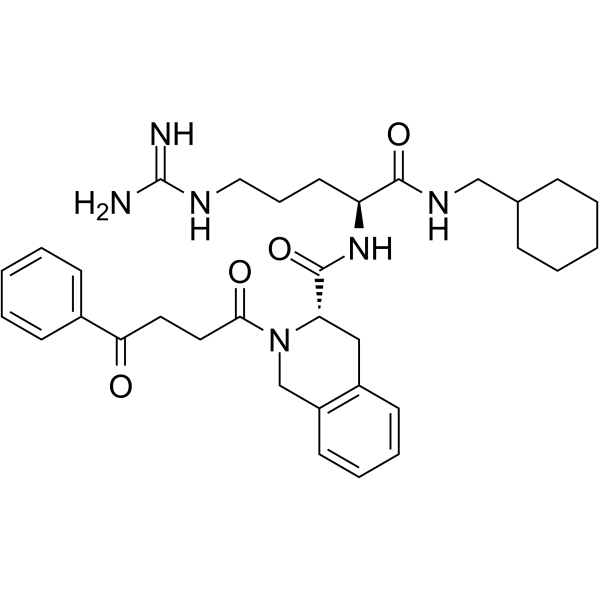 0 ImagesCat. No.: HY-111149CAS No.: 914291-61-5PS372424, a three amino-acid fragment of CXCL10, is a specific human CXCR3 agonist with anti-inflammatory activity. PS372424 prevents human T-cell migration in a humanized model of arthritic inflammation.
-
PF-06835375
 0 ImagesCat. No.: HY-163480CAS No.: 2796997-12-9PF-06835375 is a selective, humanized CXCR5-targeting immunoglobulin G1 antibody. PF-06835375 depletes CXCR5-positive B cells, follicular helper T cells and circulating Tfh-like cells. PF-06835375 is applicable to research related to autoimmune diseases.


-
Nef-M1
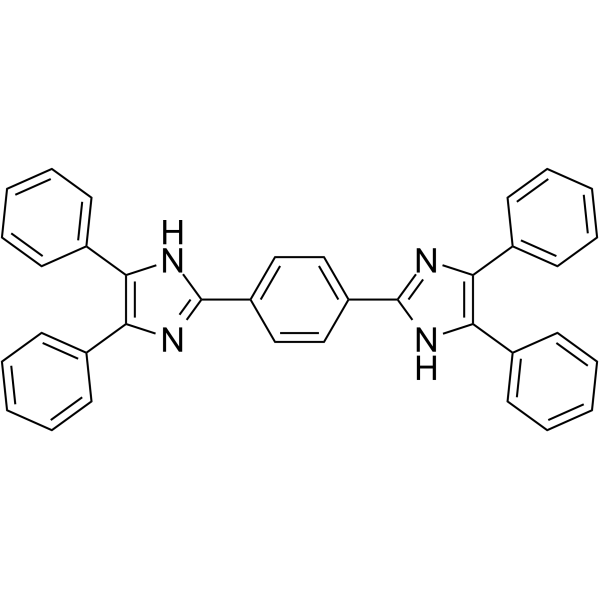
 0 ImagesNef-M1 (Nef-Motif-1) is an antagonist peptide targeting CXCR4 and an apoptosis inducer derived from a myristoylated protein encoded by the nef gene in HIV. Nef-M1 inhibits tumor angiogenesis and epithelial-mesenchymal transition (EMT). Nef-M1 activates the apoptosis pathway by increasing the level of caspase-3 in cancer cells. Nef-M1 simultaneously inhibits VEGF-A, p-GSK-3β and vimentin, and enhances E-cadherin, thereby inhibiting angiogenesis and EMT processes. Nef-M1 can be used in the study of colorectal cancer and breast cancer.

-
FC131
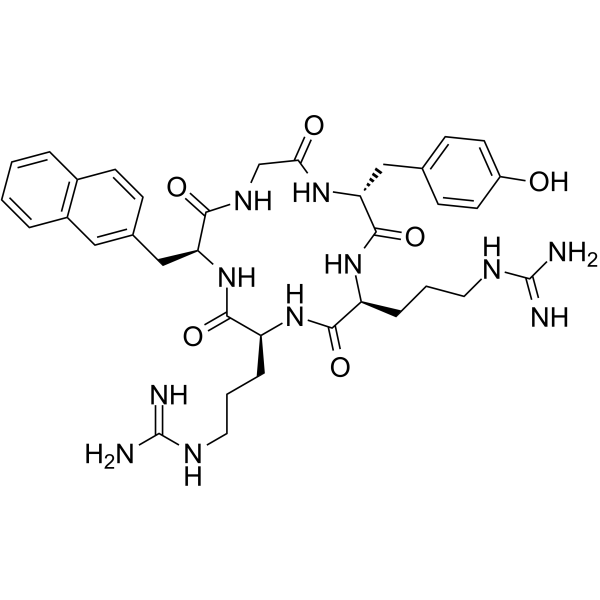 0 ImagesFC131 is a CXCR4 antagonist that inhibits AKT kinase activity in AML OCI-AML3 cells. D-ArgFC131, a derivative of FC131, inhibits the phosphorylation of downstream ERK1/2 and Akt, induces caspase-3 pathway-mediated apoptosis, and causes cell cycle arrest. FC131 exerts cytotoxic effects in cancer cells such as AML cells. FC131 is applicable for cancer-related research.
-
Anti-Mouse CXCR6 Antibody (Cx6Mab-1)
 0 ImagesCat. No.: HY-P991781Purity: 99.32%Anti-Mouse CXCR6 Antibody (Cx6Mab-1) is a monoclonal antibody targeting mouse CXC chemokine receptor 6 (mCXCR6), with a KD of 1.7 nM against CHO/mCXCR6-overexpressing cells. Anti-Mouse CXCR6 Antibody (Cx6Mab-1) binds to the N-terminal domain epitope of mCXCR6 containing Ser8, Ala9, Leu10, Tyr11, Gly13 and His14, and interacts with both overexpressed and endogenous forms of the receptor. Anti-Mouse CXCR6 Antibody (Cx6Mab-1) can be used in studies related to mouse lymphoma.

-
(Rac)-SCH 563705
 0 Images(Rac)-SCH 563705 is a racemic mixture of SCH 563705 (HY-10011). SCH 563705 (compound 16) is a potent and orally active CXCR2 and CXCR1 antagonist with IC50 values of 1.3 nM and 7.3 nM and Ki values of 1 nM and 3 nM, respectively.
-
Anti-Human/Mouse/Monkey CXCR3 Antibody (9C5)
 0 ImagesCat. No.: HY-P992014Purity: 99.33%
-
Anti-CXCL12/SDF1a Antibody
 0 ImagesCat. No.: HY-P990390Purity: ≥99.0%Anti-CXCL12/SDF1a Antibody is a CHO-expressed human antibody that targets CXCL12/SDF1a. The Anti-CXCL12/SDF1a Antibody has a huIgG1 heavy chain and a huκ light chain, with a predicted molecular weight (MW) of 145 kDa. For the isotype control of Anti-CXCL12/SDF1a Antibody, please refer to Human IgG1 kappa, Isotype Control (HY-P99001).
-
Olaptesed pegol sodium scrambled negative control
 0 ImagesCat. No.: HY-160041BOlaptesed pegol sodium scrambled negative control is the sequence scrambled negative control of Olaptesed pegol sodium.
-
HF51116
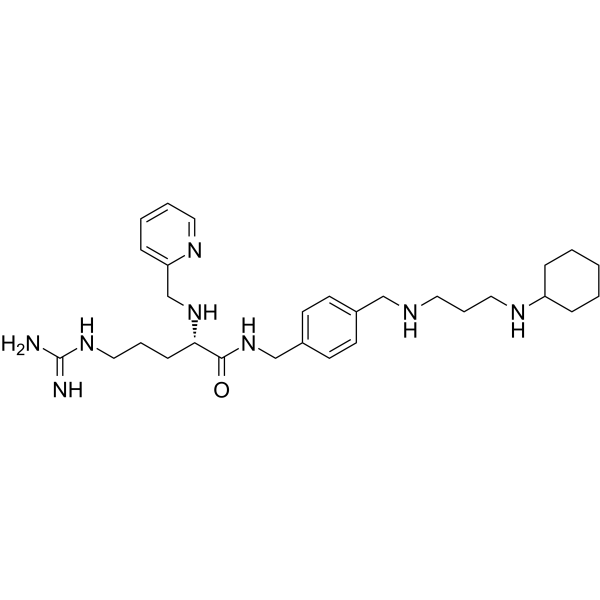 0 ImagesCat. No.: HY-144347CAS No.: 2177311-29-2HF51116 is a potent antagonist of CXCR4. HF51116 strongly antagonizes SDF-1α-induced cell migration, calcium mobilization, and CXCR4 internalization. HF51116 inhibits HIV-1 infection via CXCR4. HF51116 has the potential for the research of HIV-1 infection, hematopoietic stem cell mobilization, and cancer metastasis.
-
Plerixafor-d4
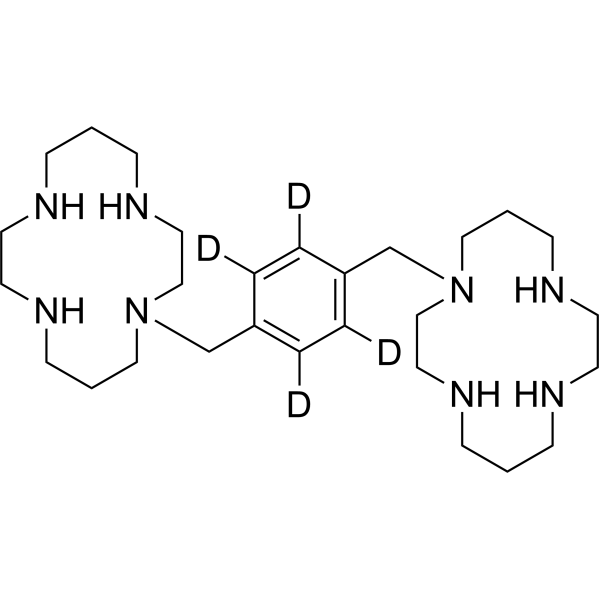 0 ImagesCat. No.: HY-10046SCAS No.: 1246819-87-3Plerixafor-d4 is the deuterium labeled Plerixafor. Plerixafor (AMD 3100) is a selective CXCR4 antagonist with an IC50 of 44 nM. Plerixafor, an immunostimulant and a hematopoietic stem cell (HSC) mobilizer, is an allosteric agonist of CXCR7. Plerixafor inhibits HIV-1 and HIV-2 replication with an EC50 of 1-10 nM.
-
Elubrixin hydrochloride
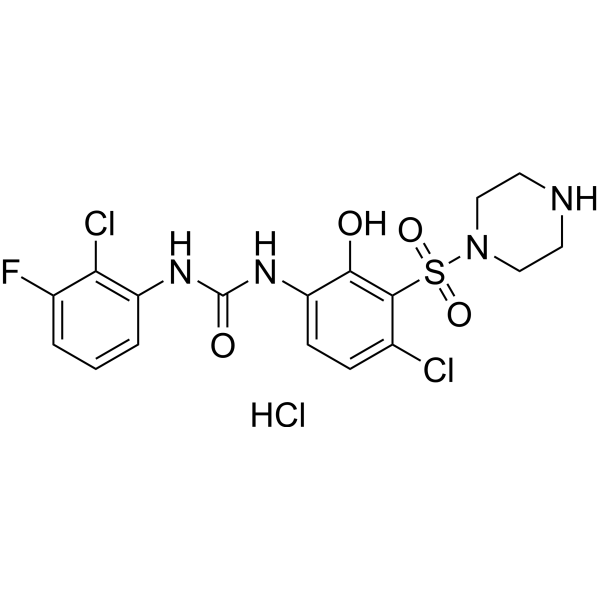 0 ImagesCat. No.: HY-18263CAS No.: 688763-65-7Synonyms: SB-656933 hydrochlorideElubrixin (SB-656933) hydrochloride is a potent, selective, competitive, reversible and orally active CXCR2 antagonist and an IL-8 receptor antagonist. Elubrixin hydrochloride inhibits neutrophil CD11b upregulation (IC50 of 260.7 nM) and shape change (IC50 of 310.5 nM). Elubrixin hydrochloride has the potential for inflammatory diseases research, such as inflammatory bowel disease and airway inflammation.
-
Anti-CXC-ELR Antibody
 0 ImagesCat. No.: HY-P990389Anti-CXC-ELR Antibody is a human-derived antibody expressed in CHO, targeting CXC-ELR. Anti-CXC-ELR Antibody is equipped with huIgG4SP type heavy chain and huκ type light chain, with a predicted molecular weight (MW) of 150 kDa. The isotype control for Anti-CXC-ELR Antibody can be referenced as Human IgG4 kappa, Isotype Control (HY-P99003).




