



mGluR
Metabotropic glutamate receptors
mGluR (metabotropic glutamate receptor) is a type of glutamate receptor that are active through an indirect metabotropic process. They are members of thegroup C family of G-protein-coupled receptors, or GPCRs. Like all glutamate receptors, mGluRs bind with glutamate, an amino acid that functions as an excitatoryneurotransmitter. The mGluRs perform a variety of functions in the central and peripheral nervous systems: mGluRs are involved in learning, memory, anxiety, and the perception of pain. mGluRs are found in pre- and postsynaptic neurons in synapses of the hippocampus, cerebellum, and the cerebral cortex, as well as other parts of the brain and in peripheral tissues. Eight different types of mGluRs, labeled mGluR1 to mGluR8, are divided into groups I, II, and III. Receptor types are grouped based on receptor structure and physiological activity.
mGluR Isoform Specific Products
All Product Categories
-
mGluR Related Products (404)
Related Products (404)

-
Antibodies (8)
-
mGluR Isoform Comparison
-
VU0477886
 0 ImagesCat. No.: HY-115796CAS No.: 1926222-30-1VU0477886 is a metabotropic glutamate receptor subtype 4 (mGlu4) positive allosteric modulator with potent activating activity on mGlu4 (EC50 = 95nM, 89% Glu Max), good pharmacokinetic characteristics (brain: plasma Kp = 1.3), and significant therapeutic efficacy in Parkinson's disease models.
-
ADX88178 TFA
 0 ImagesCat. No.: HY-18654AADX88178 TFA is an orally active, blood-brain barrier-penetrant, selective positive allosteric modulator of mGluR4, with an EC50 of 3.5 nM against hmGluR4. ADX88178 TFA modulates mGlu4 activity, enhances glutamate-mediated receptor activation, and increases the apparent affinity of glutamate for the receptor. ADX88178 TFA reverses haloperidol-induced catalepsy, potentiates the effects of levodopa (L-DOPA) and quinpirole, but fails to alleviate established abnormal involuntary movements, does not exacerbate L-DOPA-induced dyskinesia, and does not affect forelimb akinesia when administered alone. ADX88178 TFA can be used in research related to L-DOPA-induced dyskinesia and Parkinson's disease.
-
PF470
 0 ImagesCat. No.: HY-12629CAS No.: 1539296-45-1Synonyms: PF-06297470PF470 (PF-06297470) is a negative allosteric modulator of metabotropic glutamate receptor 5 (mGluR5) with significant efficacy in Parkinson's disease models, but clinical development was halted due to potential issues found in toxicology studies.
-
VU6052959
 0 ImagesCat. No.: HY-187356Synonyms: BI’7927VU6052959 (BI’7927) is an orally active, blood-brain barrier-penetrant mGlu3 modulator with an EC50 of 36 nM in humans and 16 nM in rats. VU6052959 enhances recognition memory and reverses cognitive impairment in male rats. VU6052959 can be used in the research of schizophrenia.
-
mGluR1 activator-1
 0 ImagesCat. No.: HY-174987mGluR1 activator-1 is a stable Vitamin K (HY-B2172) analogue and a mGluR1 activator that can penetrate the blood-brain barrier. mGluR1 activator-1 exhibits strong transcriptional activation via steroid and xenobiotic receptor as well as retinoic acid receptor. mGluR1 activator-1 induces neuronal differentiation in mouse neural progenitor cells. mGluR1 activator-1 can be used for the study of neurodegenerative disease such as Alzheimer’s.
-
(1S,3R)-ACPD
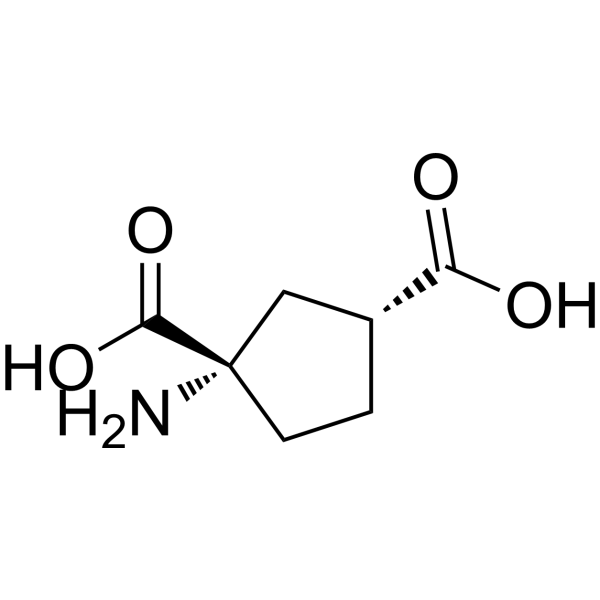 0 ImagesCat. No.: HY-100823CAS No.: 111900-32-4(1S,3R)-ACPD is a mGluR agonist that can depolarize pyramidal cells.
-
mGluR7-IN-1
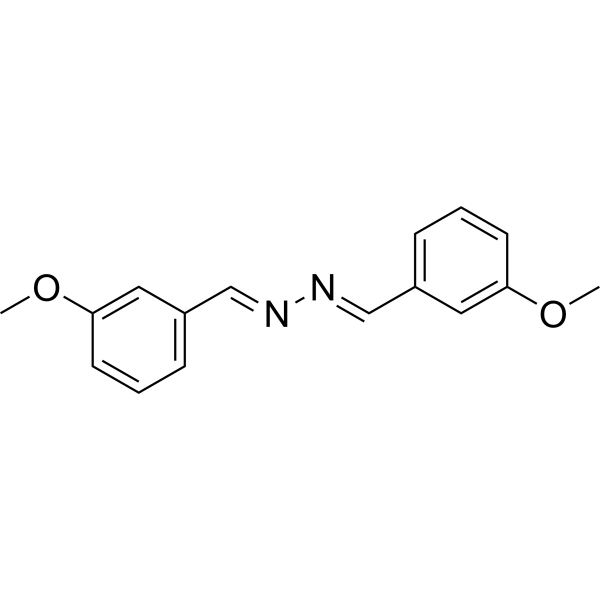
 0 ImagesCat. No.: HY-158376CAS No.: 3037223-47-2mGluR7-IN-1 (compound 2Z) is a mGluR3 inhibitor.
-
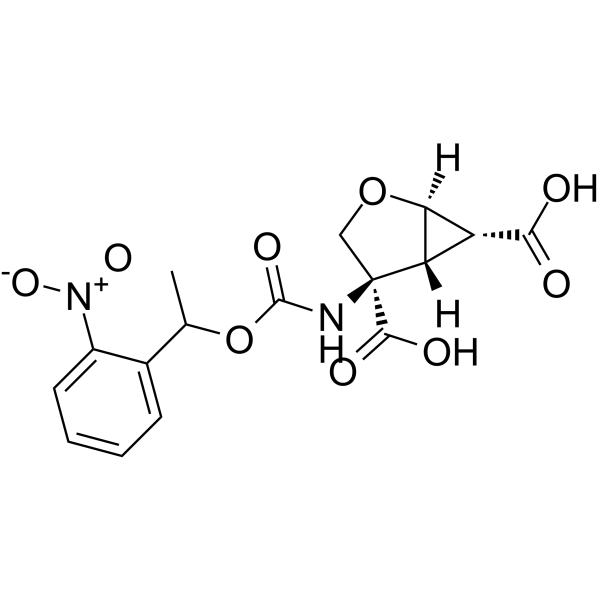
1-Benzyl-APDC
 0 ImagesCat. No.: HY-169835CAS No.: 171336-76-8
-
(Rac)-LY-2300559
 0 ImagesCat. No.: HY-111197ACAS No.: 889115-58-6(Rac)-LY-2300559 is a positive allosteric modulator of metabotropic glutamate receptor 2 (mGlu2) and an antagonist of cysteinyl leukotriene 1 (CysLT1) receptor, with both EC50 and IC50 values less than 12.5 μM. (Rac)-LY-2300559 enhances glutamate-induced mGlu2 receptor signaling while exerting antagonistic activity against the CysLT1 receptor. (Rac)-LY-2300559 can be used in migraine-related research.
-
VU0155041 sodium
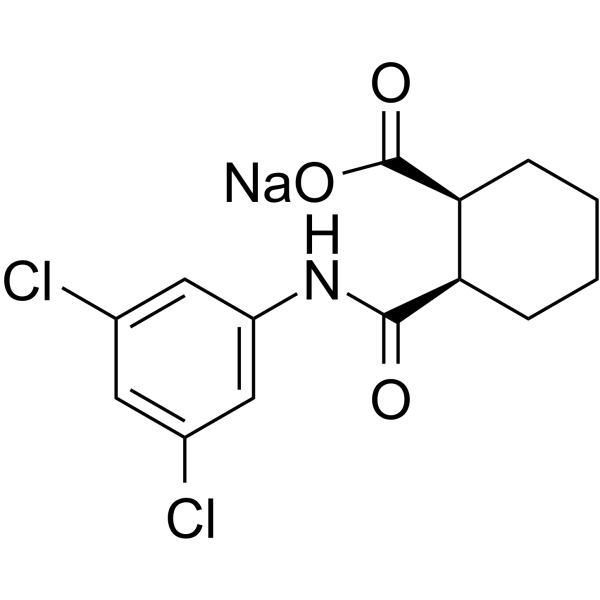 0 ImagesCat. No.: HY-14417BCAS No.: 1259372-69-4VU0155041 sodium is a potent, selective positive allosteric modulator (PAM) of mGluR4, with EC50s of 798 nM and 693 nM for human and rat mGluR4, respectively. VU0155041 has potential for the research of Parkinson's disease (PD).
-
L-Glutamine-5-13C
 0 ImagesCat. No.: HY-W766574CAS No.: 2714331-41-4L-Glutamine-5-13C Hydrochloride is the 13C-labeled L-Glutamine (HY-N0390). L-Glutamine (L-Glutamic acid 5-amide) is a non-essential amino acid present abundantly throughout the body and involved in many metabolic processes. L-Glutamine provides a source of carbons for oxidation in some cells.
-
MGS 0210
 0 ImagesCat. No.: HY-108041CAS No.: 820244-38-0Synonyms: BCI 838MGS 0210 (BCI 838) is an orally active metabolite of glutamate receptor 2/3 (mGluR2/3) agonists. MGS 0210 improves amnesia and reduces anxiety in APP mice. MGS 0210 improves PTSD-related behaviors in a mouse model of post-traumatic stress disorder (PTSD). MGS 0210 can be used in research on neurological disorders such as Alzheimer's disease and major depressive disorder.
-
MPPG
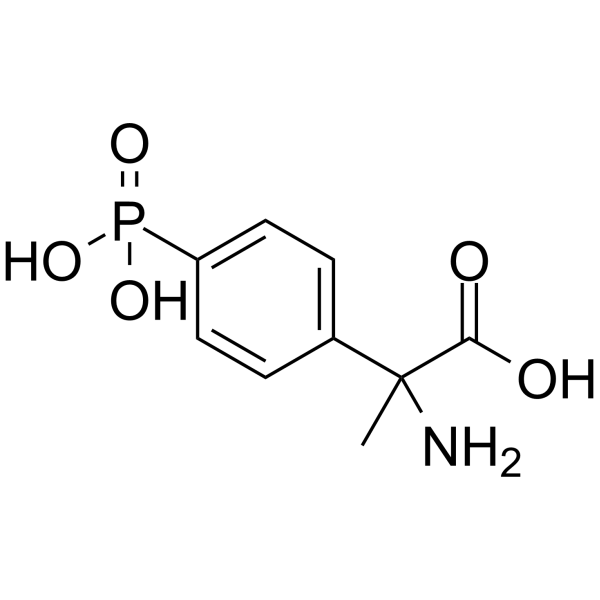 0 ImagesCat. No.: HY-101241CAS No.: 169209-65-8MPPG is a potent and selective L-AP4-sensitive receptor antagonist with an kD value of 9.2 μM, being tested on the neonatal rat spinal cord.
-
(±)-LY395756
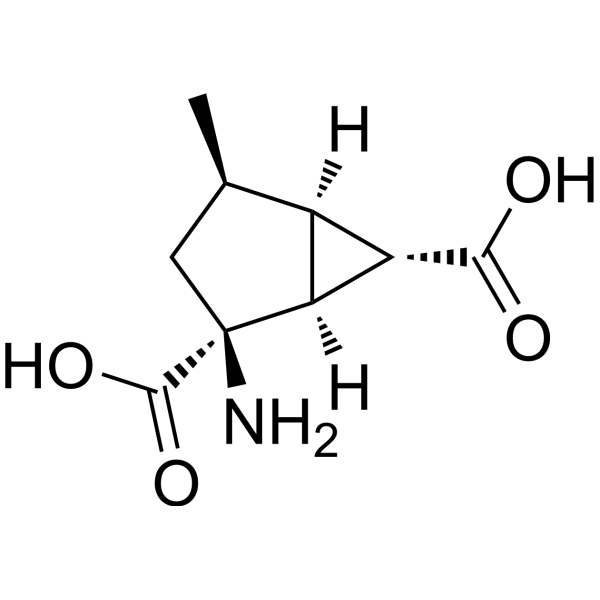 0 ImagesCat. No.: HY-103551CAS No.: 852679-66-4(±)-LY395756 is an agonist of mGlu2 receptor and an antagonist of mGlu3 receptor. (±)-LY395756 can distinguish the native mGlu2 and mGlu3 receptors.
-
(±)-LY395756
0 ImagesCat. No.: HY-103551CAS No.: 852679-66-4(±)-LY395756 is an agonist of mGlu2 receptor and an antagonist of mGlu3 receptor. (±)-LY395756 can distinguish the native mGlu2 and mGlu3 receptors.
-
VU0431316
 0 ImagesCat. No.: HY-12371CAS No.: 1620203-63-5VU0431316 is a potent and selective non-competitive antagonist of mGlu5 with an IC50 value of 24 nM.
-
mGluR2 agonist 1
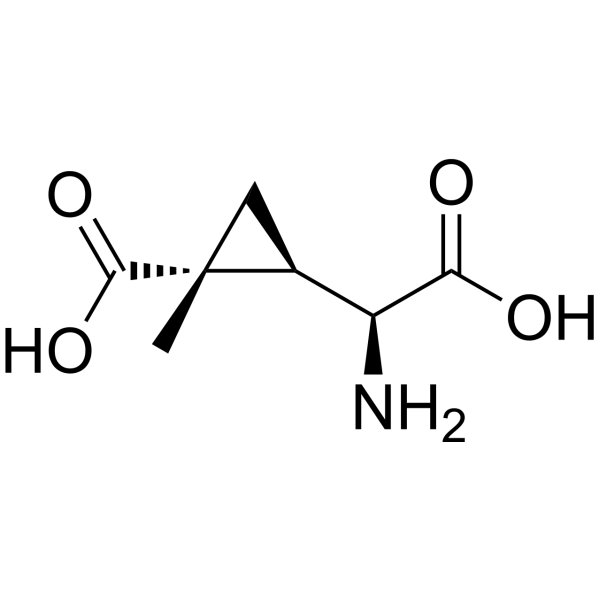 0 ImagesCat. No.: HY-162232CAS No.: 3042819-62-2mGluR2 agonist 1 (Compound 5b) is a potent and selective metabotropic glutamate 2 receptor (mGluR) agonist with an EC50 of 82 nM. mGluR2 agonist 1 can be used for the research of central nervous system (CNS) diseases.
-
JNJ-16567083
 0 ImagesCat. No.: HY-125011CAS No.: 852612-00-1Synonyms: EMQMCM free baseJNJ-16567083 (EMQMCM free base) is a selective, non-competitive metabotropic glutamate receptor 1 (mGluR1) antagonist with a Ki value of 0.87 nM. JNJ-16567083 can be radiolabeled to serve as a PET radiotracer. JNJ-16567083 can be used for research on Parkinson's disease and asthma.




