



mGluR6
Metabotropic glutamate receptor 6 (mGluR6) is a class III G protein-coupled receptor localized at the dendritic tips of retinal ON-bipolar cells, where it mediates glutamate-induced hyperpolarization in response to light increments[1][2]. Mechanistically, mGluR6 activates the Gα_o protein, which regulates the TRPM1 cation channel, producing the depolarizing b-wave of the electroretinogram essential for the ON visual pathway[3][4][5]. Proper postsynaptic localization of TRPM1 depends on mGluR6 and its scaffold protein nyctalopin, while trans-synaptic interactions with presynaptic ELFN1 proteins further stabilize the receptor complex[1][6][7]. In zebrafish, mGluR6 paralogs, mGluR6a and mGluR6b, show differential cone connectivity and spectral responses, highlighting functional divergence across isoforms[8][9]. Disease relevance is exemplified by congenital stationary night blindness, where mutations in either TRPM1 or mGluR6 impair ON-bipolar cell signaling without gross retinal morphology changes[3][10]. In experimental models, optogenetic fusion of melanopsin to mGluR6 intracellular domains (Opto-mGluR6) restores light responses in degenerated retinas, demonstrating its utility for vision restoration studies[11]. Pharmacologically, selective mGluR6 agonists such as L-AP4 enhance TRPM1-mediated Ca2+ influx in melanocytes, whereas inhibitors like voriconazole block ON-bipolar cell responses by targeting TRPM1 downstream of mGluR6[5][12]. Compared with related group III mGluRs, mGluR6 uniquely mediates direct photoreceptor-to-ON-bipolar cell transmission, a critical feature distinguishing it from mGluR7 and mGluR8[13][7].
References:
- [1]. Haug M, et al. Differential Localization and Functional Roles of mGluR6 Paralogs in Zebrafish Retina. Invest Ophthalmol Vis Sci. 2024 Oct 1;65(12):44. [Content Brief]
- [2]. Tsukamoto Y, et al. A novel connection between rods and ON cone bipolar cells revealed by ectopic metabotropic glutamate receptor 7 (mGluR7) in mGluR6-deficient mouse retinas. J Neurosci. 2007 Jun 6;27(23):6261-7. [Content Brief]
- [3]. Morgans CW, et al. TRPM1: the endpoint of the mGluR6 signal transduction cascade in retinal ON-bipolar cells. Bioessays. 2010 Jul;32(7):609-14. [Content Brief]
- [4]. Agosto MA, et al. The mGluR6 ligand-binding domain, but not the C-terminal domain, is required for synaptic localization in retinal ON-bipolar cells. J Biol Chem. 2021 Dec;297(6):101418. [Content Brief]
- [5]. Koike C, et al. TRPM1 is a component of the retinal ON bipolar cell transduction channel in the mGluR6 cascade. Proc Natl Acad Sci U S A. 2010 Jan 5;107(1):332-7. [Content Brief]
- [6]. Huang YY, et al. Novel expression patterns of metabotropic glutamate receptor 6 in the zebrafish nervous system. PLoS One. 2012;7(4):e35256. [Content Brief]
- [7]. Nawy S. Regulation of the on bipolar cell mGluR6 pathway by Ca2+. J Neurosci. 2000 Jun 15;20(12):4471-9. doi: 10.1523/JNEUROSCI.20-12-04471.2000. PMID: 10844016; PMCID: PMC6772459. et al. Regulation of the on bipolar cell mGluR6 pathway by Ca2+. J Neurosci. 2000 Jun 15;20(12):4471-9. [Content Brief]
- [8]. Matsunaga H, et al. Trans-Synaptic Regulation of Metabotropic Glutamate Receptors by Elfn Proteins in Health and Disease. Front Neural Circuits. 2021 Mar 15;15:634875. [Content Brief]
- [9]. Devi S, et al. Metabotropic glutamate receptor 6 signaling enhances TRPM1 calcium channel function and increases melanin content in human melanocytes. Pigment Cell Melanoma Res. 2013 May;26(3):348-56. [Content Brief]
- [10]. Cao Y, et al. TRPM1 forms complexes with nyctalopin in vivo and accumulates in postsynaptic compartment of ON-bipolar neurons in mGluR6-dependent manner. J Neurosci. 2011 Aug 10;31(32):11521-6. [Content Brief]
- [11]. Kralik J, et al. Functional Availability of ON-Bipolar Cells in the Degenerated Retina: Timing and Longevity of an Optogenetic Gene Therapy. Int J Mol Sci. 2021 Oct 26;22(21):11515. [Content Brief]
- [12]. Horie S, et al. A mechanism for pathological oscillations in mouse retinal ganglion cells in a model of night blindness. J Gen Physiol. 2025 Nov 3;157(6):e202413749. [Content Brief]
- [13]. Xiong WH, et al. Voriconazole, an antifungal triazol that causes visual side effects, is an inhibitor of TRPM1 and TRPM3 channels. Invest Ophthalmol Vis Sci. 2015 Feb 3;56(2):1367-73. [Content Brief]
All Product Categories
-
mGluR6 Related Products (12)
Related Products (12)

- 1
-
L-AP4
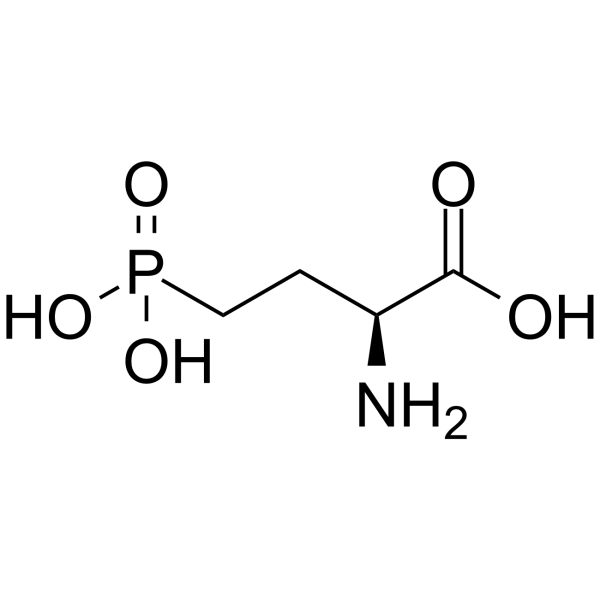 0 ImagesSynonyms: L-APBL-AP4 (L-APB) is a potent and specific agonist for the group III mGluRs, with EC50s of 0.13, 0.29, 1.0, 249 μM for mGlu4, mGlu8, mGlu6 and mGlu7 receptors, respectively.
-
DCG-IV
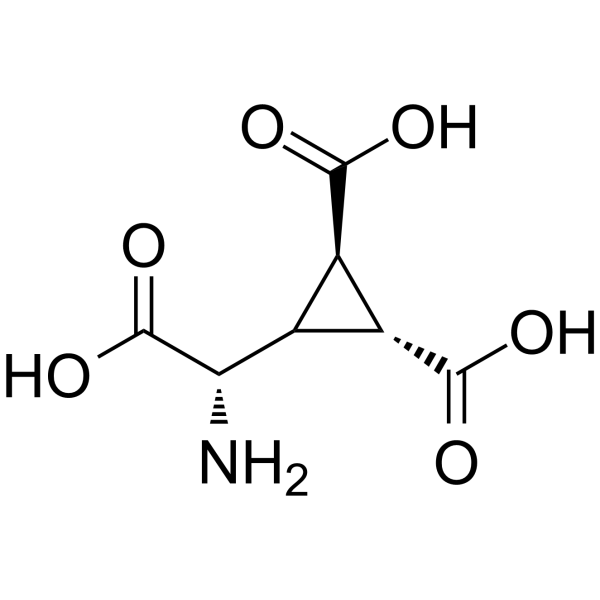 0 ImagesDCG-IV is a potent agonist of group II mGluRs with EC50s of 0.35 and 0.09 μM for mGlu2R and mGlu3R, reapectively. DCG-IV is also a competitive antagonist at group I (IC50: mGlu1R/5R=389/630 μM) and III receptors (IC50: mGlu4R/6R/7R/8R= 22.5/39.6/40.1/32 μM). DCG-IV has anticonvulsive and neuroprotective effects.
-
VU0364770
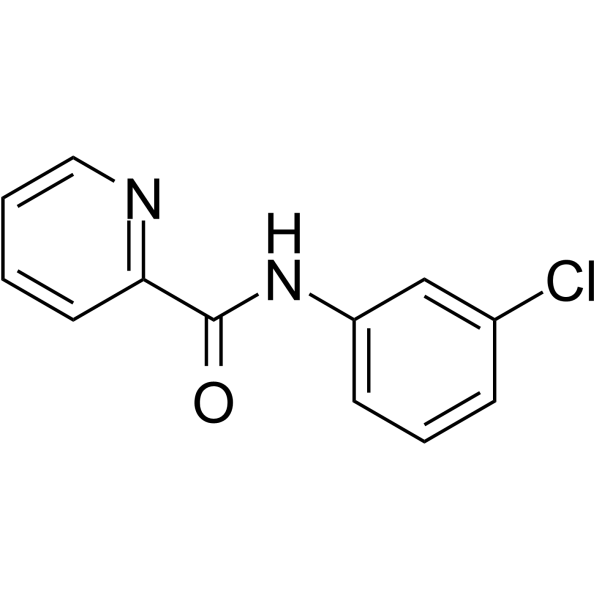 0 ImagesVU0364770 is a selective and potent positive allosteric modulator (PAM) of mGlu4. VU0346770 exhibits EC50s of 290 nM and 1.1 μM at rat mGlu4 and human mGlu4 receptor, respectively. VU0364770 exhibits antagonist activity at mGlu5 with a potency of 17.9 μM and PAM activity at mGlu6 with a potency of 6.8 μM. VU0364770 also possesses activity at MAO with Ki values of 8.5 and 0.72 μM for human MAO-A and human MAO-B, respectively.
-
L-AP4 monohydrate
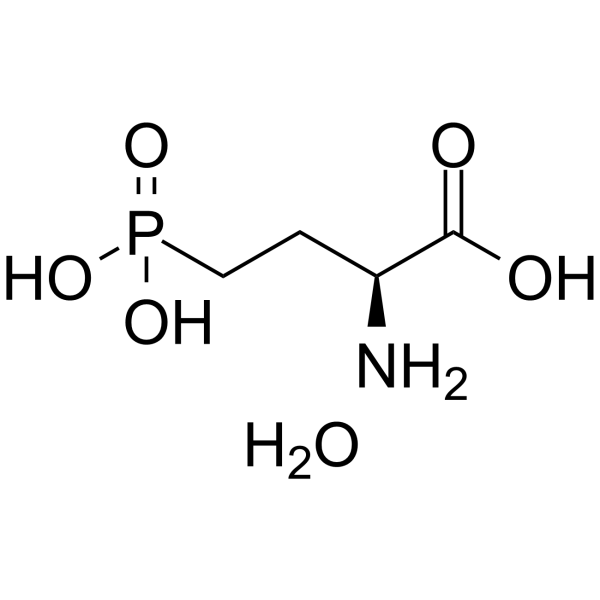 0 ImagesSynonyms: L-APB monohydrateL-AP4 (L-APB) monohydrate is a potent and specific agonist for the group III mGluRs, with EC50s of 0.13, 0.29, 1.0, 249 μM for mGlu4, mGlu8, mGlu6 and mGlu7 receptors, respectively.
-
VU0364770 hydrochloride
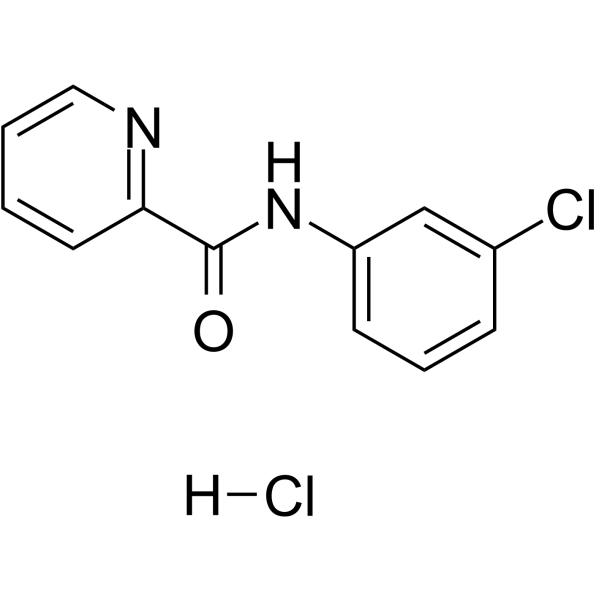 0 ImagesVU0364770 hydrochloride is a selective and potent positive allosteric modulator (PAM) of mGlu4. VU0346770 hydrochloride exhibits EC50s of 290 nM and 1.1 μM at rat mGlu4 and human mGlu4 receptor, respectively. VU0364770 hydrochloride exhibits antagonist activity at mGlu5 with a potency of 17.9 μM and PAM activity at mGlu6 with a potency of 6.8 μM. VU0364770 hydrochloride also possesses activity at MAO with Ki values of 8.5 and 0.72 μM for human MAO-A and human MAO-B, respectively.
-
LBG30300
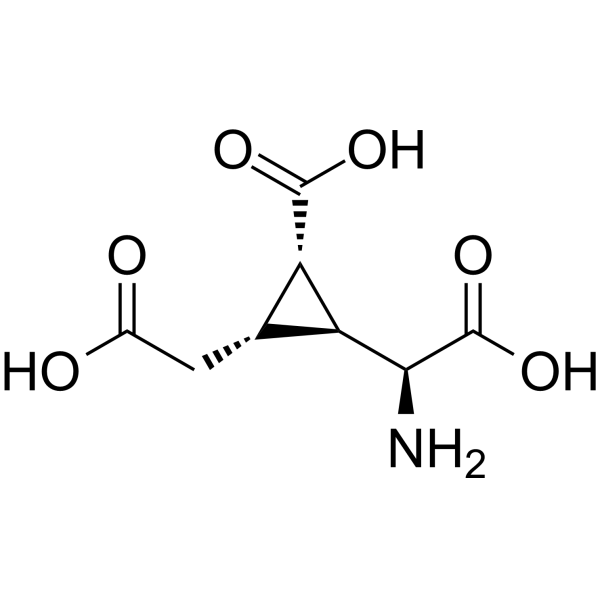 0 ImagesCat. No.: HY-162117CAS No.: 3086973-64-7LBG30300 is a subtype-selective mGlu2 receptor agonist EC50 0.6 nM. LBG30300 is blood-brain barrier permeable.
-
1-Benzyl-APDC
 0 ImagesCat. No.: HY-169835CAS No.: 171336-76-8
-
Homo-AMPA
 0 ImagesCat. No.: HY-189015CAS No.: 179169-88-1Homo-AMPA is a stereospecific mGluR6 agonist (EC50 = 58 μM) and a weak NMDA (HY-17551) receptor antagonist (IC50 = 131 μM), exerting anxiolytic-like effects and modulating pain-responsive neuronal activity through selective activation of mGluR6. Homo-AMPA can serve as a standard agonist for the pharmacological characterization of mGluR6 in related studies.
- 1



