1. Search Result
Search Result
Results for "

soybean lipoxygenase

" in MedChemExpress (MCE) Product Catalog:

12

Inhibitors & Agonists

6

Natural
Products

Targets Recommended:
Cat. No. Product Name Target Research Areas Chemical Structure
  • HY-N2392
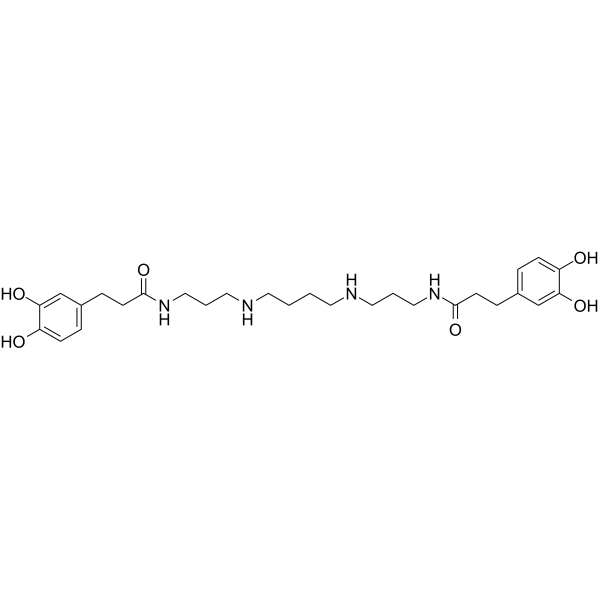
    Kukoamine A
    1 Publications Verification

    Parasite Lipoxygenase Opioid Receptor Apoptosis Autophagy Reactive Oxygen Species (ROS) Interleukin Related TNF Receptor PGE synthase COX Infection Neurological Disease Metabolic Disease Inflammation/Immunology Cancer
    Kukoamine A, a spermine alkaloid, is an orally active and brain-penetrant component found in the root barks of Lycium chinense (L. chinense) Miller. Kukoamine A inhibits purified Crithidia fasciculata trypanothione reductase and soybean lipoxygenase, activates μ-opioid receptor. Kukoamine A can inhibt cancer cell proliferation, migration and invasion, cause G0/G1 phase cell cycle arrest and induce apoptosis. Kukoamine A exerts neuroprotective effect and can induce autophagy . Kukoamine A inhibits LPS (HY-D1056)-induced NO, ROS, PGE2, TNF-α, IL-1β, IL-6 production and COX-2 activity. Kukoamine A reverses palmitic acid-induced insulin resistance, lipid accumulation, and oxidative stress via downregulation of Srebp-1c. Kukoamine A can be used for the research of cancer, infection, inflammation, metabolic and neurological disease, such as glioblastoma and Parkinson's disease .
    Kukoamine A
  • HY-N1881
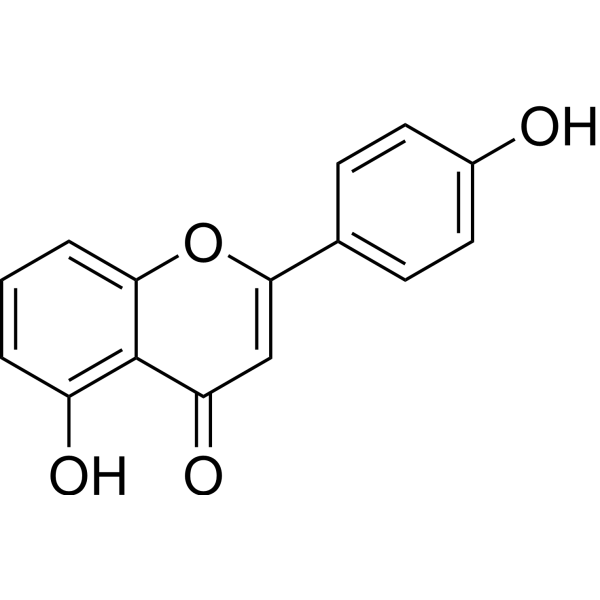
    4',5-Dihydroxyflavone
    3 Publications Verification

    Lipoxygenase Glycosidase Inflammation/Immunology
    4',5-Dihydroxyflavone (Compound 2c; Compound B3) is a type of flavonoid compound. 4',5-Dihydroxyflavone can inhibit various oxidases and its IC50 values for collagenase A (ColA) and α-glucosidase are less than 1 μM and 66 μM respectively; for soybean lipoxygenase-1 (LOX-1), its Ki value is 102.6 μM. 4',5-Dihydroxyflavone can be used in studies on anti-toxicity and anti-diabetes .
    4',5-Dihydroxyflavone
  • HY-N7012
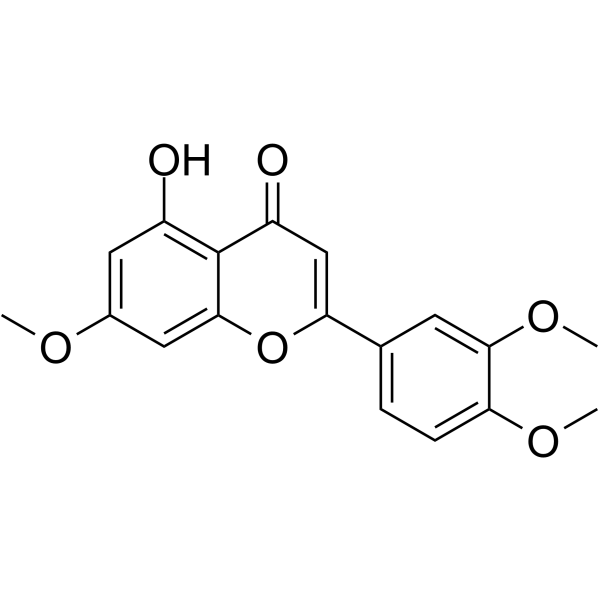
    7,3',4'-Tri-O-methylluteolin
    1 Publications Verification

    5-Hydroxy-3',4',7-trimethoxyflavone

    Lipoxygenase TNF Receptor Interleukin Related COX Fungal Parasite Apoptosis Infection Inflammation/Immunology Cancer
    7,3',4'-Tri-O-methylluteolin (5-Hydroxy-3',4',7-trimethoxyflavone) is a flavonoid with multiple biological activities. 7,3',4'-Tri-O-methylluteolin inhibits soybean lipoxygenase (LOX), with an IC50 value of 23.97 µg/mL. 7,3',4'-Tri-O-methylluteolin possesses anti-inflammatory effects in Lipopolysaccharides (HY-D1056) (LPS)-induced RAW 264.7 macrophages. 7,3',4'-Tri-O-methylluteolin inhibits the binding of MDM2 with p53 and induces apoptosis in MCF-7 breast cancer cells. 7,3',4'-Tri-O-methylluteolin also has antioxidant, antifungal and antitrypanosomal activities sup>[4]sup>[5].
    7,3',4'-Tri-O-methylluteolin
  • HY-118480

    Lipoxygenase Apoptosis Cancer
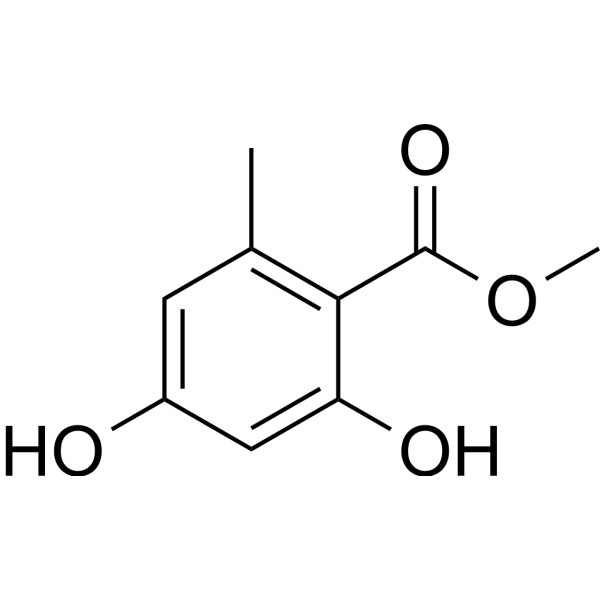
    4-MMPB is a selective inhibitor of 15-lipoxygenase, with an IC50 of 18 μM. 4-MMPB has IC50s of 19.5 μM and 19.1 μM for soybean 15-lipoxygenase (SLO) and human 15-lipoxygenase-1 (15-LOX-1), respectively. 4-MMPB has potential for the research of prostate cancer .
    4-MMPB
  • HY-138148

    Lipoxygenase Inflammation/Immunology
    13(S)-HpOTrE(γ) is a monohydroxy PUFA produced by the action of soybean lipoxygenase-1 (LO-1) on γ-linolenic acid. Further action of soybean LO-1 converts 13(S)-HpOTrE(γ) to all four isomers of 6,13-DiHOTrE.2 At concentrations greater than 100 μM, 13(S)-HpOTrE(γ) inhibits the activity of soybean LO-1.
    13(S)-HPOTrE(γ)
  • HY-116866

    Lipoxygenase Fungal Infection Inflammation/Immunology
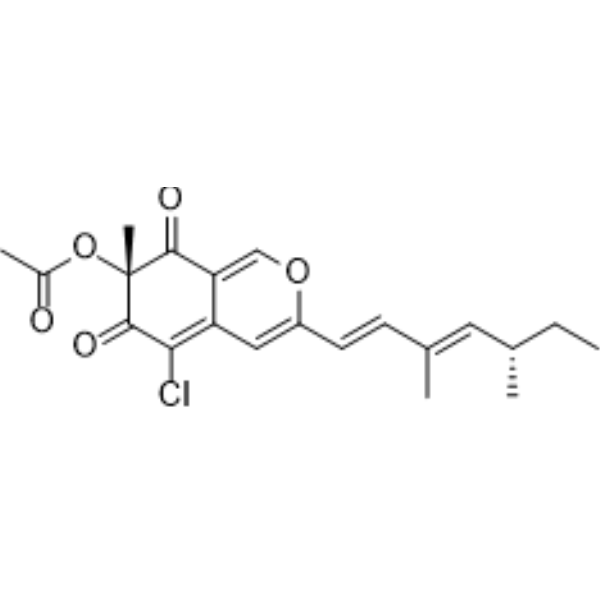
    Sclerotiorin is a reversible and uncompetitive inhibitor against soybean lipoxygenase-1 (LOX-1) (IC50: 4.2 μM). Sclerotiorin also shows antioxidant activity by scavenging free radical (ED50: 0.12 μM), and nonenzymatic lipid peroxidation inhibition activity. Sclerotiorin has antifungal activity, and also inhibits platelet aggregation. Sclerotiorin can be purified from the fermented broth of Penicillium frequentans .
    Sclerotiorin
  • HY-N10020

    Lipoxygenase Inflammation/Immunology
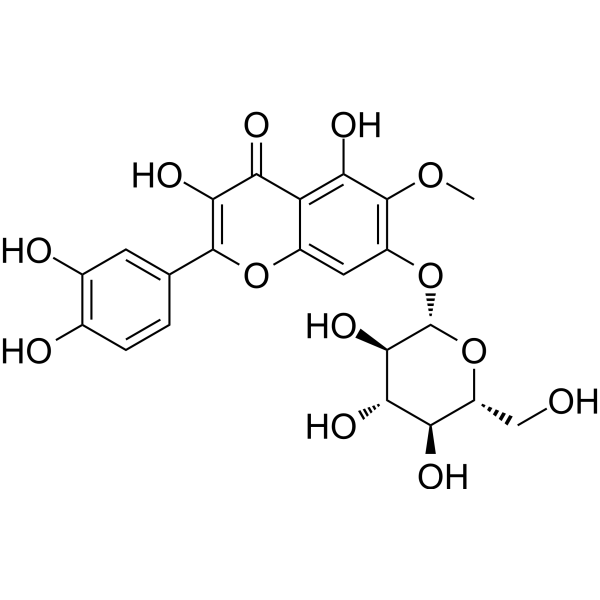
    Patulitrin has scavenging effect in the DPPH radical. Patulitrin inhibits soybean lipoxygenase. Patulitrin also has antihypertensive effect. Patulitrin is an antioxidant flavonoid that can be isolated from Anthemis tinctoria .
    Patulitrin
  • HY-N7854

    Anacardic acid 15:2

    Bacterial Infection
    Anacardic acid diene is a polyunsaturated form of anacardic acid (HY-N2020) that has been found in cashew nut shell liquid. It has antibacterial activity against methicillin resistant S. aureus (MRSA) and S. mutans (MICs=12.5 and 6.25 μg/mL, respectively). Anacardic acid diene has schistosomicidal activity against adult S. mansoni worms when used at a concentration of 100 μM. It also inhibits soybean lipoxygenase-1 in a time-dependent manner.
    Anacardic acid diene
  • HY-131310

    Endogenous Metabolite Metabolic Disease
    9(S)-HpOTrE is a monohydroperoxy polyunsaturated fatty acid produced by the action of 5-lipoxygenase (5-LO) on α-linolenic acid. It can be further metabolized to colnelenic acid by a divinyl ether synthase activity found in garlic and potato microsomal fractions. 9(S)-HpOTrE also serves as a substrate for further oxidation by both soybean and potato LOs, resulting in the formation of 9,16-dihydroperoxy acid.The suicide inactivation of LOs when 9(S)-HpOTrE is used as a substrate is thought to occur via formation of an unstable epoxide.
    9(S)-HpOTrE
  • HY-113884

    13(R)-HODE

    Endogenous Metabolite Metabolic Disease
    13(R)-HODE is the opposite enantiomer of the 13(S)-HODE produced when linoleic acid is incubated with soybean lipoxygenase. The presence of 13(R)-HODE in the supernatants and membranes of cultured bovine endothelial cells has been attributed to COX metabolism.1 13(R)-HODE is a weak (IC50=2.7 μM) inhibitor of U-46619-induced platelet aggregation.
    (R)-Coriolic acid
  • HY-N17462

    Monoamine Oxidase Inflammation/Immunology
    Methyl 9-hydroxyoctadeca-10,12,15-trienoate is a soybean lipoxygenase (LOX) inhibitor. Methyl 9-hydroxyoctadeca-10,12,15-trienoate inhibits TPA (HY-18739)-induced ear edema/inflammation in mice. Methyl 9-hydroxyoctadeca-10,12,15-trienoate can be used for the research of inflammation .
    Methyl 9-hydroxyoctadeca-10,12,15-trienoate
  • HY-182603

    Drug Derivative Reactive Oxygen Species (ROS) HCV Infection Inflammation/Immunology
    BO-653 is an orally active anti-atherosclerotic antioxidant that exhibits high binding affinity for LDL. BO-653 scavenges linoleic acid peroxyl radicals, inhibits lipid peroxidation during the auto-oxidation of linoleic acid, and potently suppresses LDL oxidation. BO-653 inhibits Hepatitis C Virus (HCV) replication in a concentration-dependent manner, with an IC50 of 36.0 μM against the HCV subgenomic replicon in FLR3-1 cells. BO-653 demonstrates significant anti-atherosclerotic effects in various animal models, including the Watanabe heritable hyperlipidemic rabbit. BO-653 is suitable for use in research related to atherosclerosis and Hepatitis C Virus infection .
    BO-653

Inquiry Online

Your information is safe with us. * Required Fields.

Salutation


Country or Region *

Applicant Name *


Organization Name *

Department *


Email Address *


Product Name *

Cat. No.


Requested quantity *

Phone Number *


Remarks

Inquiry Online

Inquiry Information

Product Name:
Cat. No.:
Quantity:
MCE Japan Authorized Agent:

