



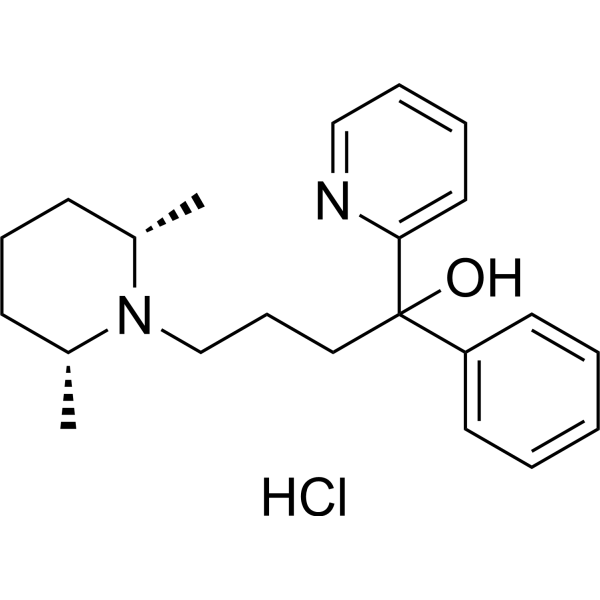
Pirmenol hydrochloride

Based on 1 Customer Validation
Pirmenol ((±)-Pirmenol) hydrochloride is an orally active antiarrhythmic agent. Pirmenol hydrochloride inhibits IK.ACh (IC50: 0.1 μM) by blocking mAchR. Pirmenol hydrochloride can be used in the research of cardiovascular disease, such as atrial fibrillation.
For research use only. We do not sell to patients.
- Purity : 98.77%
- CAS No.: 61477-94-9
- Formula: C22H31ClN2O
- Molecular Weight:374.95
-
Storage:
4°C, stored under nitrogen
* In solvent : -80°C, 6 months; -20°C, 1 month (stored under nitrogen)

To place orders, for customer services and technical support, please contact: MedChemExpress USA
Tel: 609-228-6898 E-mail: [email protected] [email protected]


-
 Biological Activity
-
Chemical Information
-
Solvent & Solubility
- Protocols
- Purity & Documentation
- References
-
 Help & FAQs




Biological Activity
Description
IC50 & Target
IC50: 0.1 μM (IK.ACh)[1]
In Vitro
Pirmenol (1 μM) hydrochloride inhibits the IK.ACh induced by carbachol or intracellular loading of GTPg S in in atrial cells[1].
Pirmenol (5 μM) hydrochloride depresses the early part of the plateau and lengthened the final repolarization of the action potentials in ventricular myocytes[3].
Pirmenol (1 μM) hydrochloride prolongs the action potential duration at 90% repolarization in atrial muscles and Purkinje fibers[3].
MedChemExpress (MCE) has not independently confirmed the accuracy of these methods. They are for reference only.
In Vivo
Pirmenol (rats) hydrochloride shows LD50s of 359.9 mg/kg (p.o), 23.6 mg/kg (i.v.)[2].
Pirmenol (mice) hydrochloride shows LD50s of 215.5 mg/kg (p.o), 20.8 mg/kg (i.v.)[2].
MedChemExpress (MCE) has not independently confirmed the accuracy of these methods. They are for reference only.
-
Animal Model:Conscious, coronary artery ligated dogs[4]
-
Dosage:Oral administration (p.o.)
-
Administration:2.5 and 5 mg/kg
-
Result:Restored normal sinus rhythm, and showed a long duration of activity, wide safety margin.


Chemical Information
-
CAS No. 61477-94-9
-
Appearance Solid
-
Molecular Weight 374.95
-
Formula C22H31ClN2O
-
Color White to yellow
-
SMILES
OC(C1=CC=CC=C1)(CCCN2[C@@H](C)CCC[C@H]2C)C3=CC=CC=N3.Cl
-
Synonyms
(±)-Pirmenol hydrochloride; CI-845
-
Shipping
Room temperature in continental US; may vary elsewhere.
-
Storage
4°C, stored under nitrogen
* In solvent : -80°C, 6 months; -20°C, 1 month (stored under nitrogen)


Solvent & Solubility
In Vitro:
H2O : 100 mg/mL (266.70 mM; Need ultrasonic)
DMSO : 66.67 mg/mL (177.81 mM; Need ultrasonic; Hygroscopic DMSO has a significant impact on the solubility of product, please use newly opened DMSO)
Please refer to the solubility information to select the appropriate solvent. Once prepared, please aliquot and store the solution to prevent product inactivation from repeated freeze-thaw cycles.
Storage method and period of stock solution: -80°C, 6 months; -20°C, 1 month (stored under nitrogen). When stored at -80°C, please use it within 6 months. When stored at -20°C, please use it within 1 month.
* Note: If you choose water as the stock solution, please dilute it to the working solution, then filter and sterilize it with a 0.22 μm filter before use.
Please refer to the solubility information to select the appropriate solvent. Once prepared, please aliquot and store the solution to prevent product inactivation from repeated freeze-thaw cycles.
Storage method and period of stock solution: -80°C, 6 months; -20°C, 1 month (stored under nitrogen). When stored at -80°C, please use it within 6 months. When stored at -20°C, please use it within 1 month.
* Note: If you choose water as the stock solution, please dilute it to the working solution, then filter and sterilize it with a 0.22 μm filter before use.
Concentration (start) × Volume (start) = Concentration (final) × Volume (final)
In Vivo:
Select the appropriate dissolution method based on your experimental animal and administration route.
- For the following dissolution methods, please ensure to first prepare a clear stock solution using an In Vitro approach and then sequentially add co-solvents:
- To ensure reliable experimental results, the clarified stock solution can be appropriately stored based on storage conditions. As for the working solution for In Vivo experiments, it is recommended to prepare freshly and use it on the same day.
- The percentages shown for the solvents indicate their volumetric ratio in the final prepared solution. If precipitation or phase separation occurs during preparation, heat and/or sonication can be used to aid dissolution.
Add each solvent one by one: 10% DMSO 40% PEG300 5% Tween-80 45% Saline
Solubility: ≥ 2.08 mg/mL (5.55 mM); Clear solution
This protocol yields a clear solution of ≥ 2.08 mg/mL (saturation unknown).
Taking 1 mL working solution as an example, add 100 μL DMSO stock solution (20.8 mg/mL) to 400 μL PEG300, and mix evenly; then add 50 μL Tween-80 and mix evenly; then add 450 μL Saline to adjust the volume to 1 mL.
Preparation of Saline: Dissolve 0.9 g sodium chloride in ddH₂O and dilute to 100 mL to obtain a clear Saline solution.
Add each solvent one by one: 10% DMSO 90% (20% SBE-β-CD in Saline)
Solubility: ≥ 2.08 mg/mL (5.55 mM); Clear solution
This protocol yields a clear solution of ≥ 2.08 mg/mL (saturation unknown).
Taking 1 mL working solution as an example, add 100 μL DMSO stock solution (20.8 mg/mL) to 900 μL 20% SBE-β-CD in Saline, and mix evenly.
Preparation of 20% SBE-β-CD in Saline (4°C, storage for one week): 2 g SBE-β-CD powder is dissolved in 10 mL Saline, completely dissolve until clear.
In Vivo Dissolution Calculator
Please enter the basic information of animal experiments:
-
-
-
-
Recommended: Prepare an additional quantity of animals to account for potential losses during experiments.
Working solution concentration: 0.22 mg/mL
This product has good water solubility, please refer to the measured solubility data in water/PBS/Saline for details.


Purity & Documentation
-
Data Sheet (277 KB)
-
SDS (393 KB)
- English - EN (393 KB)
- Français - FR (393 KB)
- Deutsch - DE (393 KB)
- Norwegian - NO (393 KB)
- Español - ES (393 KB)
- Swedish - SV (393 KB)
- Italian - IT (393 KB)
- Korean - KR (393 KB)
- Portuguese - PT (393 KB)
-
Handling Instructions (2659 KB)
References
[1]. Watanabe Y, et al. Pirmenol inhibits muscarinic acetylcholine receptor-operated K+ current in the guinea pig heart. Eur J Pharmacol. 1997 Oct 29;338(1):71-4. [Content Brief]
[2]. Schardein JL, et al. Preclinical toxicology studies with a new antiarrhythmic agent: Pirmenol hydrochloride (CI-845). Toxicol Appl Pharmacol. 1980 Nov;56(2):294-301. [Content Brief]
[3]. T Sawanobori, et al. Electrophysiologic and antiarrhythmic actions of pirmenol on rabbit and guinea pig cardiac preparations. J Cardiovasc Pharmacol. 1990 Dec;16(6):975-83. [Content Brief]
[4]. T E Mertz, et al. Pirmenol hydrochloride (CI-845): antiarrhythmic profile in coronary artery ligated conscious dogs. J Cardiovasc Pharmacol. 1980 Sep-Oct;2(5):527-41. [Content Brief]


Complete Stock Solution Preparation Table
Please refer to the solubility information to select the appropriate solvent. Once prepared, please aliquot and store the solution to prevent product inactivation from repeated freeze-thaw cycles.
Storage method and period of stock solution: -80°C, 6 months; -20°C, 1 month (stored under nitrogen). When stored at -80°C, please use it within 6 months. When stored at -20°C, please use it within 1 month.
| Optional Solvent | Concentration Solvent Mass | 1 mg | 5 mg | 10 mg | 25 mg |
|---|---|---|---|---|---|
| DMSO / H2O | 1 mM | 2.6670 mL | 13.3351 mL | 26.6702 mL | 66.6756 mL |
| 5 mM | 0.5334 mL | 2.6670 mL | 5.3340 mL | 13.3351 mL | |
| 10 mM | 0.2667 mL | 1.3335 mL | 2.6670 mL | 6.6676 mL | |
| 15 mM | 0.1778 mL | 0.8890 mL | 1.7780 mL | 4.4450 mL | |
| 20 mM | 0.1334 mL | 0.6668 mL | 1.3335 mL | 3.3338 mL | |
| 25 mM | 0.1067 mL | 0.5334 mL | 1.0668 mL | 2.6670 mL | |
| 30 mM | 0.0889 mL | 0.4445 mL | 0.8890 mL | 2.2225 mL | |
| 40 mM | 0.0667 mL | 0.3334 mL | 0.6668 mL | 1.6669 mL | |
| 50 mM | 0.0533 mL | 0.2667 mL | 0.5334 mL | 1.3335 mL | |
| 60 mM | 0.0445 mL | 0.2223 mL | 0.4445 mL | 1.1113 mL | |
| 80 mM | 0.0333 mL | 0.1667 mL | 0.3334 mL | 0.8334 mL | |
| 100 mM | 0.0267 mL | 0.1334 mL | 0.2667 mL | 0.6668 mL |
* Note: If you choose water as the stock solution, please dilute it to the working solution, then filter and sterilize it with a 0.22 μm filter before use.


Pirmenol hydrochloride Related Classifications
HY-100795A Related Classifications
 Powered by Bioz