



HDAC
Histone deacetylases
HDAC (Histone deacetylases) are a class of enzymes that remove acetyl groups (O=C-CH3) from an ε-N-acetyl lysine amino acid on ahistone, allowing the histones to wrap the DNA more tightly. This is important because DNA is wrapped around histones, and DNA expression is regulated by acetylation and de-acetylation. Its action is opposite to that of histone acetyltransferase. HDAC proteins are now also called lysine deacetylases (KDAC), to describe their function rather than their target, which also includes non-histone proteins. Together with the acetylpolyamine amidohydrolases and the acetoin utilization proteins, the histone deacetylases form an ancient protein superfamily known as the histone deacetylase superfamily.
HDAC Isoform Specific Products
-
HDAC
(391)
View all products
-
HDAC1
(317)
View all products
-
HDAC2
(211)
View all products
-
HDAC3
(204)
View all products
-
HDAC4
(72)
View all products
-
HDAC5
(56)
View all products
-
HDAC6
(335)
View all products
-
HDAC7
(53)
View all products
-
HDAC8
(188)
View all products
-
HDAC9
(41)
View all products
-
HDAC10
(67)
View all products
-
HDAC11
(71)
View all products
-
HD1
(3)
View all products
-
HD2
(4)
View all products
All Product Categories
-
HDAC Inhibitors
(780)
View all products
-
HDAC Antagonists
(3)
View all products
-
HDAC Activators
(14)
View all products
-
HDAC Modulators
(4)
View all products
-
HDAC MDM2 Inhibitor
(1)
View all products
-
HDAC Degraders
(44)
View all products
-
HDAC Controls
(4)
View all products
-
HDAC Substrates
(3)
View all products
-
HDAC Ligands
(14)
View all products
-
HDAC Related Products (915)
Related Products (915)

-
Antibodies (16)
-
HDAC Signaling Pathway
-
HDAC Isoform Comparison
-
YDH-704
 0 ImagesCat. No.: HY-187370YDH-704 is a PAK1/HDAC10 inhibitor, with IC50 values of 0.05 μM and 0.02 μM against human targets, respectively. YDH-704 blocks PAK1-mediated oncogenic signaling pathways, inhibits the proliferation and migration of tumor cells, suppresses the epigenetic regulatory function of HDAC10, downregulates PD-L1 expression, and regulates polyamine metabolism. YDH-704 reduces MDSC/Treg infiltration, enhances the infiltration and activation of CD8+ T cells, and inhibits tumor growth and lung metastasis. YDH-704 can be used for research on triple-negative breast cancer.
-
HDAC6 ligand 10
 0 ImagesCat. No.: HY-184979HDAC6 ligand 10 is a ligand that selectively targets HDAC6, and it can be used to synthesize PROTAC HDAC6 degrader 11 (HY-152134), a PROTAC-based HDAC6 degrader. HDAC6 ligand 10 applies to leukemia research.
-
Valproic acid β-D-glucuronide-d6
 0 ImagesCat. No.: HY-W700378CAS No.: 2188184-02-1Valproic acid β-D-glucuronide-d6-1 is the deuterium labeled Valproic acid β-D-glucuronide (HY-W400496). Valproic acid β-D-glucuronide is the major urinary metabolite of Valproic acid (HY-10585).
-
HDAC8-IN-15
 0 ImagesCat. No.: HY-181979HDAC8-IN-15 is a selective HDAC8 inhibitor with an IC50 of 0.40 μM. HDAC8-IN-15 increases the acetylation level of the HDAC8 substrate SMC3 without altering the total protein level of SMC3. HDAC8-IN-15 reduces cancer cell viability, inhibits colony formation, slows cell migration, induces apoptosis, and causes cell cycle arrest at the SubG1 phase. HDAC8-IN-15 can be used in studies related to neuroblastoma.
-
HDAC6-IN-72
 0 ImagesCat. No.: HY-180994HDAC6-IN-72 is a HDAC6 zinc finger ubiquitin-binding domain (ZnF-UBD) inhibitor that inhibits the interaction between HDAC6 ZnF-UBD and ubiquitin with an IC50 of 2.7 μM. HDAC6-IN-72 can be used for the research of breast cancer, colorectal cancer, multiple myeloma.
-
UBD1031
 0 ImagesCat. No.: HY-172193Purity: 99.68%Synonyms: SGC-UBD1031UBD1031 (SGC-UBD1031) is a selective USP16/HDAC6-UBD antagonist with a human USP16-UBD IC50 of 10.6 μM, KD value of 48 nM, and a human HDAC6-UBD KD of 16 nM. UBD1031 disrupts ISG15 C-terminus interactions with USP16-UBD and HDAC6-UBD, and exhibits cooperative inhibition of full-length USP16 deubiquitinase activity via USP16-UBD binding. UBD1031 can be used in research on cancer, autoimmune diseases, and Down syndrome.
-
1-Alaninechlamydocin
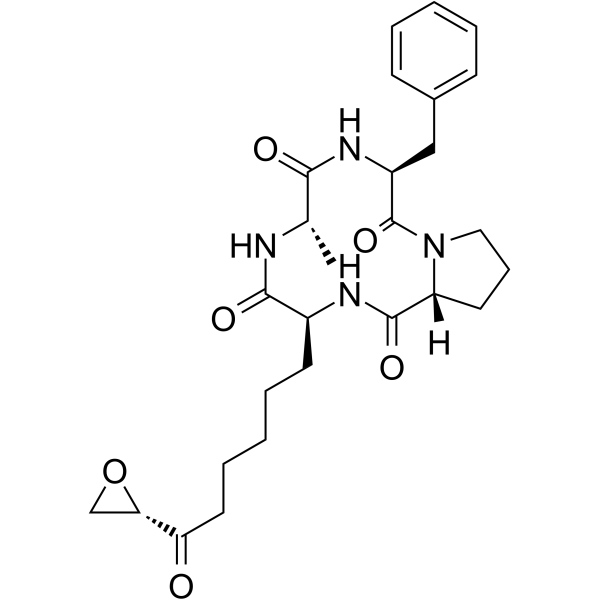 0 ImagesCat. No.: HY-P2698CAS No.: 141446-96-0

-
HDAC-IN-27
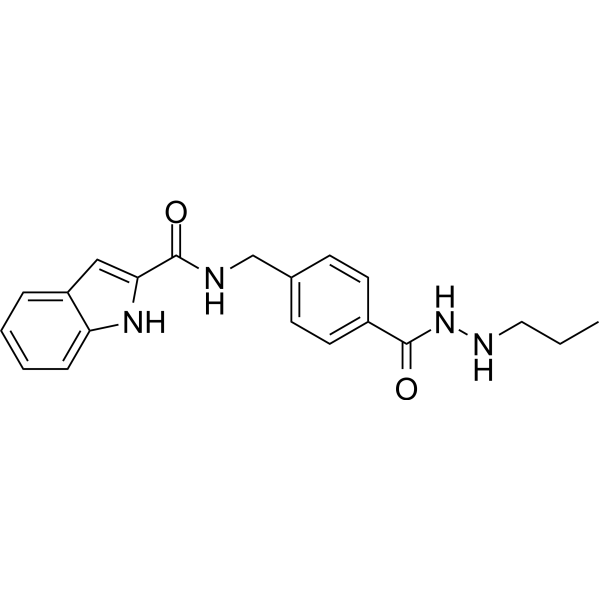 0 ImagesHDAC-IN-27 (Compound 11h) is a potent, orally active class I HDAC-selective inhibitor with IC50 values ranging from 0.43 to 3.01 nM against HDAC1-3. HDAC-IN-27 exhibits both in vivo and in vitro antitumor activity. HDAC-IN-27 demonstrates significant anti-proliferative activity against acute myeloid leukemia (AML) cell lines by inducing apoptosis and histone acetylation (AcHH3 and AcHH4). HDAC-IN-27 can be used for research in acute myeloid leukemia (AML).

-
LT-630
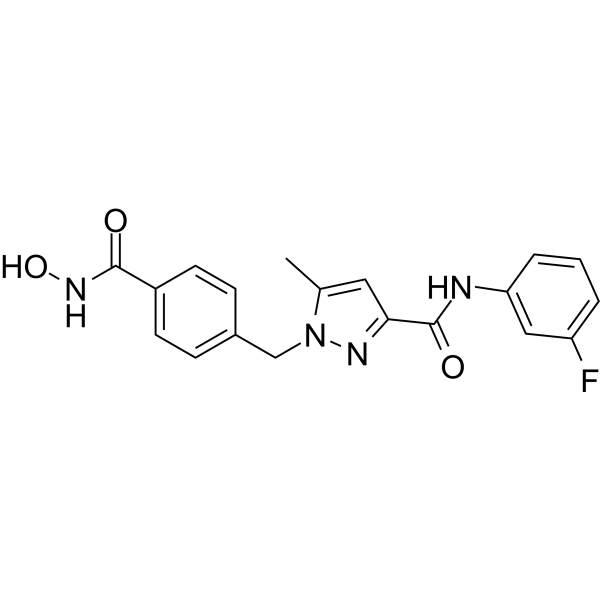 0 ImagesCat. No.: HY-162378LT-630 is a HDAC6 inhibitor. LT-630 ameliorates liver injury by reducing oxidative damage.

-
HDAC6-IN-55
 0 ImagesCat. No.: HY-172781HDAC6-IN-55 (Compound 15B) is a potent HDAC6 inhibitor and an effective anti-inflammatory agent. HDAC6-IN-55 alleviates atopic dermatitis through anti-inflammatory effects facilitated via TLR4/MAPK, STAT3 and NF-κB pathways. HDAC6-IN-55 alleviates symptoms such as skin edema, dryness, crusting, and peeling in 2,4-dinitrochlorobenzene (DNCB)-induced atopic dermatitis mice.
-
Daphnegiravone D
 0 ImagesCat. No.: HY-N13121CAS No.: 2581826-37-9Daphnegiravone D (compound 70) is an HDAC6 inhibitor with anti-hepatocellular carcinoma activity. Daphnegiravone D can induce apoptosis and selectively inhibit the proliferation of liver cancer cells through the p38 and JNK MAPK pathways.
-
JPS014
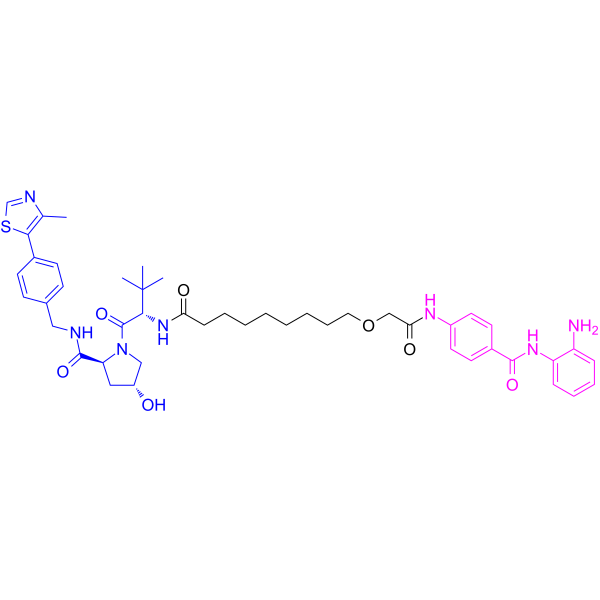 0 ImagesCat. No.: HY-145815CAS No.: 2669785-76-4JPS014 is a PROTAC degrader targeting HDAC1, HDAC2 and HDAC3, with DC50 values of 0.91 μM, 4.19 μM and 0.64 μM, respectively. JPS014 recruits the VHL E3 ligase to mediate the ubiquitination and proteasomal degradation of HDAC1, HDAC2 and HDAC3. JPS014 acts as a submicromolar inhibitor of the HDAC1-CoREST, HDAC2-CoREST and HDAC3-SMRT complexes in vitro. JPS014 increases the level of H3K56ac, reduces the stability of LSD1 and SIN3A, and induces cell apoptosis (apoptosis). JPS014 can be used for the research of colon cancer.
-
CM-444
 0 ImagesCat. No.: HY-163803CAS No.: 2256079-52-2CM-444 is inhibitor for HDAC (IC50 is 6 nM-0.6 μM) and DNA methyltransferases (DNMT, IC50 is 1.8-2.3 μM). CM-444 is an inducer for the differentiation of acute myeloid leukemia cells. CM-444 exhibits anti-leukemic activity and improves the survival rate in mouse models.
-
HDAC8-IN-14
 0 ImagesCat. No.: HY-178380HDAC8-IN-14, a curcuminoid derivative, is a selective HDAC8 inhibitor with a Ki of 9 nM. HDAC8-IN-14 induces the production of reactive oxygen species (ROS), disrupts mitochondrial membrane potential, and promotes apoptosis. HDAC8-IN-14 can significantly promote the accumulation of cells in the sub-G0/G1 phase, consistent with apoptotic or necrotic cell death. HDAC8-IN-14 induces upregulation of cytochrome c, cleaved caspase-3, and the pro-apoptotic protein Bak while leaving the anti-apoptotic Bcl-2 levels unaltered. HDAC8-IN-14 can be used for the study of leukemia.
-
HDAC/HSP90-IN-4
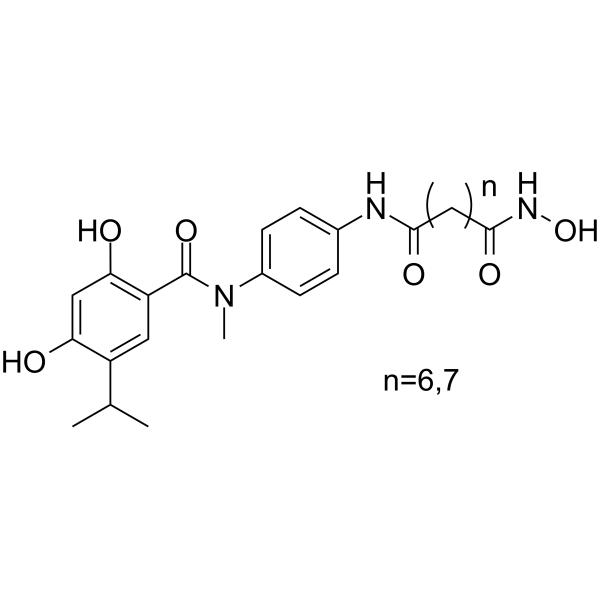 0 ImagesCat. No.: HY-146212These compounds have strong hdac and hsp90 inhibitory activities. Compound 20 (HDAC ic50 = 194 nm; Hsp90 α < b> Ic50 = 153 nm) and compound 26 ((HDAC ic50= 360 nm; Hsp90 α < b> Ic50 = 77 nm) shows the strongest HDAC and HSP90 α Inhibitory activity. Both compounds can induce hsp90 expression and down regulate hsp90 client proteins, which play an important role in regulating the survival and invasion of cancer cells.
-
HDAC1/6-IN-1
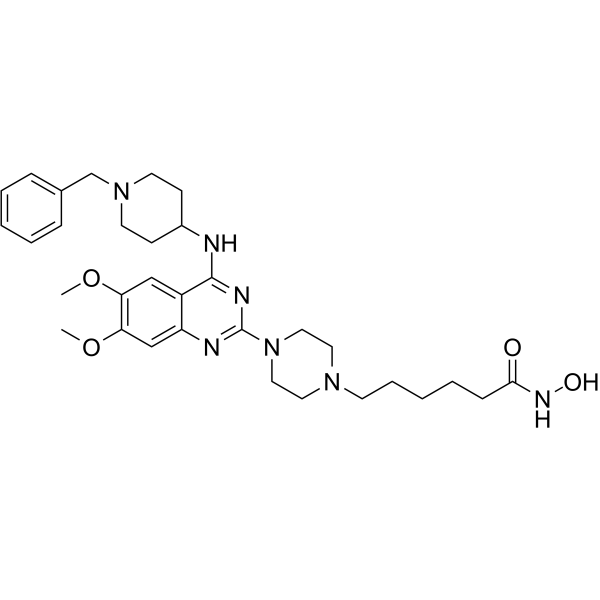 0 ImagesCat. No.: HY-144725CAS No.: 2630989-02-3HDAC1/6-IN-1 (compound D7) is a potent multitarget inhibitor of GLP, HDAC6 and HDAC1, with IC50 values of 1.3, 13, and 89 nM, respectively. HDAC1/6-IN-1 can inhibit the methylation and deacetylation of H3K9 on protein level. HDAC1/6-IN-1 induces cancer cell apoptosis, G0/G1 cell cycle arrest, and blocks migration and invasion.




