



PROTACs
PROTAC (PROteolysis-TArgeting Chimera) is a heterobifunctional nanomolecule containing two different ligands, ligand for ubiquitin E3 and ligand for target protein. The two parts are connected by linker to form a "three-unit" polymer, target protein ligand-linker-E3 ligase ligand. Building blocks of PROTAC molecules include PROTAC Linker, Ligand for Target Protein for PROTAC, Ligand for E3 Ligase, E3 Ligase Ligand-Linker Conjugate, Target Protein Ligand-Linker Conjugate, etc.
PROTACs Isoform Specific Products
All Product Categories
-
PROTACs Related Products (1353)
Related Products (1353)

-
Antibodies (1)
-
PROTACs Isoform Comparison
-
WCF-598
 0 ImagesCat. No.: HY-182331CAS No.: 3059574-58-9WCF-598 is a RXRγ (Kd: 234.2 nM) PROTAC degrader. WCF-598 induces RXRγ degradation via the ubiquitin-proteasome pathway and binds directly to RXRγ. WCF-598 indirectly induces AR-V7 degradation, impairs the stability of the RXRγ-AR-V7 complex, downregulates AR-V7 levels, and inhibits the transcription of downstream target genes of AR-V7. WCF-598 induces tumor cell apoptosis, inhibits cell proliferation, activates the p53 signaling pathway, and suppresses cell cycle progression. WCF-598 can be used for the research of prostate cancer.
-
SYC-2863
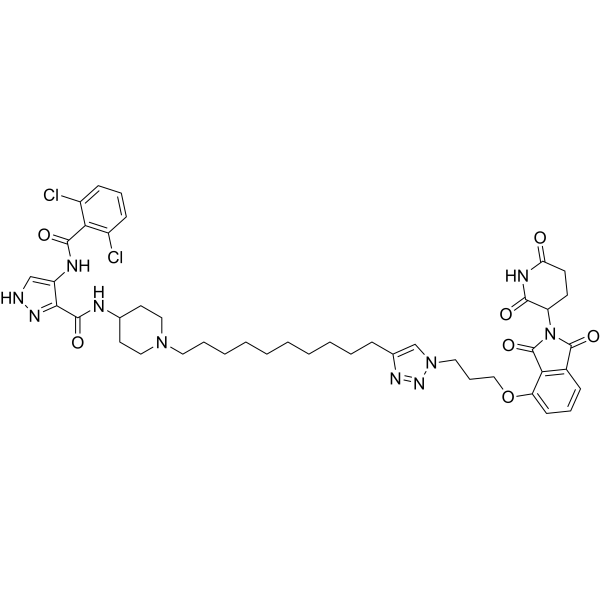
 0 ImagesCat. No.: HY-184342SYC-2863 is a CRBN-recruiting PROTAC degrader that selectively degrades ENL (MLLT1), with an ENL DC50 of 45 nM in MV4;11 cells. SYC-2863 inhibits the proliferation of MLL-rearranged leukemia and multiple myeloma cells. After degrading intracellular ENL, SYC-2863 dose-dependently downregulates the transcription levels of MYC and its downstream target genes, blocking the MYC-mediated malignant proliferation pathway. SYC-2863 can be used in studies related to MLL-rearranged leukemia and multiple myeloma.

-
PROTAC GSK3 degrader-1
 0 ImagesCat. No.: HY-185634PROTAC GSK3 degrader-1 is a potent, blood-brain barrier-permeable GSK3 PROTAC degrader, with a DC50 of 1.4 nM against GSK3β. PROTAC GSK3 degrader-1 exerts equally potent degradation activity against both GSK3α and GSK3β. It inhibits the phosphorylation of CRMP2, PRKAA1 and Tau, and stabilizes β-catenin. PROTAC GSK3 degrader-1 can be used in the research of Alzheimer's disease and Parkinson's disease.
-
PROTAC SMARCA2/4 degrader-5
 0 ImagesCat. No.: HY-159456CAS No.: 2568277-84-7PROTAC SMARCA2/4-degrader-5 (Compound I-437) is a PROTAC degrader for catalytic subunit of the SWI/SNF complex SMARCA2 and SMARCA4. PROTAC SMARCA2/4-degrader-5 degrades SMARCA2 in MV411 and in A549 with DC50 <100 nM, degrades SMARCA4 in MV411 with DC50 of 100-500 nM.
-
Pomalidomide-C5-Dovitinib
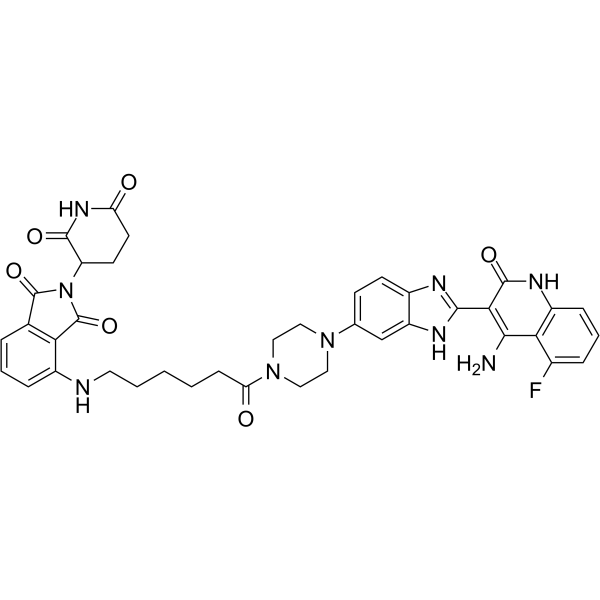 0 ImagesCat. No.: HY-139996CAS No.: 2732969-67-2

-
PROTAC SMARCA2/4 degrader-26
 0 ImagesCat. No.: HY-162815PROTAC SMARCA2/4 degrader-26 is a SMARCA2/4 PROTAC degrader with selective anti-tumor activity against lung cancer cells. PROTAC SMARCA2/4 degrader-26 degrades SMARCA2 and SMARCA4 via the PROTAC-mediated proteasomal pathway. It induces DNA damage and apoptosis in tumor cells, while inhibiting migration and colony formation of lung cancer cells; in addition, it damages normal vascular endothelial cells and exhibits significant off-target-related cytotoxicity. PROTAC SMARCA2/4 degrader-26 serves as the parent scaffold to construct the GSH-responsive prodrug PROTAC SMARCA2/4 degrader-25 (HY-162813), a derivative that shows drastically reduced cytotoxicity against normal cells. PROTAC SMARCA2/4 degrader-26 can be used in lung cancer-related research.
-
MD-265
 0 ImagesMD-265 is a PROTAC degrader targeting MDM2, which activates p53 in cancer cells carrying wild-type p53. MD-265 induces MDM2 degradation by recruiting the CRL4-CRBN ligase complex via the ubiquitination and proteasomal degradation pathway. MD-265 upregulates p53 target genes, induces apoptosis, reduces Mcl-1 levels, increases caspase-3 cleavage, and inhibits colony formation of wild-type p53 leukemia stem cells. MD-265 can be used in research related to leukemia and acute myeloid leukemia.
-
PROTAC CDK4/6/9 degrader 2
 0 ImagesCat. No.: HY-178516PROTAC CDK4/6/9 degrader 2 (Compound P4) is a CDK4/6/9 PROTAC prodrug with oral activity and low toxicity. PROTAC CDK4/6/9 degrader 2 can significantly inhibit tumor growth and suppress tumor lung metastasis. PROTAC CDK4/6/9 degrader 2 can be used in the research of cancer such as breast cancer. (Pink: CDK4/6/9 Ligand (HY-168440); Blue: CRBN Ligand (HY-178517); Black: Linker (HY-178512))

-
PROTAC MLLT1 Degrader-1
 0 ImagesCat. No.: HY-181834CAS No.: 3111054-37-3PROTAC MLLT1 Degrader-1 is a PROTAC degrader targeting MLLT1. PROTAC MLLT1 Degrader-1 inhibits AML cell proliferation and viability, suppresses tumor growth in human AML xenograft models, and can block the oncogene transcriptional program. PROTAC MLLT1 Degrader-1 can be used for the research of MLL-rearranged acute myeloid leukemia (AML).
-
XYD129
 0 ImagesCat. No.: HY-161710XYD129 is a CBP/p300 PROTAC degrader. XYD129 potently binds to CBP, p300 and CRBN proteins, with IC50 values of 0.021 μM, 0.03 μM and 0.18 μM, respectively. XYD129 forms a ternary CRBN-CBP/p300 complex and induces CBP/p300 degradation via the ubiquitin-proteasome system. XYD129 inhibits tumor growth and suppresses the proliferation of acute myeloid leukemia cells. XYD129 can be used in studies related to acute myeloid leukemia.
-
PROTAC EGFR degrader 12
 0 ImagesCat. No.: HY-171958CAS No.: 2654821-05-1PROTAC EGFR degrader 12 (example 1) is a PROTAC degrader targeting EGFR that can effectively degrade EGFR mutants, but has little effect on EGFR WT. PROTAC EGFR degrader 12 shows IC50s against EGFRL858R-T790M (NCI-H1975 cells), EGFRL858R (NCI-H3255 cells), and EGFRL858R-T790M-L797S (NCI-H1975+CS cells) of all <50 nM.

-
PROTAC SARS-CoV-2 Mpro degrader-4
 0 ImagesCat. No.: HY-174233PROTAC SARS-CoV-2 Mpro degrader-4 is a SARS-CoV-2 MPro PROTAC degrader with antiviral activity, with a DC50 value of 4.7 μM. PROTAC SARS-CoV-2 Mpro degrader-4 induces MPro ubiquitination and proteasomal degradation, and inhibits SARS-CoV-2 replication. PROTAC SARS-CoV-2 Mpro degrader-4 can be used in the research of coronavirus infections.
-
PROTAC STAT3 degrader-2
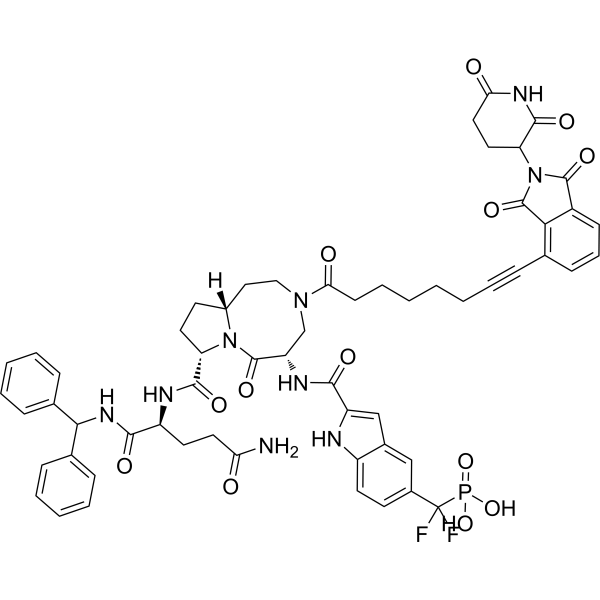 0 ImagesCat. No.: HY-153023CAS No.: 2429877-78-9PROTAC STAT3 degrader-2 is a selective and efficacious PROTAC degrader of STAT3 protein with a DC50 of 3.54 μM in Molm-16 Cell. PROTAC STAT3 degrader-2 has the potential for cancer research. PROTAC STAT3 degrader-2 is a click chemistry reagent, it contains an Alkyne group and can undergo copper-catalyzed azide-alkyne cycloaddition (CuAAc) with molecules containing Azide groups.
-
PROTAC AKR1C3 degrader-1
 0 ImagesCat. No.: HY-163609PROTAC AKR1C3 degrader-1 is a PROTAC degrader targeting AKR1C3, with a DC50 of 52 nM. PROTAC AKR1C3 degrader-1 induces proteasome-dependent degradation of AKR1C3 and inhibits the enzymatic activities of AKR1C3, AKR1C1 and AKR1C2. PROTAC AKR1C3 degrader-1 degrades ARv7 by disrupting the stable AKR1C3/ARv7 complex. PROTAC AKR1C3 degrader-1 reduces the viability of prostate cancer cells expressing AKR1C3 and sensitizes Enzalutamide (HY-70002)-resistant prostate cancer cells. PROTAC AKR1C3 degrader-1 can be used in the research of prostate cancer.
-
PROTAC CDK9 degrader-12
 0 ImagesCat. No.: HY-181231CAS No.: 3052648-82-2PROTAC CDK9 degrader-12 is a selective CDK9 PROTAC degrader with a DC50 of 23 nM. PROTAC CDK9 degrader-12 induces proteasome-dependent degradation of CDK9, blocks CDK9-mediated HIV-1 transcriptional elongation, and reduces HIV-1 RNA synthesis. PROTAC CDK9 degrader-12 is applicable to research related to HIV-1 infection.




