



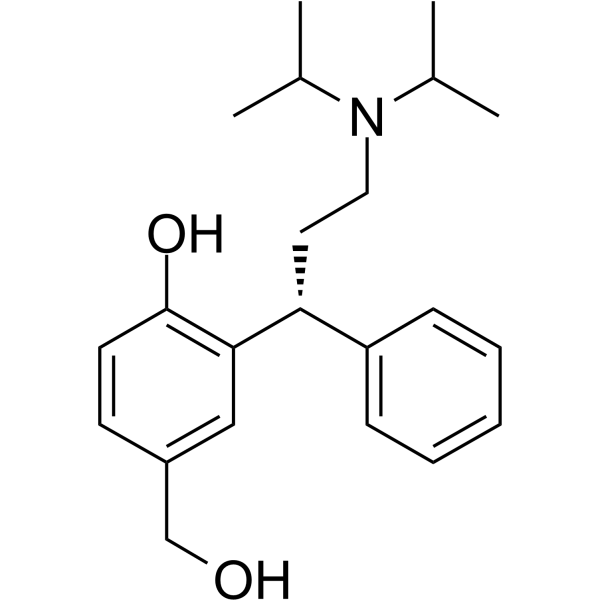
Desfesoterodine
Based on 1 publication(s) in Google Scholar
Desfesoterodine (PNU-200577) is a potent and selective muscarinic receptor (mAChR) antagonist with a KB and a pA2 of 0.84 nM and 9.14, respectively. Desfesoterodine is a major pharmacologically active metabolite of Tolterodine (PNU-200583; HY-A0024) and Fesoterodine (HY-70053). Desfesoterodine improves cerebral infarction induced detrusor overactivity in rats.
Para uso exclusivo en investigación. No vendemos a pacientes.
- No. CAS: 207679-81-0
- Fòrmula: C22H31NO2
- Peso molecular:341.50
-
Almacenamiento:Powder -20°C, 3 years , 4°C, 2 years ; In solvent -80°C, 2 years , -20°C, 1 year

To place orders, for customer services and technical support, please contact: MedChemExpress USA
Tel: 609-228-6898 E-mail: [email protected] [email protected]


-
 Actividad biológica
-
Chemical Information
-
Solvente y solubilidad
- Pureza y Documentación
- Referencias
-
 Help & FAQs



Publications Citing Use of MedChemExpress (MCE) Desfesoterodine
More

Actividad biológica
Descripciòn
IC50 & Target
Kb: 0.84 nM (mAChR)[1].
In Vitro
In vitro, Desfesoterodine preventes carbachol-induced contraction of guinea-pig isolated urinary bladder strips in a competitive and concentration-dependent manner[1].
In radioligand binding studies carries out in homogenates of guinea-pig tissues and Chinese hamster ovary cell lines expressing human muscarinic m1-m5 receptors, Desfesoterodine is not selective for any muscarinic receptor subtype[1].
MedChemExpress (MCE) has not independently confirmed the accuracy of these methods. They are for reference only.
In Vivo
In vivo, Desfesoterodine is significantly more potent at suppressing acetylcholine-induced urinary bladder contraction than electrically induced salivation in the anaesthetised cat (ID50=15 and 40 nmol/kg, respectively) [1].
MedChemExpress (MCE) has not independently confirmed the accuracy of these methods. They are for reference only.
-
Animal Model:Female Sprague Dawley rats at ages 9 to 11 weeks weighing 180 to 250 g[4]
-
Dosage:0.1 and 1 mg/kg
-
Administration:IV; single imidafenacin administration
-
Result:Significantly increased bladder compliance after moderate and high doses.


Chemical Information
-
No. CAS 207679-81-0
-
Appearance Solid
-
Peso molecular 341.50
-
Fòrmula C22H31NO2
-
Color White to yellow
-
SMILES
OC1=C(C=C(CO)C=C1)[C@@H](C2=CC=CC=C2)CCN(C(C)C)C(C)C
-
Synonyms
PNU-200577; 5-Hydroxymethyl Tolterodine
-
Envío
Room temperature in continental US; may vary elsewhere.
-
Almacenamiento
Powder -20°C 3 years 4°C 2 years In solvent -80°C 2 years -20°C 1 year


Publications (1)
-
Journal Impact Factor
-
Most Recent
-
Sci Rep
Tolterodine is a novel candidate for assessing CYP3A4 activity through metabolic volatiles to predict drug responses. [Abstract]2025 Jan 20;15(1):2462. PMID: 39828876


Solvente y solubilidad
In Vitro:
H2O : 100 mg/mL (292.83 mM; Need ultrasonic)
DMSO : 50 mg/mL (146.42 mM; Need ultrasonic; Hygroscopic DMSO has a significant impact on the solubility of product, please use newly opened DMSO)
Please refer to the solubility information to select the appropriate solvent. Once prepared, please aliquot and store the solution to prevent product inactivation from repeated freeze-thaw cycles.
Storage method and period of stock solution: -80°C, 2 years; -20°C, 1 year. When stored at -80°C, please use it within 2 years. When stored at -20°C, please use it within 1 year.
* Note: If you choose water as the stock solution, please dilute it to the working solution, then filter and sterilize it with a 0.22 μm filter before use.
Please refer to the solubility information to select the appropriate solvent. Once prepared, please aliquot and store the solution to prevent product inactivation from repeated freeze-thaw cycles.
Storage method and period of stock solution: -80°C, 2 years; -20°C, 1 year. When stored at -80°C, please use it within 2 years. When stored at -20°C, please use it within 1 year.
* Note: If you choose water as the stock solution, please dilute it to the working solution, then filter and sterilize it with a 0.22 μm filter before use.
Concentration (start) × Volume (start) = Concentration (final) × Volume (final)
In Vivo:
Select the appropriate dissolution method based on your experimental animal and administration route.
- For the following dissolution methods, please ensure to first prepare a clear stock solution using an In Vitro approach and then sequentially add co-solvents:
- To ensure reliable experimental results, the clarified stock solution can be appropriately stored based on storage conditions. As for the working solution for In Vivo experiments, it is recommended to prepare freshly and use it on the same day.
- The percentages shown for the solvents indicate their volumetric ratio in the final prepared solution. If precipitation or phase separation occurs during preparation, heat and/or sonication can be used to aid dissolution.
Add each solvent one by one: 10% DMSO 40% PEG300 5% Tween-80 45% Saline
Solubility: ≥ 2.5 mg/mL (7.32 mM); Clear solution
This protocol yields a clear solution of ≥ 2.5 mg/mL (saturation unknown).
Taking 1 mL working solution as an example, add 100 μL DMSO stock solution (25.0 mg/mL) to 400 μL PEG300, and mix evenly; then add 50 μL Tween-80 and mix evenly; then add 450 μL Saline to adjust the volume to 1 mL.
Preparation of Saline: Dissolve 0.9 g sodium chloride in ddH₂O and dilute to 100 mL to obtain a clear Saline solution.
Add each solvent one by one: 10% DMSO 90% (20% SBE-β-CD in Saline)
Solubility: ≥ 2.5 mg/mL (7.32 mM); Clear solution
This protocol yields a clear solution of ≥ 2.5 mg/mL (saturation unknown).
Taking 1 mL working solution as an example, add 100 μL DMSO stock solution (25.0 mg/mL) to 900 μL 20% SBE-β-CD in Saline, and mix evenly.
Preparation of 20% SBE-β-CD in Saline (4°C, storage for one week): 2 g SBE-β-CD powder is dissolved in 10 mL Saline, completely dissolve until clear.
In Vivo Dissolution Calculator
Please enter the basic information of animal experiments:
-
-
-
-
Recommended: Prepare an additional quantity of animals to account for potential losses during experiments.
Working solution concentration: 0.22 mg/mL
This product has good water solubility, please refer to the measured solubility data in water/PBS/Saline for details.


Pureza y Documentación
-
Ficha de datos (277 KB)
-
SDS (557 KB)
- English - EN (557 KB)
- Français - FR (557 KB)
- Deutsch - DE (557 KB)
- Norwegian - NO (557 KB)
- Español - ES (557 KB)
- Swedish - SV (557 KB)
- Italian - IT (557 KB)
- Korean - KR (557 KB)
- Portuguese - PT (557 KB)
-
Instrucciones de manejo (2659 KB)
Referencias
[1]. Nilvebrant L, Gillberg PG, Sparf B. Antimuscarinic potency and bladder selectivity of PNU-200577, a major metabolite of tolterodine. Pharmacol Toxicol. 1997 Oct;81(4):169-72. [Content Brief]
[2]. Fullhase, Claudius; Soler, Roberto; Gratzke, Christian et al. Spinal effects of the fesoterodine metabolite 5-hydroxymethyl tolterodine and/or doxazosin in rats with or without partial urethral obstruction. Journal of Urology (New York, NY, United States) (2010), 184(2), 783-789. [Content Brief]
[3]. B Malhotra, et al. The Design and Development of Fesoterodine as a Prodrug of 5-hydroxymethyl Tolterodine (5-HMT), the Active Metabolite of Tolterodine. Curr Med Chem. 2009;16(33):4481-9. [Content Brief]
[4]. Naoki Aizawa, et al. Selective Inhibitory Effect of Imidafenacin and 5-hydroxymethyl Tolterodine on Capsaicin Sensitive C Fibers of the Primary Bladder Mechanosensitive Afferent Nerves in the Rat. J Urol. 2015 Apr;193(4):1423-32. [Content Brief]


Complete Stock Solution Preparation Table
Please refer to the solubility information to select the appropriate solvent. Once prepared, please aliquot and store the solution to prevent product inactivation from repeated freeze-thaw cycles.
Storage method and period of stock solution: -80°C, 2 years; -20°C, 1 year. When stored at -80°C, please use it within 2 years. When stored at -20°C, please use it within 1 year.
| Optional Solvent | Concentration Solvent Mass | 1 mg | 5 mg | 10 mg | 25 mg |
|---|---|---|---|---|---|
| DMSO / H2O | 1 mM | 2.9283 mL | 14.6415 mL | 29.2830 mL | 73.2075 mL |
| 5 mM | 0.5857 mL | 2.9283 mL | 5.8566 mL | 14.6415 mL | |
| 10 mM | 0.2928 mL | 1.4642 mL | 2.9283 mL | 7.3208 mL | |
| 15 mM | 0.1952 mL | 0.9761 mL | 1.9522 mL | 4.8805 mL | |
| 20 mM | 0.1464 mL | 0.7321 mL | 1.4642 mL | 3.6604 mL | |
| 25 mM | 0.1171 mL | 0.5857 mL | 1.1713 mL | 2.9283 mL | |
| 30 mM | 0.0976 mL | 0.4881 mL | 0.9761 mL | 2.4403 mL | |
| 40 mM | 0.0732 mL | 0.3660 mL | 0.7321 mL | 1.8302 mL | |
| 50 mM | 0.0586 mL | 0.2928 mL | 0.5857 mL | 1.4642 mL | |
| 60 mM | 0.0488 mL | 0.2440 mL | 0.4881 mL | 1.2201 mL | |
| 80 mM | 0.0366 mL | 0.1830 mL | 0.3660 mL | 0.9151 mL | |
| 100 mM | 0.0293 mL | 0.1464 mL | 0.2928 mL | 0.7321 mL |
* Note: If you choose water as the stock solution, please dilute it to the working solution, then filter and sterilize it with a 0.22 μm filter before use.


Desfesoterodine Related Classifications
HY-76569 Related Classifications
 Powered by Bioz