



m-Carboxycinnamic acid bishydroxamide

Based on 1 Customer Validation
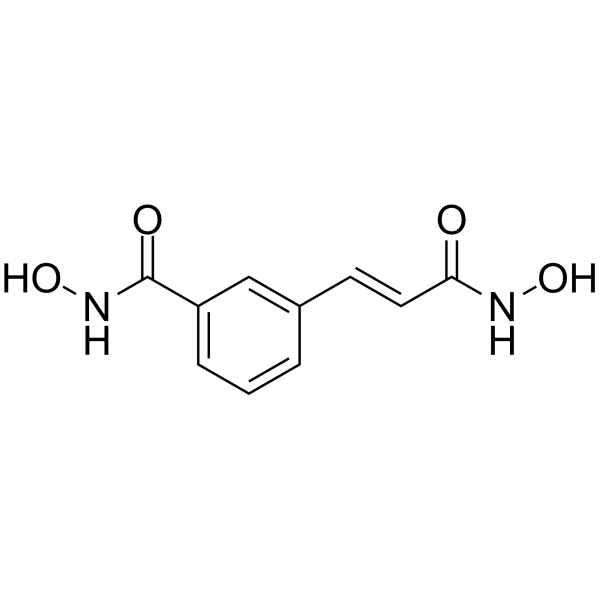
m-Carboxycinnamic acid bishydroxamide (CBHA) is a histone deacetylase inhibitor. m-Carboxycinnamic acid bishydroxamide modulates histone acetylation sites, alters DNA methylation and epigenetic status, increases global histone acetylation, alleviates transcription repression, and facilitates chromatin remodelling. m-Carboxycinnamic acid bishydroxamide can be used for the research of cloned embryo development and epigenetic regulation.
For research use only. We do not sell to patients.
- Purity : 98.0%
- CAS No.: 174664-65-4
- Formula: C10H10N2O4
- Molecular Weight:222.20
-
Storage:Powder -20°C, 3 years ; In solvent -80°C, 6 months , -20°C, 1 month

To place orders, for customer services and technical support, please contact: MedChemExpress USA
Tel: 609-228-6898 E-mail: [email protected] [email protected]


-
 Biological Activity
-
Chemical Information
-
Solvent & Solubility
- Purity & Documentation
- References
-
 Help & FAQs




Biological Activity
Description
In Vitro
m-Carboxycinnamic acid bishydroxamide (20 μM; 6 h) treatment of reconstructed androgenetic embryos improves blastocyst formation rate, supports derivation of Ca2+ES cell lines with normal karyotype, pluripotent marker expression, and altered imprinted gene expression and DNA methylation patterns relative to zygote-derived R1 ES cells[1].
m-Carboxycinnamic acid bishydroxamide (5-50 μM; 10 hr) treatment of hand-made cloned buffalo embryos significantly increases blastocyst rate to 63.77% and reduces apoptotic index to 4.36 with 10 μM, while 5 μM increases total cell number to 396.85, and 20 μM increases apoptosis[2].
m-Carboxycinnamic acid bishydroxamide (5-50 μM; 10 hr) treatment of hand-made cloned buffalo embryos increases global H3K9ac levels to IVF blastocyst levels, while 10 μM specifically reduces global H3K27me3 levels (though not to IVF levels)[2].
m-Carboxycinnamic acid bishydroxamide (10 μM; 10 hr) treatment of hand-made cloned buffalo embryos upregulates OCT-4, NANOG, and BCL-XL expression, downregulates BAX expression, and does not alter expression of p53, CASPASE3, DNMT1, DNMT3a, or HDAC1[2].
m-Carboxycinnamic acid bishydroxamide (20 μM; 10 h) treatment of mouse 1-cell cumulus cell SCNT embryos accelerates and enhances histone acetylation at H3K9, H3K18, and H4K5 sites without altering DNA methylation levels[3].
m-Carboxycinnamic acid bishydroxamide (20 μM; 10 h) treatment of mouse cumulus cell SCNT embryos significantly enhances outgrowth formation, proliferation, and Oct4-positive cell abundance in vitro[3].
MedChemExpress (MCE) has not independently confirmed the accuracy of these methods. They are for reference only.
-
Cell Line:hand-made cloned buffalo embryos
-
Concentration:10 μM
-
Incubation Time:10 h
-
Result:Upregulated OCT-4, NANOG, and BCL-XL expression.
Downregulated BAX expression.
Did not alter expression of p53, CASPASE3, DNMT1, DNMT3a, or HDAC1.
-
Cell Line:mouse cumulus cell SCNT embryos
-
Concentration:20 μM
-
Incubation Time:10 h
-
Result:Significantly enhanced outgrowth formation, proliferation, and Oct4-positive cell abundance.
In Vivo
m-Carboxycinnamic acid bishydroxamide (CBHA) (1-20 μM; in vitro exposure; 10 h post-reconstruction) improves mouse SCNT embryo preimplantation and post-implantation development, increases full-term live offspring rate to 3.6-3.8%, and boosts NT-ES cell derivation efficiency to 59% by enhancing blastocyst quality, reducing apoptosis, and promoting outgrowth proliferation[3].
MedChemExpress (MCE) has not independently confirmed the accuracy of these methods. They are for reference only.
-
Animal Model:B6D2F1 (8-week-old female; C57BL/6J×DBA/2); 129S2/SvPasCrl (male; 129Sv); SCID Beige (6-week-old male); CD-1[1]
-
Dosage:20 μM
-
Administration:incubation; 6 hours
-
Result:Increased the blastocyst rate of androgenetic embryos to 18.1%.
Enabled derived CaES cell lines to show a normal 40, XY karyotype, and express pluripotent markers (Oct4, Sox2, Nanog, SSEA-1) at levels similar to zygote-derived R1 ES cells.
Supported derived CaES cell lines to form teratomas containing all three germ layers when injected into SCID Beige mice.
Improved imprinted gene expression patterns in derived CaES cells, with paternal genes Dio3 and U2af1-rs1 and maternal gene H19 matching R1 ES cell levels.
Supported CaES-1 cells to yield a 2.6% chimera rate (11 chimeras from 421 manipulated embryos) with contribution to 9 tissues.
Supported CaES-2 cells to yield a 1.8% chimera rate (8 chimeras from 445 manipulated embryos).
-
Animal Model:B6D2F1 (female, 8-12 weeks old); ICR (female, 8-12 weeks old, foster)[3]
-
Dosage:0.1 μM; 1 μM; 5 μM; 20 μM; 100 μM; 300 μM
-
Administration:in vitro exposure; 10 h post-reconstruction
-
Result:Increased blastocyst rates to 71.2% (1 μM) and 69.5% (20 μM) from 2-cell embryos, compared to 32.9% in untreated controls and 54.8% in TSA-treated embryos.
Increased total blastocyst cell count to 63.59 and inner cell mass (ICM) cell count to 18.14 (20 μM), compared to 46.47 and 11.73 in untreated controls.
Reduced apoptotic cell percentage to 7.1% (20 μM), compared to 13.9% in untreated controls.
Increased embryo implantation rate to >60% (1 μM, 20 μM), compared to 28% in untreated controls.
Increased embryo recovery rate at E7.5 to 30% (1 μM, 20 μM), compared to 15% in untreated controls.
Increased gastrulating embryo percentage to 87.5% (1 μM) and 82% (20 μM), compared to 60% in untreated controls.
Yielded live offspring rates of 3.7% (1 μM), 3.8% (5 μM), and 3.6% (20 μM) from transferred 2-cell embryos, compared to 0.8% in untreated controls.
Increased outgrowth formation rate to 86% and NT-ES cell derivation rate to 59% (20 μM), compared to 23% and 10% in untreated controls, respectively.
Increased outgrowth total cell count to 744.7 and Oct4-positive cell count to 74.7 at day 4 (20 μM), compared to 246.4 and 44.1 in untreated controls.
Enhanced outgrowth area expansion over days 2-4 post-plating (20 μM).


Chemical Information
-
CAS No. 174664-65-4
-
Appearance Solid
-
Molecular Weight 222.20
-
Formula C10H10N2O4
-
Color White to off-white
-
SMILES
O=C(C1=CC=CC(/C=C/C(NO)=O)=C1)NO
-
Synonyms
CBHA
-
Shipping
Room temperature in continental US; may vary elsewhere.
-
Storage
Powder -20°C 3 years In solvent -80°C 6 months -20°C 1 month


Solvent & Solubility
In Vitro:
DMSO : 25 mg/mL (112.51 mM; Need ultrasonic and warming; Hygroscopic DMSO has a significant impact on the solubility of product, please use newly opened DMSO)
Please refer to the solubility information to select the appropriate solvent. Once prepared, please aliquot and store the solution to prevent product inactivation from repeated freeze-thaw cycles.
Storage method and period of stock solution: -80°C, 6 months; -20°C, 1 month. When stored at -80°C, please use it within 6 months. When stored at -20°C, please use it within 1 month.
Please refer to the solubility information to select the appropriate solvent. Once prepared, please aliquot and store the solution to prevent product inactivation from repeated freeze-thaw cycles.
Storage method and period of stock solution: -80°C, 6 months; -20°C, 1 month. When stored at -80°C, please use it within 6 months. When stored at -20°C, please use it within 1 month.
Concentration (start) × Volume (start) = Concentration (final) × Volume (final)


Purity & Documentation
-
Data Sheet (278 KB)
-
SDS (393 KB)
- English - EN (393 KB)
- Français - FR (393 KB)
- Deutsch - DE (393 KB)
- Norwegian - NO (393 KB)
- Español - ES (393 KB)
- Swedish - SV (393 KB)
- Italian - IT (393 KB)
- Korean - KR (393 KB)
- Portuguese - PT (393 KB)
-
Handling Instructions (2659 KB)
References
[2]. Agrawal H, et al. m-carboxycinnamic acid bishydroxamide improves developmental competence, reduces apoptosis and alters epigenetic status and gene expression pattern in cloned buffalo (Bubalus bubalis) embryos. Reprod Domest Anim. 2018;53(4):986-996. [Content Brief]
[3]. Dai X, et al. Somatic nucleus reprogramming is significantly improved by m-carboxycinnamic acid bishydroxamide, a histone deacetylase inhibitor. J Biol Chem. 2010 Oct 1;285(40):31002-10. [Content Brief]


Complete Stock Solution Preparation Table
Please refer to the solubility information to select the appropriate solvent. Once prepared, please aliquot and store the solution to prevent product inactivation from repeated freeze-thaw cycles.
Storage method and period of stock solution: -80°C, 6 months; -20°C, 1 month. When stored at -80°C, please use it within 6 months. When stored at -20°C, please use it within 1 month.
| Optional Solvent | Concentration Solvent Mass | 1 mg | 5 mg | 10 mg | 25 mg |
|---|---|---|---|---|---|
| DMSO | 1 mM | 4.5005 mL | 22.5023 mL | 45.0045 mL | 112.5113 mL |
| 5 mM | 0.9001 mL | 4.5005 mL | 9.0009 mL | 22.5023 mL | |
| 10 mM | 0.4500 mL | 2.2502 mL | 4.5005 mL | 11.2511 mL | |
| 15 mM | 0.3000 mL | 1.5002 mL | 3.0003 mL | 7.5008 mL | |
| 20 mM | 0.2250 mL | 1.1251 mL | 2.2502 mL | 5.6256 mL | |
| 25 mM | 0.1800 mL | 0.9001 mL | 1.8002 mL | 4.5005 mL | |
| 30 mM | 0.1500 mL | 0.7501 mL | 1.5002 mL | 3.7504 mL | |
| 40 mM | 0.1125 mL | 0.5626 mL | 1.1251 mL | 2.8128 mL | |
| 50 mM | 0.0900 mL | 0.4500 mL | 0.9001 mL | 2.2502 mL | |
| 60 mM | 0.0750 mL | 0.3750 mL | 0.7501 mL | 1.8752 mL | |
| 80 mM | 0.0563 mL | 0.2813 mL | 0.5626 mL | 1.4064 mL | |
| 100 mM | 0.0450 mL | 0.2250 mL | 0.4500 mL | 1.1251 mL |


m-Carboxycinnamic acid bishydroxamide Related Classifications
HY-W014004 Related Classifications
 Powered by Bioz
Keywords
- m-Carboxycinnamic acid bishydroxamide
- 174664-65-4
- CBHA
- HDAC
- Apoptosis
- histone acetylation sites
- androgenetic embryonic stem cell lines
- cloned mammalian embryos
- DNA methylation
- histone deacetylase
- cloned buffalo embryos
- cloned mouse embryos
- epigenetic status
- human cancer cells
- mouse androgenetic embryo-derived stem cells
- Inhibitor
- inhibitor
- inhibit