1. Search Result
Search Result
Results for "

acute liver injury model

" in MedChemExpress (MCE) Product Catalog:

19

Inhibitors & Agonists

6

Natural
Products

1

Oligonucleotides

Targets Recommended:
Cat. No. Product Name Target Research Areas Chemical Structure
  • HY-66005
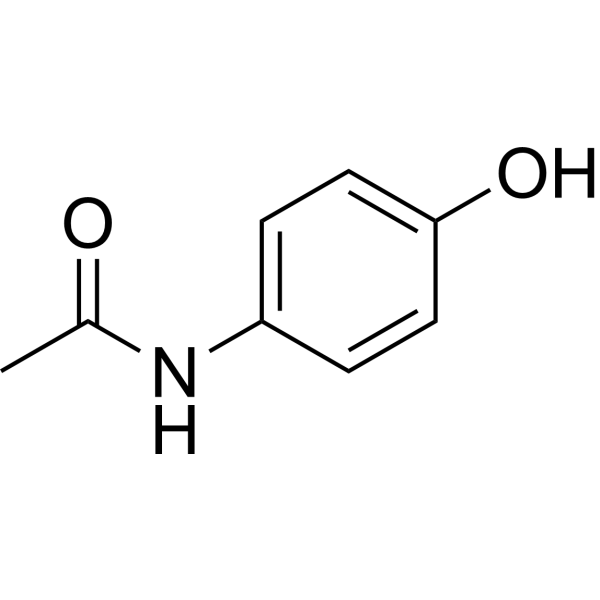
    Acetaminophen
    65+ Cited Publications

    Paracetamol; 4-Acetamidophenol; 4'-Hydroxyacetanilide

    Environmental Pollutants Endogenous Metabolite COX Histone Acetyltransferase Parasite Bacterial Ferroptosis Inflammation/Immunology Cancer
    Acetaminophen (Paracetamol) is a selective cyclooxygenase-2 (COX-2) inhibitor with an IC50 of 25.8 μM; is a widely used antipyretic and analgesic agent. . Acetaminophen is a potent hepatic N-acetyltransferase 2 (NAT2) inhibitor . Acetaminophen induces ferroptosis and leads to acute liver injury in mice model .
    Acetaminophen
  • HY-42682
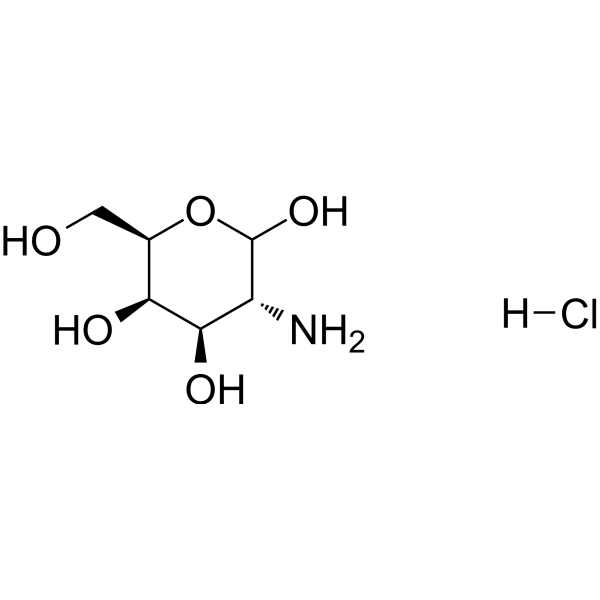
    D(+)-Galactosamine hydrochloride
    3 Publications Verification

    D-Galactosamine HCl

    Drug Derivative Inflammation/Immunology
    D(+)-Galactosamine (D-Galactosamine) hydrochloride, which is an established experimental toxin, primarily causes liver injury by the generation of free radicals and depletion of UTP nucleotides. D(+)-Galactosamine hydrochloride intoxication also induces renal dysfunction thus, renal failure is often associated with the end-stage of the liver damage. Lipopolysaccharide/D(+)-Galactosamine-induced acute liver injury is a known animal model of fulminant hepatic failure .
    D(+)-Galactosamine hydrochloride
  • HY-163897

    PROTACs Ferroptosis Reactive Oxygen Species (ROS) Inflammation/Immunology
    PROTAC NCOA4 degrader-1 is a VHL-based PROTAC NCOA4 degrader. PROTAC NCOA4 degrader-1 is a ferroptosis inhibitor. PROTAC NCOA4 degrader-1 reduces Fe 2+ elevation, ROS production, MDA content and PTGS2 mRNA expression. PROTAC NCOA4 degrader-1 ameliorates liver damage in a CCl4-induced acute liver injury model. PROTAC NCOA4 degrader-1 can be used for the researches of inflammation and immunology. (Pink: NCOA4 ligand (HY-149457). Black: linker (HY-163903). Blue: VHL ligand (HY-138678B)) .
    PROTAC NCOA4 degrader-1
  • HY-108292

    NF-κB Neurological Disease Cancer
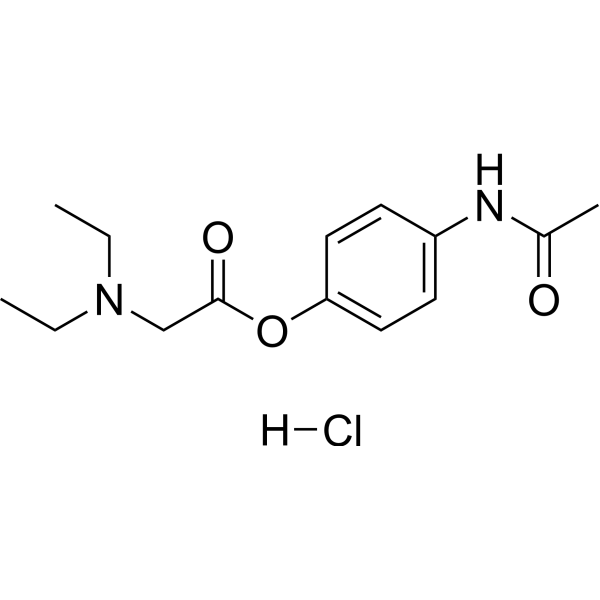
    Propacetamol hydrochloride is an orally active prodrug of paracetamol and an inducer of acute liver injury models, with multiple properties including antinociception, antioxidation and gastroprotection. Propacetamol hydrochloride potentiates Tramadol and attenuates Aspirin (HY-14654)-induced gastric mucosal damage and lipid peroxidation. Under specific conditions, Propacetamol hydrochloride also acts as a hepatotoxic inducer, triggering acute liver injury, oxidative stress and apoptosis, with strain differences in toxicity sensitivity. Propacetamol hydrochloride can be used in the research of acute liver injury, drug-induced hepatotoxicity and gastric mucosal damage .
    Propacetamol hydrochloride
  • HY-121983
    CAY10594
    1 Publications Verification

    Phospholipase Apoptosis GSK-3 Anaplastic lymphoma kinase (ALK) STAT Interleukin Related G Protein-coupled Receptor Kinase (GRK) CXCR Lactate Dehydrogenase Inflammation/Immunology Cancer
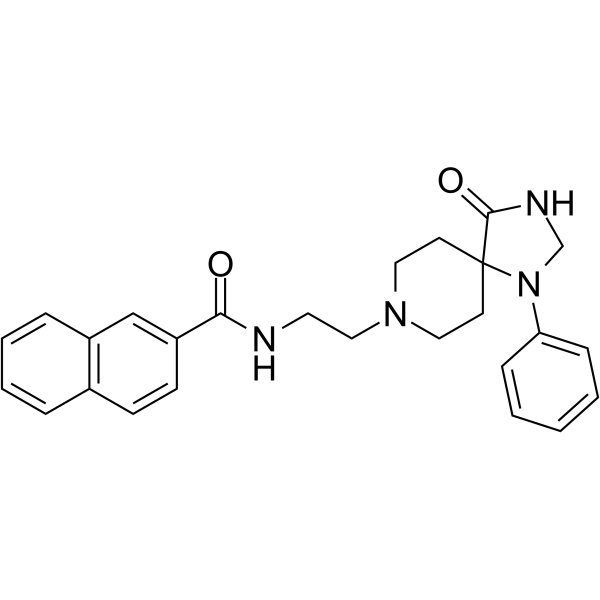
    CAY10594 is an orally active PLD2 inhibitor with an IC50 of 140 nM. CAY10594 has activities such as anti-tumor, anti-oxidation and liver protection. CAY10594 can be used for the research of diseases like breast cancer, acute liver injury and colitis .
    CAY10594
  • HY-N3181

    Apoptosis Wnt β-catenin c-Myc Survivin GSK-3 Ferroptosis Keap1-Nrf2 Heme Oxygenase (HO) NF-κB Interleukin Related Cardiovascular Disease Neurological Disease Metabolic Disease Inflammation/Immunology Cancer
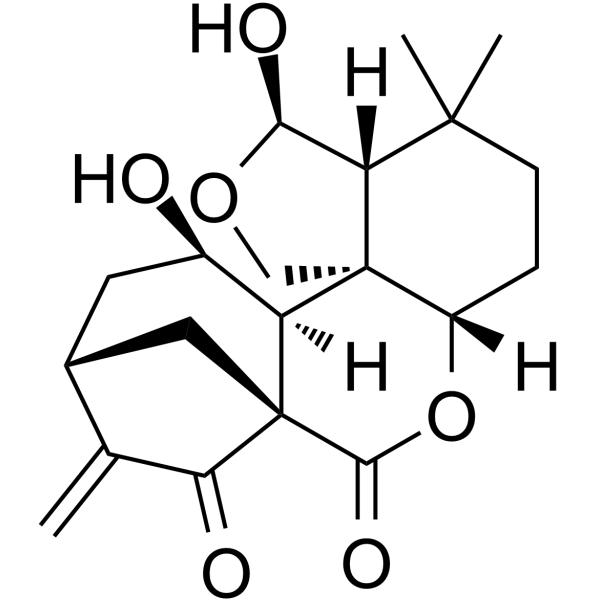
    Nodosin is an orally active diterpenoid compound that can be isolated from Isodon serra. Nodosin can inhibit the proliferation and induce cell cycle arrest and apoptosis of tumor cells. Nodosin can also inhibit oxidative stress, inflammatory responses, and ferroptosis. Nodosin has anti-inflammatory and anti-tumor activities .
    Nodosin
  • HY-170362

    Cyclic GMP-AMP Synthase Inflammation/Immunology
    cGAS-IN-4 (Compound 36) is an orally active inhibitor for cyclic GMP-AMP synthase (cGAS) with IC50 of 32 nM and 5.8 nM for h-cGAS and m-cGAS. cGAS-IN-4 inhibits the cGAMP in THP-1 cell with an IC50 of 60 nM, which improves the cellular potency. cGAS-IN-4 exhibits anti-inflammatory efficacy in Concanavalin A (HY-P2149)-induced acute liver injury in mouse models . orally active, THP-1, C57Bl/6 mouse, orally active
    cGAS-IN-4
  • HY-173235

    Galectin Cardiovascular Disease Inflammation/Immunology Cancer
    Galectin-3-IN-6 is a human and murine galectin-3 (Gal-3) inhibitor, with an IC50 of 12 nM against human galectin-3, an IC50 of 12.6 nM against mutant murine galectin-3 (V160A), and a Kd of 13 nM for human galectin-3, as well as oral bioavailability. Galectin-3-IN-6 reduces the levels of liver fibrosis markers type I collagen and α-smooth muscle actin in mouse models of acute liver injury and fibrosis. Galectin-3-IN-6 can be used for the research of acute liver injury and fibrosis .
    Galectin-3-IN-6
  • HY-42682R

    D-Galactosamine HCl (Standard)

    Reference Standards Inflammation/Immunology
    D(+)-Galactosamine (hydrochloride) (Standard) is the analytical standard of D(+)-Galactosamine (hydrochloride). This product is intended for research and analytical applications. D(+)-Galactosamine (D-Galactosamine) hydrochloride, which is an established experimental toxin, primarily causes liver injury by the generation of free radicals and depletion of UTP nucleotides. D(+)-Galactosamine hydrochloride intoxication also induces renal dysfunction thus, renal failure is often associated with the end-stage of the liver damage. Lipopolysaccharide/D(+)-Galactosamine-induced acute liver injury is a known animal model of fulminant hepatic failure .
    D(+)-Galactosamine hydrochloride (Standard)
  • HY-176274

    Fatty Acid Synthase (FASN) Stearoyl-CoA Desaturase (SCD) Reactive Oxygen Species (ROS) Interleukin Related TNF Receptor SOD LDLR Glutathione Peroxidase Metabolic Disease Inflammation/Immunology
    FASN/SCD-IN-1 is a Silybin (HY-N0779A) derivative, an orally active inhibitor of Fatty Acid Synthase (FASN)/Stearoyl-CoA Desaturase (SCD). FASN/SCD-IN-1 has shown in vitro activity in inhibiting lipid deposition, reducing FASN and SCD transcriptional levels, and exhibiting antioxidant, anti-inflammatory, and anti-fibrotic activities. FASN/SCD-IN-1 has demonstrated significant hepatoprotective effects in a rat model of acute liver injury. FASN/SCD-IN-1 ameliorates the pathological features of MASH liver, including steatosis, inflammation, and fibrosis in a mouse model of myeloproliferative steatohepatitis (MASH). FASN/SCD-IN-1 can be used to study MASH .
    FASN/SCD-IN-1
  • HY-175026

    RIP kinase NF-κB p38 MAPK Interleukin Related Inflammation/Immunology
    RIPK2-IN-8 is an orally active and highly selective RIPK2 inhibitor (IC50 = 11 nM). RIPK2-IN-8 is highly selective for RIPK2 over RIPK1 (IC50 > 30,000 nM) and has a moderate inhibitory effect on RIPK3 (IC50 = 44.61 nM). RIPK2-IN-8 inhibits the NOD2-RIPK2 signaling pathway and the expression of the inflammatory cytokines IL-6 and TNFα, thereby exerting anti-inflammatory effects. RIPK2-IN-8 has demonstrated anti-inflammatory and hepatoprotective effects in an acute liver injury (ALI) model and can be used in ALI research .
    RIPK2-IN-8
  • HY-177809

    TNF Receptor Inflammation/Immunology
    aptTNF-α sodium is a TNF-α-targeting aptamer that has tissue protective effect and systemic anti-inflammatory effect upon acute tissue injury using the mouse acute lung injury (ALI) and acute liver failure (ALF) models.
    aptTNF-α sodium
  • HY-168327

    FXR Inflammation/Immunology
    LH10 is a fexaramine-based agonist for FXR with an EC50 of 0.14 μM. LH10 exhibits liver protection efficacy, ameliorates the alpha naphthylisothiocyanate (ANIT)-induced cholestasis, APAP (HY-66005)-induced acute liver injury and non-alcoholic steatohepatitis (NASH) in mouse models .
    LH10
  • HY-169927

    Ferroptosis Inflammation/Immunology
    Ferroptosis-IN-16 (Compound 13l) is a specific inhibitor for ferroptosis with an EC50 of 0.7 nM and 0.9 nM in ES-2 cell and LX-2 cell. Ferroptosis-IN-16 ameliorates Acetaminophen (HY-66005)-induced acute liver injury in mouse model, and exhibits good metabolic stability in mouse liver microsomes .
    Ferroptosis-IN-16
  • HY-N12087

    NF-κB NO Synthase Reactive Oxygen Species (ROS) Inflammation/Immunology
    8-Deoxylactucin is an orally active sesquiterpene lactone. 8-Deoxylactucin inhibits LPS (HY-D1056)-induced NO production in RAW264.7 macrophages with an IC50 value of 4.35 μM. 8-Deoxylactucin exerts anti-inflammatory effects by blocking the NF-κB pathway. 8-Deoxylactucin demonstrates hepatoprotective efficacy in LPS/D-galactosamine-induced acute hepatitis model of mice. 8-Deoxylactucin can be used for the study of inflammatory diseases and inflammatory liver injuries .
    8-Deoxylactucin
  • HY-N18091

    Akt GSK-3 Keap1-Nrf2 NF-κB Apoptosis Infection Neurological Disease Metabolic Disease Inflammation/Immunology Cancer
    Tovophyllin A is an orally active xanthonoid compound. Tovophyllin A exerts neuroprotective effects against Parkinson's disease by activating the Akt/GSK3β signaling pathway. Tovophyllin A protects mouse models of liver injury by activating Nrf2. Tovophyllin A exhibits protective anti-inflammatory activity in mouse models of acute lung injury. Tovophyllin A inhibits the activation of NF-κB and subsequent release of pro-inflammatory cytokines. Tovophyllin A reduces apoptotic cell death (Apoptosis). Tovophyllin A has antiplasmodial activity. Tovophyllin A shows cytotoxic activity against lung epithelial cancer cells and breast cancer cells. Tovophyllin A can be used in research related to Parkinson's disease, liver injury, acute lung injury, lung epithelial cancer, and breast cancer .
    Tovophyllin A
  • HY-19090

    NO Synthase HSP Cardiovascular Disease Inflammation/Immunology
    FK 409 is a NO donor that can penetrate cell membranes. FK 409 has a vasodilatory effect on bovine retinal arteries. FK 409 alleviates acute-phase inflammation, induces HSP, and mitigates liver transplantation injury in a rat model of orthotopic liver transplantation. FK 409 can be used in research on cardiovascular diseases and liver transplant rejection and inflammatory immune system disorders .
    FK 409
  • HY-183589

    Ferroptosis Reactive Oxygen Species (ROS) Metabolic Disease
    Ferroptosis-IN-26 is a CEPT1-targeting ferroptosis inhibitor. Ferroptosis-IN-26 enhances CEPT1-dependent phosphatidylcholine remodeling to enrich cellular membranes with monounsaturated fatty acid-containing phosphatidylcholine (PC-MUFA). Ferroptosis-IN-26 suppresses lipid peroxidation. Ferroptosis-IN-26 can be used for the research of acute liver injury .
    Ferroptosis-IN-26
  • HY-183995

    PROTACs HIF/HIF Prolyl-Hydroxylase Reactive Oxygen Species (ROS) NOD-like Receptor (NLR) Metabolic Disease
    SH-26 is a PHD1 PROTAC degrader with DC50s of 1.06 μM, 4.16 μM and 4.91 μM in MDA-MB-231, HepG2 and HEK-293T cells, respectively. SH-26 recruits CRBN to induce PHD1 degradation via the ubiquitin-proteasome system. SH-26 attenuates APAP (HY-66005)-triggered ROS accumulation, mitochondrial dysfunction, and NLRP3 inflammasome activation. SH-26 can be used for the research of acute liver injury .
    SH-26

Inquiry Online

Your information is safe with us. * Required Fields.

Salutation


Country or Region *

Applicant Name *


Organization Name *

Department *


Email Address *


Product Name *

Cat. No.


Requested quantity *

Phone Number *


Remarks

Inquiry Online

Inquiry Information

Product Name:
Cat. No.:
Quantity:
MCE Japan Authorized Agent:

