



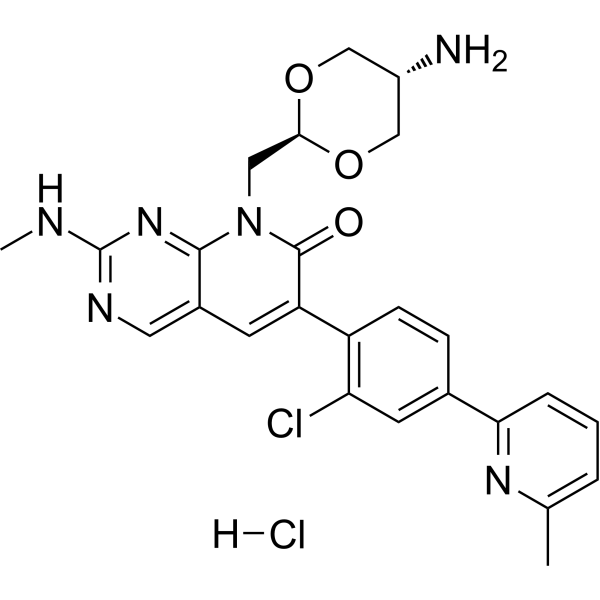
G-5555 hydrochloride
Based on 7 publication(s) in Google Scholar
G-5555 hydrochloride is a potent and selective p21-activated kinase 1 (PAK1) inhibitor with a Ki of 3.7 nM.
For research use only. We do not sell to patients.
- Purity : 99.90%
- CAS No.: 2319590-15-1
- Formula: C25H26Cl2N6O3
- Molecular Weight:529.42
-
Storage:
4°C, sealed storage, away from moisture
* In solvent : -80°C, 6 months; -20°C, 1 month (sealed storage, away from moisture)

To place orders, for customer services and technical support, please contact: MedChemExpress USA
Tel: 609-228-6898 E-mail: [email protected] [email protected]


-
 Biological Activity
-
Chemical Information
-
Solvent & Solubility
- Purity & Documentation
- References
-
 Help & FAQs


Publications Citing Use of MedChemExpress (MCE) G-5555 hydrochloride
More- Nat Commun. 2026 Feb 12;17(1):1214. [Abstract]
- Acta Pharm Sin B. 2020 Apr;10(4):603-614. [Abstract]
- Endocr Relat Cancer. 2019 Aug;26(8):699-712. [Abstract]
- PLoS One. 2024 Jul 31;19(7):e0305121. [Abstract]
- Exp Hematol. 2023 Nov:127:59-69.e2. [Abstract]
- Research Square Preprint. 2021 Apr.
- Elife. 2017 Mar 13:6:e22207. [Abstract]
 Customer Validation & Images

-
Cell Proliferation/Viability Assay
-
WB
-
Flow Cytometry
-
Cell Migration/Invasion Assay

-
IHC


Biological Activity
Description
IC50 & Target
[2]|
PAK1 3.7 nM (Ki) |
PAK2 11 nM (Ki) |
In Vitro
G-5555 shows excellent kinase selectivity and inhibits only eight out of the 235 kinases tested other than PAK1 with inhibition >70%: PAK2, PAK3, KHS1, Lck, MST3, MST4, SIK2, and YSK1. The IC50s of G-5555 against SIK2, PAK2, KHS1, MST4, YSK1, MST3 and Lck are 9, 11, 10, 20, 34, 43, 52 nM, respectively. In general, G-5555 demonstrates high selectivity for the group I PAKs. There is negligible activity for G-5555 against the hERG channel with IC50 more than 10 μM in a patch clamp assay[1]. In an array of 23 breast cancer cell lines, G-5555 has significantly greater growth inhibitory activity in cell lines that are PAK-amplified compared to non-amplified lines[2].
MedChemExpress (MCE) has not independently confirmed the accuracy of these methods. They are for reference only. .
In Vivo
MedChemExpress (MCE) has not independently confirmed the accuracy of these methods. They are for reference only.


Chemical Information
-
CAS No. 2319590-15-1
-
Appearance Solid
-
Molecular Weight 529.42
-
Formula C25H26Cl2N6O3
-
Color Light yellow to yellow
-
SMILES
ClC(C=C(C1=NC(C)=CC=C1)C=C2)=C2C3=CC4=CN=C(NC)N=C4N(C[C@@H]5OC[C@@H](N)CO5)C3=O.[H]Cl
-
Shipping
Room temperature in continental US; may vary elsewhere.
-
Storage
4°C, sealed storage, away from moisture
* In solvent : -80°C, 6 months; -20°C, 1 month (sealed storage, away from moisture)


Publications (7)
-
Journal Impact Factor
-
Most Recent
-
Nat Commun
Human iPSC-based Modeling of Pulmonary Fibrosis Reveals p300/CBP Inhibition Suppresses Alveolar Transitional Cell State. [Abstract]2026 Feb 12;17(1):1214. PMID: 41680175 -
Acta Pharm Sin B
2020 Apr;10(4):603-614. PMID: 32322465 -
Endocr Relat Cancer
2019 Aug;26(8):699-712. PMID: 31146260
G-5555 hydrochloride purchased from MedChemExpress. Usage Cited in: Endocr Relat Cancer. 2019 Aug;26(8):699-712. [Abstract]
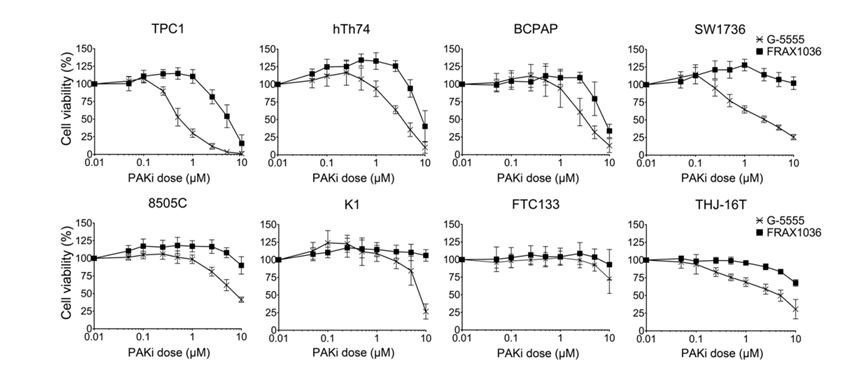
A panel of eight thyroid cancer cell lines was treated with increasing doses of G-5555 or FRAX1036 for 72 hours. Cell viability was determined by colorimetric WST-8 assay.
G-5555 hydrochloride purchased from MedChemExpress. Usage Cited in: Endocr Relat Cancer. 2019 Aug;26(8):699-712. [Abstract]
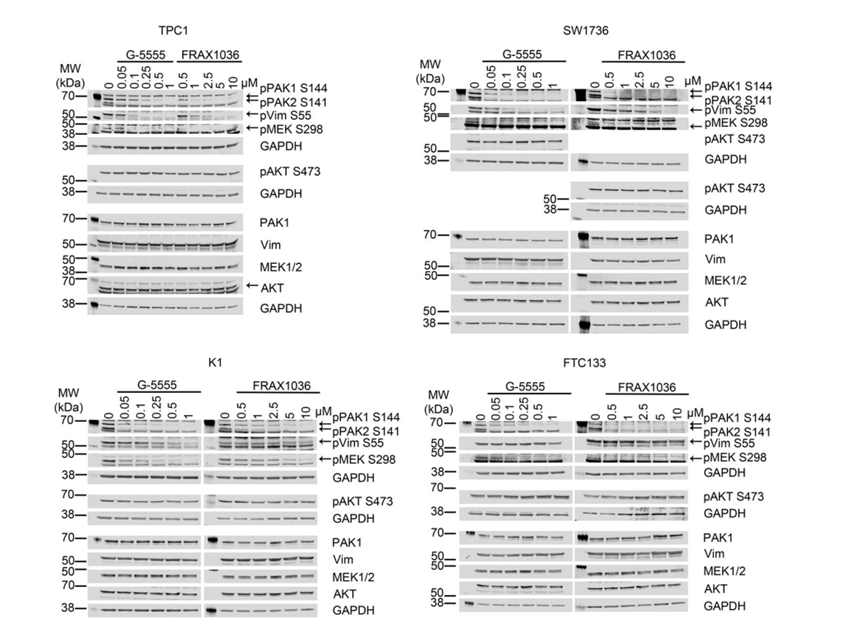
TPC1, SW1736, K1, and FTC133 cells were treated with increasing doses of G-5555 or FRAX1036 for 24 hours to avoid significant toxicity. Western blots of downstream PAK targets were conducted to confirm drug activity.
G-5555 hydrochloride purchased from MedChemExpress. Usage Cited in: Endocr Relat Cancer. 2019 Aug;26(8):699-712. [Abstract]
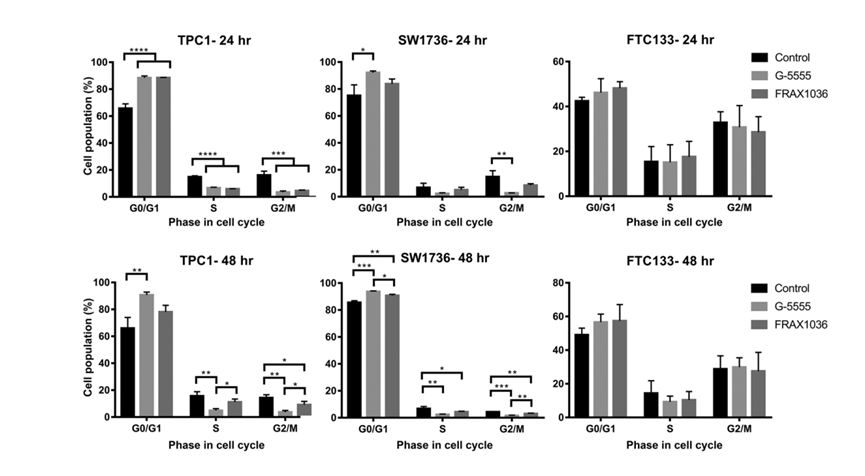
TPC1, SW1736, and FTC133 were treated with DMSO, 0.5 μM G-5555, or 5 μM FRAX1036 for 24 or 48 hours. Cells were stained with propidium iodide and analyzed by flow cytometry for relative DNA amount.
G-5555 hydrochloride purchased from MedChemExpress. Usage Cited in: Endocr Relat Cancer. 2019 Aug;26(8):699-712. [Abstract]
Representative images of invading cells treated with 0.25 μM G-5555.
G-5555 hydrochloride purchased from MedChemExpress. Usage Cited in: Endocr Relat Cancer. 2019 Aug;26(8):699-712. [Abstract]
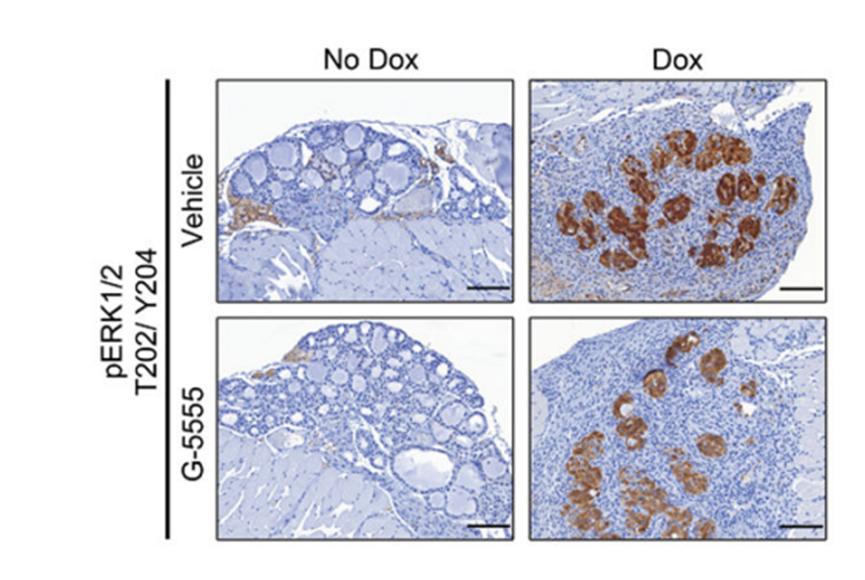
Representative pERK1/2 T202/Y204 IHC images showing induction of BRAFV600E in the thyrocytes with Dox treated with G-5555 (25 mg/kg, i.g.).
-
PLoS One
Synergistic effect of PAK and Hippo pathway inhibitor combination in NF2-deficient Schwannoma. [Abstract]2024 Jul 31;19(7):e0305121. PMID: 39083549 -
Exp Hematol
Inhibition of PAK1 generates an ameliorative effect on MPLW515L mouse model of myeloproliferative neoplasms by regulating the differentiation and survival of the megakaryocytes. [Abstract]2023 Nov:127:59-69.e2. PMID: 37741606 -
-
Elife
p27Kip1 promotes invadopodia turnover and invasion through the regulation of the PAK1/Cortactin pathway. [Abstract]2017 Mar 13:6:e22207. PMID: 28287395


Solvent & Solubility
In Vitro:
DMSO : 100 mg/mL (188.89 mM; Need ultrasonic; Hygroscopic DMSO has a significant impact on the solubility of product, please use newly opened DMSO)
H2O : 16.67 mg/mL (31.49 mM; Need ultrasonic)
Please refer to the solubility information to select the appropriate solvent. Once prepared, please aliquot and store the solution to prevent product inactivation from repeated freeze-thaw cycles.
Storage method and period of stock solution: -80°C, 6 months; -20°C, 1 month (sealed storage, away from moisture). When stored at -80°C, please use it within 6 months. When stored at -20°C, please use it within 1 month.
* Note: If you choose water as the stock solution, please dilute it to the working solution, then filter and sterilize it with a 0.22 μm filter before use.
Please refer to the solubility information to select the appropriate solvent. Once prepared, please aliquot and store the solution to prevent product inactivation from repeated freeze-thaw cycles.
Storage method and period of stock solution: -80°C, 6 months; -20°C, 1 month (sealed storage, away from moisture). When stored at -80°C, please use it within 6 months. When stored at -20°C, please use it within 1 month.
* Note: If you choose water as the stock solution, please dilute it to the working solution, then filter and sterilize it with a 0.22 μm filter before use.
Concentration (start) × Volume (start) = Concentration (final) × Volume (final)
In Vivo:
Select the appropriate dissolution method based on your experimental animal and administration route.
- For the following dissolution methods, please ensure to first prepare a clear stock solution using an In Vitro approach and then sequentially add co-solvents:
- To ensure reliable experimental results, the clarified stock solution can be appropriately stored based on storage conditions. As for the working solution for In Vivo experiments, it is recommended to prepare freshly and use it on the same day.
- The percentages shown for the solvents indicate their volumetric ratio in the final prepared solution. If precipitation or phase separation occurs during preparation, heat and/or sonication can be used to aid dissolution.
Add each solvent one by one: 10% DMSO 40% PEG300 5% Tween-80 45% Saline
Solubility: ≥ 2.5 mg/mL (4.72 mM); Clear solution
This protocol yields a clear solution of ≥ 2.5 mg/mL (saturation unknown).
Taking 1 mL working solution as an example, add 100 μL DMSO stock solution (25.0 mg/mL) to 400 μL PEG300, and mix evenly; then add 50 μL Tween-80 and mix evenly; then add 450 μL Saline to adjust the volume to 1 mL.
Preparation of Saline: Dissolve 0.9 g sodium chloride in ddH₂O and dilute to 100 mL to obtain a clear Saline solution.
Add each solvent one by one: 10% DMSO 90% (20% SBE-β-CD in Saline)
Solubility: ≥ 2.5 mg/mL (4.72 mM); Clear solution
This protocol yields a clear solution of ≥ 2.5 mg/mL (saturation unknown).
Taking 1 mL working solution as an example, add 100 μL DMSO stock solution (25.0 mg/mL) to 900 μL 20% SBE-β-CD in Saline, and mix evenly.
Preparation of 20% SBE-β-CD in Saline (4°C, storage for one week): 2 g SBE-β-CD powder is dissolved in 10 mL Saline, completely dissolve until clear.
In Vivo Dissolution Calculator
Please enter the basic information of animal experiments:
-
-
-
-
Recommended: Prepare an additional quantity of animals to account for potential losses during experiments.
Working solution concentration: 0.22 mg/mL
This product has good water solubility, please refer to the measured solubility data in water/PBS/Saline for details.


Purity & Documentation
-
Data Sheet (283 KB)
-
SDS (252 KB)
- English - EN (252 KB)
- Français - FR (252 KB)
- Deutsch - DE (252 KB)
- Norwegian - NO (252 KB)
- Español - ES (252 KB)
- Swedish - SV (252 KB)
- Italian - IT (252 KB)
- Korean - KR (252 KB)
- Portuguese - PT (252 KB)
-
Handling Instructions (2659 KB)
References
[1]. Ndubaku CO, et al. Design of Selective PAK1 Inhibitor G-5555: Improving Properties by Employing an Unorthodox Low-pK a Polar Moiety. ACS Med Chem Lett. 2015 Oct 31;6(12):1241-6. [Content Brief]
[2]. Rudolph J, et al. Chemically Diverse Group I p21-Activated Kinase (PAK) Inhibitors Impart Acute Cardiovascular Toxicity with a Narrow Therapeutic Window. J Med Chem. 2016 Jun 9;59(11):5520-41. [Content Brief]


Complete Stock Solution Preparation Table
Please refer to the solubility information to select the appropriate solvent. Once prepared, please aliquot and store the solution to prevent product inactivation from repeated freeze-thaw cycles.
Storage method and period of stock solution: -80°C, 6 months; -20°C, 1 month (sealed storage, away from moisture). When stored at -80°C, please use it within 6 months. When stored at -20°C, please use it within 1 month.
| Optional Solvent | Concentration Solvent Mass | 1 mg | 5 mg | 10 mg | 25 mg |
|---|---|---|---|---|---|
| H2O / DMSO | 1 mM | 1.8889 mL | 9.4443 mL | 18.8886 mL | 47.2215 mL |
| 5 mM | 0.3778 mL | 1.8889 mL | 3.7777 mL | 9.4443 mL | |
| 10 mM | 0.1889 mL | 0.9444 mL | 1.8889 mL | 4.7221 mL | |
| 15 mM | 0.1259 mL | 0.6296 mL | 1.2592 mL | 3.1481 mL | |
| 20 mM | 0.0944 mL | 0.4722 mL | 0.9444 mL | 2.3611 mL | |
| 25 mM | 0.0756 mL | 0.3778 mL | 0.7555 mL | 1.8889 mL | |
| 30 mM | 0.0630 mL | 0.3148 mL | 0.6296 mL | 1.5740 mL | |
| DMSO | 40 mM | 0.0472 mL | 0.2361 mL | 0.4722 mL | 1.1805 mL |
| 50 mM | 0.0378 mL | 0.1889 mL | 0.3778 mL | 0.9444 mL | |
| 60 mM | 0.0315 mL | 0.1574 mL | 0.3148 mL | 0.7870 mL | |
| 80 mM | 0.0236 mL | 0.1181 mL | 0.2361 mL | 0.5903 mL | |
| 100 mM | 0.0189 mL | 0.0944 mL | 0.1889 mL | 0.4722 mL |
* Note: If you choose water as the stock solution, please dilute it to the working solution, then filter and sterilize it with a 0.22 μm filter before use.


G-5555 hydrochloride Related Classifications
HY-19635A Related Classifications
 Powered by Bioz