



PAK6
PAK6 (p21-activated kinase 6) is a serine/threonine kinase belonging to the group II PAK family and functions as a downstream effector within Rho GTPase-associated signaling networks that regulate transcription, cytoskeletal organization, cell motility, and cellular behavior[1][2]. PAK6 was originally identified as an androgen receptor (AR)-interacting kinase, and mechanistically it modulates AR-dependent signaling through direct interaction, phosphorylation, and repression of AR transcriptional activity, establishing a functional link between kinase signaling and steroid hormone responses[3][4]. In addition to AR-associated regulation, PAK6 participates in signaling pathways that influence cell adhesion dynamics and cellular morphology, supporting its role in coordinating cytoskeletal remodeling and migratory behavior[1][5]. Disease studies have connected altered PAK6 expression or activity with prostate cancer, hepatocellular carcinoma, and other malignancies, where PAK6-dependent signaling has been implicated in tumor progression, survival, therapeutic response, or regulation of tumorigenic pathways[6][7]. Compared with the closely related group II isoforms PAK4 and PAK5, PAK6 shares highly similar substrate-recognition characteristics yet displays distinctive biological functions through its established involvement in androgen receptor signaling and tissue-specific physiological phenotypes[2][3]. For experimental applications, structural and biochemical studies have demonstrated that PAK6 activity can be inhibited by ATP-competitive compounds including PF-3758309 and sunitinib, providing useful pharmacological tools for investigating type II PAK signaling and kinase-dependent cellular mechanisms[2].
References:
- [1]. Eswaran J, et al. UnPAKing the class differences among p21-activated kinases. Trends Biochem Sci. 2008 Aug;33(8):394-403. [Content Brief]
- [2]. Gao J, et al. Substrate and inhibitor specificity of the type II p21-activated kinase, PAK6. PLoS One. 2013 Oct 28;8(10):e77818. [Content Brief]
- [3]. Yang F, et al. Androgen receptor specifically interacts with a novel p21-activated kinase, PAK6. J Biol Chem. 2001 May 4;276(18):15345-53. [Content Brief]
- [4]. Schrantz N, et al. Mechanism of p21-activated kinase 6-mediated inhibition of androgen receptor signaling. J Biol Chem. 2004 Jan 16;279(3):1922-31. [Content Brief]
- [5]. Khalili M, et al. Underserved Does Not Mean Undeserved: Unfurling the HCV Care in the Safety Net. Dig Dis Sci. 2018 Dec;63(12):3250-3252. [Content Brief]
- [6]. Liu T, et al. p21-Activated kinase 6 (PAK6) inhibits prostate cancer growth via phosphorylation of androgen receptor and tumorigenic E3 ligase murine double minute-2 (Mdm2). J Biol Chem. 2013 Feb 1;288(5):3359-69. [Content Brief]
- [7]. Liu W, et al. Tumor Suppressive Function of p21-activated Kinase 6 in Hepatocellular Carcinoma. J Biol Chem. 2015 Nov 20;290(47):28489-28501. [Content Brief]
All Product Categories
-
PAK6 Related Products (3)
Related Products (3)

-
PF-3758309
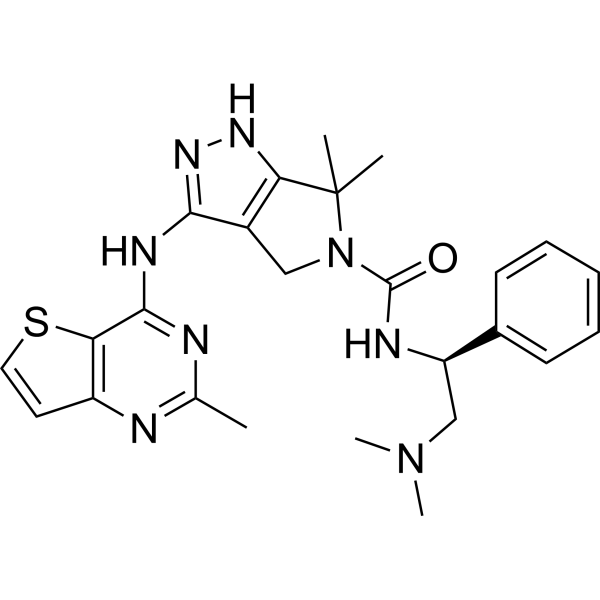 0 ImagesSynonyms: PF-03758309PF-3758309 (PF-03758309) is a potent, orally available, and reversible ATP-competitive inhibitor of PAK4 (Kd= 2.7 nM; Ki=18.7 nM). PF-3758309 has the expected cellular functions of a PAK4 inhibitor: inhibition of anchorage-independent growth, induction of apoptosis, cytoskeletal remodeling, and inhibition of proliferation.
-
PF-3758309 hydrochloride
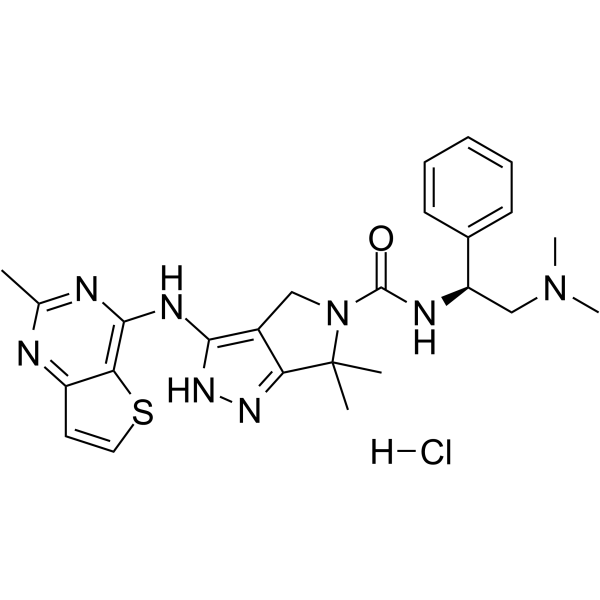 0 ImagesCat. No.: HY-13007ACAS No.: 1279034-84-2Synonyms: PF-03758309 hydrochloridePF-3758309 (PF-03758309) hydrochloride is a potent, orally available, and reversible ATP-competitive inhibitor of PAK4 (Kd= 2.7 nM; Ki=18.7 nM). PF-3758309 hydrochloride has the expected cellular functions of a PAK4 inhibitor: inhibition of anchorage-independent growth, induction of apoptosis, cytoskeletal remodeling, and inhibition of proliferation.
-
PF-3758309 dihydrochloride
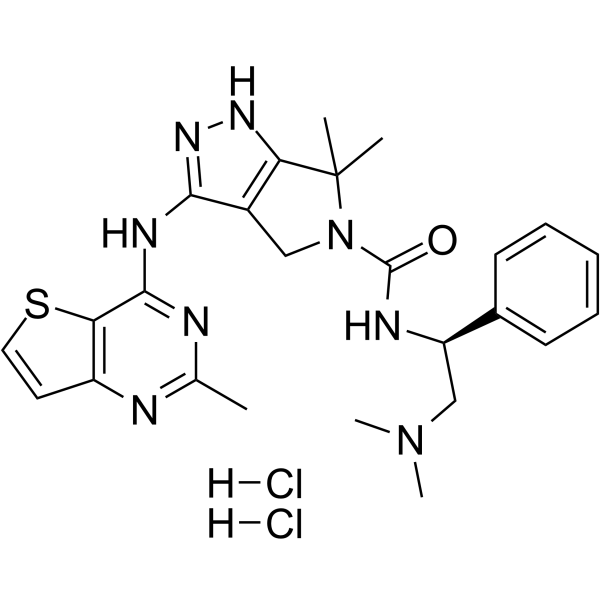 0 ImagesCat. No.: HY-13007BSynonyms: PF-03758309 dihydrochloridePF-3758309 (PF-03758309) dihydrochloride is a potent, orally available, and reversible ATP-competitive inhibitor of PAK4 (Kd= 2.7 nM; Ki=18.7 nM). PF-3758309 dihydrochloride has the expected cellular functions of a PAK4 inhibitor: inhibition of anchorage-independent growth, induction of apoptosis, cytoskeletal remodeling, and inhibition of proliferation.



