



Keap1-Nrf2
Keap1-Nrf2 is the major regulator of cytoprotective responses to electrophilic chemicals or reactive oxygen species (ROS). Keap1 is an E3 ligase, which induces the degradation of Nrf2 by ubiquitin-proteasome system (UPS). Upregulation of Nrf2 inducing by inactivation of Keap1 is often observed in cancer cells. Aberrant activation of Nrf2 in cancer cells accelerates proliferation and metabolism. For this case, Nrf2 is an attractive molecule as a therapeutic target in cancer and a lot number of Nrf2 inhibitors are developed. What’s interesting, Nrf2 induction is also reported to be treatment strategies for accelerating the detoxification of carcinogens and protect the body from chemical carcinogenesis.
All Product Categories
-
Keap1-Nrf2 Related Products (525)
Related Products (525)

-
Antibodies (7)
-
TLR4/NF-κB-IN-2
 0 ImagesCat. No.: HY-181765TLR4/NF-κB-IN-2 is an orally active TLR4/NF-κB inhibitor and Nrf2/HO-1 activator. TLR4/NF-κB-IN-2 combats oxidative stress and exerts anti-inflammatory effects by regulating the Nrf2/HO-1 and TLR4/NF-κB pathways. TLR4/NF-κB-IN-2 reduces Aβ aggregation and protects neurons. TLR4/NF-κB-IN-2 can be used in the research of Alzheimer's disease.
-
S21-1011
 0 ImagesCat. No.: HY-161643CAS No.: 2671859-87-1S21-1011 is a selective inhibitor for butyrylcholinesterase (BChE), with IC50 of 0.059 and 0.162 μM, for eqBChE and hBChE, respectively. S21-1011 exhibits good blood-brain barrier (BBB) permeability and good pharmacokinetic characters. S21-1011 exhibits anti-inflammatory activity through activation of keap1-Nrf2-ARE pathway (EC50 is 23.48 μM for antioxidant element ARE activation), ameliorates cognitive impairment in murine Alzheimer’s disease model.
-
P2Y1 antagonist 4
 0 ImagesCat. No.: HY-175675CAS No.: 3104888-50-5P2Y1 antagonist 4 is a selective P2Y1 receptor antagonist with excellent blood-brain barrier (BBB) penetration. P2Y1 antagonist 4 inhibits P2Y1 receptor-mediated cytosolic Ca2+ increase (IC50 = 1.95 μM) and platelet aggregation (IC50 = 3.24 μM) induced by ADP in rabbit washed platelets. P2Y1 antagonist 4 significantly upregulates the level of nuclear Nrf2 protein in H2O2-treated HT22 cells. P2Y1 antagonist 4 reduces myocardial infarct size in a mouse acute myocardial infarction (MI) model. P2Y1 antagonist 4 can be used for the study of ischemic stroke and myocardial infarction.
-
Stigmane B
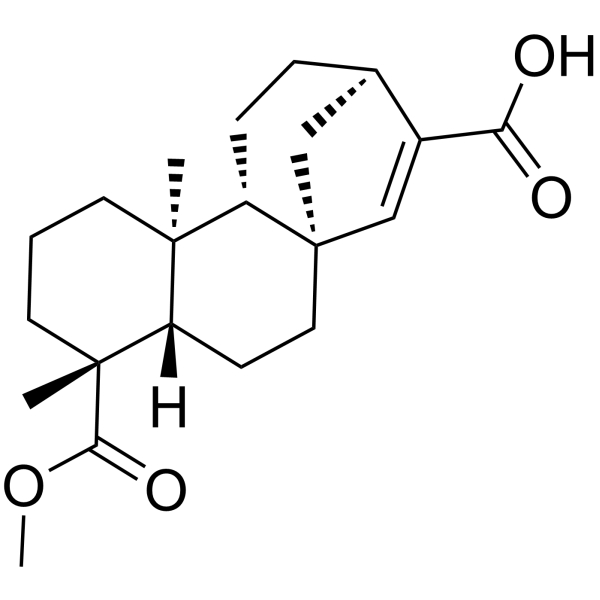 0 ImagesCat. No.: HY-N10431Stigmane B (Compound 2) is a nuclear factor E2-related factor (Nrf2) activator. Stigmane B downregulates apoptosis and reactive oxygen species (ROS) generation, and increases antioxidant enzyme activities. Stigmane B shows neuroprotective effects.
-
Nrf2 activator-27
 0 ImagesCat. No.: HY-184690Nrf2 activator-27 is a Nrf2 activator with anti-inflammatory activity. Nrf2 activator-27 increases the expression level of Nrf2, promotes its nuclear translocation, and upregulates the downstream target proteins HO-1 and NQO1. Nrf2 activator-27 reduces the production of NO, TNF-α, IL-1β and IL-6 in LPS-stimulated macrophages. Nrf2 activator-27 can be used for the research of inflammation-related diseases.
-
Loganin (Standard)
 0 ImagesSynonyms: Loganoside (Standard)Loganin (Standard) is the analytical standard of Loganin. This product is intended for research and analytical applications. Loganin is a type of iridoid glycoside compound that possesses anti-inflammatory, antioxidant, and antitumor properties, and offers protective effects against acute lung injury and pulmonary fibrosis. Loganin exerts its protective effects against LPS (HY-D1056)-mediated inflammation and oxidative stress by upregulating the Nrf2/HO-1 signaling pathway, and it reduces neuroinflammation caused by spinal cord injury (SCI).

-
Ginnalin A
 0 ImagesCat. No.: HY-N17603CAS No.: 76746-56-0Synonyms: AcertanninGinnalin A (Acertannin) is a Nrf2 activator. Ginnalin A shows antiproliferative activity against HCT116, SW480 and SW620 cells with IC50 values of 24.8, 22.0, and 39.7 μM, respectively. Ginnalin A can induce cancer cells S phase arrest. Ginnalin A can activate the p62-Keap1-Nrf2 signaling pathway, significantly upregulate the mRNA and protein expression of Nrf2, HO-1, and NQO1, and promote the transport of Nrf2 from the cytoplasm to the nucleus. Ginnalin A can be used for the research of colon cancer.
-
Nrf2 activator-20
 0 ImagesCat. No.: HY-175217CAS No.: 89883-16-9Nrf2 activator-20 is a potent Nrf2 activator with anti-inflammatory and antioxidant activities. Nrf2 activator-20 activates the anti-inflammatory pathway by interfering with the Keap1-Nrf2 interaction and is beneficial in vivo. Nrf2 activator-20 can be used for the study of acute respiratory distress syndrome (ARDS) and ischemia-reperfusion injury.
-
3-Hydroxyphenylacetic acid-d5
 0 ImagesCat. No.: HY-W001083S12-(3-Hydroxyphenyl-2,4,6-d3)acetic-2,2-d2 acid is the deuterium labeled 3-Hydroxyphenylacetic acid (HY-W001083). 3-Hydroxyphenylacetic acid is an orally active flavonoid metabolite produced by intestinal flora, with blood pressure-lowering activity. 3-Hydroxyphenylacetic acid can also inhibit ferroptosis by upregulating the expression of GPX4, thereby improving spermatogenic dysfunction in aged mice. In addition, abnormal levels of 3-Hydroxyphenylacetic acid are closely related to certain diseases, such as autism spectrum disorders.
-
Dendrobine (Standard)
 0 ImagesDendrobine (Standard) is the analytical standard of Dendrobine. This product is intended for research and analytical applications. Dendrobine is an alkaloid isolated from Dendrobium nobile. Dendrobine possesses antiviral activity against influenza A viruses, with IC50s of 3.39 μM, 2.16 μM and 5.32 μM for A/FM-1/1/47 (H1N1), A/Puerto Rico/8/34 H274Y (H1N1) and A/Aichi/2/68 (H3N2), respectively. Dendrobine activates the JNK/p38/Nrf2 signaling pathway. Dendrobine exhibits antiviral, antitumor, anti-inflammatory, and neuroprotective properties.
-
Rosolic acid
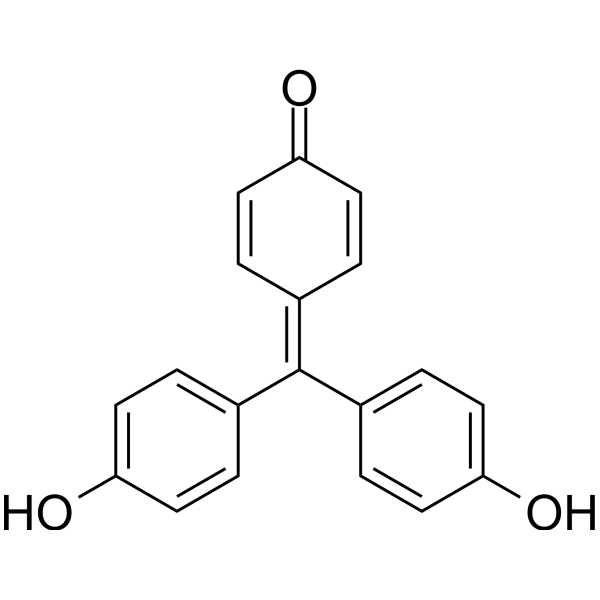 0 ImagesCat. No.: HY-W104821CAS No.: 603-45-2Rosolic Acid is an activator of Nrf2, as well as its downstream targets. Rosolic Acid increases the levels of angiogenic factors, decreases inflammation (TNF-α and IL-1β) and apoptotic markers (CXCL10 and CCL2). Rosolic Acid restores the function of pancreatic cells and protects endothelial cells (ECs) from endoplasmic reticulum stressed.
-
2-Trifluoromethyl-2'-methoxychalcone
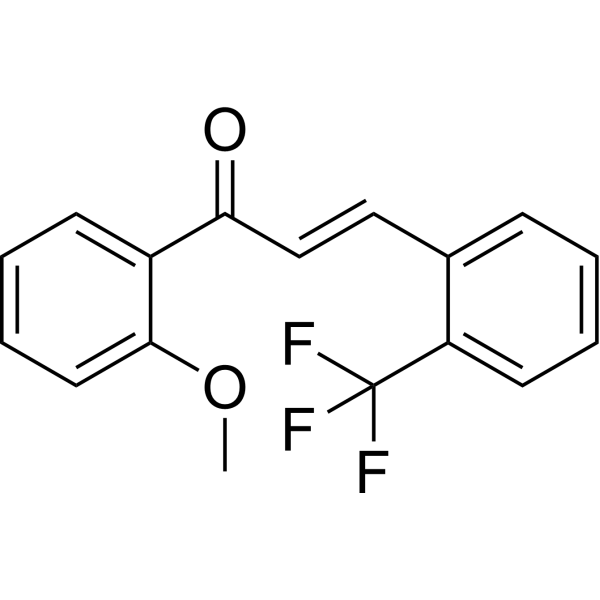 0 ImagesCat. No.: HY-124345CAS No.: 1309371-03-62-Trifluoromethyl-2'-methoxychalcone is a chalcone derivative. 2-Trifluoromethyl-2'-methoxychalcone is a potent Nrf2 activator. 2-Trifluoromethyl-2'-methoxychalcone can be used for oxidative stress and inflammation related diseases research.
-
3-Hydroxyphenylacetic acid (Standard)
 0 Images3-Hydroxyphenylacetic acid (Standard) is the analytical standard of 3-Hydroxyphenylacetic acid (HY-W001083). This product is intended for research and analytical applications. 3-Hydroxyphenylacetic acid is an orally active flavonoid metabolite produced by intestinal flora, with blood pressure-lowering activity. 3-Hydroxyphenylacetic acid can also inhibit ferroptosis by upregulating the expression of GPX4, thereby improving spermatogenic dysfunction in aged mice. In addition, abnormal levels of 3-Hydroxyphenylacetic acid are closely related to certain diseases, such as autism spectrum disorders.
-
4-Octyl itaconate (Standard)
 0 ImagesSynonyms: 4-OI (Standard)4-Octyl itaconate (Standard) is the analytical standard of 4-Octyl itaconate. This product is intended for research and analytical applications. 4-Octyl Itaconate is a cell-permeable Itaconate derivative. Itaconate is an anti-inflammatory metabolite that activates Nrf2 via alkylation of KEAP1[1].
-
Resveratrol (GMP)
 0 ImagesResveratrol (GMP) is Resveratrol (HY-16561) produced by using GMP guidelines. GMP small molecules work appropriately as an auxiliary reagent for cell therapy manufacture. Resveratrol (trans-Resveratrol; SRT501), a natural polyphenolic phytoalexin that possesses anti-oxidant, anti-inflammatory, cardioprotective, and anti-cancer properties. Resveratrol (SRT 501) has a wide spectrum of targets including mTOR, JAK, β-amyloid, Adenylyl cyclase, IKKβ, DNA polymerase. Resveratrol also is a specific SIRT1 activator. Resveratrol is a potent pregnane X receptor (PXR) inhibitor. Resveratrol is an Nrf2 activator, ameliorates aging-related progressive renal injury in mice model. Resveratrol increases production of NO in endothelial cells.
-
17-Oxo-4(Z),7(Z),10(Z),13(Z),15(E),19(Z)-docosahexaenoic acid
 0 ImagesCat. No.: HY-139408CAS No.: 1233715-28-0Synonyms: 17-Oxo-DHA; 17-Oxo-4(Z),7(Z),10(Z),13(Z),15(E),19(Z)-DHA17-Oxo-4(Z),7(Z),10(Z),13(Z),15(E),19(Z)-docosahexaenoic acid (17-Oxo-DHA) is a metabolite of lipoxygenase-mediated oxidation of DHA. 17-Oxo-4(Z),7(Z),10(Z),13(Z),15(E),19(Z)-docosahexaenoic acid is a PPARγ agonist and activates a Nrf2 dependent antioxidant reaction.
-
NEPP11
 0 ImagesCat. No.: HY-180327CAS No.: 313051-12-6NEPP11 is a cyclopentenone prostaglandin analogue. NEPP11 can inhibit glutamate-induced HT22 cell death in mouse hippocampus and prevent manganese-induced apoptosis in PC12 cells. NEPP11 can activate Nrf2 and maintain MEK1/2 and ERK1/2 activity by inhibiting c-Raf downregulation. NEPP11 exerts a neuroprotective effect in a mouse model of focal cerebral ischemia caused by permanent middle cerebral artery occlusion.
-
PIISVYWK
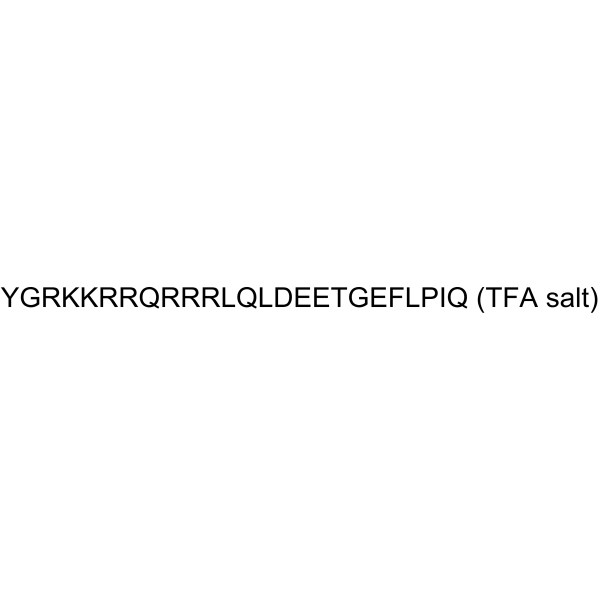
 0 ImagesCat. No.: HY-P11589CAS No.: 2016043-80-2PIISVYWK is an orally active PPARγ Inhibitor, heme oxygenase-1 Activator, and Nrf2 Activator. PIISVYWK mediates activity via the HO-1/Nrf2 pathway, ameliorates oxidative stress, reduces inflammation, and mediates anti-obesity activity. PIISVYWK can be used for the research of obesity.




