



Adrenocorticotropic hormone
Based on 1 publication(s) in Google Scholar
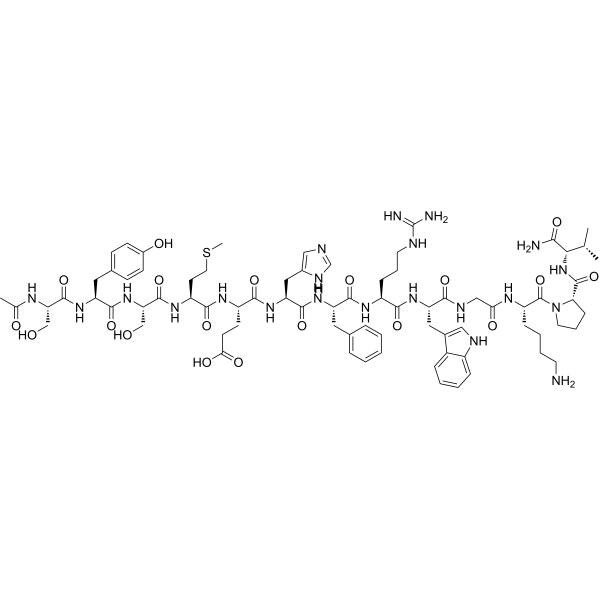
Adrenocorticotropic hormone (ACTH; Adrenocorticotrophic hormone) is a polypeptide tropic hormone produced by the anterior pituitary gland. Adrenocorticotropic hormone stimulates cortisol secretion from the adrenal cortex via the hypothalamic-pituitary-adrenal (HPA) axis. Adrenocorticotropic hormone regulates cortisol and androgen production. Adrenocorticotropic hormone can promote the development of spermatogenesis. Adrenocorticotropic hormone can relieve acute inflammation in gout models by inhibiting the polarization of macrophages to M1 type, inhibiting ROS and proinflammatory factor production and protecting mitochondrial function. Adrenocorticotropic hormone can be used for the researches of inflammation, endocrinology, metabolic disease, such as gout and nephrotic syndrome.
For research use only. We do not sell to patients.
- Purity : 99.60%
- CAS No.: 9002-60-2
- Formula: C207H308N56O58S
- Molecular Weight:4541.14
-
Storage:
Sealed storage, away from moisture.
Powder -80°C, 2 years , -20°C, 1 year* In solvent : -80°C, 6 months; -20°C, 1 month (sealed storage, away from moisture)

To place orders, for customer services and technical support, please contact: MedChemExpress USA
Tel: 609-228-6898 E-mail: [email protected] [email protected]


-
 Biological Activity
-
Chemical Information
-
Solvent & Solubility
- Purity & Documentation
- References
-
 Help & FAQs


Publications Citing Use of MedChemExpress (MCE) Adrenocorticotropic hormone
More

Biological Activity
Description
IC50 & Target
[3]|
IL-6 |
IL-1β |
In Vitro
Adrenocorticotropic hormone (100 nM, 5weeks) induces clusters development of spermatogenesis isolated from mouse seminiferous tubules and significantly increases the proportion of pre-meiotic cells (CDH-1, VASA, MC2R-positive) and the expression of PLZF, VASA, MC2R, THY-1 genes[2].
Adrenocorticotropic hormone (100 nM, 5weeks) significantly increases the proportion and gene expression of meiotic marker BOULE-positive cells in cells isolated from mouse seminiferous tubules and has no significant effect on the proportion of meiotic marker CREM-positive cells, increases the proportion of post-meiotic marker ACROSIN-positive cells but decreases its gene expression, and has no effect on the expression of SCP3 and PROTAMINE[2].
Adrenocorticotropic hormone (1.25×10⁻⁴-2.5×10⁻⁴ U/ml, 48 h) inhibits phagocytic function in MSU-stimulated THP-1-induced macrophages, promotes the polarization of MSU-stimulated macrophages to M2 type, downregulates the secretion of M1-type proinflammatory factors IL-1β, IL-6, and TNF-α, inhibit ROS production and reduces the opening of mitochondrial permeability transition pores (mPTP) to protect mitochondrial function[3].
Adrenocorticotropic hormone (1.25×10⁻⁴ U/ml, 48 h) regulates the transcription of inflammation-related genes by upregulating genes such as NR1H2, IL-37, and FccRIIIA, and downregulating genes such as NLRP3, MC2R, and MC3R in THP-1-induced macrophages[3].
MedChemExpress (MCE) has not independently confirmed the accuracy of these methods. They are for reference only.
In Vivo
MedChemExpress (MCE) has not independently confirmed the accuracy of these methods. They are for reference only.
-
Animal Model:MSU-induced gout mice models (C57BL/6, 6 weeks)[3]
-
Dosage:0.25 U/mL or 2.5 U/mL
-
Administration:Subcutaneously injection, 30 minutes after MSU intra-articular injection
-
Result:Reduced inflammatory cell infiltration in joint tissues.
Had no significant effect on serum cortisol levels.
Clinical Trial
| NCT Number | Sponsor | Condition | Start Date |
Phase

|
|---|---|---|---|---|
| NCT01329991 | Plexxikon| | 2011-05 | PHASE1 |


Chemical Information
-
CAS No. 9002-60-2
-
Appearance Solid
-
Molecular Weight 4541.14
-
Formula C207H308N56O58S
-
Color White to off-white
-
Synonyms
ACTH; Adrenocorticotrophic hormone
-
Sequence
Ser-Tyr-Ser-Met-Glu-His-Phe-Arg-Trp-Gly-Lys-Pro-Val-Gly-Lys-Lys-Arg-Arg-Pro-Val-Lys-Val-Tyr-Pro-Asn-Gly-Ala-Glu-Asp-Glu-Ser-Ala-Glu-Ala-Phe-Pro-Leu-Glu-Phe
-
Sequence Shortening
SYSMEHFRWGKPVGKKRRPVKVYPNGAEDESAEAFPLEF
-
Shipping
Room temperature in continental US; may vary elsewhere.
-
Storage
Sealed storage, away from moisture
Powder -80°C 2 years -20°C 1 year * In solvent : -80°C, 6 months; -20°C, 1 month (sealed storage, away from moisture)


Publications (1)
-
Journal Impact Factor
-
Most Recent
-
Cephalalgia
Post-stress modulation of the HPA and melanocortin systems alleviates migraine-like behaviors in mice. [Abstract]2025 Jul;45(7):3331024251352856. PMID: 40632107


Solvent & Solubility
In Vitro:
DMSO : 50 mg/mL (11.01 mM; Need ultrasonic; Hygroscopic DMSO has a significant impact on the solubility of product, please use newly opened DMSO)
Please refer to the solubility information to select the appropriate solvent. Once prepared, please aliquot and store the solution to prevent product inactivation from repeated freeze-thaw cycles.
Storage method and period of stock solution: -80°C, 6 months; -20°C, 1 month (sealed storage, away from moisture). When stored at -80°C, please use it within 6 months. When stored at -20°C, please use it within 1 month.
Please refer to the solubility information to select the appropriate solvent. Once prepared, please aliquot and store the solution to prevent product inactivation from repeated freeze-thaw cycles.
Storage method and period of stock solution: -80°C, 6 months; -20°C, 1 month (sealed storage, away from moisture). When stored at -80°C, please use it within 6 months. When stored at -20°C, please use it within 1 month.
Concentration (start) × Volume (start) = Concentration (final) × Volume (final)


Purity & Documentation
-
Data Sheet (277 KB)
-
SDS (557 KB)
- English - EN (557 KB)
- Français - FR (557 KB)
- Deutsch - DE (557 KB)
- Norwegian - NO (557 KB)
- Español - ES (557 KB)
- Swedish - SV (557 KB)
- Italian - IT (557 KB)
- Korean - KR (557 KB)
- Portuguese - PT (557 KB)
-
Handling Instructions (2659 KB)
References
[1]. Yamamoto R, et al.. Physiology, Adrenocorticotropic Hormone (ACTH). 2025 Dec 1. In: StatPearls [Internet]. Treasure Island (FL): StatPearls Publishing; 2025 Jan–. [Content Brief]
[2]. AbuMadighem A, et al. Adrenocorticotropic hormone and its receptor as a novel testicular system involves in the development of spermatogenesis. Life Sci. 2025 May 1;368:123480. [Content Brief]
[3]. Xu R, et al. Natural Adrenocorticotropic Hormone (ACTH) Relieves Acute Inflammation in Gout Patients by Changing the Function of Macrophages. J Healthc Eng. 2022 Mar 22;2022:9241835. [Content Brief]
[4]. Bomback AS, et al. Treatment of nephrotic syndrome with adrenocorticotropic hormone (ACTH). Discov Med. 2011 Aug;12(63):91-6. [Content Brief]


Complete Stock Solution Preparation Table
Please refer to the solubility information to select the appropriate solvent. Once prepared, please aliquot and store the solution to prevent product inactivation from repeated freeze-thaw cycles.
Storage method and period of stock solution: -80°C, 6 months; -20°C, 1 month (sealed storage, away from moisture). When stored at -80°C, please use it within 6 months. When stored at -20°C, please use it within 1 month.
| Optional Solvent | Concentration Solvent Mass | 1 mg | 5 mg | 10 mg | 25 mg |
|---|---|---|---|---|---|
| DMSO | 1 mM | 0.2202 mL | 1.1010 mL | 2.2021 mL | 5.5052 mL |
| 5 mM | 0.0440 mL | 0.2202 mL | 0.4404 mL | 1.1010 mL | |
| 10 mM | 0.0220 mL | 0.1101 mL | 0.2202 mL | 0.5505 mL |


Adrenocorticotropic hormone Related Classifications
HY-106373 Related Classifications
 Powered by Bioz