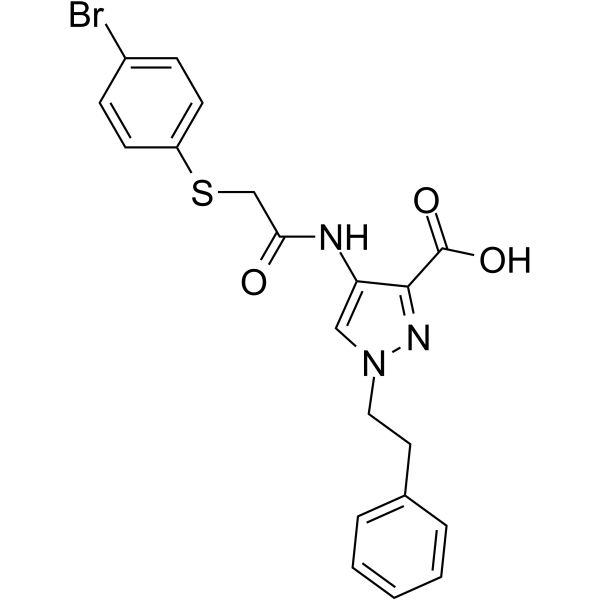
TNFRSF6/Fas/CD95
TNFRSF6/Fas/CD95 is a TNF receptor family death-domain receptor that triggers apoptosis and supports immune control by killing pathogen-infected cells and obsolete or potentially dangerous lymphocytes[1]. Mechanistically, activated Fas forms the death-inducing signaling complex (DISC) with receptor-associated proteins, linking CD95 engagement to apoptotic signal initiation[2]. DISC recruitment of FLICE/caspase-8 connects Fas physically to proapoptotic proteases and drives downstream apoptosis execution[3]. In disease models, dominant interfering FAS mutations impair apoptosis in human autoimmune lymphoproliferative syndrome, establishing Fas as a practical target for immune-homeostasis studies[4]. Compared with membrane-bound Fas, alternative splicing of Fas/CD95 exon 6 produces a membrane receptor that promotes apoptosis or a soluble isoform that inhibits apoptosis[5]. Earlier work also identified three functional soluble Fas forms generated by alternative splicing, supporting isoform-specific experimental design[6]. For applications, agonistic anti-Fas antibody models induce fulminant liver injury, providing a controlled system to study Fas-mediated apoptosis and protective interventions[7].
References:
- [1]. Strasser A, et al. The many roles of FAS receptor signaling in the immune system. Immunity. 2009 Feb 20;30(2):180-92. [Content Brief]
- [2]. Kischkel FC, et al. Cytotoxicity-dependent APO-1 (Fas/CD95)-associated proteins form a death-inducing signaling complex (DISC) with the receptor. EMBO J. 1995 Nov 15;14(22):5579-88. [Content Brief]
- [3]. Muzio M, et al. FLICE, a novel FADD-homologous ICE/CED-3-like protease, is recruited to the CD95 (Fas/APO-1) death--inducing signaling complex. Cell. 1996 Jun 14;85(6):817-27. [Content Brief]
- [4]. Fisher GH, et al. Dominant interfering Fas gene mutations impair apoptosis in a human autoimmune lymphoproliferative syndrome. Cell. 1995 Jun 16;81(6):935-46. [Content Brief]
- [5]. Tejedor JR, et al. Genome-wide identification of Fas/CD95 alternative splicing regulators reveals links with iron homeostasis. Mol Cell. 2015 Jan 8;57(1):23-38. [Content Brief]
- [6]. Cascino I, et al. Three functional soluble forms of the human apoptosis-inducing Fas molecule are produced by alternative splicing. J Immunol. 1995;154(6):2706-2713.
- [7]. Costelli P, et al. Mice lacking TNFalpha receptors 1 and 2 are resistant to death and fulminant liver injury induced by agonistic anti-Fas antibody. Cell Death Differ. 2003 Sep;10(9):997-1004. [Content Brief]
All Product Categories
-
TNFRSF6/Fas/CD95 Related Products (2)
Related Products (2)

-
Etanercept
 0 ImagesEtanercept, a dimeric fusion protein that binds TNF, acts as a TNF inhibitor. Etanercept competitively inhibits the binding of both TNF-α and TNF-β to cell surface TNF receptors, rendering TNF biologically inactive. Etanercept shows efficacy against rheumatoid arthritis, juvenile idiopathic arthritis, and plaque psoriasis.