1. Anti-infection Cell Cycle/DNA Damage Immunology/Inflammation Apoptosis
  2. Bacterial DNA/RNA Synthesis Nuclear Factor of activated T Cells (NFAT) Apoptosis
  3. Usnic acid

Usnic acid is a secondary metabolite of lichens with a unique dibenzofuran skeleton. Usnic acid inhibits DNA/RNA synthesis and has antibacterial activity. Usnic acid induces cell cycle arrest and apoptosis and has anticancer activity. Usnic acid inhibits RANKL-mediated osteoclast formation and function by reducing the transcriptional and translational expression of NFATc1. Usnic acid has antioxidant and anti-inflammatory activities by inhibiting lipid peroxidation and myeloperoxidase.

연구목적의 판매만을 진행합니다. 환자를 대상으로 한 판매는 하지 않습니다.

Usnic acid

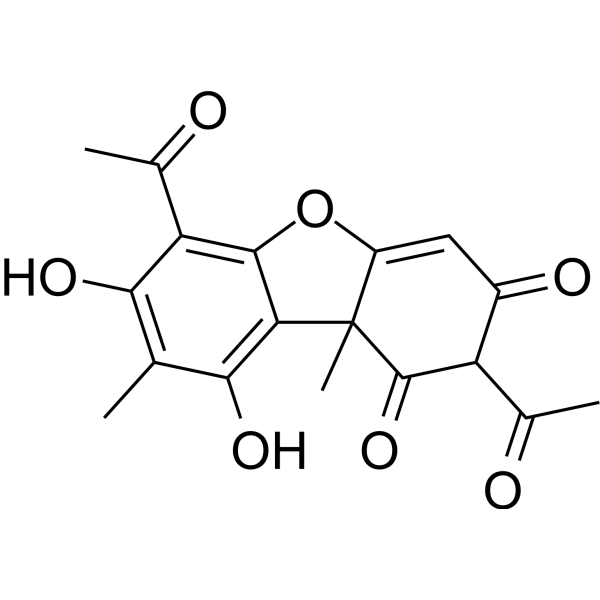
Usnic acid 화학구조

CAS No. : 125-46-2

사이즈 가격 재고 수량
무료 샘플 (0.1 - 0.2 mg)   지금 신청하기  
100 mg 해외재고보유
500 mg 해외재고보유
1 g   견적 받기  
5 g   견적 받기  

* 장바구니에 담기 전 물품의 수량을 선택해 주십시오.

This product is a controlled substance and not for sale in your territory.

고객리뷰

Based on 2 publication(s) in Google Scholar

Other Forms of Usnic acid:

Top Publications Citing Use of Products

View All DNA/RNA Synthesis Isoform Specific Products:

  • Biological Activity

  • 순도&문서

  • References

  • 고객리뷰

제품 설명

Usnic acid is a secondary metabolite of lichens with a unique dibenzofuran skeleton. Usnic acid inhibits DNA/RNA synthesis and has antibacterial activity. Usnic acid induces cell cycle arrest and apoptosis and has anticancer activity. Usnic acid inhibits RANKL-mediated osteoclast formation and function by reducing the transcriptional and translational expression of NFATc1. Usnic acid has antioxidant and anti-inflammatory activities by inhibiting lipid peroxidation and myeloperoxidase[1][2][3][4].

Cellular Effect
Cell Line Type Value Description References
HeLa IC50
10 3
Compound: (+)-1
Antiproliferative activity against human HeLa cells assessed as reduction in cell viability after 48 hrs by MTT assay
[PMID: 31282672]
HeLa IC50
>10 3
Compound: (+)-1
Antiproliferative activity against human HeLa cells assessed as reduction in cell viability after 24 hrs by MTT assay
[PMID: 31282672]
HeLa IC50
> 10 3
Compound: (-)-1
Antiproliferative activity against human HeLa cells assessed as reduction in cell viability after 24 hrs by MTT assay
[PMID: 31282672]
HeLa IC50
>10 3
Compound: (-)-1
Antiproliferative activity against human HeLa cells assessed as reduction in cell viability after 24 hrs by MTT assay
[PMID: 31282672]
HeLa IC50
> 10 3
Compound: (+)-1
Antiproliferative activity against human HeLa cells assessed as reduction in cell viability after 24 hrs by MTT assay
[PMID: 31282672]
HeLa IC50
> 10 3
Compound: (+)-1
Antiproliferative activity against human HeLa cells assessed as reduction in cell viability after 24 hrs by MTT assay
[PMID: 31282672]
HeLa IC50
10 3
Compound: (+)-1
Antiproliferative activity against human HeLa cells assessed as reduction in cell viability after 48 hrs by MTT assay
[PMID: 31282672]
HeLa IC50
> 10 3
Compound: (-)-1
Antiproliferative activity against human HeLa cells assessed as reduction in cell viability after 48 hrs by MTT assay
[PMID: 31282672]
HeLa IC50
> 10 3
Compound: (-)-1
Antiproliferative activity against human HeLa cells assessed as reduction in cell viability after 24 hrs by MTT assay
[PMID: 31282672]
HeLa IC50
> 10 3
Compound: (-)-1
Antiproliferative activity against human HeLa cells assessed as reduction in cell viability after 48 hrs by MTT assay
[PMID: 31282672]
MCF7 IC50
>10 3
Compound: (+)-1
Antiproliferative activity against human MCF7 cells assessed as reduction in cell viability after 24 hrs by MTT assay
[PMID: 31282672]
HeLa IC50
10 3
Compound: (+)-1
Antiproliferative activity against human HeLa cells assessed as reduction in cell viability after 48 hrs by MTT assay
[PMID: 31282672]
MCF7 IC50
>10 3
Compound: (-)-1
Antiproliferative activity against human MCF7 cells assessed as reduction in cell viability after 24 hrs by MTT assay
[PMID: 31282672]
MCF7 IC50
> 10 3
Compound: (-)-1
Antiproliferative activity against human MCF7 cells assessed as reduction in cell viability after 24 hrs by MTT assay
[PMID: 31282672]
MCF7 IC50
10 3
Compound: (+)-1
Antiproliferative activity against human MCF7 cells assessed as reduction in cell viability after 48 hrs by MTT assay
[PMID: 31282672]
MCF7 IC50
> 10 3
Compound: (+)-1
Antiproliferative activity against human MCF7 cells assessed as reduction in cell viability after 24 hrs by MTT assay
[PMID: 31282672]
PC-3 IC50
>10 3
Compound: (+)-1
Antiproliferative activity against human PC3 cells assessed as reduction in cell viability after 24 hrs by MTT assay
[PMID: 31282672]
MCF7 IC50
> 10 3
Compound: (-)-1
Antiproliferative activity against human MCF7 cells assessed as reduction in cell viability after 48 hrs by MTT assay
[PMID: 31282672]
PC-3 IC50
>10 3
Compound: (-)-1
Antiproliferative activity against human PC3 cells assessed as reduction in cell viability after 24 hrs by MTT assay
[PMID: 31282672]
MCF7 IC50
10 3
Compound: (+)-1
Antiproliferative activity against human MCF7 cells assessed as reduction in cell viability after 48 hrs by MTT assay
[PMID: 31282672]
PC-3 IC50
> 10 3
Compound: (-)-1
Antiproliferative activity against human PC3 cells assessed as reduction in cell viability after 24 hrs by MTT assay
[PMID: 31282672]
PC-3 IC50
> 10 3
Compound: (+)-1
Antiproliferative activity against human PC3 cells assessed as reduction in cell viability after 24 hrs by MTT assay
[PMID: 31282672]
PC-3 IC50
> 10 3
Compound: (-)-1
Antiproliferative activity against human PC3 cells assessed as reduction in cell viability after 48 hrs by MTT assay
[PMID: 31282672]
PC-3 IC50
> 10 3
Compound: (+)-1
Antiproliferative activity against human PC3 cells assessed as reduction in cell viability after 48 hrs by MTT assay
[PMID: 31282672]
MCF7 IC50
10 3
Compound: (+)-1
Antiproliferative activity against human MCF7 cells assessed as reduction in cell viability after 48 hrs by MTT assay
[PMID: 31282672]
MCF7 IC50
> 10 3
Compound: (+)-1
Antiproliferative activity against human MCF7 cells assessed as reduction in cell viability after 24 hrs by MTT assay
[PMID: 31282672]
MCF7 IC50
> 10 3
Compound: (-)-1
Antiproliferative activity against human MCF7 cells assessed as reduction in cell viability after 24 hrs by MTT assay
[PMID: 31282672]
MCF7 IC50
> 10 3
Compound: (-)-1
Antiproliferative activity against human MCF7 cells assessed as reduction in cell viability after 48 hrs by MTT assay
[PMID: 31282672]
PC-3 IC50
> 10 3
Compound: (+)-1
Antiproliferative activity against human PC3 cells assessed as reduction in cell viability after 24 hrs by MTT assay
[PMID: 31282672]
PC-3 IC50
> 10 3
Compound: (+)-1
Antiproliferative activity against human PC3 cells assessed as reduction in cell viability after 48 hrs by MTT assay
[PMID: 31282672]
PC-3 IC50
> 10 3
Compound: (-)-1
Antiproliferative activity against human PC3 cells assessed as reduction in cell viability after 24 hrs by MTT assay
[PMID: 31282672]
PC-3 IC50
> 10 3
Compound: (-)-1
Antiproliferative activity against human PC3 cells assessed as reduction in cell viability after 48 hrs by MTT assay
[PMID: 31282672]
In Vitro

Usnic acid (0-40 μg/mL, 0-150 min) inhibits the growth of B. subtilis, S. aureus and V. harveyi[1].
Usnic acid (0.5/1 μg/mL, 15-150 min) inhibits the incorporation rate of DNA, RNA and protein synthesis macromolecular precursors thymidine, uridine and leucine in B. subtilis and S. aureus[1].
Usnic acid (25-100 μM, 24-48 h) inhibits the viability and clonogenicity of A549 cells. It also induces G0/G1 cell cycle arrest, mitochondrial membrane depolarization and apoptosis of A549 cells[2].
Usnic acid (0.3-3 μM, 4 d) inhibits the differentiation of bone marrow-derived macrophages (BMM) into mature osteoclasts in a dose-dependent manner[4].
Usnic acid (3 μM, 0-3 d) inhibits the transcriptional and translational expression of RANKL on NFATc1 in BMMs[4].
Usnic acid (3 μM, 5-30 min) inhibits RANKL-induced activities of MAP kinases p38, ERK and JNK in BMMs[4].

MedChemExpress (MCE) has not independently confirmed the accuracy of these methods. They are for reference only.

Cell Viability Assay[2]

Cell Line: A549 cells
Concentration: 25, 50, 100 μM
Incubation Time: 24/48 h
Result: Inhibited cell proliferation (35-48%/59-72%).

Cell Proliferation Assay[2]

Cell Line: A549 cells
Concentration: 1, 5, 10 μM
Incubation Time: 7 days
Result: Inhibited cell colony formation (8, 23, 85%).

Cell Cycle Analysis[2]

Cell Line: A549 cells
Concentration: 25, 50, 100 μM
Incubation Time: 24/48 h
Result: Induced cell cycle arrest at G0/G1 (77%, 81% and 80%; 87%, 85%, and 82%).
Down-regulated CDK4, CDK-6 and cyclin D1 protein levels.
Up-regulated p21/Cip1 protein and cleaved-PARP levels.

Apoptosis Analysis[2]

Cell Line: A549 cells
Concentration: 25, 50, 100 μM
Incubation Time: 48 h
Result: Increased the number of apoptotic cells (6%, 10% and 11%).

RT-PCR[4]

Cell Line: BMMs
Concentration: Usnic acid (3 µM) for 1 h prior to RANKL (10 ng/mL) and M-CSF (30 ng/mL) stimulation
Incubation Time: 0, 1, 2, 3 d
Result: Down-regulated the gene expression levels of TRAP, DC-STAMP, and cathepsin K.

Western Blot Analysis[4]

Cell Line: BMMs
Concentration: Usnic acid (3 µM) for 1 h prior to RANKL (10 ng/mL) stimulation
Incubation Time: 5, 15, 30 min
Result: Down-regulated the protein expression levels of p38, ERK and JNK.
In Vivo

Usnic acid (25-200 mg/kg, p.o., once) can inhibit Indomethacin (HY-14397)-induced gastric injury in rats (80.2-96.4%)[3].
Usnic acid (1 μg/g, i.p., every day for up to 8 days) inhibited osteoclastic bone resorption in the lipopolysaccharide (LPS) bone erosion model [4].

MedChemExpress (MCE) has not independently confirmed the accuracy of these methods. They are for reference only.

Animal Model: Indomethacin-induced gastric damage model (male, Albino-Wistar rats, weighing 180-190 g; Indomethacin 25 mg/kg body weight orally.)[3]
Dosage: 25, 50, 100 and 200 mg/kg
Administration: Oral gavage (p.o.), once
Result: Reduced gastric damage in rats (80.2-96.4%).
Increased SOD, GPx, GSH and cNOS levels.
Reduced CAT, GR, LPO, iNOS and MPx levels.
Animal Model: LPS-induced mouse bone erosion model (five-week-old male ICR mice, 5 µg/µL LPS was injected intraperitoneally on days 1 and 4)[4]
Dosage: 1 μg/g
Administration: Intraperitoneal injection (i.p.), every day for up to 8 days
Result: Increased BMD and BV/TV.
Reduced BS/TV and Tb.Sp.
분자량

344.32

화학식

C18H16O7

CAS No.
Appearance

Solid

Color

White to yellow

SMILES

O=C(C1(C)C(OC2=C(C(C)=O)C(O)=C(C)C(O)=C12)=C3)C(C(C)=O)C3=O

Structure Classification
Initial Source
선적

Room temperature in continental US; may vary elsewhere.

보관
Powder -20°C 3 years
4°C 2 years
In solvent -80°C 6 months
-20°C 1 month
용액&용해도
In Vitro: 

DMSO : 3.33 mg/mL (9.67 mM; ultrasonic and warming and heat to 60°C; Hygroscopic DMSO has a significant impact on the solubility of product, please use newly opened DMSO)

Preparing
Stock Solutions
Concentration Solvent Mass 1 mg 5 mg 10 mg
1 mM 2.9043 mL 14.5214 mL 29.0428 mL
5 mM 0.5809 mL 2.9043 mL 5.8085 mL
View the Complete Stock Solution Preparation Table

* Please refer to the solubility information to select the appropriate solvent. Once prepared, please aliquot and store the solution to prevent product inactivation from repeated freeze-thaw cycles.
Storage method and period of stock solution: -80°C, 6 months; -20°C, 1 month. When stored at -80°C, please use it within 6 months. When stored at -20°C, please use it within 1 month.

  • 몰농도 계산기

  • 농도 희석 계산기

Mass (g) = Concentration (mol/L) × Volume (L) × Molecular Weight (g/mol)

Mass
=
Concentration
×
Volume
×
Molecular Weight *

Concentration (start) × Volume (start) = Concentration (final) × Volume (final)

This equation is commonly abbreviated as: C1V1 = C2V2

Concentration (start)

C1

×
Volume (start)

V1

=
Concentration (final)

C2

×
Volume (final)

V2

In Vivo:

For the following dissolution methods, please prepare the working solution directly. It is recommended to prepare fresh solutions and use them promptly within a short period of time.
The percentages shown for the solvents indicate their volumetric ratio in the final prepared solution. If precipitation or phase separation occurs during preparation, heat and/or sonication can be used to aid dissolution.

  • Protocol 1

    Add each solvent one by one:  50% PEG300    50% Saline

    Solubility: 2 mg/mL (5.81 mM); Suspended solution; Need ultrasonic

  • Protocol 2

    Add each solvent one by one:  0.5% CMC-Na/saline water

    Solubility: 2 mg/mL (5.81 mM); Suspended solution; Need ultrasonic

In Vivo Dissolution Calculator
Please enter the basic information of animal experiments:

Dosage

mg/kg

Animal weight
(per animal)

g

Dosing volume
(per animal)

μL

Number of animals

Recommended: Prepare an additional quantity of animals to account for potential losses during experiments.
Calculation results:
Working solution concentration: mg/mL
순도&문서

Purity: 98.90%

References

Complete Stock Solution Preparation Table

* Please refer to the solubility information to select the appropriate solvent. Once prepared, please aliquot and store the solution to prevent product inactivation from repeated freeze-thaw cycles.
Storage method and period of stock solution: -80°C, 6 months; -20°C, 1 month. When stored at -80°C, please use it within 6 months. When stored at -20°C, please use it within 1 month.

Optional Solvent Concentration Solvent Mass 1 mg 5 mg 10 mg 25 mg
DMSO 1 mM 2.9043 mL 14.5214 mL 29.0428 mL 72.6069 mL
5 mM 0.5809 mL 2.9043 mL 5.8086 mL 14.5214 mL
  • No file chosen (Maximum size is: 1024 Kb)
  • If you have published this work, please enter the PubMed ID.
  • Your name will appear on the site.
Help & FAQs
  • Do most proteins show cross-species activity?

    Species cross-reactivity must be investigated individually for each product. Many human cytokines will produce a nice response in mouse cell lines, and many mouse proteins will show activity on human cells. Other proteins may have a lower specific activity when used in the opposite species.

최근 본 상품:

온라인 문의

Your information is safe with us. * Required Fields.

상품명


Requested Quantity *

고객명 *


호칭

메일주소 *


전화번호 *

Department


회사명 *

City

Country or Region *


비고

대량구매 문의

Inquiry Information

상품명:
Usnic acid
Cat. No.:
HY-N0656
수량:
MCE Japan Authorized Agent: