



Wnt
The Wnt signaling pathways are a group of signal transduction pathways made of proteins that pass signals from outside of a cell through cell surface receptors to the inside of the cell. Three Wnt signaling pathways have been characterized: the canonical Wnt pathway, the noncanonical planar cell polarity pathway, and the noncanonical Wnt/calcium pathway. All three Wnt signaling pathways are activated by the binding of a Wnt-protein ligand to a Frizzled family receptor, which passes the biological signal to the protein Dishevelled inside the cell. The canonical Wnt pathway leads to regulation of gene transcription, the noncanonical planar cell polarity pathway regulates the cytoskeleton that is responsible for the shape of the cell, and the noncanonical Wnt/calcium pathway regulates calcium inside the cell. The clinical importance of Wnt signaling pathway has been demonstrated by mutations that lead to a variety of diseases, including breast and prostate cancer, glioblastoma, type II diabetes.
Wnt Isoform Specific Products
All Product Categories
-
Wnt Related Products (441)
Related Products (441)

-
Antibodies (26)
-
Wnt Isoform Comparison
-
DVL1/P-gp-IN-1
 0 ImagesCat. No.: HY-184469DVL1/P-gp-IN-1 is a DVL1 inhibitor (lC50 of 0.97 μM) and a P-glycoprptein (P-gp) inhibitor. DVL1/P-gp-IN-1 specific binds to the PDZ domain of the DVL1 protein of the Wnt/β-catenin pathway and inhibition of the P-gp. DVL1/P-gp-IN-1 reduces β-catenin expression, suppresses colon cancer cells proliferation, and induces apoptosis both in vitro and in xenograft models. DVL1/P-gp-IN-1 can be used in colorectal cancer research.
-
ML243
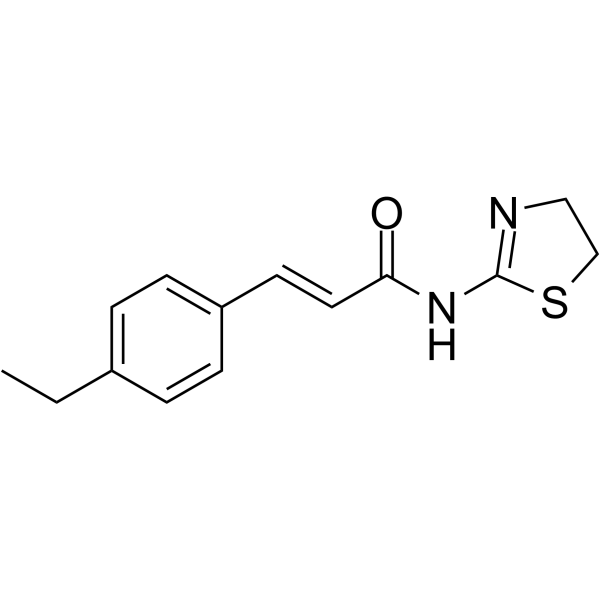 0 ImagesCat. No.: HY-19972CAS No.: 1426576-80-8ML243 is a selective small-molecule inhibitor of breast cancer stem cells. ML243 has 32-fold greater selective inhibition in the breast CSC-like cell line HMLE_shECad than the control cell line HMLE_shGFP. ML243 may target the Wnt pathway at the protein level without altering RNA expression levels.
-
LP-935001
 0 ImagesCat. No.: HY-182632CAS No.: 1875037-24-3LP-935001 is a Notum carboxylesterase inhibitor with an IC50 of 0.4 nM.LP-935001 prevents palmitoleate group removal from Wnt proteins, restores Wnt/β-catenin signaling.LP-935001 enhances cortical bone thickness in rodent models.LP-935001 can be used for the research of bone loss/nonvertebral fractures.
-
XD23
 0 ImagesCat. No.: HY-162970CAS No.: 2806007-82-7XD23 is a potent osteosarcoma inhibitor that works by downregulating DKK1 and activating the WNT/β-catenin signaling pathway.
-
TNKS-IN-1
 0 ImagesTNKS-IN-1 is a selective and potent tankyrase (TNKS1/TNKS2) inhibitor with IC50 values of 7.9 nM and 8.7 nM. TNKS-IN-1 induces axin2 accumulation with an EC50 of 1500 nM. TNKS-IN-1 can antagonize the Wnt signal transduction pathway by stabilizing axin proteins and promoting β-catenin degradation. TNKS-IN-1 can be used for the research of colorectal cancer.
-
SJ-300
 0 ImagesCat. No.: HY-179459CAS No.: 1210357-06-4SJ-300 is a potent and selective, orally active and brain-penetrat DKK3-LRP1 interaction inhibitor. SJ-300 restores Aβ clearance in AD models. SJ 300 binds to mLRPIV with a Kd of 7.9 μM, inhibits the DKK3 mLRPIV complex with an IC50 of 3.2 μM, and does not disrupt the binding of Aβ to LRP1. SJ 300 rescues cognitive function and ameliorates neuropathology (Aβ plaque reduction ≈ 73.3 %) in vivo. SJ 300 can be employed for research in Alzheimer’s disease.
-
C1s Enzyme
 0 ImagesCat. No.: HY-E70390Synonyms: masp-2, c1 esterase, c1-esteraseC1s Enzyme is a subunit of the complement C1 complex, which activates the complement as a serine protease. C1s Enzyme cleaves LRP5 and LRP6, and thus activates the Wnt/β-Catenin signaling pathway. C1s Enzyme promotes the macrophage M2 polarization and inhibits M1 polarization. C1s Enzyme enhances efferocytosis, exhibits anti-inflammatory activity.
-
β-catenin-IN-8
 0 ImagesCat. No.: HY-169348CAS No.: 259130-14-8β-catenin-IN-8 (Compound 25) is a β-catenin inhibitor. β-catenin-IN-8 inhibits β-catenin and c-Myc protein levels, and inhibits Wnt-target genes level (Fgf20 and Sall4). β-catenin-IN-8 has colorectal cancer anticancer activities, and has metabolic stability.
-
Getacatetide
 0 ImagesCat. No.: HY-P11597CAS No.: 2775373-65-2Synonyms: CY-101Getacatetide (CY-101) is a peptide-based Wnt/β-catenin inhibitor, which can be used for the study of solid tumors.
-
XRF-1021
 0 ImagesCat. No.: HY-179378CAS No.: 2968523-32-0XRF-1021 is an orally active HIPK2 inhibitor (IC50 = 0.18 μM). XRF-1021 reduces the expression of fibrotic markers in TGF-β1 stimulated NRK-49F and HK-2 cells, including Fibronectin, Collagen I and α-SMA. XRF-1021 blocks TGF-β, NF-κB, p53, Wnt/β-catenin, and Notch signaling. XRF-1021 reduces renal injury and fibrosis in vivo. XRF-1021 can be used for the research of chronic kidney disease.
-
Pamidronate disodium pentahydrate (Standard)
 0 ImagesCat. No.: HY-B0730RCAS No.: 109552-15-0Pamidronate (disodium pentahydrate) (Standard) is the analytical standard of Pamidronate (disodium pentahydrate). This product is intended for research and analytical applications. Pamidronate disodium pentahydrate, the second-generation nitrogen-containing bisphosphonate, is an inhibitor of bone loss. Pamidronate disodium pentahydrate significantly inhibits subchondral bone loss in early osteoarthritis by upregulating the expression of osteoprotegerin in cartilage and subchondral bone, and inhibiting the expression of RANKL and MMP-9 in both tissues, as well as TLR-4 in cartilage, thereby alleviating cartilage degeneration. Additionally, Pamidronate disodium pentahydrate can inhibit the signaling of Wnt and β-catenin, and is applicable for research on osteoporosis and osteosarcoma.
-
Anti-APCDD1 Antibody
 0 ImagesCat. No.: HY-P992189
-
E09241
 0 ImagesCat. No.: HY-W185542CAS No.: 1043110-13-9E09241 is an orally active osteoclastogenesis inhibitor. E09241 reduces the RANKL-induced expression of NFATc1 and MMP-9 by activating Wnt/β-catenin. E09241 increases the OPG/RANKL ratio by upregulating OPG expression, inhibits bone resorption, promotes bone formation and prevents ovariectomy-related bone loss. E09241 can be used in the research of osteoporosis.
-
CDK8-IN-20
 0 ImagesCat. No.: HY-180124CDK8-IN-20 (Compound 67j) is a selective, potent and orally active type I CDK8 inhibitor with an IC50 of 70.5 nM. CDK8-IN-20 shows IC50 values of 147.8, 726.9 and 217.4 nM for homologous kinase CDK19, CDK7 and CDK9. CDK8-IN-20 can inhibit the Wnt/β-catenin pathway and downregulate the expression of β-catenin, Cyclin D1, and c-Myc. CDK8-IN-20 can induce ROS production and cause G2/M and S phase arrest. CDK8-IN-20can be used for the research of cancer, such as colon cancer.
-
Halofenate
 0 ImagesCat. No.: HY-14998CAS No.: 26718-25-2Synonyms: MK 185Halofenate, structurally akin to clofibrate, was evaluated in hypertriglyceridemic patients over 6-week periods in a controlled, double-blind crossover trial. It effectively reduced serum triglycerides by 50%, with minimal impact on serum cholesterol levels. Additionally, it lowered serum uric acid by 30% and exhibited uricosuric effects independent of glomerular filtration rate. Halofenate was associated with a significant increase in plasma thyroxine (T4), accompanied by a decrease in protein-bound iodine and T4 by column. In vitro studies confirmed its ability to displace T4 from thyroid-binding proteins, suggesting a thyroxine-displacing effect, which could influence thyroid function in vivo.
-
Triptonide (Standard)
 0 ImagesCat. No.: HY-32736RCAS No.: 38647-11-9Synonyms: NSC 165677 (Standard); PG 492 (Standard)Triptonide (Standard) is the analytical standard of Triptonide. This product is intended for research and analytical applications. Triptonide (NSC 165677) is a natural product identified in Tripterygium wilfordii Hook F.. Triptonide is a Wnt signaling inhibitor with an IC50 of appropriately 0.3 nM. Triptonide has immunosuppression, anti-inflammatory, anti-fertility, neuroprotective and anti-lymphoma effects.
-
PC8
 0 ImagesCat. No.: HY-181999PC8 is a selective dual inhibitor of PARP1/CDK6, with an IC50 of 0.126 μM for PARP1 and 0.197 μM for CDK6. PC8 does not alter PARP1 expression, but reduces the expression of its downstream target PAR. PC8 inhibits the canonical Wnt/β-catenin signaling pathway. PC8 induces intracellular ROS accumulation and exacerbates DNA damage. PC8 inhibits the proliferation of triple-negative breast cancer (TNBC) cells. PC8 can be used for the research of triple-negative breast cancer.
-
Cardiogenol C
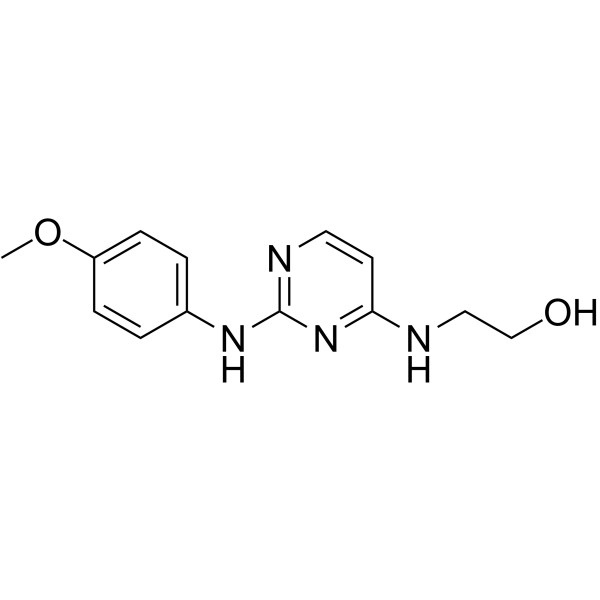 0 ImagesCat. No.: HY-12319CAS No.: 671225-39-1Cardiogenol C is a potent cell-permeable pyrimidine inducer which prompts the differentiation of ESCs into cardiomyocytes (EC50=100 nM). Cardiogenol C also acts cardiomyogenic on already lineage-committed progenitor cell types with a limited degree of plasticity. Cardiogenol C is a useful cardiomyogenic agent and can be used as a tool to improve cardiac repair by cell transplantation therapy in animal models.
-
Anti-Kremen2 Antibody
 0 ImagesCat. No.: HY-P992252
-
Lonchocarpin
 0 ImagesCat. No.: HY-119590CAS No.: 31501-55-0Synonyms: LonchocarpineLonchocarpin (Lonchocarpine) is a Wnt/β-catenin signaling pathway inhibitor. The IC50 of Lonchocarpin in SW480 pBAR/Renilla cells is 4 μM. Acting downstream of β-catenin stabilization, Lonchocarpin inhibits β-catenin nuclear localization and TCF-mediated transcription, as well as the proliferation and migration of colorectal cancer cells. Lonchocarpin enhances Nrf2/ARE-mediated antioxidant responses in primary astrocytes via AMPK and JNK-related signaling, reduces H2O2-induced ROS production, and increases the expression of HO-1, NQO1 and MnSOD. Lonchocarpin can be used in research on colorectal cancer and oxidative stress.




