



Wnt11
Wnt11 is a Wnt ligand involved in gastrulation, neurulation, cardiogenesis, nephrogenesis, and chondrogenesis during fetal development[1]. Mechanistically, Wnt11 activates canonical and non-canonical Wnt signaling cascades depending on receptor context, including Frizzled, LRP6, ROR2, and RYK[1]. This receptor-dependent signaling links Wnt11 to cellular movement, cardiac specification, and morphogenesis, with evidence that Wnt11 can induce cardiomyogenesis during embryonic development and in adult cells[1][2]. In disease models, human WNT11 expression has been reported in multiple cancers, while Wnt11 downregulation in hepatocellular carcinoma and ectopic Wnt11 expression reduced proliferation and migration through PKC, β-catenin, RhoA/Rho kinase, and Rac1-related mechanisms[1][3]. Compared with related isoforms, Wnt11 differs from prototypic canonical Wnt3a and noncanonical Wnt5a because Wnt ligands activate distinct pathways through specific coreceptor coupling and reciprocal pathway inhibition at the cell surface[4]. For experimental applications, Wnt11 remains useful for studying noncanonical Wnt signaling, cardiomyogenic differentiation, developmental organogenesis, and tumor-cell migration models[1][2][3].
References:
- [1]. Katoh M, et al. Integrative genomic analyses of WNT11: transcriptional mechanisms based on canonical WNT signals and GATA transcription factors signaling. Int J Mol Med. 2009 Aug;24(2):247-51. [Content Brief]
- [2]. Flaherty MP, et al. Noncanonical Wnt11 signaling and cardiomyogenic differentiation. Trends Cardiovasc Med. 2008 Oct;18(7):260-8. [Content Brief]
- [3]. Toyama T, et al. Noncanonical Wnt11 inhibits hepatocellular carcinoma cell proliferation and migration. Mol Cancer Res. 2010 Feb;8(2):254-65. [Content Brief]
- [4]. Grumolato L, et al. Canonical and noncanonical Wnts use a common mechanism to activate completely unrelated coreceptors. Genes Dev. 2010 Nov 15;24(22):2517-30. [Content Brief]
All Product Categories
-
Wnt11 Related Products (1)
Related Products (1)

-
Wilforine
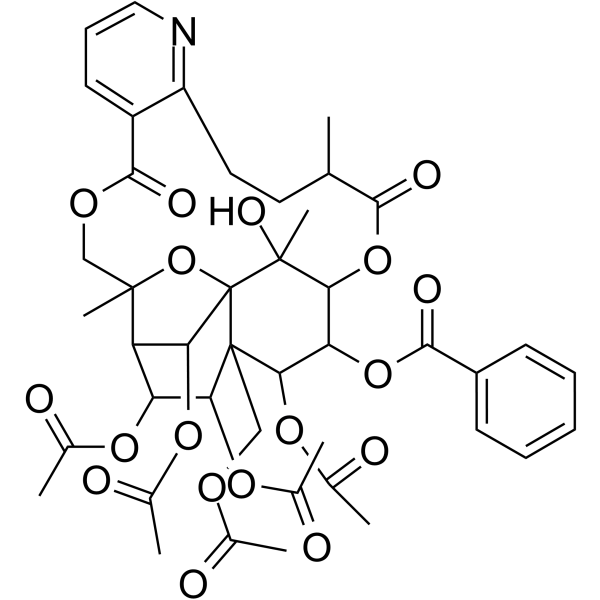 0 ImagesWilforine is an orally active JAK-STAT pathway inhibitor with immunomodulatory effects and the ability to inhibit osteoclast fusion. Wilforine disrupts lipid raft integrity, reprograms cholesterol and glycosphingolipid metabolic pathways, regulates NF-κB and the complement system, and modulates the expression of various interleukins. Wilforine also inhibits the Wnt11/β-catenin signaling pathway and suppresses the proliferation of fibroblast-like synoviocytes. Wilforine can serve as a quality and pharmacokinetic marker for Tripterygium glycoside tablets, and can be applied to research on related diseases such as rheumatoid arthritis, inflammatory osteolysis, and SAPHO syndrome.



