



Wnt7
Wnt7 refers mainly to WNT7A and WNT7B, secreted Wnt ligands that regulate embryonic development, CNS angiogenesis, and blood-brain barrier formation[1][2]. Mechanistically, WNT7A/B activate endothelial β-catenin signaling through GPR124-RECK-LRP5/6 receptor complexes, with WNT7 signaling showing isoform-selective dependence on RECK compared with WNT3A[2][3]. In disease models, WNT7B drives autocrine Wnt/β-catenin signaling and anchorage-independent growth in pancreatic adenocarcinoma cells, while Wnt7a/7b deletion or pharmacologic Wnt inhibition blocks glioma vessel co-option and improves temozolomide response[4][5]. Compared with related Wnt isoforms, WNT7A and WNT7B directly bind RECK, whereas WNT3A does not, supporting Wnt7-specific regulation of ligand bioavailability and endothelial signaling[3]. For experimental applications, Wnt secretion inhibitors such as IWP-2 suppress ligand-dependent Wnt/β-catenin activity in PDAC cells, while FZD4-LRP5 agonists can induce a Norrin-like barrier transcriptional response in retinal models[4][6].
Verweise:
- [1]. Beretta CA, et al. All four zebrafish Wnt7 genes are expressed during early brain development. Gene Expr Patterns. 2011 Mar-Apr;11(3-4):277-84. [Content Brief]
- [2]. Heiden R, et al. WNT7A/B assemble a GPR124-RECK-LRP5/6 coreceptor complex to activate β-catenin signaling in brain endothelial cells. J Biol Chem. 2025 Oct;301(10):110682. [Content Brief]
- [3]. Vallon M, et al. A RECK-WNT7 Receptor-Ligand Interaction Enables Isoform-Specific Regulation of Wnt Bioavailability. Cell Rep. 2018 Oct 9;25(2):339-349.e9. [Content Brief]
- [4]. Arensman MD, et al. WNT7B mediates autocrine Wnt/β-catenin signaling and anchorage-independent growth in pancreatic adenocarcinoma. Oncogene. 2014 Feb 13;33(7):899-908. [Content Brief]
- [5]. Griveau A, et al. A Glial Signature and Wnt7 Signaling Regulate Glioma-Vascular Interactions and Tumor Microenvironment. Cancer Cell. 2018 May 14;33(5):874-889.e7. [Content Brief]
- [6]. Zhang L, et al. A Frizzled4-LRP5 agonist promotes blood-retina barrier function by inducing a Norrin-like transcriptional response. iScience. 2023 Jul 18;26(8):107415. [Content Brief]
All Product Categories
-
Wnt7 Verwandte Produkte (2)
Verwandte Produkte (2)

-
WNT7A-IN-1 sodium
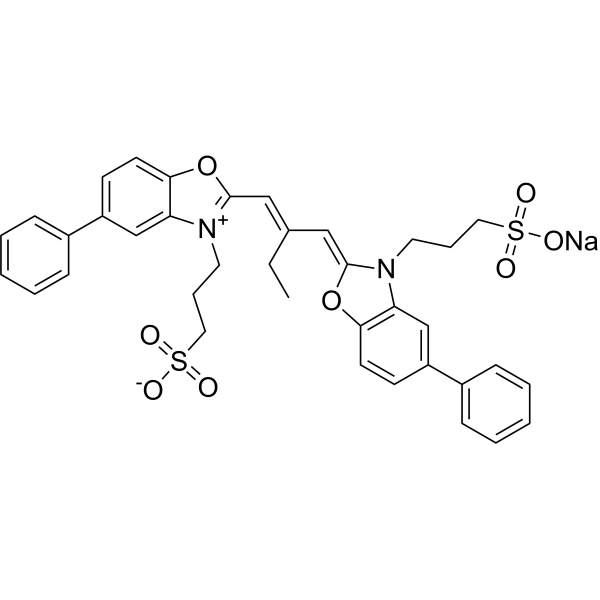 0 ImagesArt. -Nr.: HY-D1474CAS. Nr.: 33628-03-4WNT7A-IN-1 sodium (1365-0109), a WNT7A inhibitor, disrupts the protein-protein interaction between WNT7A and its receptor FZD5, resulting in the upregulation of MHC-I expression. WNT7A-IN-1 sodium significantly increases the expression of MHC-I and p-p65,while concurrently reducing the expression of active β-catenin. WNT7A-IN-1 sodium (compound F) is also a photographic sensitizer in the green spectral region.
-
WNT7A-IN-1
 0 ImagesWNT7A-IN-1 (1365-0109), a WNT7A inhibitor, disrupts the protein-protein interaction between WNT7A and its receptor FZD5, resulting in the upregulation of MHC-I expression. WNT7A-IN-1 significantly increases the expression of MHC-I and p-p65,while concurrently reducing the expression of active β-catenin. WNT7A-IN-1 (compound F) is also a photographic sensitizer in the green spectral region.



