



Wnt3
Wnt3 is a secreted Wnt ligand linked to canonical Wnt/β-catenin signaling, a pathway that controls embryonic development and adult homeostasis[1]. Mechanistically, Wnt3 activity supports TCF/LEF-dependent transcription and connects ligand-receptor signaling to cell fate regulation[1]. In mouse embryos, Wnt3 expression precedes gastrulation and becomes restricted to the posterior epiblast, visceral endoderm, primitive streak, and mesoderm[2]. Wnt3-null embryos fail to form a primitive streak, mesoderm, or node, establishing Wnt3 as a core regulator of vertebrate axis formation[2]. In limb development, ectodermal Wnt3/β-catenin signaling establishes and maintains the apical ectodermal ridge, linking Wnt3 to limb morphogenesis[3]. Human evidence further connects homozygous WNT3 mutation with tetra-amelia, supporting its early requirement in limb, craniofacial, and urogenital development[4]. Compared with Wnt3a, Wnt3 shows distinct activity in spinal cord neural precursors: Wnt3 transiently increases proliferation and enhances neurogenesis, whereas Wnt3a sustains proliferation[5]. For experimental applications, Wnt3/Wnt3a pathway studies can use canonical Wnt agonists, antagonists, or GSK-3β inhibitors to interrogate β-catenin-dependent proliferation, neurogenesis, and neurite outgrowth[1][5].
References:
- [1]. MacDonald BT, et al. Wnt/beta-catenin signaling: components, mechanisms, and diseases. Dev Cell. 2009 Jul;17(1):9-26. [Content Brief]
- [2]. Liu P, et al. Requirement for Wnt3 in vertebrate axis formation. Nat Genet. 1999 Aug;22(4):361-5. [Content Brief]
- [3]. Barrow JR, et al. Ectodermal Wnt3/beta-catenin signaling is required for the establishment and maintenance of the apical ectodermal ridge. Genes Dev. 2003 Feb 1;17(3):394-409. [Content Brief]
- [4]. Niemann S, et al. Homozygous WNT3 mutation causes tetra-amelia in a large consanguineous family. Am J Hum Genet. 2004 Mar;74(3):558-63. [Content Brief]
- [5]. David MD, et al. Wnt-3a and Wnt-3 differently stimulate proliferation and neurogenesis of spinal neural precursors and promote neurite outgrowth by canonical signaling. J Neurosci Res. 2010 Nov 1;88(14):3011-23. [Content Brief]
All Product Categories
-
Wnt3 Related Products (4)
Related Products (4)

-
TFMB-(S)-2-HG
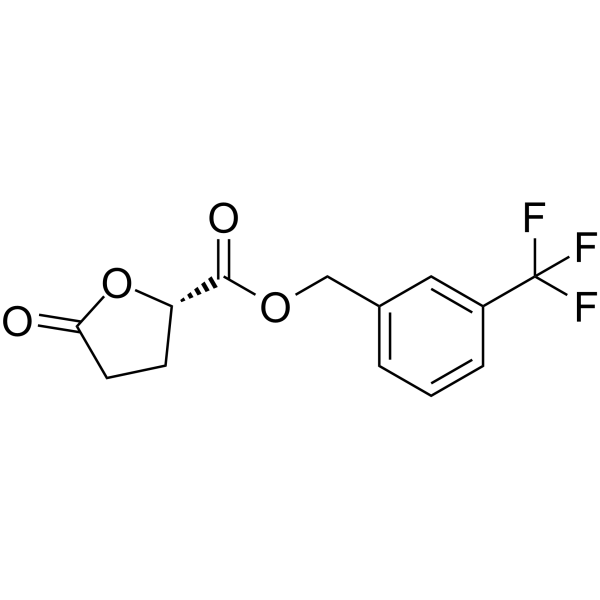 0 ImagesTFMB-(S)-2-HG is a potent TET2 inhibitor. TFMB-(S)-2-HG also inhibits the EglN prolyl hydroxylases. TFMB-(S)-2-HG downregulates Wnt3a, β-catenin (intranuclear) protein expression. TFMB-(S)-2-HG inhibits osteogenic differentiation of cells. TFMB-(S)-2-HG has the potential for the research of acute myeloid leukemia (AML).
-
Dendrophenol
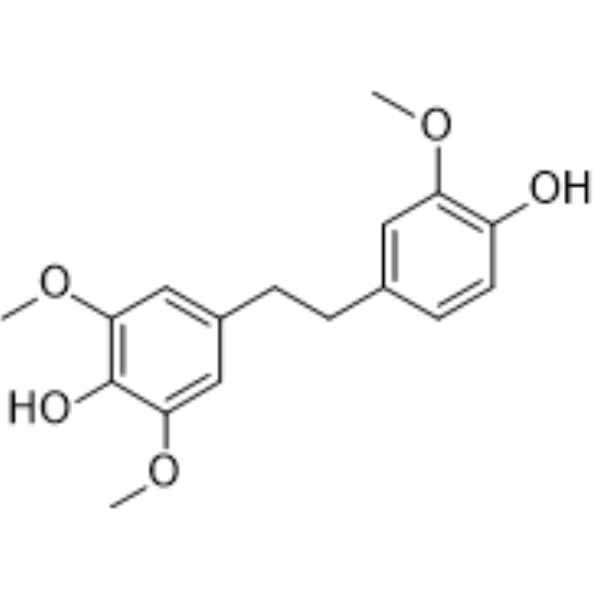 0 ImagesSynonyms: MoscatilinDendrophenol (Moscatilin) is a NF-κB inhibitor that inhibits inflammation. Dendrophenol exerts potent cytotoxic effect against tumor cells and induces cell cycle arrest and apoptosis. Dendrophenol has antitumor activity. In addition, Dendrophenol can inhibit vascular calcification by inhibiting the activation of WNT3/β-catenin.
-
ABC99
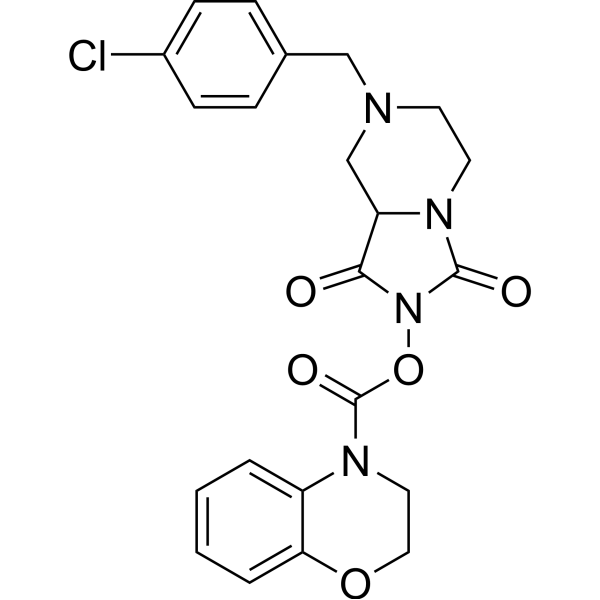 0 ImagesABC99 is an N-hydroxyhydantoin (NHH) carbamate that selectively inhibits the Wnt-deacylating enzyme NOTUM (IC50=13 nM). ABC99 preserves Wnt3A signaling in the presence of NOTUM.
-
NKP608
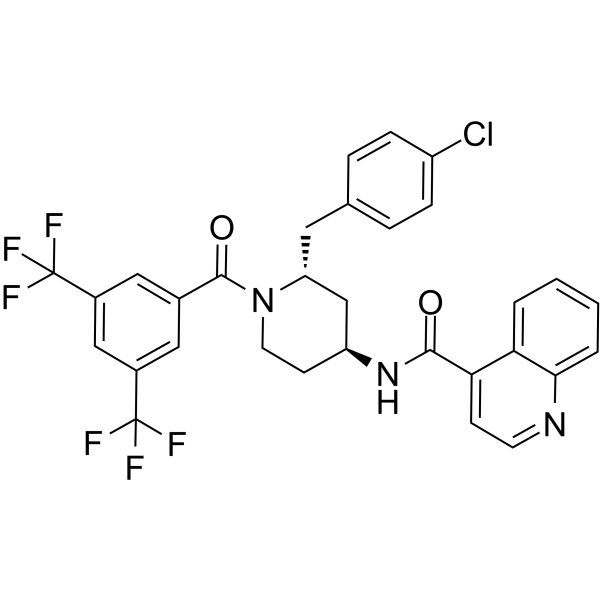 0 ImagesNKP608 is a non-peptidic derivative of 4-aminopiperidine, a highly selective, orally active, neurokinin-1 (NK1) receptor antagonist with IC50 of 2.6 nM. NKP608 is active both in vitro and in vivo, showing extremely low affinity for NK2, NK3 receptors. NKP608 exerts its effects by blocking the NK₁ receptor, regulate cell proliferation and apoptosis, affect neurotransmitter functions and gastric mucosal repair mechanisms, and suppress the Wnt/β-catenin pathway in antitumor research. NKP608 is applicable to research related to various diseases, including cough, anxiety disorders, depression, gastric mucosal injury, and colorectal cancer.



