



Trypanosome Infection
-
Trypanosome Infection (43)

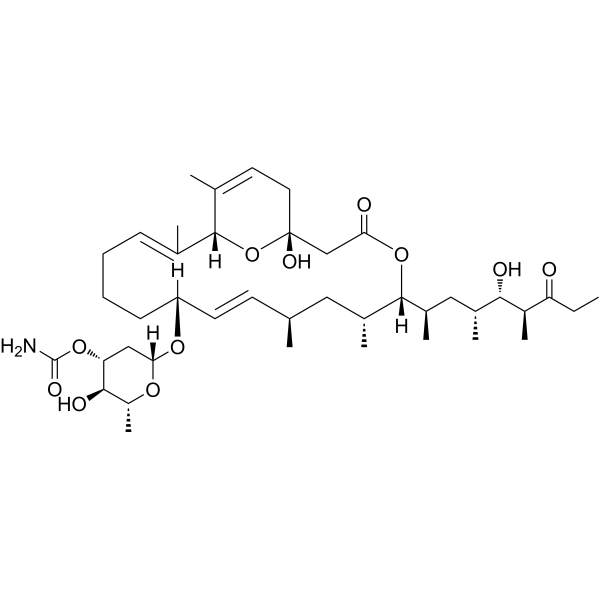
- Formula: C41H67NO11
- Molecular Weight: 749.97
Venturicidin A (Aabomycin A1) is a natural product derived from Streptomyces, possessing antifungal, anti-Trypanosoma brucei, anti-Leishmania donovani, and ATP synthase inhibitory activities. Venturicidin A acts as an antibiotic adjuvant, promoting the uptake of aminoglycoside antibiotics and enhancing bactericidal efficacy. Venturicidin A inhibits ATP synthesis by blocking proton translocation through the FO subunit. In bloodstream-form Trypanosoma brucei, Venturicidin A causes collapse of the mitochondrial membrane potential; in fungi, it disrupts cell membrane integrity, induces leakage of cytoplasmic contents, elevates ROS levels, and downregulates the expression of fungal pathogenicity-related genes. Venturicidin A exhibits antifungal activity against Botrytis cinerea. Venturicidin A is used in research on bacterial infections, trypanosome/leishmania infections, and gray mold disease.

- Formula: C7H12
- Molecular Weight: 96.17
Norbornane is a component of the essential oil extracted from the rhizomes of Cyperus rotundus from Morocco. Active derivatives of Norbornane are fused heterocyclic compounds with in vitro anti-tumor and anti-Trypanosoma brucei activities. Norbornane and its derivatives can be used in research related to cancers such as leukemia and African trypanosomiasis.
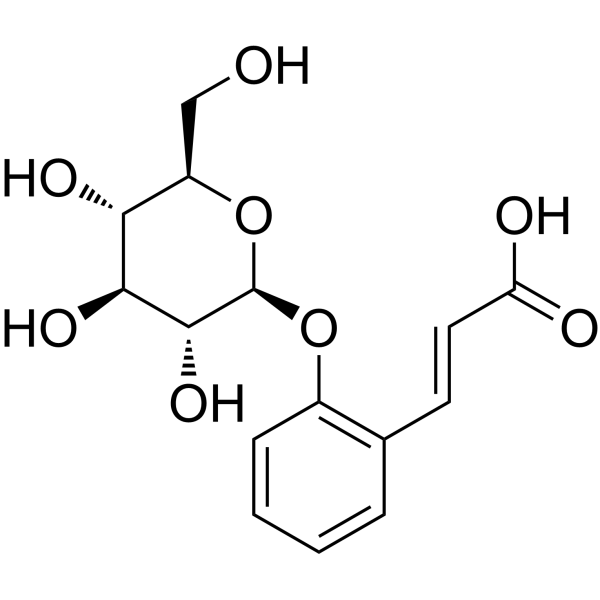
- Formula: C15H18O8
- Molecular Weight: 326.30
trans-Melilotoside is a coumarin precursor and that can be isolated from Melilotus neapolitan. trans-Melilotoside exhibits antiparasitic and DPPH radical-scavenging activity. trans-Melilotoside can be used for the research of human african trypanosomiasis, chagas’ disease, malaria[1][3].
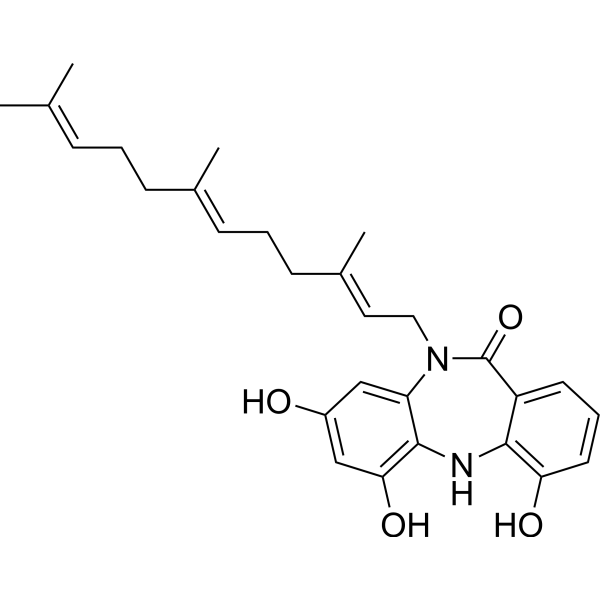
- Formula: C28H34N2O4
- Molecular Weight: 462.58
Diazepinomicin (ECO-4601) is an anticancer and antibacterial agent. Diazepinomicin can be produced by a Micromonospora strain. Diazepinomicin induces Apoptosis. Diazepinomicin inhibits the proteases Rhodesain and Cathepsin L at an IC50 of 70-90 μM. Diazepinomicin possesses anti-inflammatory and anti-tumor activity. Diazepinomicin has demonstrated activity against hepatocellular carcinoma. Diazepinomicin shows antiparasitic activity against trypomastigote forms of Trypanosoma brucei with an IC50 of 13.5 μM. Diazepinomicin exhibits moderate antibacterial activity against specific Gram-positive bacteria, with an MIC of approximately 32 μg/mL.

- Formula: C21H22BF3N2O5
- Molecular Weight: 450.22
Enfiborole is an oxaborolane ester inhibitor with trypanocidal activity against parasites. Enfiborole displays IC50 values ≤ 20 nM against Trypanosoma brucei and Trypanosoma cruzi, and its IC50 against replicating trypanosomes ranges from 21 to 999 nM. Enfiborole inhibits the growth of Trypanosoma brucei, suppresses hypoxanthine incorporation in replicating trypanosomes, and inhibits the growth of Trypanosoma cruzi amastigotes. Enfiborole can be used in studies related to trypanosome infections.

- Formula: C18H17FO5
- Molecular Weight: 332.32
CPN4F is a chalcone derivative with antiparasitic activity. CPN4F is an inhibitor of the cysteine protease cruzain. CPN4F forms a key hydrogen bond with the Trp-184 residue in the active site of parasitic cruzain as an electrophile, and induces oxidative stress, cell membrane degradation, and necrosis, thereby inhibiting parasite proliferation. CPN4F is used in research related to Chagas disease.

- Formula: C14H14N2O
- Molecular Weight: 226.27
KLK6-IN-2 is a reversible non-covalent and selective KLK6 inhibitor, with an IC50 of 2.1 μM against hKLK6. KLK6-IN-2 acts as a reversible competitive inhibitor of boar Spermatozoa acrosin, with a Ki of 2.6 μM against porcine acrosin. KLK6-IN-2 exhibits trypanocidal activity against Trypanosoma brucei rhodesiense, with an IC50 of 3.71 μM.

- Formula: C15H20O8
- Molecular Weight: 328.32
Dihydromelilotoside is an insecticide present in the stems of Dendrobium aurantiacum var. denneanum, sugarcane juice, and the aerial parts of Ajuga lupulina. Dihydromelilotoside can be used in studies related to Chagas disease (American trypanosomiasis).

- Formula: C84H136N28O27
- Molecular Weight: 1970.18
PKI (5-22) is a specific inhibitory peptide targeting the catalytic subunit of protein kinase A (PKA) and contains the active region of PKI. PKI (5-22) inhibits the enzymatic activity of the PKA catalytic subunit-like protein in Trypanosoma equiperdum. PKI (5-22) can be used in the research of trypanosomiasis.

- Formula: C19H20O7
- Molecular Weight: 360.36
Vernodalin is an orally active, cytotoxic sesquiterpene lactone with a Kd value of 9.55 μM for p38 MAPK. Vernodalin downregulates the expression of phosphorylated ERK, JNK, AKT, PI3K, mTOR, p38MAPK, FAK, MMP-2, MMP-9, and uPA, while upregulates the expression of TIMP-1 and TIMP-2. Vernodalin increases ROS production, upregulates the expression of Bax and caspase 3, downregulates the expression of Bcl-2, and induces apoptosis (apoptosis), oxidative stress response and cell cycle arrest. Vernodalin inhibits the proliferation, adhesion and metastasis of cancer cells. Vernodalin enhances the activity of VEGF-B, AMPK and eNOS signaling pathways. Vernodalin alleviates myocardial injury and restores hemodynamic parameters. Vernodalin inhibits the growth of Trypanosoma brucei rhodesiense. Vernodalin can be used in research related to various cancers including gastric cancer, colorectal cancer and lung cancer, as well as African human trypanosomiasis and myocardial infarction.

- Formula: C13H12N4O4
- Molecular Weight: 288.26
Antitrypanosomal agent 33 is a potent antitrypanosomal agent with activity against Trypanosoma cruzi intracellular amastigotes, Trypanosoma brucei brucei, and Trypanosoma brucei rhodesiense. Antitrypanosomal agent 33 can be used for the research of trypanosomiasis, chagas disease.

- Formula: C16H19N3O2S
- Molecular Weight: 317.41
Antitrypanosomal agent 32 is a antitrypanosomal agent with nanomolar potency against multiple Trypanosoma cruzi strains, including CL-Brener, Y, Dm28c-Luc and Tulahuen. Antitrypanosomal agent 32 sustains inhibition of parasite growth after washing and reduces parasitemia levels in BALB/c mice. Antitrypanosomal agent 32 can be used for the research of trypanosome infection.

- Formula: C20H14O6
- Molecular Weight: 350.32
Cladospirone B is a secondary metabolite of the endophytic fungus Lasiodiplodia theobromae. Cladospirone B exhibits trypanocidal activity, with a MIC of 17.8 µM against Trypanosoma brucei. Cladospirone B can be used in the research of African human trypanosomiasis (sleeping sickness).

- Formula: C21H20ClN3
- Molecular Weight: 349.86
Homidium chloride is a potent antiparasitic agent exhibiting activity against Trypanosoma rhodesiense and Trypanosoma congolense. Homidium chloride can reduce parasitaemia in murine models of infection. Homidium chloride can be used for trypanosomiasis research.

- Formula: C9H14N3O9P
- Molecular Weight: 339.20
Mizoribine 5'-monophosphate (MZR-P) is the active metabolite of Mizoribine (HY-17470). Mizoribine 5'-monophosphate is an inhibitor of inosine-5'-monophosphate dehydrogenase (IMPDH), and its Ki values for IMPDH of Trypanosoma brucei, Bacillus subtilis and Oceanobacillus iheyensis are 3.3, 72 and 157 nM respectively. Mizoribine 5'-monophosphate can be used in anti-trypanosomiasis and immunosuppression research.

- Formula: C15H23N7O3
- Molecular Weight: 349.39
MDL 73811 is a potent AdoMetDC inhibitor and anti-trypanosomal compound. MDL 73811 has curative efficacy in a hemolymphatic model of HAT.

- Formula: C24H30N8O5
- Molecular Weight: 510.55
Methotrexate diethyl ester is a potent DHFR inhibitor. Methotrexate diethyl ester can be used in the research of T.cruzi infection and leukemia.

- Formula: C14H12N2O3S2
- Molecular Weight: 320.39
SID 24785302 is a hexokinase inhibitor with antiparasitic activity. SID 24785302 exhibits activity against T. brucei and Leishmania. SID 24785302 can be used for the research of mitochondrial DNA disorders and parasitic infection.

- Formula: C15H20N6O5
- Molecular Weight: 364.36
Alazopeptin is a non-ribosomal tripeptide azoamino acid antibiotic isolated from various Streptomyces species, with significant anti-tumor, antibacterial and trypanocidal activities. Alazopeptin exhibits cytotoxicity against mouse leukemia cells and S-180 tumor cells, inhibits the growth of Bacillus subtilis, and shows activity against Trypanosoma brucei. Alazopeptin can be widely used in studies related to mouse leukemia, S-180 tumor, human African trypanosomiasis and nagana.

- Formula: C17H19N9
- Molecular Weight: 349.39
CGP 40215 is an S-adenosylmethionine decarboxylase inhibitor with an IC50 of 20.3 μM against Trypanosoma brucei brucei AdoMet decarboxylase. CGP 40215 blocks spermidine production and leads to putrescine accumulation. CGP 40215 inhibits polyamine biosynthesis in intact trypanosomes, acts synergistically with the ornithine decarboxylase inhibitor DFMO (HY-B0744) against CNS model infections, and ameliorates laboratory infections caused by multiple Trypanosoma brucei subspecies and Trypanosoma congolense isolates, including strains tolerant to standard trypanocides. CGP 40215 can be used for research on African trypanosomiasis and Chagas disease.



