
1. Search Result
Search Result
Results for "

human A2780 ovarian

" in MedChemExpress (MCE) Product Catalog:

22

Inhibitors & Agonists

1

Biochemical Assay Reagents

1

Inhibitory Antibodies

6

Natural
Products

Cat. No. Product Name Target Research Areas Chemical Structure
  • HY-153278

    CDK7-IN-21

    CDK DNA/RNA Synthesis c-Myc Early 2 Factor (E2F) Topoisomerase Cancer
    Q901 (CDK7-IN-21) is a selective and potent CDK7 inhibitor with an IC50 of 10 nM. Q901 disrupts MYC and E2FTOP1-DPCs and sensitizes tumor to TOP1 inhibitors by suppressing RNAPII transition from initiation to elongation. Q901 can inhibit tumor growth and significantly enhances tumor growth inhibition combined with TOP1 inhibitors. Q901 can be used for the research of cancer, such as colon cancer and lung cancer .
    Q901
  • HY-15995
    Tubulysin A
    1 Publications Verification

    TubA

    Antibiotic Microtubule/Tubulin ADC Payload Mitosis Cancer
    Tubulysin A (TubA) is an anticancer and antiangiogenic agent with anti-microtubule, anti-mitosis and anti-proliferative activity against a variety of cancer cells with IC50 values in the pmol range. It can induce apoptosis of cancer cells and has no effect on normal cells. Tubulysins are a group of potent cytotoxins consisting of nine members (A-I). Tubulysin A can synthesize ADC as ADC Cytotoxin .
    Tubulysin A
  • HY-B1022
    Dimesna
    1 Publications Verification

    BNP-7787

    Drug Derivative Endocrinology Cancer
    Dimesna (BNP-7787), the disulfide form of Mesna (HY-13679), is a platinum-related toxicity protective agent. Dimesna converts to Mesna, which in turn inactivates toxic platinum substances. Dimesna does not interfere with the antitumor activity of platinum compounds. Dimesna does not affect the antiproliferative effects of Cisplatin (HY-17394) or Carboplatin (HY-17393). Dimesna counteracts Cisplatin-induced nephrotoxicity. Dimesna exerts selective protective effects on the kidneys. Dimesna can be used in studies related to ovarian cancer and Cisplatin-induced nephrotoxicity .
    Dimesna
  • HY-P99925

    REGN421

    Notch Metabolic Disease Cancer
    Enoticumab (REGN421, SAR153192) is an IgG1κ antibody targeting human Dll4. DLL4 is a ligand of the Notch signaling pathway and regulates fatty acid uptake through non-transcriptional regulation of macropinocytosis-dependent long-chain fatty acid uptake. Specific in vivo activity of Enoticumab in an ovarian xenograft model. EGN421 (2.5 mg/kg once weekly) resulted in 86% and 83% tumor growth inhibition in mouse subcutaneous TOV-112D or intraperitoneal A2780 human tumor xenograft models, respectively .
    Enoticumab
  • HY-W096169D

    Biochemical Assay Reagents Drug Intermediate Cancer
    Platinum is a metallic element, and its complexes act as orally active anticancer agents. Platinum-based complexes used for tumors include Cisplatin (HY-17394), Carboplatin (HY-17393), and Oxaliplatin (HY-17371) .
    Platinum
  • HY-123888

    E1/E2/E3 Enzyme Bacterial Cancer
    Viomellein is a SUMOylation inhibitor with antibacterial and anticancer activities. Viomellein inhibits biofilm formation of strains produced from the fungus Aspergillus ochraceus from the Mediterranean sponge Agelas oroides. Viomellein exhibits cytotoxicity against A2780 human ovarian cancer cells with an IC50 value of 5.0 μM. Viomellein also inhibits SUMOylation of RanGAP1 (GTPase activating protein) with an IC50 of 10.2 μM .
    Viomellein
  • HY-N6926

    HIV Apoptosis Caspase VEGFR ERK PI3K Akt mTOR PARP Infection Cancer
    1,3,5-Tricaffeoylquinic acid acts as an angiogenesis inhibitor and apoptosis inducer, and exhibits anti-HIV activity. 1,3,5-Tricaffeoylquinic acid inhibits the phosphorylation of VEGFR2, ERK, PI3K, Akt and mTOR in the angiogenesis signaling pathway. 1,3,5-Tricaffeoylquinic acid regulates apoptosis-related proteins, upregulates the levels of activated caspase-8, Bax, activated PARP and caspase-3/9, while downregulates the level of Bcl-2. 1,3,5-Tricaffeoylquinic acid inhibits tube formation and shows cytotoxicity against ovarian cancer cells. 1,3,5-Tricaffeoylquinic acid can be used in studies related to ovarian cancer .
    1,3,5-Tricaffeoylquinic acid
  • HY-10226

    R306465

    Apoptosis HDAC Cancer
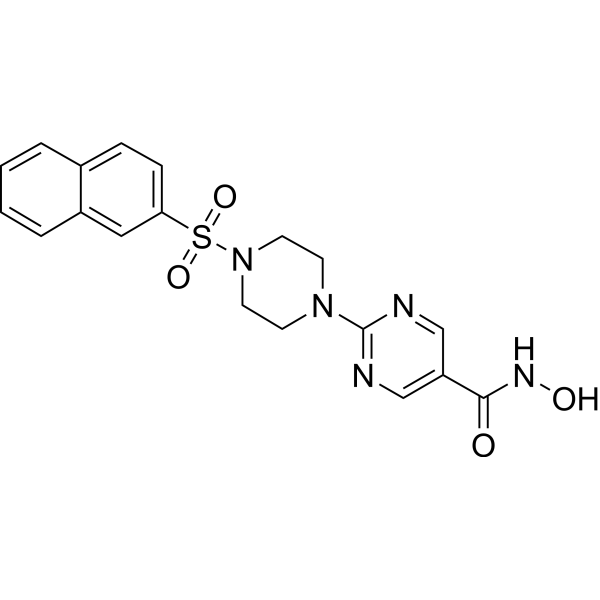
    JNJ-16241199 (R306465) is an orally active, selectivehydroxamate-based histone deacetylase (HDAC) inhibitor, with theIC50of 3.3 nM and 23 nM for HDAC1and HDAC8, respectively.JNJ-16241199induces histone 3 acetylation and strongly increases the expression of p21 waf1, cip1 in A2780 ovarian carcinoma cells.JNJ-16241199 inducescell apoptosisand shows anticancer activityin a broad spectrum of human malignancies. JNJ-16241199 can be used for cancer study .
    JNJ-16241199
  • HY-175857

    HDAC Apoptosis Cancer
    HDAC-IN-92 is a pan-HDAC inhibitor with an IC50 of 12.58 µM in A2780 cells. HDAC-IN-92 demonstrates broad-spectrum, notable cytotoxic activity against a range of human cancer cell lines, including ovarian, liver, and breast carcinomas. HDAC-IN-92 causes apoptosis and demonstrates a notable decrease in tumor cell colony formation. HDAC-IN-92 inhibits the formation of blood vessels in the chick chorioallantoic membrane (CAM). HDAC-IN-92 exhibits anti-tumor effect in a 4T1 tumor-bearing mouse model. HDAC-IN-92 can be used for research targeting solid tumor .
    HDAC-IN-92
  • HY-162721

    Biochemical Assay Reagents Cancer
    Anticancer agent 242 (7) possesses anticancer activity in A2780 (IC50 = 0.24 μM, ovarian adenocarcinoma), A2780cis (IC50 = 0.45 μM, resistant derivative of A2780), CCD18Co (IC50 = 0.59 μM, non-malignant human fibroblasts), A549 (IC50 = 0.32 μM, lung carcinoma), HT29 (IC50 = 0.26 μM, colorectal adenocarcinoma), and MCF7 (IC50 = 0.55 μM, breast adenocarcinoma) .
    Anticancer agent 242
  • HY-N9892

    Sirtuin Others
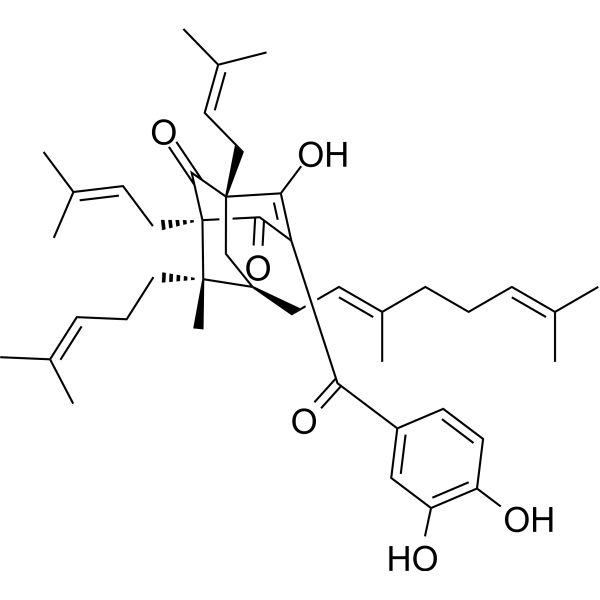
    Guttiferone G inhibits recombinant human SIRT1 and SIRT2 (IC50: 9 and 22 μM, respectively). Guttiferone G is weakly cytotoxic in A2780 human ovarian cell line (IC50: 8.0 μg/mL). Guttiferone G can be isolated from Garcinia macrophylla .
    Guttiferone G
  • HY-174160

    TAM Receptor Apoptosis Cancer
    MerTK-IN-2 (compound 15f) is an orally active MerTK inhibitor with an IC50 of 37.5 nM. MerTK-IN-2 can induce apoptosis. MerTK-IN-2 has antitumor activity with IC50 values of 1.79, 18.32, and 2.18 μM for human ovarian cancer cells A2780, breast cancer cells MDA-MB-231, and colon cancer cells HCT116, respectively .
    MerTK-IN-2
  • HY-123034

    CDK Bcl-2 Family Apoptosis Cancer
    CDKI-83 is a potent CDK9 and CDK1 inhibitor with Ki values of 21 nM and 72 nM for CDK9/T1 and CDK1/B, respectively. CDKI-83 demonstrates effective anti-proliferative activity in human tumour cell lines with a GI50<1 μM. CDKI-83 effectively induces apoptosis in A2780 human ovarian cancer cells. CDKI-83 reduces phosphorylation at Ser-2 of RNA polymerase II (RNAPII) by inhibiting cellular CDK9 activity, and down-regulates Mcl-1 and Bcl-2. CDKI-83 has the potential for anti-cancer research .
    CDKI-83
  • HY-182734

    CDK Cancer
    BMS-357075 is a pan-CDK inhibitor with CDK1 IC50 18 nM, CDK2 IC50 3 nM, CDK4 IC50 26 nM. BMS-357075 induces cytotoxicity in human ovarian cancer A2780 cells. BMS-357075 exhibits anticancer activity in mice against P388 murine leukemia. BMS-357075 can be used for the research of leukemia .
    BMS-357075
  • HY-N3446

    Apoptosis Cancer
    IVHD-valtrate, an active Valeriana jatamansi derivative, is against human ovarian cancer cells in vitro and in vivo. IVHD-valtrate induces cancer cells apoptosis and arrests the ovarian cancer cells in the G2/M phase. IVHD-valtrate has the potential to be a novel chemotherapeutic agent for the human ovarian cancer research .
    IVHD-valtrate
  • HY-119694

    Drug Metabolite Mitochondrial Metabolism Cytochrome P450 Cancer
    Rotenolone is a metabolite of Rotenone (HY-B1756), inhibitor of Mitochondrial complex I, and antiproliferative agent, with an IC50 of 137 nM against bovine complex I. Rotenolone undergoes biotransformation via multiple cytochrome P450 isoenzymes in rainbow trout liver microsomes. Rotenolone exhibits anticancer activity against ovarian cancer, breast cancer, prostate cancer, non-small cell lung cancer, and colon cancer. Rotenolone can be used in studies related to ovarian cancer, breast cancer, prostate cancer, non-small cell lung cancer, and colon cancer .
    Rotenolone
  • HY-N15168

    Parasite Infection Cancer
    3,4,5'-Trihydroxy-3'-methoxy-trans-stilbene (Compound 3) is a stilbenoid compound found in Stuhlmannia moavi. 3,4,5'-Trihydroxy-3'-methoxy-trans-stilbene exerts weak proliferative inhibitory activity and antimalarial activity with IC50 values of 54 and 27 μM against A2780 human ovarian cancer cells and Plasmodium falciparum. 3,4,5'-Trihydroxy-3'-methoxy-trans-stilbene can be used for researches of ovarian cancer and malaria .
    3,4,5'-Trihydroxy-3'-methoxy-trans-stilbene
  • HY-10226R

    R306465 (Standard)

    Reference Standards Apoptosis HDAC Cancer
    JNJ-16241199 (Standard) is the analytical standard of JNJ-16241199 (HY-10226). This product is intended for research and analytical applications. JNJ-16241199 (R306465) is an orally active, selectivehydroxamate-based histone deacetylase (HDAC) inhibitor, with theIC50of 3.3 nM and 23 nM for HDAC1and HDAC8, respectively.JNJ-16241199induces histone 3 acetylation and strongly increases the expression of p21waf1, cip1 in A2780 ovarian carcinoma cells.JNJ-16241199 inducescell apoptosisand shows anticancer activityin a broad spectrum of human malignancies. JNJ-16241199 can be used for cancer study .
    JNJ-16241199 (Standard)
  • HY-156484

    PI3K mTOR Cancer
    SPR519 is a selective, orally active dual PI3Kα/mTOR kinase inhibitor, with an IC50 of 0.03 μM against PI3Kα and an IC50 of 0.01 μM against mTOR. SPR519 exhibits anticancer effects in ovarian cancer and colon cancer xenograft models. SPR519 can be used for the research of solid tumors (ovarian cancer, colon cancer) .
    SPR519
  • HY-184154

    Thymidylate Synthase Cancer
    LC1236 is a thymidylate synthase (hTS) dimer dissociator with a target Kd of 7 μM and poor transmembrane permeability. LC1236 inhibits enzymatic activity by shifting the monomer-dimer equilibrium toward inactive monomers. LC1236 acts as a cytotoxic agent to inhibit cancer cell growth, and exerts synergistic cytotoxicity with electroporation via enhancing intracellular accumulation. LC1236 can be used in the research of cancers such as ovarian cancer and colorectal cancer .
    LC1236
  • HY-N19113

    Endogenous Metabolite Infection Cancer
    Emindole SB is an anticancer agent. Emindole SB can be isolated from Penicillium species. Emindole SB exerts anticancer effects against ovarian cancer, breast cancer and lymphoma. Emindole SB shows no toxicity to Caenorhabditis elegans. Emindole SB can be used in studies related to ovarian cancer, lymphoma and breast cancer .
    Emindole SB
  • HY-184155

    Thymidylate Synthase Apoptosis Cancer
    LC1343 is a human thymidylate synthase (hTS) inhibitor with an IC50 of 7 μM. LC1343 inhibits cancer cell growth and induces apoptosis in cancer cells. LC1343 can be used for the research of ovarian cancer, colorectal cancer, and pancreatic cancer .
    LC1343

Inquiry Online

Your information is safe with us. * Required Fields.

Salutation


Country or Region *

Applicant Name *


Organization Name *

Department *


Email Address *


Product Name *

Cat. No.


Requested quantity *

Phone Number *


Remarks

Inquiry Online

Inquiry Information

Product Name:
Cat. No.:
Quantity:
MCE Japan Authorized Agent:

