



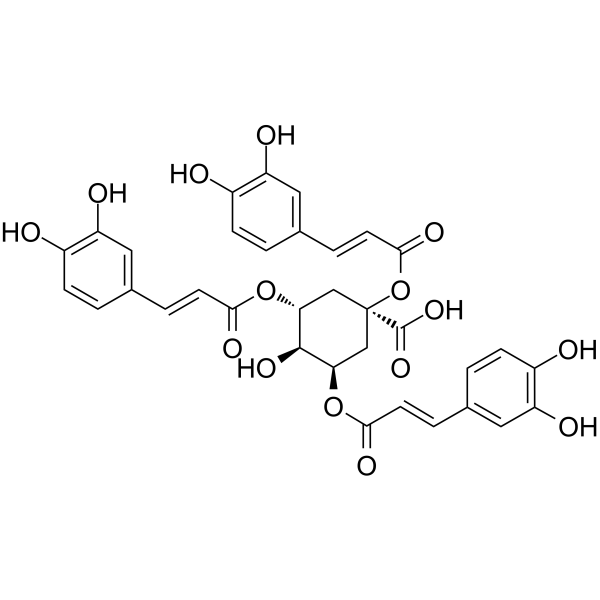
1,3,5-Tricaffeoylquinic acid
1,3,5-Tricaffeoylquinic acid acts as an angiogenesis inhibitor and apoptosis inducer, and exhibits anti-HIV activity. 1,3,5-Tricaffeoylquinic acid inhibits the phosphorylation of VEGFR2, ERK, PI3K, Akt and mTOR in the angiogenesis signaling pathway. 1,3,5-Tricaffeoylquinic acid regulates apoptosis-related proteins, upregulates the levels of activated caspase-8, Bax, activated PARP and caspase-3/9, while downregulates the level of Bcl-2. 1,3,5-Tricaffeoylquinic acid inhibits tube formation and shows cytotoxicity against ovarian cancer cells. 1,3,5-Tricaffeoylquinic acid can be used in studies related to ovarian cancer.
Para uso exclusivo en investigación. No vendemos a pacientes.
- No. CAS: 1073897-80-9
- Fòrmula: C34H30O15
- Peso molecular:678.59
-
Almacenamiento:
Please store the product under the recommended conditions in the Certificate of Analysis.

To place orders, for customer services and technical support, please contact: MedChemExpress USA
Tel: 609-228-6898 E-mail: [email protected] [email protected]


-
 Actividad biológica
-
Chemical Information
- Pureza y Documentación
- Referencias
-
 Help & FAQs


Ver todos los productos específicos de isoformas Caspase
MoreVer todos los productos específicos de isoformas VEGFR
More

Actividad biológica
Descripciòn
IC50 & Target
|
Caspase-8 |
Caspase 3 |
Caspase-9 |
In Vitro
1,3,5-Tricaffeoylquinic acid (6.2-100 μM; 24 h) potently induces cytotoxicity in human ovarian cancer cell line A2780[1].
1,3,5-Tricaffeoylquinic acid (50-100 μM; 24 h) induces apoptotic cell death in the human ovarian cancer cell line A2780[1].
1,3,5-Tricaffeoylquinic acid (50-100 μM; 24 h) activates both exogenous and endogenous apoptotic signaling pathways in human ovarian cancer cell line A2780 after treatment at 50 and 100 μM for 24 h, upregulating pro-apoptotic proteins and downregulating the anti-apoptotic protein Bcl-2[1].
1,3,5-Tricaffeoylquinic acid (50-100 μM; 24 h) inhibits angiogenesis in HUVECs by suppressing the phosphorylation of VEGFR2 and its downstream ERK and PI3K/Akt/mTOR signaling pathways[1].
1,3,5-Tricaffeoylquinic acid (25-100 μM; 24 h) non-toxically inhibits tube formation in HUVECs, reducing tube formation by 61.77% after 24 h of treatment at 100 μM[1].
MedChemExpress (MCE) has not independently confirmed the accuracy of these methods. They are for reference only.
-
Cell Line:A2780 human ovarian cancer cells
-
Concentration:6.2-100 μM
-
Incubation Time:24 h
-
Result:Reduced cell viability to 25.81% at 100 μM.
Exhibited a concentration-dependent cytotoxic effect.
Had an IC50 of 47.43 μM.
-
Cell Line:A2780 human ovarian cancer cells
-
Concentration:50-100 μM
-
Incubation Time:24 h
-
Result:Increased the percentage of annexin V-positive apoptotic cells to 15.63% at 50 μM and 37.81% at 100 μM.
-
Cell Line:HUVECs (human umbilical vein endothelial cells)
-
Concentration:50-100 μM
-
Incubation Time:24 h
-
Result:Decreased phosphorylation of VEGFR2, ERK, PI3K, Akt, and mTOR.
Enhanced these effects when co-treated with pathway inhibitors.
Increased protein expression levels of cleaved caspase-8, Bax, cleaved caspase-9, cleaved caspase-3, and cleaved PARP.
Decreased protein expression levels of Bcl-2.


Chemical Information
-
No. CAS 1073897-80-9
-
Peso molecular 678.59
-
Fòrmula C34H30O15
-
SMILES
OC1=C(O)C=CC(/C=C/C(O[C@@]2(C[C@H]([C@H](O)[C@H](OC(/C=C/C3=CC(O)=C(O)C=C3)=O)C2)OC(/C=C/C4=CC(O)=C(O)C=C4)=O)C(O)=O)=O)=C1
-
Structure Classification
-
Initial Source
-
Envío
Room temperature in continental US; may vary elsewhere.
-
Almacenamiento
Please store the product under the recommended conditions in the Certificate of Analysis.


Pureza y Documentación
Referencias
[1]. Heyman HM, et al. Identification of anti-HIV active dicaffeoylquinic- and tricaffeoylquinic acids in Helichrysum populifolium by NMR-based metabolomic guided fractionation. Fitoterapia. 2015 Jun;103:155-64. [Content Brief]
[2]. Lee D, et al. 1,3,5-Tricaffeoylquinic Acid from Ipomoea batatas Vines Induced Ovarian Cancer Cell Apoptosis and Inhibited Endothelial Tube Formation. Biomol Ther (Seoul). 2025 May 1;33(3):483-493. [Content Brief]

Calculators
Concentration (start) × Volume (start) = Concentration (final) × Volume (final)


1,3,5-Tricaffeoylquinic acid Related Classifications
HY-N6926 Related Classifications
 Powered by Bioz