



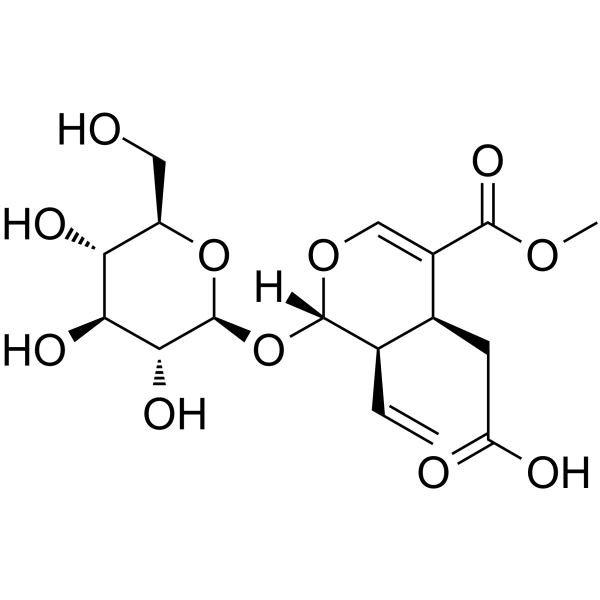
Secoxyloganin
Based on 1 publication(s) in Google Scholar
Secoxyloganin is an orally effective iridoid derivative. Secoxyloganin can be isolated from the flower buds of L. japonica. Secoxyloganin induces Apoptosis by inhibiting the expression of Bcl-2. Secoxyloganin potently inhibits the proliferation of breast cancer cells, while exerting weak activity against normal mammary epithelial cells. Secoxyloganin inhibits the decrease in tail vein blood flow associated with allergic reactions.
For research use only. We do not sell to patients.
- Purity: 99.33%
- CAS No.: 58822-47-2
- Formula: C17H24O11
- Molecular Weight:404.37
-
Storage:
4°C, protect from light
* In solvent : -80°C, 6 months; -20°C, 1 month (protect from light)

To place orders, for customer services and technical support, please contact: MedChemExpress USA
Tel: 609-228-6898 E-mail: [email protected] [email protected]


-
 Biological Activity
-
Chemical Information
-
Solvent & Solubility
- Purity & Documentation
- References
-
 Help & FAQs


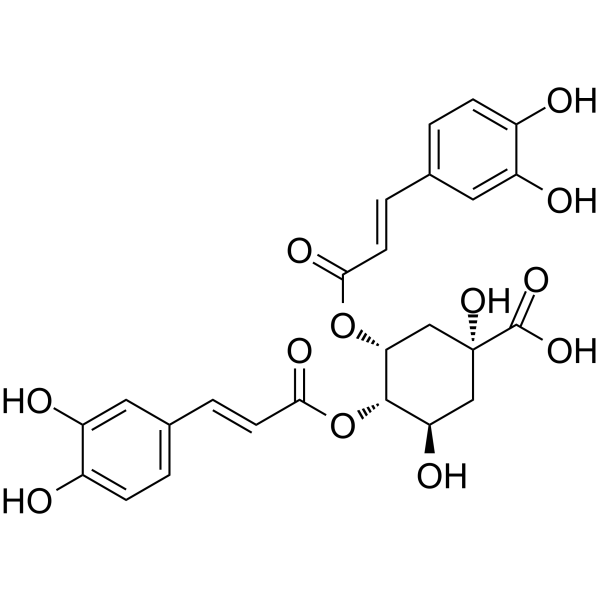
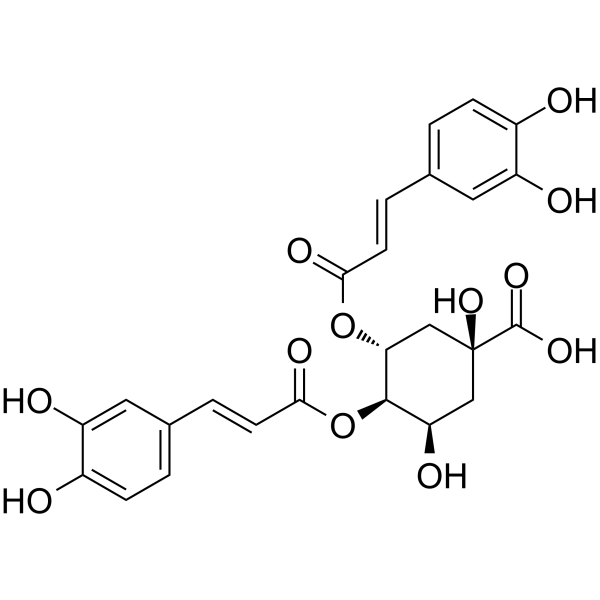
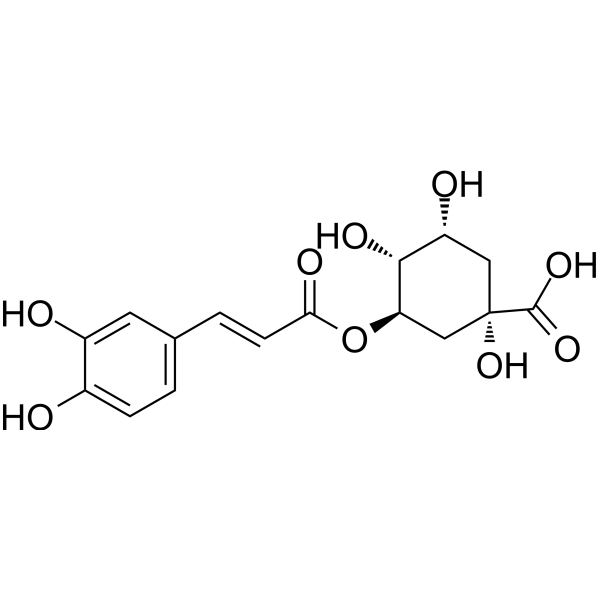

Publications Citing Use of MedChemExpress (MCE) Secoxyloganin
More

Biological Activity
|
Bcl-2 |
Secoxyloganin (0.37-96 µM; 24 h) potently inhibits the proliferation of breast cancer MDA-MB-231 cells with an IC50 of 6.5 µM, while it shows weak activity against normal fR2 mammary epithelial cells with an IC50 of 38 µM[1].
Secoxyloganin (6-24 µM) induces concentration-dependent DNA damage in breast cancer MDA-MB-231 cells[1].
Secoxyloganin (6-24 µM; 24 h) induces concentration-dependent apoptosis in breast cancer MDA-MB-231 cells[1].
Secoxyloganin (6-24 µM; 24 h) regulates the expression of apoptosis-related proteins in human breast cancer MDA-MB-231 cells, upregulating Bax and decreasing Bcl-2[1].
Secoxyloganin (6-24 µM) induces G0/G1 cell cycle arrest in breast cancer MDA-MB-231 cells[1].
MedChemExpress (MCE) has not independently confirmed the accuracy of these methods. They are for reference only.
-
Cell Line:human breast cancer MDA-MB-231 cells
-
Concentration:6-24 µM
-
Incubation Time:24 h
-
Result:Induced a concentration-dependent increase in apoptosis in MDA-MB-231 cells, with increased intensities of early apoptotic yellow-green fluorescence and late apoptotic orange-red fluorescence at higher concentrations.
Increased the percentage of apoptotic MDA-MB-231 cells from 3.7% in control to 21.8% at 6 µM, 30.3% at 12 µM, and 40.2% at 24 µM.
-
Cell Line:human breast cancer MDA-MB-231 cells
-
Concentration:6-24 µM
-
Incubation Time:Certain time
-
Result:Increased the proportion of MDA-MB-231 cells in the G0/G1 phase from 32.76% in control to 43.61% at 6 µM, 69.79% at 12 µM, and 77.50% at 24 µM, indicating G0/G1 cell cycle arrest.
MedChemExpress (MCE) has not independently confirmed the accuracy of these methods. They are for reference only.
-
Animal Model:ddY mice (male, 5 weeks old, SPF grade, sensitized intraperitoneally with HEL in complete Freund’s adjuvant)[2]
-
Dosage:10 mg/kg
-
Administration:p.o.; 4 doses on days 0, 3, 6, 9
-
Result:Significantly inhibited the HEL-induced decrease in tail vein BF compared to the HEL-sensitized control group after day 7 of sensitization, with BF remaining near 100% of normal levels through day 9 (control BF dropped to ~70% of normal).
Showed no inhibitory effect on ADP-induced whole blood platelet aggregation in HEL-sensitized mice on day 9.


Chemical Information
-
CAS No. 58822-47-2
-
Appearance Solid
-
Molecular Weight 404.37
-
Formula C17H24O11
-
Color White to light yellow
-
SMILES
C=C[C@@H]1[C@@H](C(C(OC)=O)=CO[C@@]1([H])O[C@@H]2O[C@@H]([C@@H](O)[C@H](O)[C@H]2O)CO)CC(O)=O
-
Structure Classification
-
Initial Source
-
Shipping
Room temperature in continental US; may vary elsewhere.
-
Storage
4°C, protect from light
* In solvent : -80°C, 6 months; -20°C, 1 month (protect from light)


Publications (1)
-
Journal Impact Factor
-
Most Recent
-
Phytomedicine
A novel mechanism of Reduning injection in sepsis treatment: Targeting inflammatory kinases TBK1 and IKKβ. [Abstract]2026 Feb:151:157776. PMID: 41512388


Solvent & Solubility
DMSO : 100 mg/mL (247.30 mM; Need ultrasonic; Hygroscopic DMSO has a significant impact on the solubility of product, please use newly opened DMSO)
Please refer to the solubility information to select the appropriate solvent. Once prepared, please aliquot and store the solution to prevent product inactivation from repeated freeze-thaw cycles.
Storage method and period of stock solution: -80°C, 6 months; -20°C, 1 month (protect from light). When stored at -80°C, please use it within 6 months. When stored at -20°C, please use it within 1 month.
Please refer to the solubility information to select the appropriate solvent. Once prepared, please aliquot and store the solution to prevent product inactivation from repeated freeze-thaw cycles.
Storage method and period of stock solution: -80°C, 6 months; -20°C, 1 month (protect from light). When stored at -80°C, please use it within 6 months. When stored at -20°C, please use it within 1 month.
Concentration (start) × Volume (start) = Concentration (final) × Volume (final)
Select the appropriate dissolution method based on your experimental animal and administration route.
- For the following dissolution methods, please ensure to first prepare a clear stock solution using an In Vitro approach and then sequentially add co-solvents:
- To ensure reliable experimental results, the clarified stock solution can be appropriately stored based on storage conditions. As for the working solution for In Vivo experiments, it is recommended to prepare freshly and use it on the same day.
- The percentages shown for the solvents indicate their volumetric ratio in the final prepared solution. If precipitation or phase separation occurs during preparation, heat and/or sonication can be used to aid dissolution.
Add each solvent one by one: 10% DMSO 40% PEG300 5% Tween-80 45% Saline
Solubility: ≥ 2.5 mg/mL (6.18 mM); Clear solution
This protocol yields a clear solution of ≥ 2.5 mg/mL (saturation unknown).
Taking 1 mL working solution as an example, add 100 μL DMSO stock solution (25.0 mg/mL) to 400 μL PEG300, and mix evenly; then add 50 μL Tween-80 and mix evenly; then add 450 μL Saline to adjust the volume to 1 mL.
Preparation of Saline: Dissolve 0.9 g sodium chloride in ddH₂O and dilute to 100 mL to obtain a clear Saline solution.
Add each solvent one by one: 10% DMSO 90% (20% SBE-β-CD in Saline)
Solubility: ≥ 2.5 mg/mL (6.18 mM); Clear solution
This protocol yields a clear solution of ≥ 2.5 mg/mL (saturation unknown).
Taking 1 mL working solution as an example, add 100 μL DMSO stock solution (25.0 mg/mL) to 900 μL 20% SBE-β-CD in Saline, and mix evenly.
Preparation of 20% SBE-β-CD in Saline (4°C, storage for one week): 2 g SBE-β-CD powder is dissolved in 10 mL Saline, completely dissolve until clear.
Please enter the basic information of animal experiments:
-
-
-
-
Recommended: Prepare an additional quantity of animals to account for potential losses during experiments.
Please enter your animal formula composition:
-
%DMSO +
Recommended: Keep the proportion of DMSO in working solution below 2% if your animal is weak.
-
%+
-
+%Tween-80 + +
-
%Saline +
The co-solvents required include: DMSO, . All of co-solvents are available by MedChemExpress (MCE). , Tween 80. All of co-solvents are available by MedChemExpress (MCE).
Working solution concentration: 0.22 mg/mL
Method for preparing stock solution: mg drug dissolved in μL DMSO. Stock solution concentration: mg/mL. * In solvent : -80°C, 6 months; -20°C, 1 month (protect from light)
1. Take μL DMSO stock solution;
2. Add μL .
μL , mix evenly;
3. Then add μL Tween 80, mix evenly;
4. Then add μL
Please ensure that the stock solution in the first step is dissolved to a clear state, and add co-solvents in sequence. You can use ultrasonic heating (ultrasonic cleaner, recommended frequency 20-40 kHz), vortexing, etc. to assist dissolution.


Purity & Documentation
-
Data Sheet (283 KB)
-
SDS (394 KB)
- English - EN (394 KB)
- Français - FR (394 KB)
- Deutsch - DE (394 KB)
- Norwegian - NO (394 KB)
- Español - ES (394 KB)
- Swedish - SV (394 KB)
- Italian - IT (394 KB)
- Korean - KR (394 KB)
- Portuguese - PT (394 KB)
-
Handling Instructions (2659 KB)
References


Complete Stock Solution Preparation Table
Please refer to the solubility information to select the appropriate solvent. Once prepared, please aliquot and store the solution to prevent product inactivation from repeated freeze-thaw cycles.
Storage method and period of stock solution: -80°C, 6 months; -20°C, 1 month (protect from light). When stored at -80°C, please use it within 6 months. When stored at -20°C, please use it within 1 month.
| Optional Solvent | Concentration Solvent Mass | 1 mg | 5 mg | 10 mg | 25 mg |
|---|---|---|---|---|---|
| DMSO | 1 mM | 2.4730 mL | 12.3649 mL | 24.7298 mL | 61.8246 mL |
| 5 mM | 0.4946 mL | 2.4730 mL | 4.9460 mL | 12.3649 mL | |
| 10 mM | 0.2473 mL | 1.2365 mL | 2.4730 mL | 6.1825 mL | |
| 15 mM | 0.1649 mL | 0.8243 mL | 1.6487 mL | 4.1216 mL | |
| 20 mM | 0.1236 mL | 0.6182 mL | 1.2365 mL | 3.0912 mL | |
| 25 mM | 0.0989 mL | 0.4946 mL | 0.9892 mL | 2.4730 mL | |
| 30 mM | 0.0824 mL | 0.4122 mL | 0.8243 mL | 2.0608 mL | |
| 40 mM | 0.0618 mL | 0.3091 mL | 0.6182 mL | 1.5456 mL | |
| 50 mM | 0.0495 mL | 0.2473 mL | 0.4946 mL | 1.2365 mL | |
| 60 mM | 0.0412 mL | 0.2061 mL | 0.4122 mL | 1.0304 mL | |
| 80 mM | 0.0309 mL | 0.1546 mL | 0.3091 mL | 0.7728 mL | |
| 100 mM | 0.0247 mL | 0.1236 mL | 0.2473 mL | 0.6182 mL |


Secoxyloganin Related Classifications
HY-N3009 Related Classifications
 Powered by Bioz