



VEGFR
Vascular endothelial growth factor receptor
VEGFRs consist of three subtypes, the fms-like tyrosine kinase Flt-1 (VEGFR1/Flt-1), the kinase domain region, also referred to as fetal liver kinase (VEGFR2/KDR/Flk-1), and Flt-4 (VEGFR3). Each receptor has seven immunoglobulinlike domains in the extracellular domain, a single transmembrane region, and a consensus tyrosine kinase sequence interrupted by a kinase insert domain. VEGFR1 and 2 are expressed on vascular endothelial cells, whereas VEGFR3 is expressed on lymphatic endothelial. The VEGF family members VEGF-A, -B, -C, -D, -E, and PlGF, and the human immunodeficiency (HIV) Tat protein bind in specific patterns to three related receptor protein tyrosine kinases, VEGFR1, 2, and 3, and induce the formation of homo- and heteromeric receptor complexes. Binding of VEGF to VEGFR causes dimerization and autophosphorylation of the receptor. Intracellular proteins such as VEGFR-associated protein (VRAP), PLC, and Sck that associate with specific tyrosine residues of VEGFR are phosphorylated upon receptor activation. Several signal transduction pathways are activated by the binding of VEGF to its receptor, leading to increased proliferation, survival, permeability, and migration of cells.
VEGFR Isoform Specific Products
All Product Categories
-
VEGFR Inhibitors
(733)
View all products
-
VEGFR Agonists
(7)
View all products
-
VEGFR Antagonists
(6)
View all products
-
VEGFR Activators
(17)
View all products
-
VEGFR Modulators
(6)
View all products
-
VEGFR Chemical
(1)
View all products
-
VEGFR Inducer
(1)
View all products
-
VEGFR Degraders
(6)
View all products
-
VEGFR Ligands
(5)
View all products
-
VEGFR Proteins
(36)
View all products
-
VEGFR-1 Proteins
(10)
View all products
-
VEGFR-3 Proteins
(7)
View all products
-
VEGFR Related Products (831)
Related Products (831)

-
Recombinant Proteins (36)
-
Antibodies (9)
-
VEGFR Isoform Comparison
-
R1530
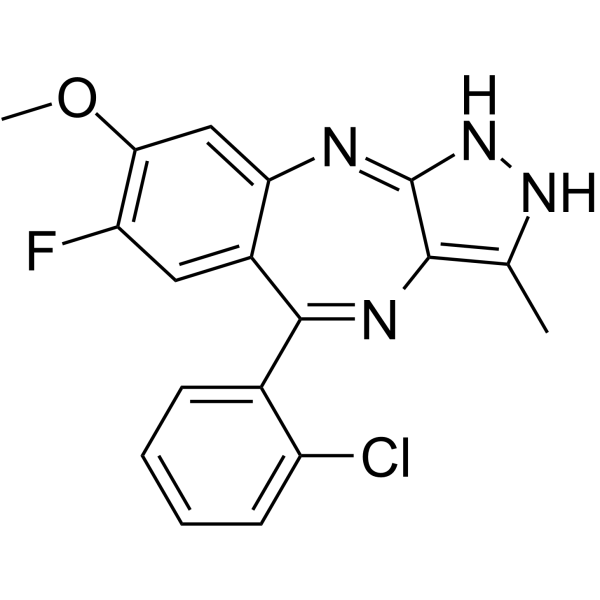 0 ImagesR1530 is a highly potent, orally active, dual-acting mitosis/angiogenesis inhibitor, with anti-tumor and anti-angiogenic activities. R1530 is a multikinase inhibitor which binds to 31 kinases with Kd values of <500 nM. R1530 inhibits VGFR2 and FGFR1 with IC50 of 10 nM and 28 nM, respectively. R1530 triggers apoptosis (mitotic catastrophe) or senescence.
-
Olinvacimab
 0 ImagesCat. No.: HY-P99768CAS No.: 2095504-49-5Synonyms: TTAC-0001; TanibirumabOlinvacimab (TTAC-0001) is a fully human anti-VEGFR2 monoclonal antibody. Olinvacimab inhibits VEGF binds to KDR with a Kd value of 0.23 nM. Olinvacimab has antiangiogenic activity. Olinvacimab can be used for the research of recurrent glioblastoma and breast cancer.
-
Pulocimab
 0 ImagesSynonyms: AK-109Pulocimab is an anti-VEGFR2 monoclonal antibody (mAb). Pulocimab can be used for the research of cancers.
-
Dilpacimab
 0 ImagesCat. No.: HY-P99852CAS No.: 1791420-09-1Synonyms: ABT165; PR1283233Dilpacimab (ABT165) is a bispecific variable domain immunoglobulin. Dilpacimab binds to and inhibits DLL4 and VEGF and acts as a tumor growth inhibitor. Dilpacimab can be used in research related to metastatic colorectal cancer and advanced solid tumors.
-
Cabozantinib-d6
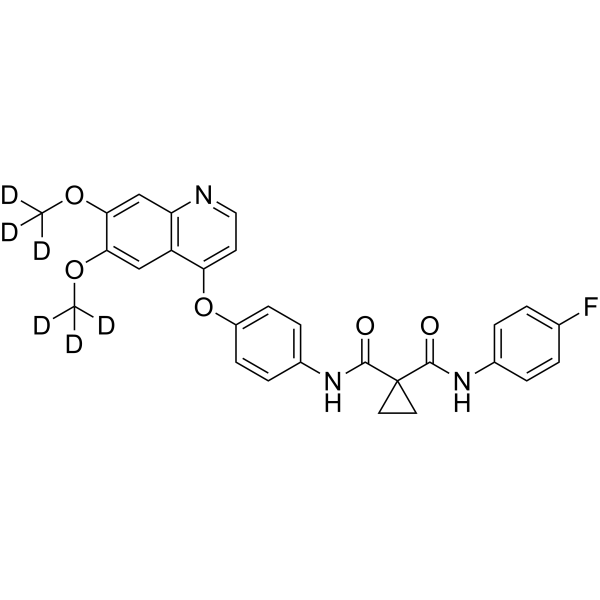 0 ImagesSynonyms: XL184-d6; BMS-907351-d6
-
Tyrphostin AG1433
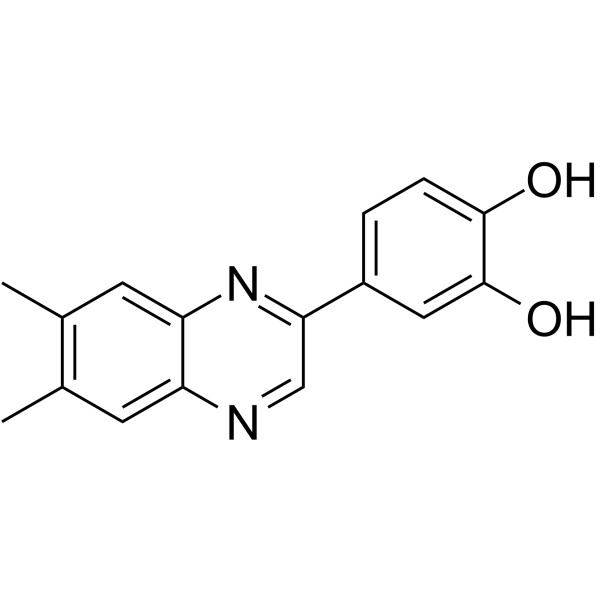 0 ImagesSynonyms: SU1433; AG1433
-
Bevasiranib sodium
 0 ImagesCat. No.: HY-153484ACAS No.: 849758-52-7Bevasiranib sodium is a siRNA that targets and silences VEGF-A. Bevasiranib sodium activates the RNA-induced silencing complex to degrade VEGF-A mRNA, mediates TLR3-related inhibition of choroidal neovascularization, and triggers RNA interference-mediated gene silencing through endogenous eukaryotic RNAi mechanisms. After intravitreal injection, Bevasiranib sodium distributes to various ocular tissues and resists degradation by intraocular nucleases, reducing choroidal neovascularization area and alleviating vascular leakage. Bevasiranib sodium can be used in research related to macular degeneration.
-
Suvemcitug
 0 ImagesCat. No.: HY-P990082CAS No.: 1610010-57-5Synonyms: APX-003; BD-0801Suvemcitug (APX-003) is a selective humanized rabbit monoclonal IgG1 (κ) anti-VEGF antibody. Suvemcitug inhibits the binding of VEGF to purified VEGFR1 (IC50 = 21.0 ng/mL) and VEGFR2 (IC50 = 275.4 ng/mL). Suvemcitug suppresses tumor angiogenesis, tumor growth and metastasis. Suvemcitug is applicable to research related to epithelial ovarian cancer, fallopian tube cancer and primary peritoneal cancer.
-
Peptide HRH acetate
 0 ImagesCat. No.: HY-P11775APeptide HRH acetate is a polypeptide that specifically binds to VEGF receptors. Peptide HRH acetate inhibits VEGF-stimulated endothelial cell proliferation. Peptide HRH acetate inhibits angiogenesis and suppresses corneal neovascularization. Peptide HRH acetate can be used in anti-angiogenesis related studies.
-
SCR-1481B1
 0 ImagesSynonyms: Metatinib free base; c-Met inhibitor 2 free baseSCR-1481B1 (Metatinib anhydrous; c-Met inhibitor 2) is an inhibitor of the N-terminal fragment of Gasdermin D (GSDMD), with an IC50 of 1.04 μM and a Ka of 0.42 μM in mice. SCR-1481B1 effectively blocks GSDMD-NT oligomerization and pore formation, inhibits GSDMD-mediated pyroptosis (Pyroptosis), preserves mitochondrial integrity, and reduces proinflammatory cytokine secretion. SCR-1481B1 also inhibits angiogenesis, exerts GSDMD-independent antitumor effects, and enhances the infiltration of antitumor immune cells. SCR-1481B1 is also an inhibitor targeting to c-MET and VEGFR2, can be used in studies related to melanoma and sepsis.
-
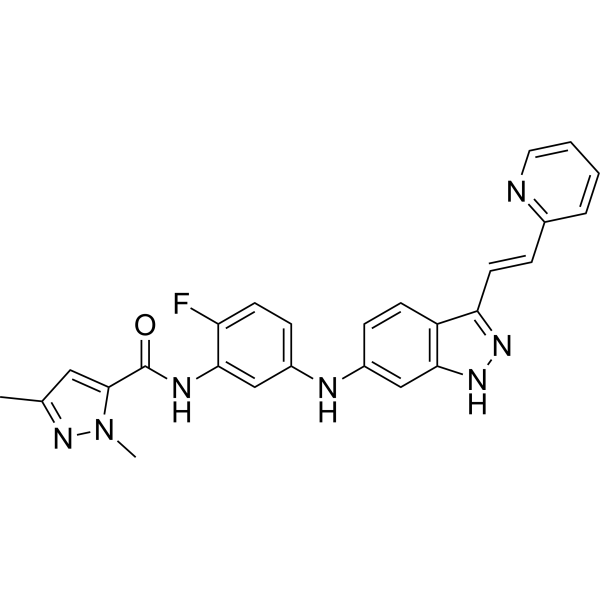
Vulinacimab
 0 ImagesSynonyms: HLX-06Vulinacimab (HLX-06) is a human monoclonal antibody directed against human vascular endothelial growth factor receptor 2 (VEGFR-2). Vulinacimab specifically binds to and inhibits VEGFR-2, which may inhibit tumor angiogenesis and tumor cell proliferation. Vulinacimab can be used for the research of solid tumors and non-small cell lung cancer.
-
hVEGF-IN-3
 0 ImageshVEGF-IN-3 (compound 9) is a potent hVEGF inhibitor. hVEGF-IN-3 inhibits HT-29, MCF-7, and HEK-293 cells proliferation with IC50s of 61, 142, and 114 μM.
-
Taurocholic acid-d8 sodium
 0 ImagesSynonyms: Sodium taurocholate-d8 (Standard); N-Choloyltaurine-d8 sodiumTaurocholic acid-d8 (sodium) is deuterium labeled Taurocholic acid (sodium). Taurocholic acid sodium (Sodium taurocholate) has marked bioactive effects such as an inhibitory potential against hepatic artery ligation induced biliary damage by upregulation of VEGF-A expression. Taurocholic acid sodium has immunoregulation effect.
-
NBM-T-BMX-OS01
 0 ImagesSynonyms: BMXNBM-T-BMX-OS01 (BMX) is a derivative of Osthole (HY-N0054). NBM-T-BMX-OS01 attenuates the phosphorylation levels of ERK and Akt in an AMPK-dependent manner. NBM-T-BMX-OS01 induces oxidative stress through the production of ROS. NBM-T-BMX-OS01 enhances Cisplatin-induced cell proliferation inhibition, colony formation inhibition, apoptosis (apoptosis) and cell cycle arrest. NBM-T-BMX-OS01 inhibits VEGF-induced phosphorylation of VEGFR2 and FAK. NBM-T-BMX-OS01 inhibits VEGF-induced endothelial cell proliferation, migration and tube formation, as well as microvessel sprouting in rat aortic rings and angiogenesis induced by colorectal cancer cells. NBM-T-BMX-OS01 inhibits the growth of subcutaneous colorectal cancer xenografts in nude mice. NBM-T-BMX-OS01 can be used in studies related to lung cancer, colorectal cancer and angiogenesis.
-
Varisacumab
 0 ImagesCat. No.: HY-P99525CAS No.: 1610010-60-0Synonyms: R 84 (antibody); GNR-011Varisacumab (R 84; GNR-011) is a fully humanized IgG1 monoclonal antibody targeting VEGF. Varisacumab specifically blocks the interaction between VEGF and VEGFR2, but does not interfere with the interaction between VEGF and VEGFR1. Varisacumab achieves effective anti-tumor and anti-angiogenic effects and can be used in the research of non-small cell lung cancer and pancreatic cancer.
-
Nintedanib-13C,d3
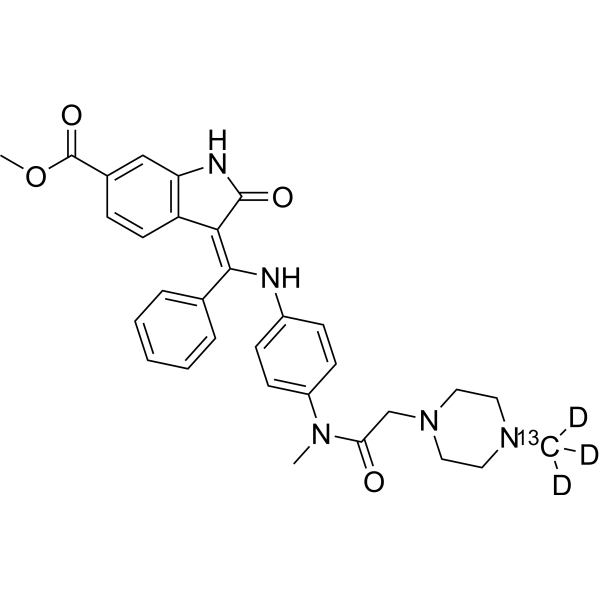 0 ImagesCat. No.: HY-50904S1Synonyms: BIBF 1120-13C,d3Nintedanib-13C,d3 is the 13C- and deuterium labeled Nintedanib. Nintedanib (BIBF 1120) is a potent triple angiokinase inhibitor for VEGFR1/2/3, FGFR1/2/3 and PDGFRα/β with IC50s of 34 nM/13 nM/13 nM, 69 nM/37 nM/108 nM and 59 nM/65 nM, respectively.
-
Cabozantinib-d4
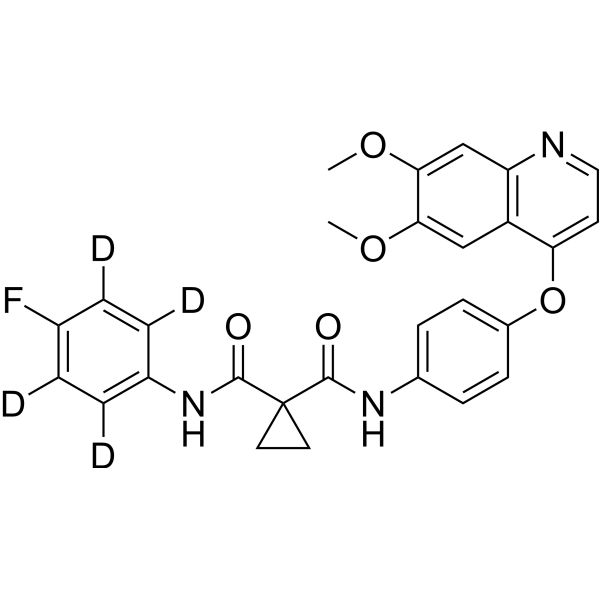 0 ImagesSynonyms: XL184-d4; BMS-907351-d4




