



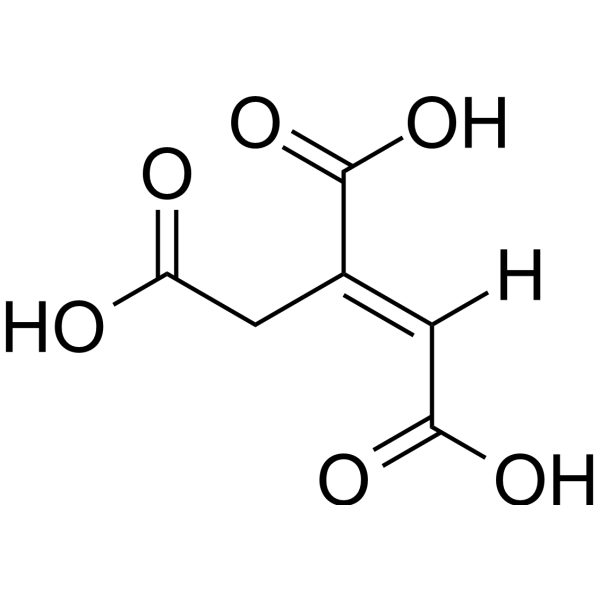
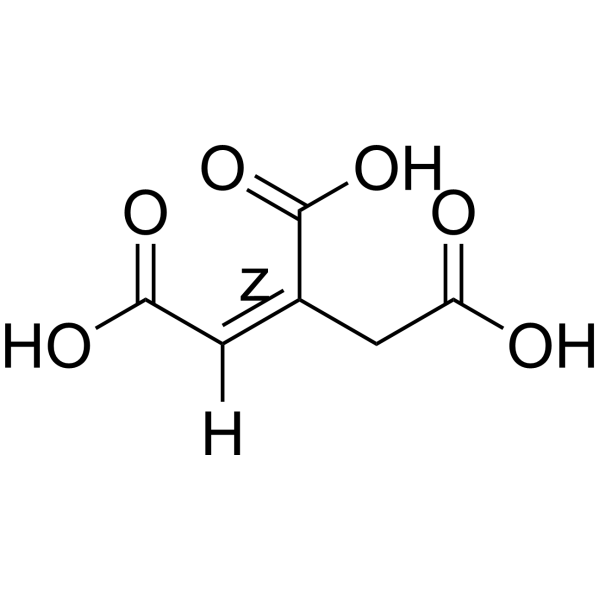
trans-Aconitic acid

Based on 1 Customer Validation
trans-Aconitic acid is an orally active aconitase inhibitor that non-competitively inhibits the conversion of citric acid to cis-aconitic acid and competitively inhibits the conversion of cis-aconitic acid to isocitric acid. trans-Aconitic acid inhibits the growth of Leishmania donovani promastigotes, the transformation of Leishmania donovani amastigotes to promastigotes, and the in vitro proliferation of Leishmania donovani amastigotes within macrophages in vitro. trans-Aconitic acid can be used in research related to visceral leishmaniasis (kala-azar).
For research use only. We do not sell to patients.
- Purity : 99.74%
- CAS No.: 4023-65-8
- Formula: C6H6O6
- Molecular Weight:174.11
-
Storage:Powder -20°C, 3 years , 4°C, 2 years ; In solvent -80°C, 6 months , -20°C, 1 month

To place orders, for customer services and technical support, please contact: MedChemExpress USA
Tel: 609-228-6898 E-mail: [email protected] [email protected]


-
 Biological Activity
-
Chemical Information
-
Solvent & Solubility
- Purity & Documentation
- References
-
 Help & FAQs


All Parasite Isoforms
More

Biological Activity
Description
IC50 & Target
|
Human Endogenous Metabolite |
In Vitro
trans-Aconitic acid (10-20 mM; duration of culture) inhibits the growth of Leishmania donovani (strain MHOH/IN/88/DD8) promastigotes when used at 10 mM and 20 mM concentrations in Ray’s liquid medium[1].
trans-Aconitic acid (2-20 mM; 24-96 h) potently inhibits the in vitro transformation of Leishmania donovani (strain MHOH/IN/88/DD8) amastigotes to promastigotes, with 60-99% inhibition at 2-10 mM and complete inhibition at 20 mM over 96 h[1].
trans-Aconitic acid (2-10 mM; 4 days) inhibits the in vitro multiplication of Leishmania donovani (strain MHOH/IN/88/DD8) amastigotes in BALB/c mouse peritoneal macrophages, with 60-83% inhibition at 2-10 mM concentrations over 4 days, and reduces the percentage of infected macrophages in a concentration-dependent manner[1].
trans-Aconitic acid (5-10 mM; 48-72 h) at 5 mM and 10 mM concentrations has no significant effect on the viability of BALB/c mouse peritoneal macrophages after 48 or 72 h of incubation[1].
trans-Aconitic acid (5-20 mM; up to 168 h) inhibits in vitro growth of L. donovani promastigotes in a dose-dependent manner, with this inhibitory effect reversible by equimolar cis-aconitic acid or citrate[2].
trans-Aconitic acid (2-10 mM; up to 120 h) inhibits in vitro transformation of L. donovani amastigotes to promastigotes, with 2 mM causing 95.2% inhibition and 10 mM causing complete inhibition[2].
trans-Aconitic acid (5-10 mM; 5 days) inhibits in vitro multiplication of L. donovani amastigotes within BALB/c mouse peritoneal macrophages, with 5 mM causing 59.5% reduction in amastigotes per macrophage and 10 mM causing 85.1% reduction[2].
MedChemExpress (MCE) has not independently confirmed the accuracy of these methods. They are for reference only.
-
Cell Line:Leishmania donovani (strain MHOH/IN/88/DD8) promastigote
-
Concentration:10 mM, 20 mM
-
Incubation Time:duration of culture
-
Result:Inhibited the growth of Leishmania donovani promastigotes in FCS-supplemented RPMI 1640 medium.\nInhibited the growth of Leishmania donovani promastigotes in Ray’s liquid medium.
-
Cell Line:Leishmania donovani (strain MHOH/IN/88/DD8) amastigote
-
Concentration:2 mM, 5 mM, 10 mM, 20 mM
-
Incubation Time:24 h, 48 h, 72 h, 96 h
-
Result:Reduced amastigote-to-promastigote transformation by 50% at 2 mM, 48 h; 55% at 2 mM, 72 h; 67% at 2 mM, 96 h.
Reduced amastigote-to-promastigote transformation by 69% at 5 mM, 48 h; 67% at 5 mM, 72 h; 82% at 5 mM, 96 h.
Achieved complete inhibition of amastigote-to-promastigote transformation through 72 h at 10 mM; reduced transformation by 99% at 10 mM, 96 h.
Achieved complete inhibition of amastigote-to-promastigote transformation through 96 h at 20 mM.
-
Cell Line:Leishmania donovani (strain MHOH/IN/88/DD8) amastigote (in BALB/c mouse peritoneal macrophages)
-
Concentration:2 mM, 5 mM, 10 mM
-
Incubation Time:4 days
-
Result:Inhibited amastigote multiplication by 60% at 2 mM, with 83% of macrophages remaining infected.
Inhibited amastigote multiplication by 74% at 5 mM, with 69% of macrophages remaining infected.
Inhibited amastigote multiplication by 83% at 10 mM, with 56% of macrophages remaining infected.
-
Cell Line:Leishmania donovani promastigotes
-
Concentration:5 mM, 10 mM, 20 mM
-
Incubation Time:up to 168 h
-
Result:Inhibited multiplication of L.
donovani promastigotes in a dose-dependent manner.
Reversed its inhibitory effect after addition of an equimolar amount of cis-aconitic acid or citrate.
-
Cell Line:Leishmania donovani amastigotes
-
Concentration:2 mM, 5 mM, 10 mM
-
Incubation Time:up to 120 h
-
Result:Inhibited transformation by 95.2% at 2 mM.
Completely inhibited transformation at 10 mM.
Showed slight transformation positivity after 96 h at 5 mM.
-
Cell Line:Leishmania donovani amastigotes (within BALB/c mouse peritoneal macrophages)
-
Concentration:5 mM, 10 mM
-
Incubation Time:5 days
-
Result:Reduced amastigotes per infected macrophage by 59.5% and reduced the percentage of infected macrophages by 25% at 5 mM.
Reduced amastigotes per infected macrophage by 85.1% and reduced the percentage of infected macrophages by 41.7% at 10 mM.
In Vivo
trans-Aconitic acid (up to 2000 mg/kg; i.p.) causes no acute mortality in BALB/c mice at intraperitoneal doses up to 2000 mg/kg[1].
trans-Aconitic acid (200-400 mg/kg/day; p.o.; i.p.; i.m.; daily; 20 consecutive days) dose-dependently suppresses spleen parasite burden in hamsters with established visceral leishmaniasis, with up to 99.6% suppression at 400 mg/kg/day via the intramuscular route, and reduces infection-related organ weight increases to near normal levels[2].
trans-Aconitic acid (200-400 mg/kg/day; p.o.; daily; 5 consecutive days) dose-dependently suppresses spleen parasite burden in hamsters with 8-day acute visceral leishmaniasis, with 98.5% suppression at 400 mg/kg/day via oral administration[2].
trans-Aconitic acid (200-400 mg/kg/day; p.o.; daily; 20 consecutive days) dose-dependently suppresses spleen parasite burden in hamsters with 30-day established visceral leishmaniasis, with 99.8% suppression at 400 mg/kg/day via oral administration[2].
Trans-aconitic acid (2.5-10 mM; hydroponic exposure; 3 times (days 10, 12, 14 of cultivation)) inhibits Glycine max growth and photosynthesis in a dose- and time-dependent manner, with 10 mM causing the most severe effects including 64% reduced root fresh weight, 56% reduced Φₚₛᵢᵢ, and 77% reduced nutrient solution uptake[4].
MedChemExpress (MCE) has not independently confirmed the accuracy of these methods. They are for reference only.
-
Animal Model:Syrian golden hamsters (male, 80-83 g body weight, intracardial infection with Leishmania donovani)[1]
-
Dosage:200 mg/kg/day; 400 mg/kg/day
-
Administration:i.p.; daily; 15 days
-
Result:Reduced total liver amastigote burden by 70% at 200 mg/kg/day.
Reduced spleen weight to 132 mg at 200 mg/kg/day.
Reduced liver weight to 2.35 g at 200 mg/kg/day.
Reduced total liver amastigote burden by 99% at 400 mg/kg/day.
Reduced spleen weight to 147 mg at 400 mg/kg/day.
Reduced liver weight to 2.28 g at 400 mg/kg/day.
Caused no adverse effect on body weight relative to controls.
-
Animal Model:Syrian golden hamsters (male; intracardial infection with Leishmania donovani promastigotes, established infection model)[2]
-
Dosage:200 mg/kg/day; 400 mg/kg/day
-
Administration:p.o.; i.p.; i.m.; daily; 20 consecutive days
-
Result:Suppressed spleen parasite burden by 73.2% and reduced elevated liver and spleen weights to near uninfected control values.
Suppressed spleen parasite burden by 98.2% and reduced liver and spleen weights to near uninfected control values.
Suppressed spleen parasite burden by 71.9% and reduced elevated liver and spleen weights to near uninfected control values.
Suppressed spleen parasite burden by 98.7% and reduced liver and spleen weights to near uninfected control values.
Suppressed spleen parasite burden by 77.0% and reduced elevated liver and spleen weights to near uninfected control values.
Suppressed spleen parasite burden by 99.6% and reduced liver and spleen weights to near uninfected control values.


Chemical Information
-
CAS No. 4023-65-8
-
Appearance Solid
-
Molecular Weight 174.11
-
Formula C6H6O6
-
Color White to off-white
-
SMILES
O=C(O)/C=C(CC(O)=O)/C(O)=O
-
Structure Classification
-
Shipping
Room temperature in continental US; may vary elsewhere.
-
Storage
Powder -20°C 3 years 4°C 2 years In solvent -80°C 6 months -20°C 1 month


Solvent & Solubility
In Vitro:
H2O : 100 mg/mL (574.35 mM; Need ultrasonic)
Please refer to the solubility information to select the appropriate solvent. Once prepared, please aliquot and store the solution to prevent product inactivation from repeated freeze-thaw cycles.
Storage method and period of stock solution: -80°C, 6 months; -20°C, 1 month. When stored at -80°C, please use it within 6 months. When stored at -20°C, please use it within 1 month.
* Note: If you choose water as the stock solution, please dilute it to the working solution, then filter and sterilize it with a 0.22 μm filter before use.
Please refer to the solubility information to select the appropriate solvent. Once prepared, please aliquot and store the solution to prevent product inactivation from repeated freeze-thaw cycles.
Storage method and period of stock solution: -80°C, 6 months; -20°C, 1 month. When stored at -80°C, please use it within 6 months. When stored at -20°C, please use it within 1 month.
* Note: If you choose water as the stock solution, please dilute it to the working solution, then filter and sterilize it with a 0.22 μm filter before use.
Concentration (start) × Volume (start) = Concentration (final) × Volume (final)
In Vivo:
For the following dissolution methods, please prepare the working solution directly:
It is recommended to prepare fresh solutions and use them promptly within a short period of time.
The percentages shown for the solvents indicate their volumetric ratio in the final prepared solution. If precipitation or phase separation occurs during preparation, heat and/or sonication can be used to aid dissolution.
Add each solvent one by one: PBS
Solubility: 50 mg/mL (287.17 mM); Clear solution; Need ultrasonic


Purity & Documentation
-
Data Sheet (297 KB)
-
SDS (393 KB)
- English - EN (393 KB)
- Français - FR (393 KB)
- Deutsch - DE (393 KB)
- Norwegian - NO (393 KB)
- Español - ES (393 KB)
- Swedish - SV (393 KB)
- Italian - IT (393 KB)
- Korean - KR (393 KB)
- Portuguese - PT (393 KB)
-
Handling Instructions (2659 KB)
References
[1]. Misra S, et al. Evaluation of antileishmanial activity of trans-aconitic acid. Biochem Med Metab Biol. 1989;42(3):171-178. [Content Brief]
[2]. Kar S, et al. Experimental visceral leishmaniasis: role of trans-aconitic acid in combined chemotherapy. Antimicrob Agents Chemother. 1993;37(11):2459-2465. [Content Brief]
[3]. Montoya G, et al. Quantitation of trans-aconitic acid in different stages of the sugar-manufacturing process. J Agric Food Chem. 2014;62(33):8314-8318. [Content Brief]
[4]. Bortolo TDSC, et al. Trans-aconitic acid inhibits the growth and photosynthesis of Glycine max. Plant Physiol Biochem. 2018;132:490-496. [Content Brief]


Complete Stock Solution Preparation Table
Please refer to the solubility information to select the appropriate solvent. Once prepared, please aliquot and store the solution to prevent product inactivation from repeated freeze-thaw cycles.
Storage method and period of stock solution: -80°C, 6 months; -20°C, 1 month. When stored at -80°C, please use it within 6 months. When stored at -20°C, please use it within 1 month.
| Optional Solvent | Concentration Solvent Mass | 1 mg | 5 mg | 10 mg | 25 mg |
|---|---|---|---|---|---|
| H2O | 1 mM | 5.7435 mL | 28.7175 mL | 57.4350 mL | 143.5874 mL |
| 5 mM | 1.1487 mL | 5.7435 mL | 11.4870 mL | 28.7175 mL | |
| 10 mM | 0.5743 mL | 2.8717 mL | 5.7435 mL | 14.3587 mL | |
| 15 mM | 0.3829 mL | 1.9145 mL | 3.8290 mL | 9.5725 mL | |
| 20 mM | 0.2872 mL | 1.4359 mL | 2.8717 mL | 7.1794 mL | |
| 25 mM | 0.2297 mL | 1.1487 mL | 2.2974 mL | 5.7435 mL | |
| 30 mM | 0.1914 mL | 0.9572 mL | 1.9145 mL | 4.7862 mL | |
| 40 mM | 0.1436 mL | 0.7179 mL | 1.4359 mL | 3.5897 mL | |
| 50 mM | 0.1149 mL | 0.5743 mL | 1.1487 mL | 2.8717 mL | |
| 60 mM | 0.0957 mL | 0.4786 mL | 0.9572 mL | 2.3931 mL | |
| 80 mM | 0.0718 mL | 0.3590 mL | 0.7179 mL | 1.7948 mL | |
| 100 mM | 0.0574 mL | 0.2872 mL | 0.5743 mL | 1.4359 mL |
* Note: If you choose water as the stock solution, please dilute it to the working solution, then filter and sterilize it with a 0.22 μm filter before use.


trans-Aconitic acid Related Classifications
HY-W016813 Related Classifications
 Powered by Bioz