



Cathepsin
Cathepsins are protease enzymes, categorized into multiple families. Cathepsins can be serine protease, cysteine protease, or aspartyl protease. There are about 15 classes of cathepsins in humans (Cathepsin A, B, C, D, E, F, G, H, K, L, O, S, V, W, and Z). Cathepsins are active in the low pH milieu of lysosomes and are versatile in their functions. Like other enzymes, they are vital for the normal physiological functions such as digestion, blood coagulation, bone resorption, ion channel activity, innate immunity, complement activation, apoptosis, vesicular trafficking, autophagy, angiogenesis, proliferation, and metastasis, among scores of others.
Numerous pathologies have been attributed to the dysregulated cathepsins, some of which include arthritis, periodontitis, pancreatitis, macular degeneration, muscular dystrophy, atherosclerosis, obesity, stroke, Alzheimer's disease, schizophrenia, tuberculosis, and Ebola.
Cathepsin Isoform Specific Products
All Product Categories
-
Cathepsin Inhibitors
(216)
View all products
-
Cathepsin Antagonist
(1)
View all products
-
Cathepsin Activators
(7)
View all products
-
Cathepsin Inducers
(3)
View all products
-
Cathepsin Degrader
(1)
View all products
-
Cathepsin Control
(1)
View all products
-
Cathepsin Substrates
(21)
View all products
-
Cathepsin Ligand
(1)
View all products
-
Cathepsin Proteins
(35)
View all products
-
Cathepsin B Proteins
(5)
View all products
-
Cathepsin C Proteins
(4)
View all products
-
Cathepsin D Proteins
(5)
View all products
-
Cathepsin E Proteins
(3)
View all products
-
Cathepsin K Proteins
(1)
View all products
-
Cathepsin L1 Proteins
(4)
View all products
-
Cathepsin S Proteins
(2)
View all products
-
Cathepsin Related Products (297)
Related Products (297)

-
Recombinant Proteins (35)
-
Antibodies (6)
-
Cathepsin Isoform Comparison
-
Cathepsin C-IN-7
 0 ImagesCat. No.: HY-177408CAS No.: 77180-19-9Cathepsin C-IN-7 (Page 68) is a Cathepsin C inhibitor. Cathepsin C-IN-7 can be used in research related to primary cancers and cancer metastases.
-
MV061194
 0 ImagesCat. No.: HY-15101CAS No.: 1021423-50-6MV061194 is a selective cathepsin K inhibitor with a human Ki of 2.5 nM. MV061194 can be used for the research of osteoporosis.
-
Heterophyllin A
 0 ImagesCat. No.: HY-P6293CAS No.: 145459-18-3Heterophyllin A can be isolated from the aboveground parts of Elaeagnus angustifolia.
-
MK-0674
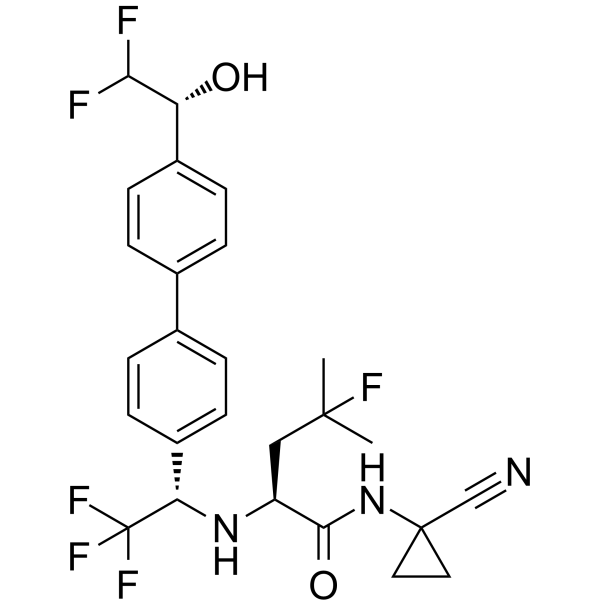 0 ImagesCat. No.: HY-10290CAS No.: 887781-62-6MK-0674 is a potent, orally bioavailable and selective cathepsin K inhibitor, with an IC50 of 0.4 nM, shows 1156, 1465, 11857 and 243 fold selectivity over Cat B, Cat F, Cat L and Cat S.
-
LmCPB-IN-1
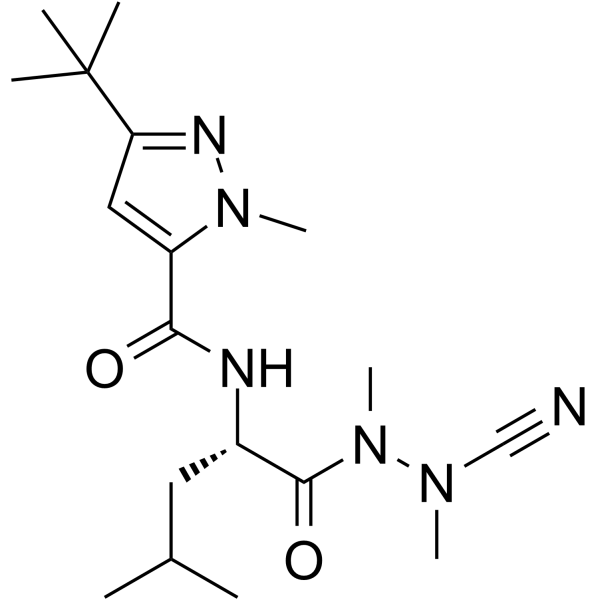 0 ImagesCat. No.: HY-146649CAS No.: 2151025-98-6LmCPB-IN-1 (compound 35) is a potent and reversible covalent Leishmania mexicana cysteine protease B (LmCPB) inhibitor with a pKi of 9.7.
-
Ac-RR-AFC TFA
 0 ImagesCat. No.: HY-P11325Purity: 99.56%Ac-RR-AFC TFA is a Cathepsin B fluorogenic substrate (Ex=400 nm, Em=505 nm). Cathepsin B activity in cells lysates is determined by measuring cleavage of Ac-RR-AFC TFA and its cleavage occurs at the RR-AFC amide bond. Ac-RR-AFC TFA can be used for activity assays and mechanistic studies on cathepsin B.
-
Estatin B
 0 ImagesCat. No.: HY-N14193CAS No.: 106396-24-1
-
Z-Arg-Arg-AMC
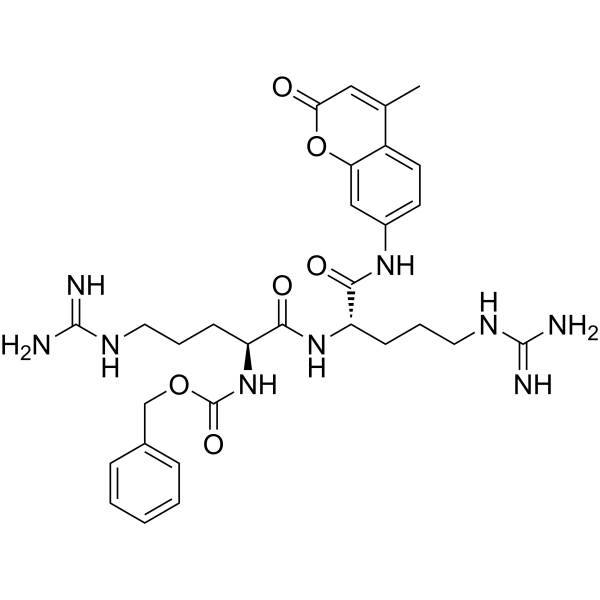 0 ImagesCat. No.: HY-P4369CAS No.: 88937-61-5Z-Arg-Arg-AMC is a selective substrate of cathepsin B.
-
ASPER-29
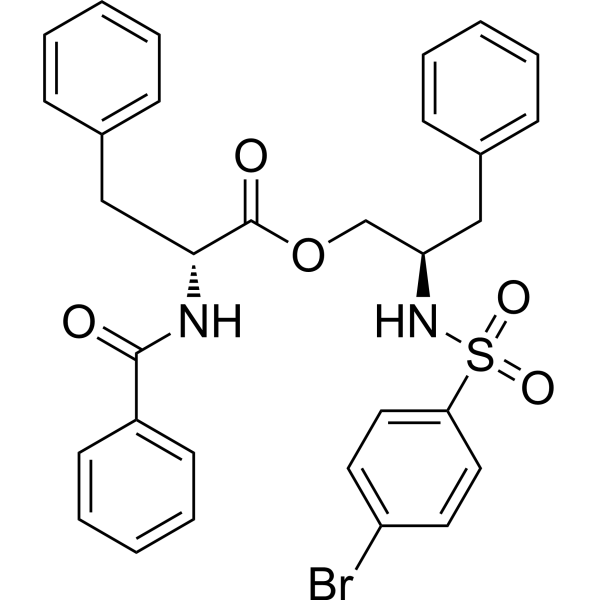 0 ImagesCat. No.: HY-152210CAS No.: 2630388-03-1ASPER-29 is Asperphenamate HY-129578 analog. ASPER-29 also is a dual cathepsin L and S inhibitor with IC50 value of 6.03 μM and 5.02 μM, respectively. ASPER-29 can be used for the research of the migration and invasion of cancer.
-
CAA-0225
 0 ImagesCat. No.: HY-16121CAS No.: 244072-26-2CAA-0225 is a tissue protease L inhibitor that inhibits rat liver tissue protease L with a IC50 value of 1.9 nM. CAA-0225 can participate in the degradation of autophagosome membrane markers LC3-II and GABARAP (HY-P72639), improve cardiac function in mice with reperfusion injury, and kill and eliminate Trypanosoma brucei parasites[1][2][3].
-
BI-9740
 0 ImagesCat. No.: HY-171888CAS No.: 1628596-25-7BI-9740 is an orally active and selective cathepsin C (CatC) inhibitor, with an IC50 of 0.6 nM in mice and 2.6 nM in rats. BI-9740 can inhibit the production of active neutrophil elastase. Additionally, BI-9740 is capable of reducing the activities of neutrophil elastase and cathepsin G in the bone marrow of rats, alleviating pathological damage to grafts after heart transplantation, shortening the reperfusion time, and improving left ventricular function. BI-9740 can be used in research related to organ transplantation.
-
Cathepsin K inhibitor 5
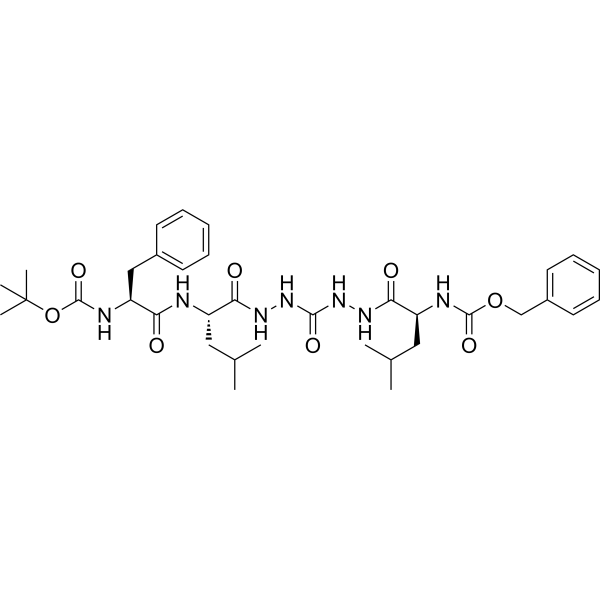 0 ImagesCat. No.: HY-P10117CAS No.: 448945-62-8Cathepsin K inhibitor 5 is a potent Cathepsin K inhibitor.
-
Ctsc Mouse Pre-designed siRNA Set A
 0 ImagesCat. No.: HY-RS03326
Ctsc Mouse Pre-designed siRNA Set A contains three designed siRNAs for Ctsc gene (Mouse), as well as a negative control, a positive control, and a FAM-labeled negative control.
-
GN-604
 0 ImagesCat. No.: HY-183351GN-604 is a targeted drug conjugate (Targeted Drug Conjugate, TDC) formed by conjugation of GNS561 (HY-137978) with DN604, a Pt (II) complex. GN-604 selectively inhibits PPT1, induces lysosomal dysfunction, suppresses autophagy and triggers apoptosis. GN-604 promotes the targeted sequestration of Pt (II) inside cells, induces DNA damage and inhibits the proliferation of malignant cells. GN-604 is applicable to research related to triple-negative breast cancer.
-
Leupeptin hemisulfate (Standard)
 0 ImagesLeupeptin hemisulfate (Standard) is the analytical standard of Leupeptin hemisulfate (HY-18234A). This product is intended for research and analytical applications. Leupeptin hemisulfate is a broad-spectrum protease inhibitor. Leupeptin hemisulfate inhibits serine, cysteine and threonine proteases, and regulates autophagy. Leupeptin hemisulfate reduces the expression levels of LC3B, iNOS, Cox-2, Beclin-1 and the level of endopeptidases; increases the levels of p62, Arg 1, Msr 1 and Mrc−1; and blocks the upregulation of p-PTEN, p-NF-κB, p-PI3K, p-Akt, p-p38 and ERK1/2. Leupeptin hemisulfate inhibits NO, ROS, proinflammatory cytokines, the IFN-γ/IL-10 ratio, phagolysosome fusion, mammalian lysosomal hydrolase activity and SARS-CoV-2 replication; and reverses impaired autophagic flux. Leupeptin hemisulfate is applicable to research related to chronic inflammatory diseases, edema, skin tumorigenesis, COVID-19 and respiratory infections.
-
PI3K-001
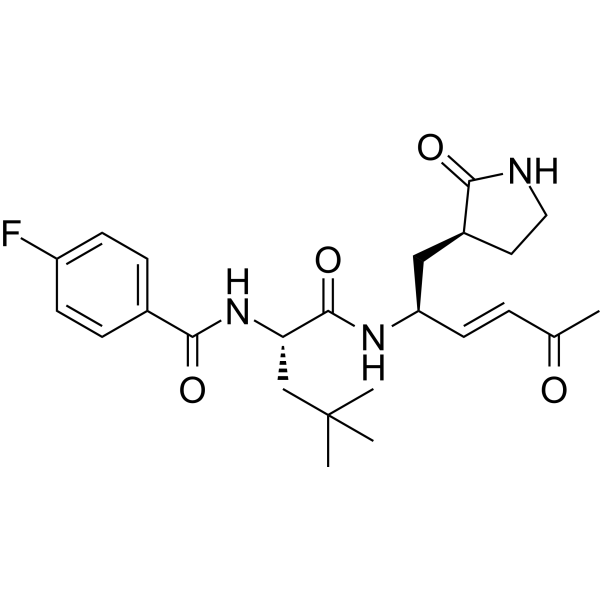
 0 ImagesCat. No.: HY-181741PI3K-001 is a cathepsin B-responsive prodrug and antifibrotic agent. PI3K-001 undergoes cathepsin B-mediated cleavage of the Val-Ala linker in fibrotic lung lesions to release an active PI3K inhibitor payload, while it remains stable in healthy tissues. PI3K-001 improves collagen deposition, tissue collapse and alveolar injury in fibrotic lung tissues. PI3K-001 is applicable for the research of pulmonary fibrosis.
-
Ctsb Rat Pre-designed siRNA Set A
 0 ImagesCat. No.: HY-RS03324
Ctsb Rat Pre-designed siRNA Set A contains three designed siRNAs for Ctsb gene (Rat), as well as a negative control, a positive control, and a FAM-labeled negative control.
-
TB-9
 0 ImagesCat. No.: HY-164956CAS No.: 1415033-91-8TB-9, a Tasiamide B (HY-N15154) derivative, is a potent cathepsin D, cathepsin E, and BACE1 inhibitor with IC50s of 0.0783 nM, 0.724 nM, and 54.2 nM, respectively.
-
Cathepsin K-IN-8
 0 ImagesCat. No.: HY-177315CAS No.: 501126-27-8Cathepsin K-IN-8 (cxample 6-60) is a cathepsin K inhibitor that can be used for the study of inflammation, rheumatoid arthritis, osteoarthritis, osteoporosis and tumors.




