



Cathepsin E
Cathepsin E is an intracellular aspartic endopeptidase with substrate specificity similar to Cathepsin D, but its tissue distribution and cellular localization distinguish it from the broadly lysosomal Cathepsin D[1][2]. Mechanistically, Cathepsin E appears in antigen-presenting Langerhans and interdigitating reticulum cells, where endosomal localization supports a proposed role in antigen processing[3]. In immune models, Cathepsin E deficiency reduced macrophage chemotaxis and adhesion by lowering surface CCR2, formyl peptide receptors, CD18, and CD29[4]. In disease models, Cathepsin E expression changed in transthyretin amyloidosis tissues and correlated with peripheral nerve and gastrointestinal involvement[5]. In tumor studies, Cathepsin E promoted soluble TRAIL release and suppressed tumor growth and metastasis in mouse and xenograft models[6]. Compared with Cathepsin D, Cathepsin E showed diffuse cytoplasmic gastric staining and a restricted tissue profile, supporting isoform-specific experimental design[7][8]. For research applications, grassystatins A-C selectively inhibited Cathepsin E over Cathepsin D and reduced dendritic-cell antigen presentation[9]. Grassystatin-derived peptides retained Cathepsin E selectivity with improved synthesis, supporting targeted inhibition in cancer and immunology research[10].
参考文献:
- [1]. Chlabicz M, et al. Cathepsin E (EC 3.4.23.34)--a review. Folia Histochem Cytobiol. 2011;49(4):547-57. [Content Brief]
- [2]. Yamamoto K, et al. Biological significance and activity control of cathepsin E compared with cathepsin D. Adv Exp Med Biol. 1991;306:297-306. [Content Brief]
- [3]. Solcia E, et al. Cathepsin E in antigen-presenting Langerhans and interdigitating reticulum cells. Its possible role in antigen processing. Eur J Histochem. 1993;37(1):19-26. PMID: 7682863. [Content Brief]
- [4]. Tsukuba T, et al. Impaired chemotaxis and cell adhesion due to decrease in several cell-surface receptors in cathepsin E-deficient macrophages. J Biochem. 2009 May;145(5):565-73. [Content Brief]
- [5]. Gonçalves NP, et al. Differential expression of Cathepsin E in transthyretin amyloidosis: from neuropathology to the immune system. J Neuroinflammation. 2017 Jun 6;14(1):115. [Content Brief]
- [6]. Kawakubo T, et al. Cathepsin E prevents tumor growth and metastasis by catalyzing the proteolytic release of soluble TRAIL from tumor cell surface. Cancer Res. 2007 Nov 15;67(22):10869-78. [Content Brief]
- [7]. Saku T, et al. Cathepsins D and E in normal, metaplastic, dysplastic, and carcinomatous gastric tissue: an immunohistochemical study. Gut. 1990 Nov;31(11):1250-5. [Content Brief]
- [8]. Muto N, et al. Characteristic distribution of cathepsin E which immunologically cross-reacts with the 86-kDa acid proteinase from rat gastric mucosa. J Biochem. 1988 Apr;103(4):629-32. [Content Brief]
- [9]. Kwan JC, et al. Grassystatins A-C from marine cyanobacteria, potent cathepsin E inhibitors that reduce antigen presentation. J Med Chem. 2009 Sep 24;52(18):5732-47. [Content Brief]
- [10]. Stotz S, et al. Grassystatin-derived peptides selectively inhibit cathepsin E and have low affinity to cathepsin D. Biochem Biophys Res Commun. 2020 Jun 18;527(1):238-241. [Content Brief]
All Product Categories
-
Cathepsin E 関連製品 (8)
関連製品 (8)

-
組換えタンパク質 (3)
-
Umibecestat
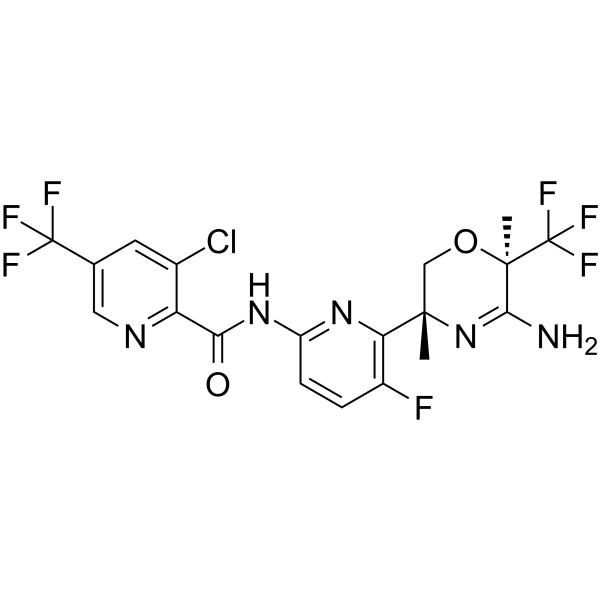 0 Images別名: CNP520Umibecestat (CNP520) is a selective, orally active BACE inhibitor, with an IC50 of 11 nM for hBACE-1, 10 nM for mouse BACE-1, and 30 nM for hBACE-2. Umibecestat reduces β-Amyloid levels in the brain and cerebrospinal fluid, decreases β-amyloid plaque deposition, and inhibits plaque-associated neuroinflammation. Umibecestat is used in research related to Alzheimer's disease.
-
Y1693
 0 ImagesY1693 is an orally active RANKL inhibitor with a Kd of 5.03 μM for hRANKL. Y1693 inhibits the activation of the downstream c-fos/NFATc1 signaling pathway by blocking its interaction with RANK. Y1693 significantly inhibits RANKL-induced osteoclast differentiation, F-actin ring formation and bone resorptive activity, while downregulating the mRNA and protein expressions of TRAP, cathepsin K, c-fos and NFATc1. Y1693 shows no obvious cytotoxicity to bone marrow-derived macrophages and osteoclast precursor cells, and exhibits favorable ADME properties. Y1693 improves ovariectomy-induced osteoporosis in mice and reverses ligation-induced periodontal alveolar bone loss. Y1693 is applicable to research related to osteoporosis and periodontal diseases.
-
Cathepsin D and E FRET Substrate
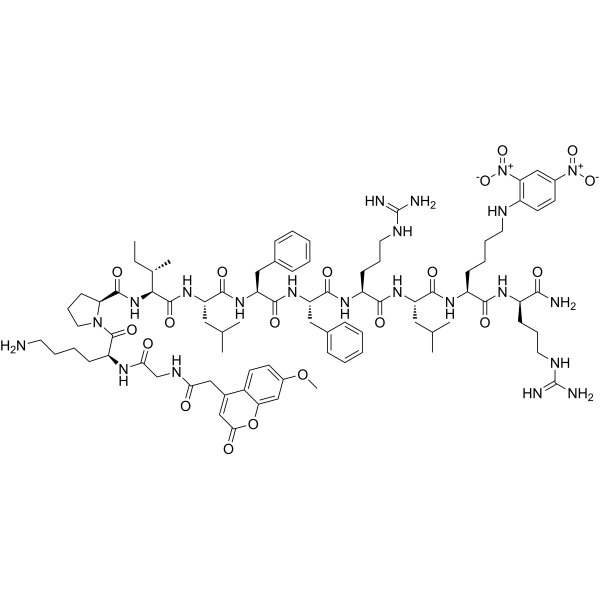 0 Images製品番号: HY-P2498CAS 番号: 839730-93-7Cathepsin D and E FRET Substrate is a fluorogenic substrate for cathepsins D and E and not for B, H or L. The cleavage occurs at the Phe-Phe amide bond resul. Cathepsin D and E FRET Substrate is a valuable tool for routine assays and for mechanistic studies on cathepsins E and D.
-
NB-216
 0 Images製品番号: HY-11014CAS 番号: 943924-04-7NB-216 is an orally active and brain-penetrant BACE-1 inhibitor (IC50 = 17 nM). NB-216 has a strong inhibitory effect on cathepsin D (IC50 = 1 nM) and cathepsin E (IC50 = 0.4 nM). NB-216 can be used for the study of Alzheimer's disease.
-
TB-9
 0 Images製品番号: HY-164956CAS 番号: 1415033-91-8TB-9, a Tasiamide B (HY-N15154) derivative, is a potent cathepsin D, cathepsin E, and BACE1 inhibitor with IC50s of 0.0783 nM, 0.724 nM, and 54.2 nM, respectively.
-
SQ 32602
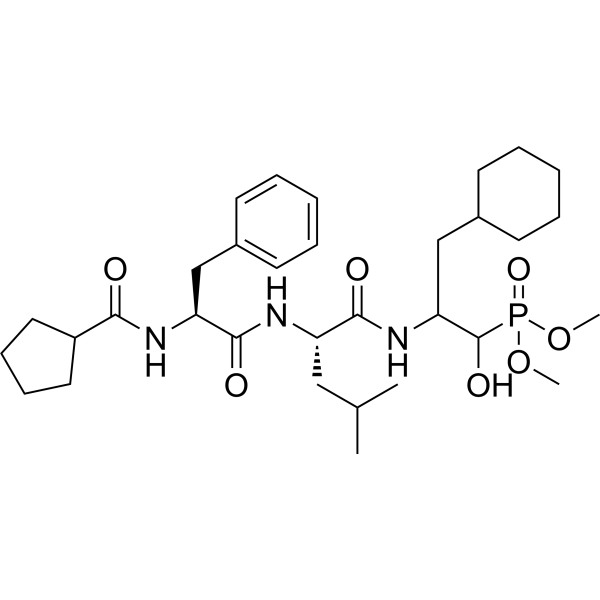 0 Images製品番号: HY-124202CAS 番号: 169529-81-1SQ 32602 is an inhibitor of cathepsin E, with the IC50 of 88 nM.
-
TB-11
 0 ImagesTB-11 is a Cathepsin D inhibitor, with IC50s of 0.126 nM (Cathepsin D), 1.92 nM (Cathepsin E), 48.8 nM (BACE1), respectively. TB-11 can be used for tumor research.
-
Umibecestat hydrochloride
 0 Images製品番号: HY-119689ACAS 番号: 2365306-62-1別名: CNP520 hydrochlorideUmibecestat hydrochloride (CNP520 hydrochloride) is a selective, orally active BACE inhibitor, with an IC50 of 11 nM for hBACE-1, 10 nM for mouse BACE-1, and 30 nM for hBACE-2. Umibecestat hydrochloride reduces β-Amyloid levels in the brain and cerebrospinal fluid, decreases β-amyloid plaque deposition, and inhibits plaque-associated neuroinflammation. Umibecestat hydrochloride is used in research related to Alzheimer's disease.




