



Cathepsin C
Cathepsin C, also called dipeptidyl peptidase I, activates granular serine proteases from immune and inflammatory cells through a structural exclusion domain that supports terminal peptide processing[1]. It functions during neutrophilic differentiation by activating neutrophil serine proteases, including neutrophil elastase, cathepsin G, proteinase 3, and neutrophil serine protease 4[2]. These proteases regulate inflammatory and immune responses after activated neutrophils release them at inflammatory sites[2]. Therefore, Cathepsin C connects intracellular protease maturation with extracellular neutrophil activation, tissue injury, and NET-associated inflammatory pathology[3]. In disease models, Cathepsin C inhibition with MOD06051 reduced neutrophil elastase activity, lowered NET-forming ability, ameliorated MPO-ANCA-associated vasculitis, and decreased NETs in rats[3]. Mechanistically, Cathepsin C differs from related cathepsin isoforms because cathepsin S inhibition can block Cathepsin C maturation, while residual neutrophil serine protease activity indicates Cathepsin C-independent activation by NSPs-AAP-1[4]. Compared with cathepsin G, a neutrophil-derived serine protease that modulates integrin clustering and effector functions, Cathepsin C acts upstream as a protease-processing enzyme rather than a released effector protease[5]. For experimental applications, reversible nitrile Cathepsin C inhibitors and cathepsin S inhibitors provide tools to dissect neutrophil serine protease maturation and inflammatory tissue injury[4].
References:
- [1]. Turk D, et al. Structure of human dipeptidyl peptidase I (cathepsin C): exclusion domain added to an endopeptidase framework creates the machine for activation of granular serine proteases. EMBO J. 2001 Dec 3;20(23):6570-82. [Content Brief]
- [2]. Korkmaz B, et al. Neutrophil proteinase 3 and dipeptidyl peptidase I (cathepsin C) as pharmacological targets in granulomatosis with polyangiitis (Wegener granulomatosis). Semin Immunopathol. 2013 Jul;35(4):411-21. [Content Brief]
- [3]. Nishibata Y, et al. Cathepsin C inhibition reduces neutrophil serine protease activity and improves activated neutrophil-mediated disorders. Nat Commun. 2024 Aug 22;15(1):6519. [Content Brief]
- [4]. Domain R, et al. Pharmacological inhibition of cathepsin S and of NSPs-AAP-1 (a novel, alternative protease driving the activation of neutrophil serine proteases). Biochem Pharmacol. 2024 Nov;229:116114. [Content Brief]
- [5]. Raptis SZ, et al. Serine protease cathepsin G regulates adhesion-dependent neutrophil effector functions by modulating integrin clustering. Immunity. 2005 Jun;22(6):679-91. [Content Brief]
All Product Categories
-
Cathepsin C Related Products (12)
Related Products (12)

-
Recombinant Proteins (4)
- 1
-
E 64c
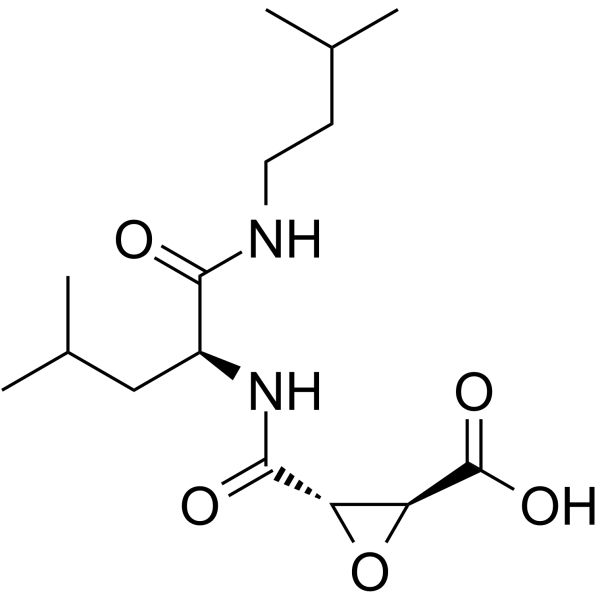 0 ImagesE 64c is a derivative of naturally occurring epoxide inhibitor of cysteine proteases, a Calcium-activated neutral protease (CANP) inhibitor and a very weak irreversible cathepsin C inhibitor. E 64c exhibits entry-blocking effect for MERS-CoV.
-
GSK-2793660
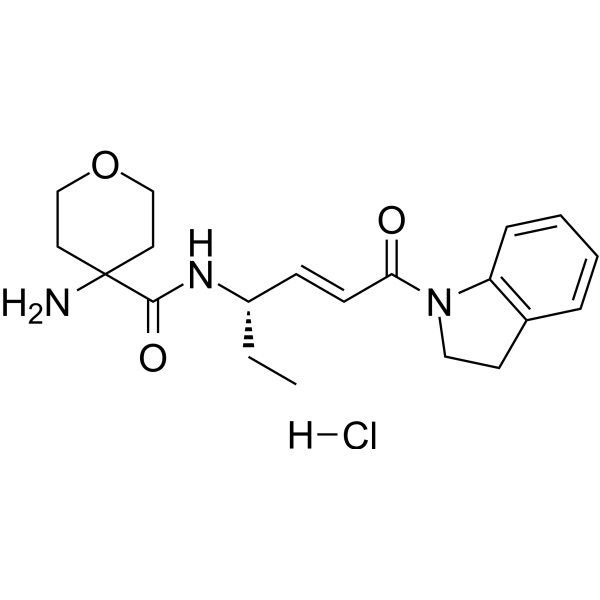 0 ImagesGSK-2793660 is an orally active and irreversible inhibitor of Cathepsin C (CTSC). GSK-2793660 can be used for the research of bronchiectasis.

-
GSK-2793660 free base
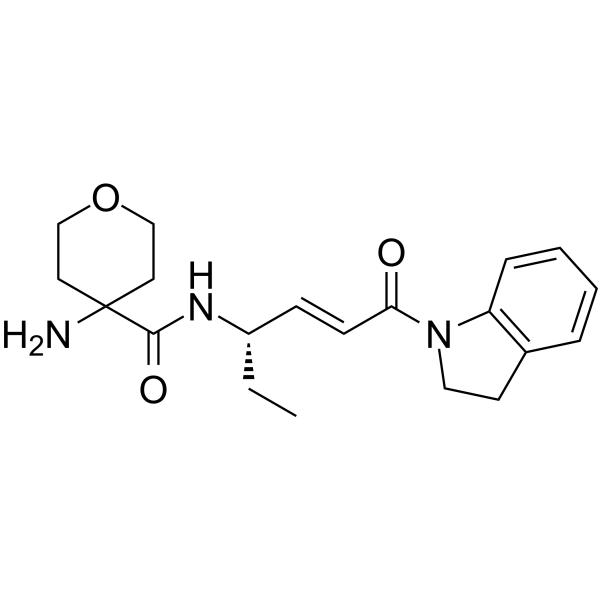 0 ImagesCat. No.: HY-112318CAS No.: 1613458-70-0GSK-2793660 (free base) is an oral, irreversible inhibitor of Cathepsin C (CTSC). GSK-2793660 (free base) can be used for the research of bronchiectasis.
-
Z-Val-Val-Nle-diazomethylketone
 0 ImagesCat. No.: HY-P5898CAS No.: 155026-49-6Synonyms: Z-Val-Val-Nle-CHN2Z-Val-Val-Nle-diazomethylketone is a cathepsin S (CATS) inhibitor. Z-Val-Val-Nle-diazomethylketone significantly inhibits the IFNg-induced upregulation of the MHCII molecules HLA-DR and Ii-p33/35 with an increase of Ii-p10 protein level. Z-Val-Val-Nle-diazomethylketone can be used for dermatological diseases like psoriasis, atopic dermatitis and actinic keratosis research.
-
Verducatib
 0 ImagesVerducatib (BI 1291583) is an orally active inhibitor of cathepsin C (also known as DPP1). Verducatib restores the protease-inhibitor balance by inhibiting the activation of neutrophil serine proteases, thereby alleviating pulmonary inflammation and regulating infection responses. Verducatib significantly reduces the risk (including severe exacerbations) and frequency of acute exacerbations in bronchiectasis (BE). Verducatib also improves lung function and quality of life, and shortens the duration of antibiotic use. The overall incidence of adverse events of Verducatib is comparable to that of placebo, with only slightly more mild-to-moderate cutaneous adverse events observed in the high-dose group, demonstrating promising clinical application potential.
-
Cathepsin C-IN-4
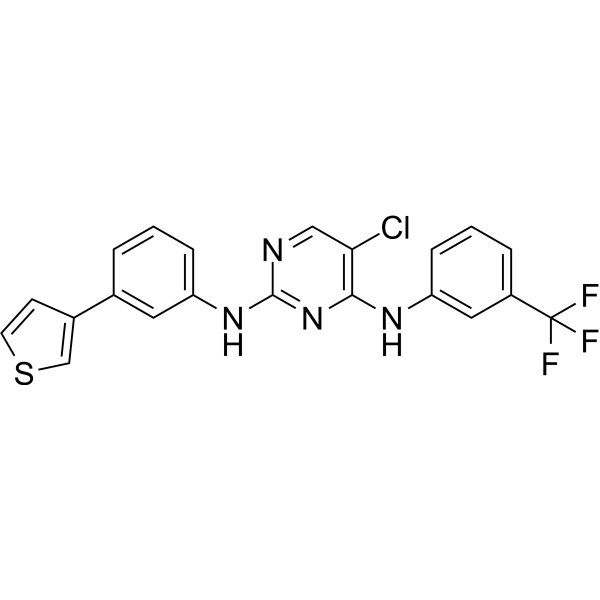 0 ImagesCat. No.: HY-146581CAS No.: 2825567-86-8Cathepsin C-IN-4 (compound SF27) is a potent Cathepsin C (Cat C) inhibitor, with an IC50 of 65.6 nM. Cathepsin C-IN-4 also inhibits THP-1 and U937 cell, with IC50 values of 203.4 and 177.6 nM, respectively.
-
Cathepsin L-IN-6
 0 ImagesCat. No.: HY-180799CAS No.: 3077842-39-5Cathepsin L-IN-6 (Compound 6a) is a selective cathepsin L inhibitor with an IC50 of 0.021 μM. Cathepsin L-IN-6 suppresses cathepsin L activity by directly binding to cathepsin L. Cathepsin L-IN-6 inhibits IL-6 and IL-8. Cathepsin L-IN-6 shows a high anti-inflammatory activity. Cathepsin L-IN-6 can be used in the research of acute lung injury.
-
Cathepsin C-IN-3
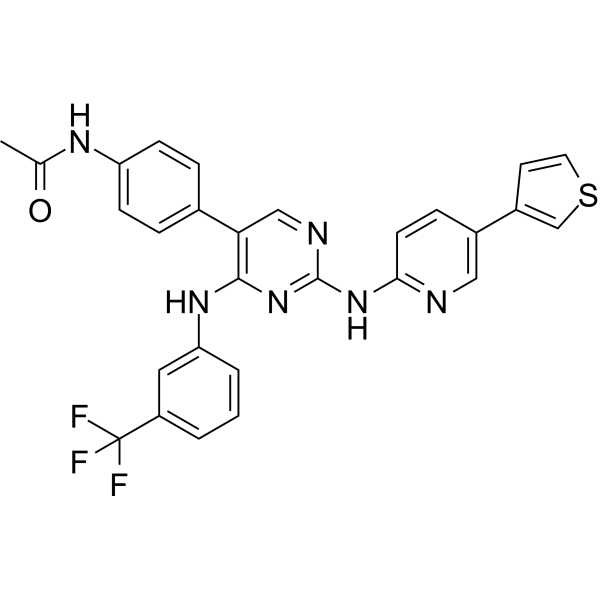 0 ImagesCat. No.: HY-146580CAS No.: 2825567-71-1Cathepsin C-IN-3 (compound SF11) is a potent Cathepsin C (Cat C) inhibitor, with an IC50 of 61.79 nM. Cathepsin C-IN-3 also inhibits THP-1 and U937 cell, with IC50 values of 101.5 and 86.5 nM, respectively.
-
Cathepsin C-IN-7
 0 ImagesCat. No.: HY-177408CAS No.: 77180-19-9Cathepsin C-IN-7 (Page 68) is a Cathepsin C inhibitor. Cathepsin C-IN-7 can be used in research related to primary cancers and cancer metastases.
-
BI-9740
 0 ImagesCat. No.: HY-171888CAS No.: 1628596-25-7BI-9740 is an orally active and selective cathepsin C (CatC) inhibitor, with an IC50 of 0.6 nM in mice and 2.6 nM in rats. BI-9740 can inhibit the production of active neutrophil elastase. Additionally, BI-9740 is capable of reducing the activities of neutrophil elastase and cathepsin G in the bone marrow of rats, alleviating pathological damage to grafts after heart transplantation, shortening the reperfusion time, and improving left ventricular function. BI-9740 can be used in research related to organ transplantation.
-
AM4299 A
 0 ImagesCat. No.: HY-187615CAS No.: 160825-48-9AM4299 A is a thiol protease inhibitor with IC50 values of 73, 390 and 88 nM against Cathepsin B, Cathepsin L and Papain, respectively. AM4299 A shows low toxicity and favorable biosafety in mice. AM4299 A can be used in studies related to osteoporosis and parasitic diseases.
- 1




