



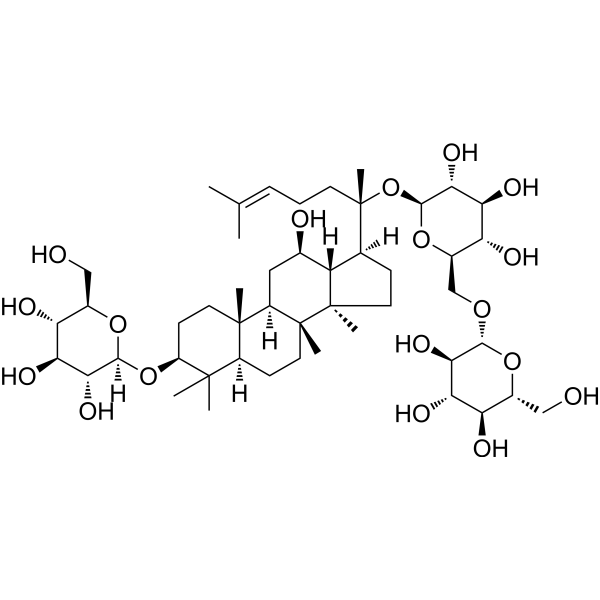
Gypenoside XVII
Based on 3 publication(s) in Google Scholar
Gypenoside XVII, a novel phytoestrogen belonging to the gypenosides, can activate estrogen receptors.
For research use only. We do not sell to patients.
- Purity : 99.87%
- CAS No.: 80321-69-3
- Formula: C48H82O18
- Molecular Weight:947.15
-
Storage:
4°C, protect from light
* In solvent : -80°C, 6 months; -20°C, 1 month (protect from light)

To place orders, for customer services and technical support, please contact: MedChemExpress USA
Tel: 609-228-6898 E-mail: [email protected] [email protected]


-
 Biological Activity
-
Chemical Information
-
Solvent & Solubility
- Protocols
- Purity & Documentation
- References
-
 Help & FAQs


-
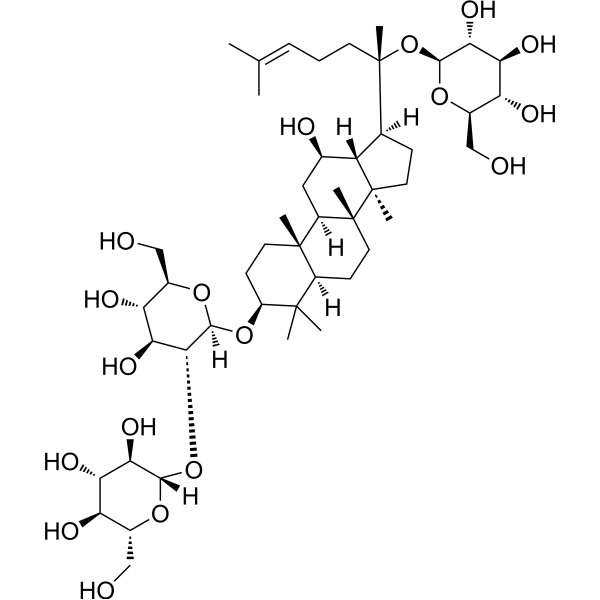
HY-N0043
Ginsenoside RdCytochrome P450 Inhibitor -
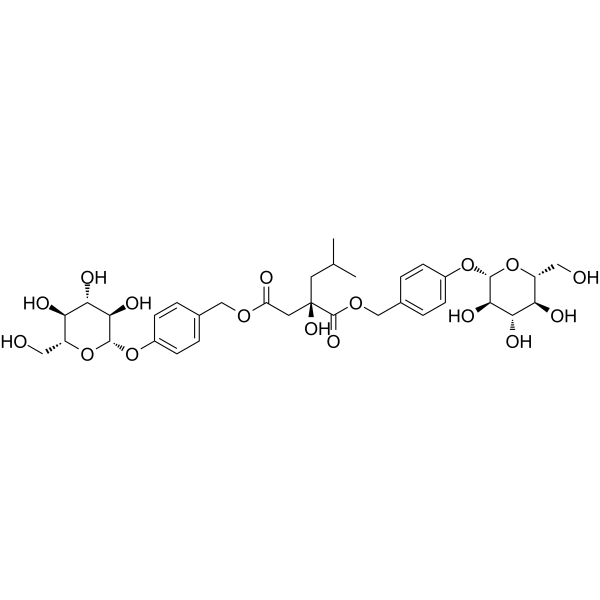
HY-122308
MilitarineAnti-inflammatory Agent -

HY-N0553R
Gypenoside XVII (Standard)Endogenous Metabolite -
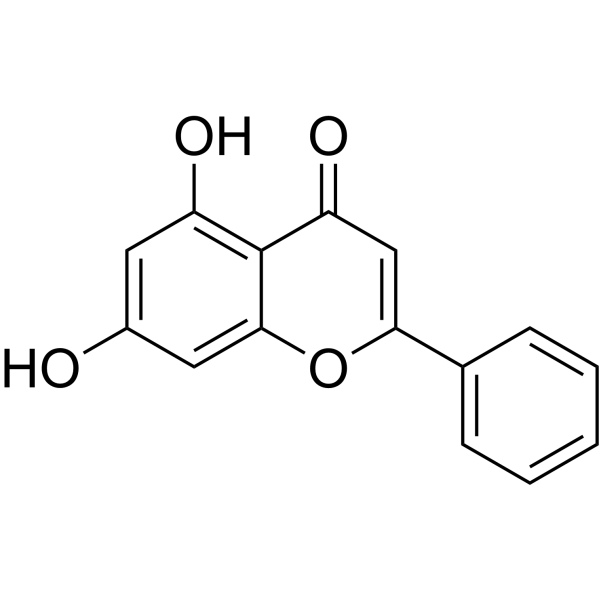
HY-14589
ChrysinEstrogen Receptor/ERR Inhibitor -
HY-N0377
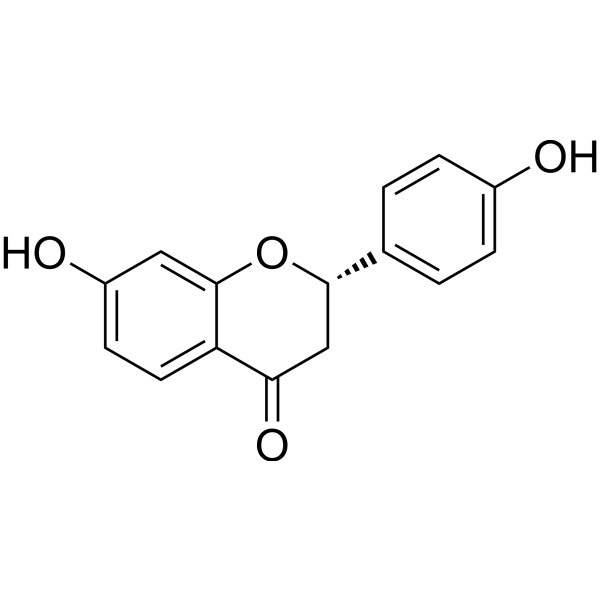
LiquiritigeninEstrogen Receptor/ERR Agonist -

HY-14589R
Chrysin (Standard)Estrogen Receptor/ERR Inhibitor -

HY-N0377R
Liquiritigenin (Standard)Estrogen Receptor/ERR Agonist
Publications Citing Use of MedChemExpress (MCE) Gypenoside XVII
MoreAll Endogenous Metabolite Isoforms
More

Biological Activity
Description
IC50 & Target
Estrogen receptor[1]
In Vitro
The ability of Gypenoside XVII (GP-17) to prevent Ox-LDL-induced cytotoxicity is detected by cell viability assays. Gypenoside XVII does not demonstrate any cytotoxicity in HUVECs. Gypenoside XVII can protect HUVECs against Ox-LDL-induced apoptosis. Gypenoside XVII dose-dependently mitigates the toxic effect of Ox-LDL on HUVEC viability. The viability of HUVECs is significantly higher than that of other groups at 50 μg/mL Gypenoside XVII [1].
MedChemExpress (MCE) has not independently confirmed the accuracy of these methods. They are for reference only.
In Vivo
MedChemExpress (MCE) has not independently confirmed the accuracy of these methods. They are for reference only.


Chemical Information
-
CAS No. 80321-69-3
-
Appearance Solid
-
Molecular Weight 947.15
-
Formula C48H82O18
-
Color White to off-white
-
SMILES
C[C@]([C@@](C[C@H]1O)([H])[C@]2(CC[C@@H]3O[C@]([C@@H]([C@@H](O)[C@@H]4O)O)([H])O[C@@H]4CO)C)(CC[C@@]2([H])C3(C)C)[C@]5([C@@]1([H])[C@]([C@@](CC/C=C(C)/C)(C)O[C@@H]([C@@H]([C@@H](O)[C@@H]6O)O)O[C@@H]6CO[C@@H]([C@@H]([C@@H](O)[C@@H]7O)O)O[C@@H]7CO)([H])CC5)C
-
Synonyms
Gynosaponin S
-
Structure Classification
-
Shipping
Room temperature in continental US; may vary elsewhere.
-
Storage
4°C, protect from light
* In solvent : -80°C, 6 months; -20°C, 1 month (protect from light)


Publications (3)
-
Journal Impact Factor
-
Most Recent
-
J Ethnopharmacol
Gypenoside XVII inhibits ox-LDL-induced macrophage inflammatory responses and promotes cholesterol efflux through activating the miR-182-5P/HDAC9 signaling pathway. [Abstract]2024 Jan 30;319(Pt 1):117070. PMID: 37625608 -
Eur J Pharmacol
Gypenoside XVII regulates apoptosis and fear extinction deficits mediated by post-traumatic stress disorder through the PERK/CHOP signaling pathway. [Abstract]2025 Dec 15:1009:178391. PMID: 41276105 -


Solvent & Solubility
In Vitro:
DMSO : ≥ 100 mg/mL (105.58 mM; Hygroscopic DMSO has a significant impact on the solubility of product, please use newly opened DMSO)
H2O : 41.67 mg/mL (44.00 mM; Need ultrasonic)
* "≥" means soluble, but saturation unknown.
Please refer to the solubility information to select the appropriate solvent. Once prepared, please aliquot and store the solution to prevent product inactivation from repeated freeze-thaw cycles.
Storage method and period of stock solution: -80°C, 6 months; -20°C, 1 month (protect from light). When stored at -80°C, please use it within 6 months. When stored at -20°C, please use it within 1 month.
* Note: If you choose water as the stock solution, please dilute it to the working solution, then filter and sterilize it with a 0.22 μm filter before use.
Please refer to the solubility information to select the appropriate solvent. Once prepared, please aliquot and store the solution to prevent product inactivation from repeated freeze-thaw cycles.
Storage method and period of stock solution: -80°C, 6 months; -20°C, 1 month (protect from light). When stored at -80°C, please use it within 6 months. When stored at -20°C, please use it within 1 month.
* Note: If you choose water as the stock solution, please dilute it to the working solution, then filter and sterilize it with a 0.22 μm filter before use.
Concentration (start) × Volume (start) = Concentration (final) × Volume (final)
In Vivo:
Select the appropriate dissolution method based on your experimental animal and administration route.
- For the following dissolution methods, please ensure to first prepare a clear stock solution using an In Vitro approach and then sequentially add co-solvents:
- To ensure reliable experimental results, the clarified stock solution can be appropriately stored based on storage conditions. As for the working solution for In Vivo experiments, it is recommended to prepare freshly and use it on the same day.
- The percentages shown for the solvents indicate their volumetric ratio in the final prepared solution. If precipitation or phase separation occurs during preparation, heat and/or sonication can be used to aid dissolution.
Add each solvent one by one: 10% DMSO 40% PEG300 5% Tween-80 45% Saline
Solubility: ≥ 2.5 mg/mL (2.64 mM); Clear solution
This protocol yields a clear solution of ≥ 2.5 mg/mL (saturation unknown).
Taking 1 mL working solution as an example, add 100 μL DMSO stock solution (25.0 mg/mL) to 400 μL PEG300, and mix evenly; then add 50 μL Tween-80 and mix evenly; then add 450 μL Saline to adjust the volume to 1 mL.
Preparation of Saline: Dissolve 0.9 g sodium chloride in ddH₂O and dilute to 100 mL to obtain a clear Saline solution.
Add each solvent one by one: 10% DMSO 90% (20% SBE-β-CD in Saline)
Solubility: ≥ 2.5 mg/mL (2.64 mM); Clear solution
This protocol yields a clear solution of ≥ 2.5 mg/mL (saturation unknown).
Taking 1 mL working solution as an example, add 100 μL DMSO stock solution (25.0 mg/mL) to 900 μL 20% SBE-β-CD in Saline, and mix evenly.
Preparation of 20% SBE-β-CD in Saline (4°C, storage for one week): 2 g SBE-β-CD powder is dissolved in 10 mL Saline, completely dissolve until clear.
For the following dissolution methods, please prepare the working solution directly:
It is recommended to prepare fresh solutions and use them promptly within a short period of time.
The percentages shown for the solvents indicate their volumetric ratio in the final prepared solution. If precipitation or phase separation occurs during preparation, heat and/or sonication can be used to aid dissolution.
Add each solvent one by one: PBS
Solubility: 25 mg/mL (26.39 mM); Clear solution; Need ultrasonic
In Vivo Dissolution Calculator
Please enter the basic information of animal experiments:
-
-
-
-
Recommended: Prepare an additional quantity of animals to account for potential losses during experiments.
Working solution concentration: 0.22 mg/mL
This product has good water solubility, please refer to the measured solubility data in water/PBS/Saline for details.


Purity & Documentation
-
Data Sheet (283 KB)
-
SDS (252 KB)
- English - EN (252 KB)
- Français - FR (252 KB)
- Deutsch - DE (252 KB)
- Norwegian - NO (252 KB)
- Español - ES (252 KB)
- Swedish - SV (252 KB)
- Italian - IT (252 KB)
- Korean - KR (252 KB)
- Portuguese - PT (252 KB)
-
Handling Instructions (2659 KB)
References


Complete Stock Solution Preparation Table
Please refer to the solubility information to select the appropriate solvent. Once prepared, please aliquot and store the solution to prevent product inactivation from repeated freeze-thaw cycles.
Storage method and period of stock solution: -80°C, 6 months; -20°C, 1 month (protect from light). When stored at -80°C, please use it within 6 months. When stored at -20°C, please use it within 1 month.
| Optional Solvent | Concentration Solvent Mass | 1 mg | 5 mg | 10 mg | 25 mg |
|---|---|---|---|---|---|
| H2O / DMSO | 1 mM | 1.0558 mL | 5.2790 mL | 10.5580 mL | 26.3950 mL |
| 5 mM | 0.2112 mL | 1.0558 mL | 2.1116 mL | 5.2790 mL | |
| 10 mM | 0.1056 mL | 0.5279 mL | 1.0558 mL | 2.6395 mL | |
| 15 mM | 0.0704 mL | 0.3519 mL | 0.7039 mL | 1.7597 mL | |
| 20 mM | 0.0528 mL | 0.2639 mL | 0.5279 mL | 1.3197 mL | |
| 25 mM | 0.0422 mL | 0.2112 mL | 0.4223 mL | 1.0558 mL | |
| 30 mM | 0.0352 mL | 0.1760 mL | 0.3519 mL | 0.8798 mL | |
| 40 mM | 0.0264 mL | 0.1320 mL | 0.2639 mL | 0.6599 mL | |
| DMSO | 50 mM | 0.0211 mL | 0.1056 mL | 0.2112 mL | 0.5279 mL |
| 60 mM | 0.0176 mL | 0.0880 mL | 0.1760 mL | 0.4399 mL | |
| 80 mM | 0.0132 mL | 0.0660 mL | 0.1320 mL | 0.3299 mL | |
| 100 mM | 0.0106 mL | 0.0528 mL | 0.1056 mL | 0.2639 mL |
* Note: If you choose water as the stock solution, please dilute it to the working solution, then filter and sterilize it with a 0.22 μm filter before use.


Gypenoside XVII Related Classifications
HY-N0553 Related Classifications
 Powered by Bioz