



HDAC
Histone deacetylases
HDAC (Histone deacetylases) are a class of enzymes that remove acetyl groups (O=C-CH3) from an ε-N-acetyl lysine amino acid on ahistone, allowing the histones to wrap the DNA more tightly. This is important because DNA is wrapped around histones, and DNA expression is regulated by acetylation and de-acetylation. Its action is opposite to that of histone acetyltransferase. HDAC proteins are now also called lysine deacetylases (KDAC), to describe their function rather than their target, which also includes non-histone proteins. Together with the acetylpolyamine amidohydrolases and the acetoin utilization proteins, the histone deacetylases form an ancient protein superfamily known as the histone deacetylase superfamily.
HDAC Isoform Specific Products
-
HDAC
(386)
View all products
-
HDAC1
(316)
View all products
-
HDAC2
(211)
View all products
-
HDAC3
(203)
View all products
-
HDAC4
(72)
View all products
-
HDAC5
(56)
View all products
-
HDAC6
(332)
View all products
-
HDAC7
(53)
View all products
-
HDAC8
(186)
View all products
-
HDAC9
(41)
View all products
-
HDAC10
(66)
View all products
-
HDAC11
(71)
View all products
-
HD1
(3)
View all products
-
HD2
(4)
View all products
All Product Categories
-
HDAC Inhibitors
(775)
View all products
-
HDAC Antagonists
(3)
View all products
-
HDAC Activators
(14)
View all products
-
HDAC Modulators
(4)
View all products
-
HDAC MDM2 Inhibitor
(1)
View all products
-
HDAC Degraders
(43)
View all products
-
HDAC Controls
(4)
View all products
-
HDAC Substrates
(3)
View all products
-
HDAC Ligands
(11)
View all products
-
HDAC Related Products (906)
Related Products (906)

-
Antibodies (16)
-
HDAC Signaling Pathway
-
HDAC Isoform Comparison
-
HDAC6-IN-47
 0 ImagesCat. No.: HY-163834HDAC6-IN-47 (Compound S-29b) is inhibitor for HDAC, which exhibits high affinities to HDAC1, HDAC2, HDAC3, HDAC6, HDAC8, HDAC10 with Ki of 60, 56, 162, 0.44, 362 and 849 nM, respectively. HDAC6-IN-47 causes tubulin hyperacetylation in MV4-11, inhibits the proliferation of MV4-11 with an EC50 of 0.50 µM. HDAC6-IN-47 can be used in research of leukemia.
-
PI3Kδ/HDAC6-IN-1
 0 ImagesCat. No.: HY-174396CAS No.: 3075011-99-0PI3Kδ/HDAC6-IN-1 (Compound 22E) is an orally active and dual inhibitor of PI3Kδ and HDAC6 with IC50 values of 2.4 nM and 6.2 nM, respectively. PI3Kδ/HDAC6-IN-1 exhibits potent antiproliferative effects on non-Hodgkin lymphoma (NHL) cells and possesses in vivo antitumor activity without significant toxicity. PI3Kδ/HDAC6-IN-1 arrests the cell cycle at the G0/G1 phase and induces apoptosis. PI3Kδ/HDAC6-IN-1 blocks the PI3K/AKT/mTOR signaling pathway and increases the acetylation levels of α-tubulin and histone H3.
-
GSK-3β/HDAC-IN-2
 0 ImagesCat. No.: HY-174398GSK-3β/HDAC-IN-2 is a potent inhibitor of GSK-3β (IC50 = 0.04 μM), HDAC2 (IC50 = 1.05 μM, Ki = 0.070 μM) and HDAC6 (IC50 = 1.52 μM, Ki = 0.017 μM). GSK-3β/HDAC-IN-2 inhibits HDAC2 and HDAC6 activities and blocks tau hyperphosphorylation. GSK-3β/HDAC-IN-2 exerts neuroprotective effects and shows no significant toxicity. GSK-3β/HDAC-IN-2 can be used in the research of Alzheimer's disease.
-
HDAC-IN-31
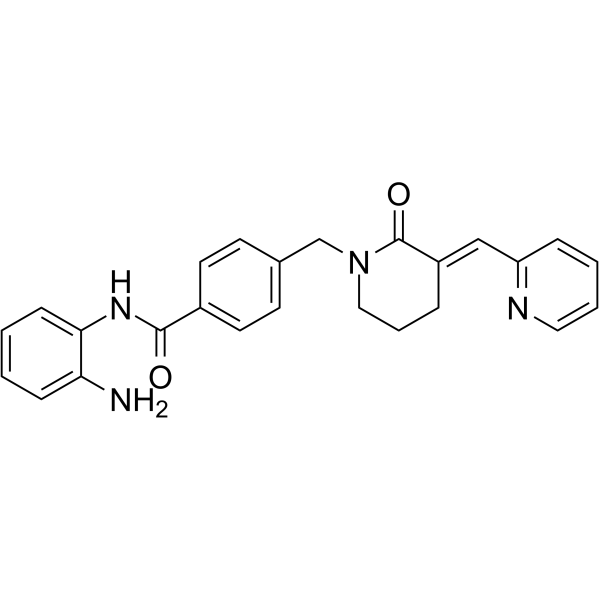 0 ImagesCat. No.: HY-144293CAS No.: 1916505-13-9HDAC-IN-31 is a potent, selective and orally active HDAC inhibitor with IC50s of 84.90, 168.0, 442.7, >10000 nM for HDAC1, HDAC2, HDAC3, HDAC8, respectively. HDAC-IN-31 induces apoptosis and cell cycle arrests at G2/M phase. HDAC-IN-31 shows good antitumor efficacy. HDAC-IN-31 has the potential for the research of diffuse large B-cell lymphoma.
-
Dihydrochlamydocin
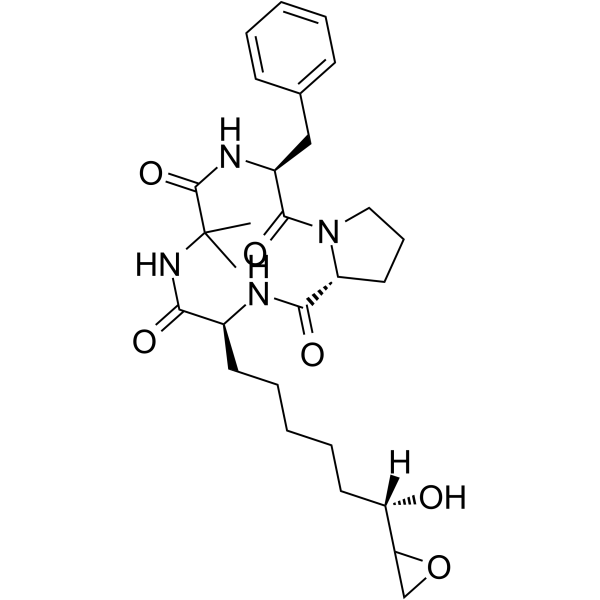 0 ImagesCat. No.: HY-115761CAS No.: 52574-64-8Dihydrochlamydocin is a histone deacetylases (HDAC) inhibitor. Dihydrochlamydocin shows strong cytostatic activity towards mastocytoma cells.
-
cGAS/HDAC-IN-1
 0 ImagesCat. No.: HY-184398cGAS/HDAC-IN-1 is an orally active dual cGAS/HDAC inhibitor that exhibits potent inhibitory activity against human and mouse cGAS (IC50: 0.17 and 1.80 μM, respectively) and moderate activity against HDAC3 and HDAC6 (IC50: 1.2 and 0.4 μM, respectively). cGAS/HDAC-IN-1 directly suppresses cGAS activity and increases its acetylation levels via HDAC3 inhibition. cGAS/HDAC-IN-1 is effective in murine models of inflammatory bowel disease and Aicardi-Goutières syndrome, and can be used in research on cGAS-dependent disorders.
-
F2F-202
 0 ImagesCat. No.: HY-184165F2F-202 is a selective HDAC6 inhibitor with an IC50 of 7.1 nM, exhibiting high selectivity toward HDAC1. F2F-202 does not directly bind to or inhibit the Hda1 protease activity of Candida albicans itself, but reduces the mRNA transcription level of the Hda1 gene. When combined with Voriconazole (HY-76200), F2F-202 decreases the yeast-hypha transition rate of azole-resistant Candida albicans and impairs the antioxidant response of azole-resistant Candida albicans. F2F-202 can be used in studies related to azole-resistant Candida albicans infections.

-
SHN7
 0 ImagesCat. No.: HY-184706CAS No.: 3126116-06-8SHN7 is a selective HDAC1/HDAC6 inhibitor, NQO1 substrate and ROS inducer, with an IC50 of 30 nM against HDAC1 and an IC50 of 10 nM against HDAC6. SHN7 inhibits STAT3 with a Kd of 8.9 μM. SHN7 arrests the cell cycle at the G2/M phase and induces Apoptosis. SHN7 exhibits anti-tumor effects in triple-negative breast cancer (TNBC) xenograft models. SHN7 can be used for the research of triple-negative breast cancer.
-
Largazole
 0 ImagesCat. No.: HY-13906CAS No.: 1009815-87-5Synonyms: (+)-LargazoleLargazole ((+)-Largazole) is an orally active, blood-brain barrier-permeable class I histone deacetylase (HDAC) inhibitor with in vivo anticancer activity and osteogenic efficacy. As a prodrug, Largazole hydrolyzes to Largazole thiol (HY-170890), which has a Ki value of 0.07 nM against human HDAC2. Largazole regulates the cell cycle, induces apoptosis, upregulates tumor suppressors and osteoblast differentiation markers, inhibits osteoclast formation, and upregulates neuroprotection-related genes. Largazole can be used in the research of various cancers including colorectal cancer, as well as neurodegenerative diseases.
-
Romidepsin (GMP)
 0 ImagesCat. No.: HY-15149GSynonyms: FK 228 (GMP); FR 901228 (GMP); NSC 630176 (GMP)Romidepsin (GMP) (FK 228 (GMP)) is Romidepsin (HY-15149) produced by using GMP guidelines. GMP small molecules works appropriately as an auxiliary reagent for cell therapy manufacture. Romidepsin (FK 228) is a Histone deacetylase (HDAC) inhibitor with anti-tumor activities. Romidepsin (FK 228) inhibits HDAC1, HDAC2, HDAC4, and HDAC6 with IC50s of 36 nM, 47 nM, 510 nM and 1.4 μM, respectively. Romidepsin (FK 228) is produced by Chromobacterium violaceum, induces cell G2/M phase arrest and apoptosis.
-
Top/HDAC-IN-1
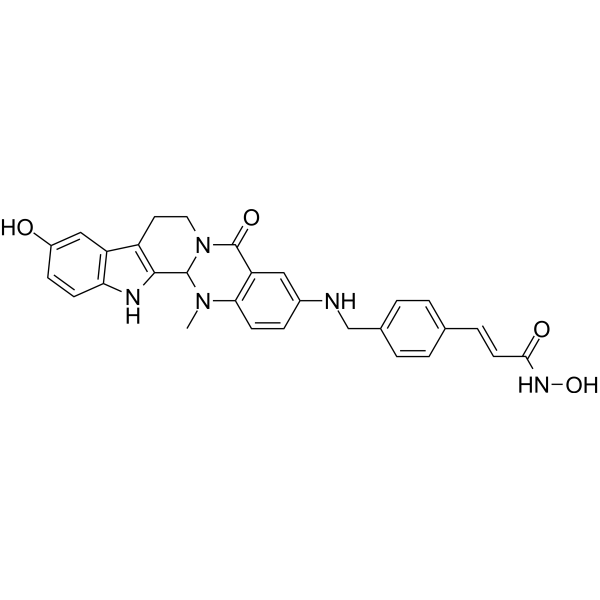 0 ImagesCat. No.: HY-145851CAS No.: 2775446-49-4Top/HDAC-IN-1 (Compound 29b) is a topoisomerase/HDAC dual inhibitor with IC50s of 18, 230, 790, 87, and 5250 nM for HDAC1, HDAC2, HDAC3, HDAC6, and HDAC8, respectively. Top/HDAC-IN-1 exhibits potent antitumor activities against the HCT116 cell line with the IC50 of 180 nM. Top/HDAC-IN-1 efficiently induces apoptosis with G2 cell cycle arrest in HCT116 cells.
-
HDAC ligand-5
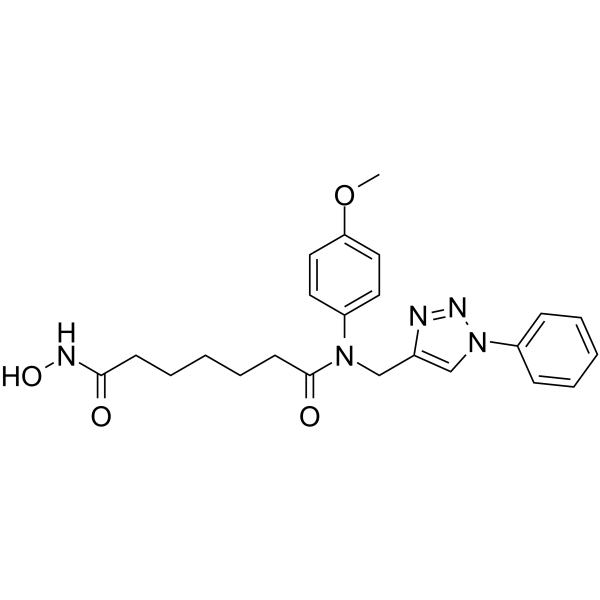
 0 ImagesCat. No.: HY-168864HDAC ligand-5 is a template for the non-selective HDAC inhibitor Vorinostat (HY-10221). HDAC ligand-5 can serve as a ligand for target protein (Ligands for Target Protein for PROTAC) for the development of PROTAC HDAC degraders with antitumor activity. HDAC ligand-5 can be used for the synthesis of FF2049 (HY-168863).


-
Tubulin/HDAC-IN-2
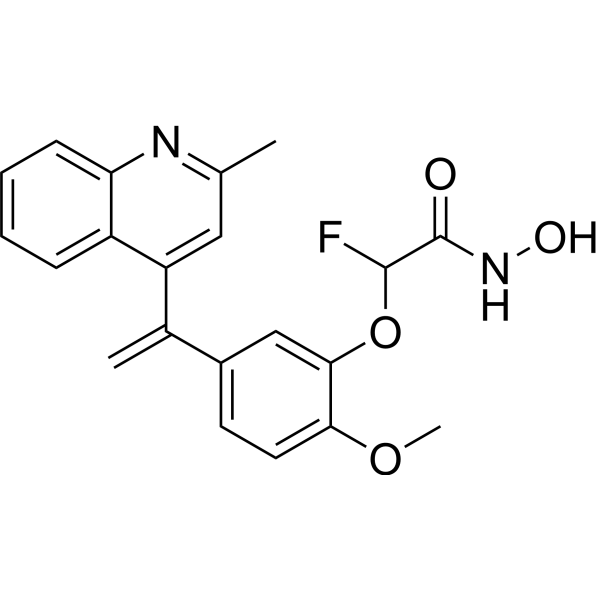 0 ImagesCat. No.: HY-155523CAS No.: 3049740-77-1Tubulin/HDAC-IN-2 (Compound II-19k) is a dual inhibitor of Tubulin and HDAC, with an IC50 of 0.403 μM, 0.591μM, 3.552μM, 0.459μM for HDAC1/2/3/6. Tubulin/HDAC-IN-2 blocks cell cycle arrest at G2 phase, induces cell apoptosis. Tubulin/HDAC-IN-2 inhibits the growth of hematoma and solid tumor cells, reduces tumor metastasis, and also inhibits tumor growth in a liver tumor allograft mouse model.
-
HDAC6-IN-44
 0 ImagesCat. No.: HY-162630HDAC6-IN-44 (compound H10) is a selective HDAC6 inhibitor with an IC50 value of 8.97 nM. HDAC6-IN-44 can inhibit the idiopathic pulmonary fibrosis (IPF) phenotype and exhibits antifibrotic activity. Additionally, HDAC6-IN-44 reduces fibrogenesis in a bleomycin-induced pulmonary fibrosis mouse model and demonstrates good metabolic stability. HDAC6-IN-44 holds promise for research in the field of idiopathic pulmonary fibrosis.




