



PARP
poly ADP ribose polymerase
PARP is a family of proteins involved in a number of cellular processes involving mainly DNA repair and programmed cell death. The PARP family comprises 17 members. They have all very different structures and functions in the cell. PARP1, PARP2, VPARP (PARP4), Tankyrase-1 and -2 (PARP-5a or TNKS, and PARP-5b or TNKS2) have a confirmed PARP activity. Others include PARP3, PARP6, TIPARP (or PARP7), PARP8, PARP9, PARP10, PARP11, PARP12, PARP14, PARP15, and PARP16. PARP is found in the cell’s nucleus. The main role is to detect and signal single-strand DNA breaks (SSB) to the enzymatic machinery involved in the SSB repair.
PARP Isoform Specific Products
-
PARP
(306)
View all products
-
PARP1
(210)
View all products
-
PARP2
(84)
View all products
-
PARP3
(23)
View all products
-
PARP4
(11)
View all products
-
TNKS1/
PARP5A (41)View all products
-
TNKS2/
PARP5B (38)View all products
-
PARP7
(25)
View all products
-
PARP10
(20)
View all products
-
PARP14
(17)
View all products
-
PARP15
(14)
View all products
-
PARP12
(4)
View all products
-
PARP16
(3)
View all products
All Product Categories
-
PARP Inhibitors
(461)
View all products
-
PARP Agonists
(4)
View all products
-
PARP Activators
(111)
View all products
-
PARP Modulators
(12)
View all products
-
PARP Inducers
(20)
View all products
-
PARP Degraders
(25)
View all products
-
PARP Substrate
(1)
View all products
-
PARP Ligands
(4)
View all products
-
PARP Related Products (698)
Related Products (698)

-
Antibodies (11)
-
PARP Isoform Comparison
-
NSC-368262
 0 ImagesCat. No.: HY-120031CAS No.: 299421-08-2NSC-368262 is a STAT3 inhibitor. NSC-368262 selectively alkylates and covalently modifies STAT3 Cys468 at the DNA-binding interface of STAT3, blocks the DNA-binding activity of STAT3, and inhibits the phosphorylation of STAT3. NSC-368262 blocks the accumulation of activated STAT3 in the nucleus of cancer cells, induces PARP cleavage and apoptosis in cells, and inhibits tumor growth in mouse models. NSC-368262 can be used in research related to breast cancer and cervical cancer.
-
Mcl-1-IN-23
 0 ImagesCat. No.: HY-184310CAS No.: 2756736-34-0Mcl-1-IN-23 is a Mcl-1 inhibitor with a Ki value of 0.024 μM. Mcl-1-IN-23 binds directly to Mcl-1 and displaces the pro-apoptotic proteins Bak and Bim from Mcl-1 complexes. Mcl-1-IN-23 induces cell apoptosis, activates caspase-3, promotes PARP cleavage, and exerts antiproliferative activity against cancer cells. Mcl-1-IN-23 can be used for the research of leukemia.
-
PARP1-IN-34
 0 ImagesCat. No.: HY-170432PARP1-IN-34 (compound 30) is a selective PARP1 inhibitor with an IC50 of 0.32 nM. PARP1-IN-34 is a subnanomolar PARP1 inhibitor with >1000-fold selectivity against PARP2 with an IC50 of 326 nM. PARP1-IN-34 shows antitumor efficacy[1].

-
Proadifen hydrochloride (Standard)
 0 ImagesSynonyms: SKF-525A (Standard); U-5446 (Standard); RP-5171 (Standard)Proadifen (hydrochloride) (Standard) is the analytical standard of Proadifen (hydrochloride). This product is intended for research and analytical applications. Proadifen (SKF-525A) hydrochloride is a non-competitive Cytochrome P450 inhibitor with an IC50 value of 19 μM. Proadifen hydrochloride reduces monoamine oxidase A (MAO-A) activity and reverses the antidepressantlike behavioral effect of Imipramine (HY-B1490A) and Desipramine (HY-B1272A) in rats. Proadifen hydrochloride also reduces N, N-dimethyltryptamine (DMT) metabolism in liver microsomes and inhibits N-demethylationand Acridone (HY-W007771) formation. Proadifen hydrochloride augments Lipopolysaccharide (LPS) (HY-D1056)-induced fever and exacerbates Prostaglandin E2 (PGE2) (HY-101952) levels in the rat. Proadifen hydrochloride is promising for research of metabolism-related deseases, ovarian carcinoma, inflammation and dopamine neurons-related deseases[4].
-
PARP/EZH2-IN-1
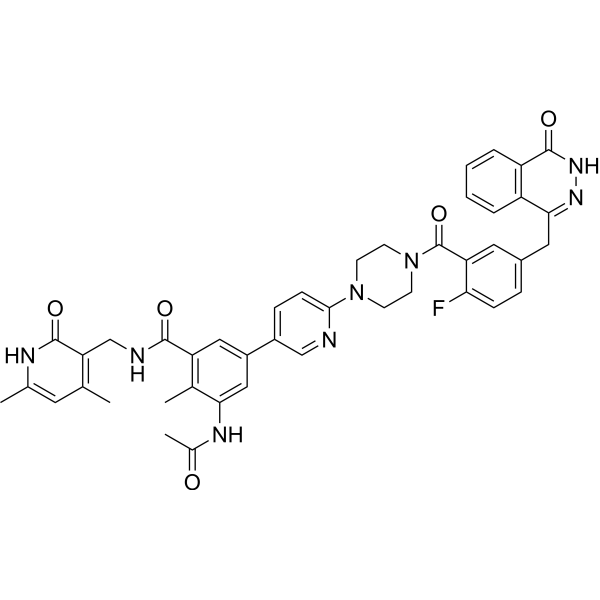 0 ImagesCat. No.: HY-132885CAS No.: 2687273-52-3PARP/EZH2-IN-1 is a first-in-class dual PARP-1/EZH2 inhibitor with IC50 values of 6.87 nM and 36.51 nM, respectively. PARP/EZH2-IN-1 induces autophagy in cancer cells and shows potent antiproliferative activity in BRCA wild-type triple-negative breast cancer cells.
-
PARP7-IN-24
 0 ImagesCat. No.: HY-173262CAS No.: 3072866-54-4

-
PARP1 degrader-2
 0 ImagesCat. No.: HY-181460PARP1 degrader-2 (Compound 11e) is a potent, selective PARP1 HYT degrader (DC50: 2.16 μM). PARP1 degrader-2 selectively binds to and degrades PARP1 but not PARP2. PARP1 degrader-2 mediates the degradation of PARP1 via the ubiquitin-proteasome system (UPS). PARP1 degrader-2 exhibits anticancer activity against triple-negative breast cancer and colon cancer (hydrophobic tag: (HY-W022007); PARP1 ligand: (HY-75706); Linker: (HY-W015300)).
-
MMRi6
 0 ImagesMMRi6 is a Mdm2-MdmX RING domain inhibitor that can disrupt Mdm2-MdmX RING-RING interaction in vitro. MMRi6 inhibits MdmX-stimulated Mdm2 autoubiquitination and Mdm2-MdmX-mediated p53 polyubiquitination in vitro without affecting NEDD4-1 autoubiquitination. MMRi6 induces p53 stabilization and accumulation and induces PARP cleavage in wt-p53 Emu-myc lymphoma cells. MMRi6 inhibits the growth of wt-p53 and p53-null Emu-myc lymphoma cells with IC50s of approximately 0.5 μM and 3 μM, respectively. MMRi6 can be used for the study of leukemia/lymphoma.
-
PARP-1-IN-23
 0 ImagesCat. No.: HY-163658CAS No.: 2976497-48-8PARP-1-IN-23 (Compound I16 ) is an orally active and selective PARP-1 inhibitor with the IC50 of 12.38 nM. PARP-1-IN-23 inhibits tumor growth in vivo.
-
PROTAC PARP/EGFR ligand 1
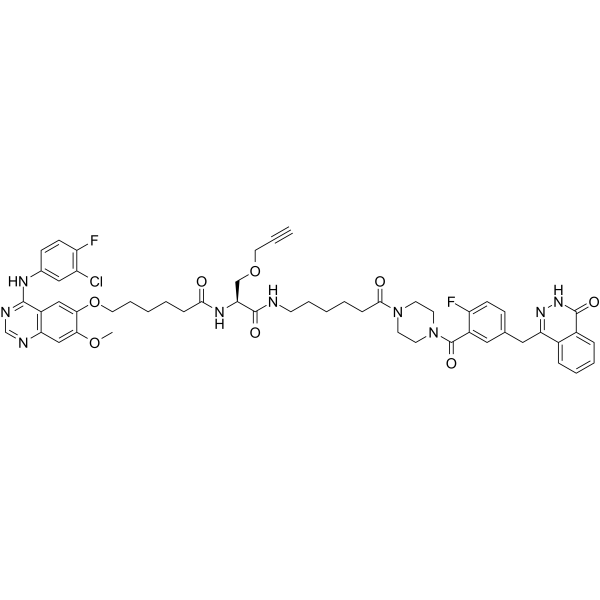 0 ImagesCat. No.: HY-141486ACAS No.: 2661609-57-8
-
Senaparib hydrochloride
 0 ImagesCat. No.: HY-137450ACAS No.: 1401683-39-3Synonyms: IMP4297 hydrochloride; JS109 hydrochlorideSenaparib hydrochloride (IMP4297 hydrochloride) is an oral, selective PARP1/2 inhibitor with potent anti-tumor activity. Senaparib hydrochloride shows antitumor activity against advanced ovarian cancer.
-
Peiminine (Standard)
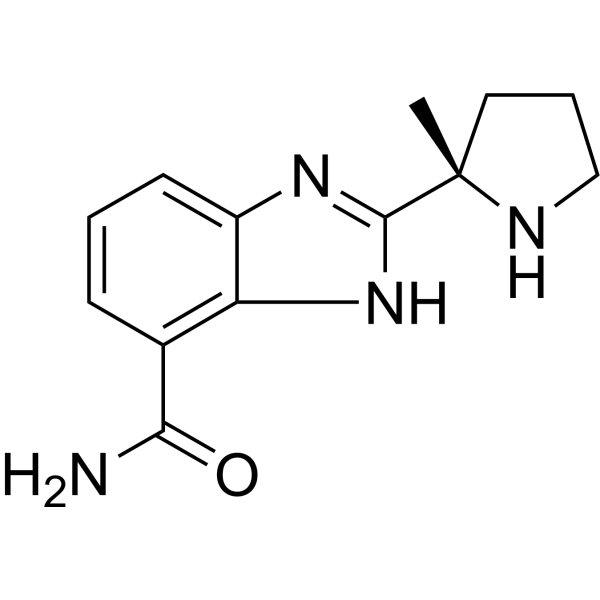
 0 ImagesCat. No.: HY-N0213RCAS No.: 18059-10-4Synonyms: Verticinone (Standard); Raddeanine (Standard)Peiminine (Standard) is the analytical standard of Peiminine. This product is intended for research and analytical applications. Peiminine is a compound that can be isolated from Bolbostemma paniculatum (Maxim) Franquet (Cucurbitaceae family). Peiminine can induce apoptosis in human hepatocellular carcinoma HepG2 cells through both extrinsic and intrinsic apoptotic pathways. Peiminine has anti-inflammatory, anticancer, anti-osteoporosis, cardioprotective and other activities in many animal models.

-
Apoptosis inducer 34
 0 ImagesApoptosis inducer 34 (Compound 4) is a small molecule compound that induces apoptosis by directly activating the intrinsic apoptotic pathway. Apoptosis inducer 34 promotes Apaf-1 oligomerization to form mature apoptosomes, thereby activating caspase-9 and caspase-3. It significantly activates the apoptotic pathway in Jurkat cells by enhancing the cytochrome c-dependent apoptotic signaling pathway, inducing PARP cleavage and chromosomal DNA fragmentation. Furthermore, Apoptosis inducer 34 exhibits low toxicity to normal cells, demonstrating potential for selective targeting of cancer cells. Apoptosis inducer 34 is a promising candidate for studying cancer related to apoptotic pathways.
-
Santamarine
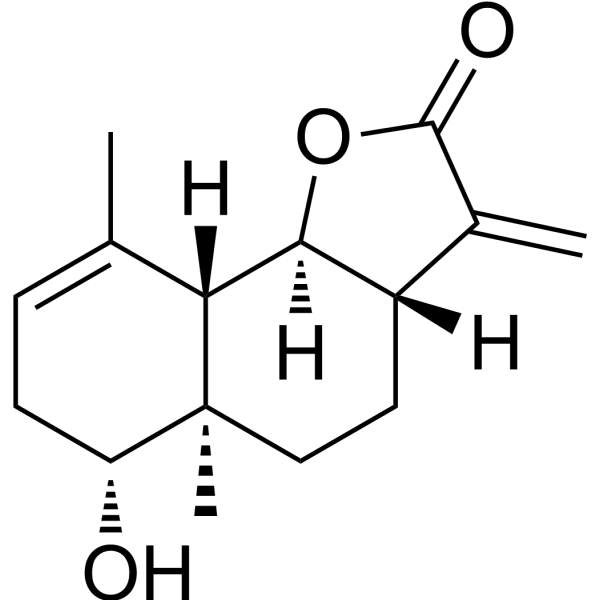 0 ImagesSantamarine (Santamarin; Balchanin) is a sesquiterpene lactone found in Artemisia scoparia. Santamarine shows anti-inflammatory, antioxidant, anticancer and anti-photoaging activities. Santamarine suppresses UVA-induced phosphorylation of JNK and p38 MAPK, nuclear translocation of phosphorylated c-Fos and c-Jun, and AP-1-mediated MMP-1 transcription and secretion. Santamarine suppresses NF-κB signaling, iNOS, COX-2, TNF-α, and IL-1β production. Santamarine inhibits thioredoxin reductase activity, induces ROS production, mitochondrial apoptosis, G2/M cell cycle arrest, and DNA damage, and reduces cancer cell growth. Santamarine can be used for the photoaging, inflammatory diseases and cancer.
-
PARP1-IN-28
 0 ImagesCat. No.: HY-159612CAS No.: 2855059-11-7
-
PARP7-IN-25
 0 ImagesCat. No.: HY-179312CAS No.: 2819998-77-9PARP7-IN-25 is a PARP7 inhibitor with an IC50 of 1.582 nM.PARP7-IN-25 inhibits enzymatic activity of PARP7. PARP7-IN-25 inhibits proliferation of lung cancer cells.PARP7-IN-25 can be used for the research of PARP7-related cancer.




