



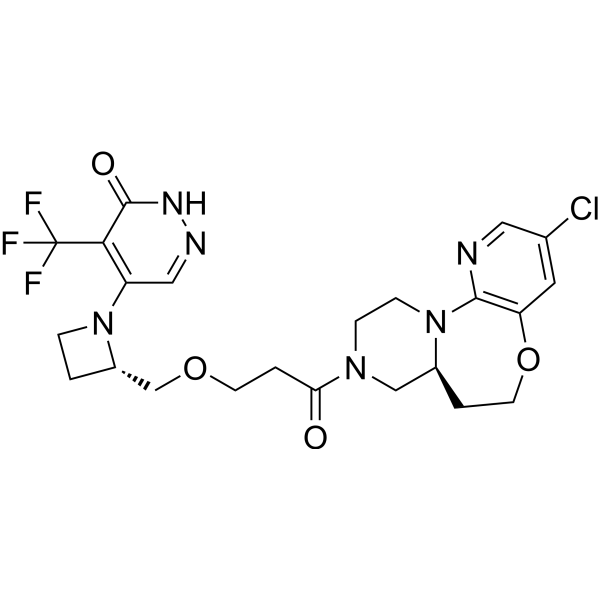
PARP7-IN-18
PARP7-IN-18 is a potent, highly selective, and orally active PARP7 inhibitor with an IC50 of 0.11 nM. PARP7-IN-18 exhibits >1000-fold selectivity over other PARP family members. PARP7-IN-18 inhibits NCI-H1373 lung cancer cell proliferation with an IC50 of 2.5 nM and promotes IFN-β expression. PARP7-IN-18 exhibits favorable pharmacokinetic properties and can be used in research on PARP7-sensitive tumors, such as lung cancer.
Nur für Forschungszwecke. Wir verkaufen nicht an Patienten.
- CAS. Nr.: 2819999-00-1
- Formel: C23H26ClF3N6O4
- Molecular Weight:542.94
-
Speicherung:
Please store the product under the recommended conditions in the Certificate of Analysis.

To place orders, for customer services and technical support, please contact: MedChemExpress USA
Tel: 609-228-6898 E-mail: [email protected] [email protected]


-
 Biologische Aktivität
-
Chemical Information
- Protokoll
- Reinheit & Dokumentation
- Verweise
-
 Help & FAQs




Biologische Aktivität
Beschreibung
IC50 & Target
[1]|
PARP7 0.11 nM (IC50) |
Cellular Effect
|
Cell Line

|
Type | Value | Description | References |
|---|---|---|---|---|
| NCI-H1373 | IC50 |
2.5 nM
Compound: 8
|
Antiproliferative activity against human NCI-H1373 cells incubated for 4 days by luminescence cell viability assay
Antiproliferative activity against human NCI-H1373 cells incubated for 4 days by luminescence cell viability assay
|
[PMID: 38277917] |
| RAW264.7 | EC50 |
46 nM
Compound: 8
|
Upregulation of IFN-beta expression in mouse RAW264.7 cells incubated for 1 day by ELISA
Upregulation of IFN-beta expression in mouse RAW264.7 cells incubated for 1 day by ELISA
|
[PMID: 38277917] |
In Vitro
PARP7-IN-18 (compound 8) inhibits PARP7 with an IC50 of 0.11 nM and shows high selectivity over PARP1, PARP2, PARP11, PARP12 and PARP14 (IC50 > 1000 nM)[1].
PARP7-IN-18 (0.64 nM-10 μM; 4 days) inhibits NCI-H1373 lung cancer cell proliferation, with an IC50 of 2.5 nM[1].
PARP7-IN-18 (0.64 nM-10 μM; 24 h) promotes IFN-β expression in RAW264.7 macrophages, with an EC50 of 46 nM[1].
PARP7-IN-18 shows moderate inhibitory activity against CYP2C9 with an IC50 of 1.2 μM, while only weakly inhibits CYP1A2, CYP2C19, CYP2D6 and CYP3A4[1].
PARP7-IN-18 inhibits hERG potassium channel with an IC50 of 6.8 μM, revealing potential chronic cardiac toxicity risk[1].
MedChemExpress (MCE) has not independently confirmed the accuracy of these methods. They are for reference only.
-
Cell Line:NCI-H1373
-
Concentration:0.64 nM-10 µM
-
Incubation Time:4 days
-
Result:Inhibited NCI-H1373 lung cancer cell proliferation with an IC50 value of 2.5 nM.
-
Cell Line:RAW264.7 macrophages
-
Concentration:0.64 nM-10 µM
-
Incubation Time:24 h
-
Result:Promoted IFN-β expression with an EC50 value of 46 nM.
Parmacokinetics
| Species | Dose | Route | Tmax | T1/2 | AUC | F | Cmax | CL | Vss |
|---|---|---|---|---|---|---|---|---|---|
| Dog[1] | 10 mg/kg | p.o. | 0.4 h | 6.6 h | 4.41 μg·h/mL | 78 % | 3490 μg/mL | / | / |
| Dog[1] | 2 mg/kg | i.v. | / | 0.6 h | 1.14 μg·h/mL | / | / | 29.5 mL/min/kg | 1050 mL/kg |
| Mice[1] | 10 mg/kg | p.o. | 0.3 h | 1.9 h | 3.43 μg·h/mL | 104 % | 1.73 μg/mL | / | / |
| Mice[1] | 2 mg/kg | i.v. | / | 0.4 h | 0.66 μg·h/mL | / | / | 51.4 mL/min/kg | 681 mL/kg |
| Rat[1] | 10 mg/kg | p.o. | 0.4 h | 0.7 h | 1.04 μg·h/mL | 30 % | 725 μg/mL | / | / |
| Rat[1] | 2 mg/kg | i.v. | / | 0.7 h | 0.68 μg·h/mL | / | / | 49.2 mL/min/kg | 1770 mL/kg |
In Vivo
MedChemExpress (MCE) has not independently confirmed the accuracy of these methods. They are for reference only.
-
Animal Model:Female CB17 SCID nude mice subcutaneously inoculated with 0.1 mL of NCI-H1373 cells into the right back[1]
-
Dosage:30 mg/kg
-
Administration:Oral gavage (p.o.); once daily; for 21 days
-
Result:Suppressed NCI-H1373 xenograft tumor growth.
Achieved tumor growth inhibition (TGI) of 81.6%.
Reduced tumor volume and dissected tumor weight compared with the vehicle group.
- RNA extraction experimental
- BrdU Incorporation Assay
- Somatic Cell Culture
- CFSE Dye Dilution Proliferation Assay
- Dye-dilution cell tracking and proliferation staining
- CCK-8/WST-8 Cell Proliferation Assay
- Protocol for Cell Cycle
- Cell Counting-Based Growth Curve Assay
- Colony Formation (Clonogenic) Assay
- Cell Viability Determination by MTT Colorimetric Assay
- EdU Incorporation Assay (Click Chemistry-Based DNA Synthesis Measurement)
- Ki-67 Immunostaining Proliferation Assay
- PCNA Immunodetection Proliferation Assay
- Protocol for Cell Counting and Cell Density Analysis
- MTT Cell Proliferation Assay


Chemical Information
-
CAS. Nr. 2819999-00-1
-
Molecular Weight 542.94
-
Formel C23H26ClF3N6O4
-
SMILES
O=C1NN=CC(N2CC[C@H]2COCCC(N3C[C@H]4N(C5=C(OCC4)C=C(Cl)C=N5)CC3)=O)=C1C(F)(F)F
-
Versand
Room temperature in continental US; may vary elsewhere.
-
Speicherung
Please store the product under the recommended conditions in the Certificate of Analysis.


Reinheit & Dokumentation
Verweise

Calculators
Konzentration (Stammlösung) × Volumen (Stammlösung) = Konzentration (Ziellösung) × Volumen (Ziellösung)


PARP7-IN-18 Related Classifications
HY-162172 Related Classifications
 Powered by Bioz