1. Anti-infection
  2. Parasite Antibiotic
  3. Diclazuril

Diclazuril (R-64433), a benzeneacetonitrile derivative, is a potent and orally active anticoccidial agent. Diclazuril can be used for the research of certain infectious and parasitic diseases, including coccidiosis, acute toxoplasmosis, equine protozoal pyoencephalitis (EPM) et.al.

Nur für Forschungszwecke. Wir verkaufen nicht an Patienten.

Diclazuril

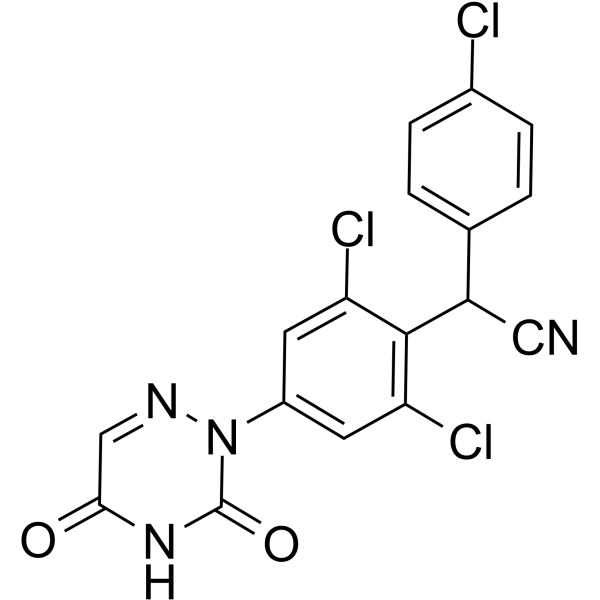
Diclazuril Chemische Struktur

CAS. Nr. : 101831-37-2

Größe Preis Verfügbarkeit Menge
Solid + Solvent (Highly Recommended)
10 mM * 1 mL in DMSO
ready for reconstitution
Auf Lager
Solution
10 mM * 1 mL in DMSO Auf Lager
Solid
50 mg Auf Lager
100 mg Auf Lager
500 mg Auf Lager
1 g Auf Lager
5 g   Angebot einholen  
10 g   Angebot einholen  

* Bitte wählen Sie Menge, bevor Sie Artikel hinzufügen.

This product is a controlled substance and not for sale in your territory.

Kundenbewertung

Based on 2 publication(s) in Google Scholar

Other Forms of Diclazuril:

Top Publications Citing Use of Products
  • Biologische Aktivität

  • Reinheit & Dokumentation

  • Verweise

  • Kundenbewertung

Beschreibung

Diclazuril (R-64433), a benzeneacetonitrile derivative, is a potent and orally active anticoccidial agent. Diclazuril can be used for the research of certain infectious and parasitic diseases, including coccidiosis, acute toxoplasmosis, equine protozoal pyoencephalitis (EPM) et.al[1][2].

IC50 & Target

Coccidia


Cellular Effect
Cell Line Type Value Description References
HepG2 EC50
31.6 3
Compound: Diclazuril
Activation of human PXR expressed in human HepG2 (DPX-2) cells after 24 hrs by luciferase reporter gene based luminescent analysis
[PMID: 20966043]
HepG2 EC50
31.6 3
Compound: Diclazuril
Activation of human PXR expressed in human HepG2 (DPX-2) cells after 24 hrs by luciferase reporter gene based luminescent analysis
[PMID: 20966043]
Hepatocyte IC50
0.008 6
Compound: 15
In vitro anti-coccidial activity against chicken hepatocyte Eimeria acervulina
[PMID: 10476881]
HepG2 EC50
35.5 3
Compound: Diclazuril
Activation of human PXR expressed in human HepG2 (DPX-2) cells assessed as induction of CYP3A4 after 24 hrs by luminescent analysis
[PMID: 20966043]
HepG2 EC50
35.5 3
Compound: Diclazuril
Activation of human PXR expressed in human HepG2 (DPX-2) cells assessed as induction of CYP3A4 after 24 hrs by luminescent analysis
[PMID: 20966043]
HepG2 EC50
31.6 3
Compound: Diclazuril
Activation of human PXR expressed in human HepG2 (DPX-2) cells after 24 hrs by luciferase reporter gene based luminescent analysis
[PMID: 20966043]
HepG2 EC50
9 3
Compound: Diclazuril
Activation of rat PXR expressed in human HepG2 cells after 24 hrs by luciferase reporter gene based luminescent analysis
[PMID: 20966043]
HepG2 EC50
9 3
Compound: Diclazuril
Activation of rat PXR expressed in human HepG2 cells after 24 hrs by luciferase reporter gene based luminescent analysis
[PMID: 20966043]
HepG2 EC50
35.5 3
Compound: Diclazuril
Activation of human PXR expressed in human HepG2 (DPX-2) cells assessed as induction of CYP3A4 after 24 hrs by luminescent analysis
[PMID: 20966043]
MDCK EC50
31 3
Compound: 22
Antiviral activity against Influenza A virus A/PR/8/34 (H1N1) infected in MDCK cells assessed as reduction in plaque formation after 2 days by plaque reduction assay
[PMID: 27046062]
HepG2 EC50
9 3
Compound: Diclazuril
Activation of rat PXR expressed in human HepG2 cells after 24 hrs by luciferase reporter gene based luminescent analysis
[PMID: 20966043]
MDCK EC50
31 3
Compound: 4
Antiviral activity against Influenza A virus (A/PR/8/34) (H1N1) infected in MDCK cells assessed as reduction in plaque formation after 48 hrs by plaque reduction assay
[PMID: 25856229]
MDCK EC50
31 3
Compound: 4
Antiviral activity against Influenza A virus (A/PR/8/34) (H1N1) infected in MDCK cells assessed as reduction in plaque formation after 48 hrs by plaque reduction assay
[PMID: 25856229]
MDCK EC50
31 3
Compound: 22
Antiviral activity against Influenza A virus A/PR/8/34 (H1N1) infected in MDCK cells assessed as reduction in plaque formation after 2 days by plaque reduction assay
[PMID: 27046062]
Hepatocyte IC50
0.0008 102
Compound: Diclazuril
Inhibitory activity against second generation merozoids of Eimeria tenella in chick hepatocyte assay in the absence of inhibitor; value given as 0.004-0.0008
[PMID: 9873375]
Hepatocyte IC50
0.0008 102
Compound: Diclazuril
Inhibitory activity against second generation merozoids of Eimeria tenella in chick hepatocyte assay in the presence of Tranylcypromine; value given as 0.004-0.0008
[PMID: 9873375]
Hepatocyte IC50
0.0008 102
Compound: Diclazuril
Inhibitory activity against second generation merozoids of Eimeria tenella in chick hepatocyte assay in the presence of iproniazid; value given as 0.004-0.0008
[PMID: 9873375]
Hepatocyte IC50
0.008 6
Compound: 15
In vitro anti-coccidial activity against chicken hepatocyte Eimeria acervulina
[PMID: 10476881]
Hepatocyte IC50
0.008 6
Compound: 15
In vitro anti-coccidial activity against chicken hepatocyte Eimeria tenella
[PMID: 10476881]
MDCK EC50
31 3
Compound: 22
Antiviral activity against Influenza A virus A/PR/8/34 (H1N1) infected in MDCK cells assessed as reduction in plaque formation after 2 days by plaque reduction assay
[PMID: 27046062]
MDCK EC50
31 3
Compound: 4
Antiviral activity against Influenza A virus (A/PR/8/34) (H1N1) infected in MDCK cells assessed as reduction in plaque formation after 48 hrs by plaque reduction assay
[PMID: 25856229]
In Vivo

Diclazuril (R-64433) is a coccidiostat, the lambs treated with diclazuril showed an intense, persistent oocyst excretion, with average levels of 97.54 opg, considerably higher than those recorded in the animals treated with toltrazuril (p < 0.05)[1]. Diclazuril (R-64433) is effective against E. maxima later in its life cycle, subclinical intestinal lesions may be present for a short time after infection. Diclazuril (R-64433) was shown in studies to reduce lesion scores and improve performance and health of birds challenged with E. maxima[2].

MedChemExpress (MCE) has not independently confirmed the accuracy of these methods. They are for reference only.

Klinische Studie
Molekulargewicht

407.64

Formel

C17H9Cl3N4O2

CAS. Nr.
Appearance

Solid

Color

White to off-white

SMILES

O=C(NC1=O)N(N=C1)C2=CC(Cl)=C(C(C#N)C3=CC=C(Cl)C=C3)C(Cl)=C2

Versand

Room temperature in continental US; may vary elsewhere.

Speicherung
Powder -20°C 3 years
4°C 2 years
In solvent -80°C 2 years
-20°C 1 year
Lösungsmittel & Löslichkeit
In Vitro: 

DMSO : 25 mg/mL (61.33 mM; Need ultrasonic; Hygroscopic DMSO has a significant impact on the solubility of product, please use newly opened DMSO)

Preparing
Stock Solutions
Concentration Solvent Mass 1 mg 5 mg 10 mg
1 mM 2.4531 mL 12.2657 mL 24.5314 mL
5 mM 0.4906 mL 2.4531 mL 4.9063 mL
View the Complete Stock Solution Preparation Table

* Please refer to the solubility information to select the appropriate solvent. Once prepared, please aliquot and store the solution to prevent product inactivation from repeated freeze-thaw cycles.
Storage method and period of stock solution: -80°C, 2 years; -20°C, 1 year. When stored at -80°C, please use it within 2 years. When stored at -20°C, please use it within 1 year.

  • Molaritätsrechner

  • Verdünnungsrechner

Mass (g) = Concentration (mol/L) × Volume (L) × Molecular Weight (g/mol)

Mass
=
Concentration
×
Volume
×
Molecular Weight *

Concentration (start) × Volume (start) = Concentration (final) × Volume (final)

This equation is commonly abbreviated as: C1V1 = C2V2

Concentration (start)

C1

×
Volume (start)

V1

=
Concentration (final)

C2

×
Volume (final)

V2

In Vivo:

Select the appropriate dissolution method based on your experimental animal and administration route.

For the following dissolution methods, please ensure to first prepare a clear stock solution using an In Vitro approach and then sequentially add co-solvents:
To ensure reliable experimental results, the clarified stock solution can be appropriately stored based on storage conditions. As for the working solution for in vivo experiments, it is recommended to prepare freshly and use it on the same day.
The percentages shown for the solvents indicate their volumetric ratio in the final prepared solution. If precipitation or phase separation occurs during preparation, heat and/or sonication can be used to aid dissolution.

  • Protocol 1

    Add each solvent one by one:  10% DMSO    90% Corn Oil

    Solubility: ≥ 2.5 mg/mL (6.13 mM); Clear solution

    This protocol yields a clear solution of ≥ 2.5 mg/mL (saturation unknown). If the continuous dosing period exceeds half a month, please choose this protocol carefully.

    Taking 1 mL working solution as an example, add 100 μL DMSO stock solution (25.0 mg/mL) to 900 μL Corn oil, and mix evenly.

In Vivo Dissolution Calculator
Please enter the basic information of animal experiments:

Dosage

mg/kg

Animal weight
(per animal)

g

Dosing volume
(per animal)

μL

Number of animals

Recommended: Prepare an additional quantity of animals to account for potential losses during experiments.
Please enter your animal formula composition:
%
DMSO +
+
%
Tween-80 +
%
Saline
Recommended: Keep the proportion of DMSO in working solution below 2% if your animal is weak.
The co-solvents required include: DMSO, . All of co-solvents are available by MedChemExpress (MCE). , Tween 80. All of co-solvents are available by MedChemExpress (MCE).
Calculation results:
Working solution concentration: mg/mL
Method for preparing stock solution: mg drug dissolved in μL  DMSO (Stock solution concentration: mg/mL).
The concentration of the stock solution you require exceeds the measured solubility. The following solution is for reference only. If necessary, please contact MedChemExpress (MCE).
Method for preparing in vivo working solution for animal experiments: Take μL DMSO stock solution, add μL . μL , mix evenly, next add μL Tween 80, mix evenly, then add μL Saline.
 If the continuous dosing period exceeds half a month, please choose this protocol carefully.
Please ensure that the stock solution in the first step is dissolved to a clear state, and add co-solvents in sequence. You can use ultrasonic heating (ultrasonic cleaner, recommended frequency 20-40 kHz), vortexing, etc. to assist dissolution.
Reinheit & Dokumentation

Purity: 99.70%

Verweise

Complete Stock Solution Preparation Table

* Please refer to the solubility information to select the appropriate solvent. Once prepared, please aliquot and store the solution to prevent product inactivation from repeated freeze-thaw cycles.
Storage method and period of stock solution: -80°C, 2 years; -20°C, 1 year. When stored at -80°C, please use it within 2 years. When stored at -20°C, please use it within 1 year.

Optional Solvent Concentration Solvent Mass 1 mg 5 mg 10 mg 25 mg
DMSO 1 mM 2.4531 mL 12.2657 mL 24.5314 mL 61.3286 mL
5 mM 0.4906 mL 2.4531 mL 4.9063 mL 12.2657 mL
10 mM 0.2453 mL 1.2266 mL 2.4531 mL 6.1329 mL
15 mM 0.1635 mL 0.8177 mL 1.6354 mL 4.0886 mL
20 mM 0.1227 mL 0.6133 mL 1.2266 mL 3.0664 mL
25 mM 0.0981 mL 0.4906 mL 0.9813 mL 2.4531 mL
30 mM 0.0818 mL 0.4089 mL 0.8177 mL 2.0443 mL
40 mM 0.0613 mL 0.3066 mL 0.6133 mL 1.5332 mL
50 mM 0.0491 mL 0.2453 mL 0.4906 mL 1.2266 mL
60 mM 0.0409 mL 0.2044 mL 0.4089 mL 1.0221 mL
  • No file chosen (Maximum size is: 1024 Kb)
  • If you have published this work, please enter the PubMed ID.
  • Your name will appear on the site.
Help & FAQs
  • Do most proteins show cross-species activity?

    Species cross-reactivity must be investigated individually for each product. Many human cytokines will produce a nice response in mouse cell lines, and many mouse proteins will show activity on human cells. Other proteins may have a lower specific activity when used in the opposite species.

Ihre kürzlich angesehenen Produkte:

Online-Anfrage

Your information is safe with us. * Required Fields.

Produktname


Requested Quantity *

Name des Antragstellers *


Anrede

E-Mail-Addresse *


Telefonnummer *

Department


Name der Organisation *

City

Bundesland

Country or Region *


Bemerkungen

Massenanfrage

Inquiry Information

Produktname:
Diclazuril
Art. -Nr.:
HY-B0357
Menge:
MCE Japan Authorized Agent: