



CDK
Cyclin dependent kinase
CDKs (Cyclin-dependent kinases) are serine-threonine kinases first discovered for their role in regulating the cell cycle. They are also involved in regulating transcription, mRNA processing, and the differentiation of nerve cells. CDKs are relatively small proteins, with molecular weights ranging from 34 to 40 kDa, and contain little more than the kinase domain. In fact, yeast cells can proliferate normally when their CDK gene has been replaced with the homologous human gene. By definition, a CDK binds a regulatory protein called a cyclin. Without cyclin, CDK has little kinase activity; only the cyclin-CDK complex is an active kinase.
There are around 20 Cyclin-dependent kinases (CDK1-20) known till date. CDK1, 4 and 5 are involved in cell cycle, and CDK 7, 8, 9 and 11 are associated with transcription.
CDK levels remain relatively constant throughout the cell cycle and most regulation is post-translational. Most knowledge of CDK structure and function is based on CDKs of S. pombe (Cdc2), S. cerevisia (CDC28), and vertebrates (CDC2 and CDK2). The four major mechanisms of CDK regulation are cyclin binding, CAK phosphorylation, regulatory inhibitory phosphorylation, and binding of CDK inhibitory subunits (CKIs).
CDK Isoform Specific Products
-
CDK
(487)
View all products
-
CDK1
(196)
View all products
-
CDK2
(315)
View all products
-
CDK3
(28)
View all products
-
CDK4
(233)
View all products
-
CDK5
(98)
View all products
-
CDK6
(178)
View all products
-
CDK7
(119)
View all products
-
CDK8
(57)
View all products
-
CDK9
(205)
View all products
-
CDK11
(9)
View all products
-
CDK12
(53)
View all products
-
CDK13
(27)
View all products
-
CDK14
(6)
View all products
-
CDK16
(8)
View all products
-
CDK19
(25)
View all products
-
CDC
(21)
View all products
-
CLK
(31)
View all products
-
Pho85
(1)
View all products
-
CDK10
(1)
View all products
-
CDK15
(1)
View all products
-
CDK17
(2)
View all products
-
CDK18
(1)
View all products
-
CDK20
(1)
View all products
-
PITSLRE
(1)
View all products
All Product Categories
-
CDK Inhibitors
(1077)
View all products
-
CDK Agonists
(3)
View all products
-
CDK Antagonists
(2)
View all products
-
CDK Activators
(18)
View all products
-
CDK Modulators
(15)
View all products
-
CDK Degraders
(95)
View all products
-
CDK Controls
(4)
View all products
-
CDK Substrate
(1)
View all products
-
CDK Ligands
(16)
View all products
-
Cyclin-Dependent Kinases (CDKs) Proteins
(80)
View all products
-
Cyclin Dependent Kinase 1 (CDK1) Proteins
(9)
View all products
-
Cyclin-Dependent Kinase 2 (CDK2) Proteins
(12)
View all products
-
Cyclin-Dependent Kinase 3 (CDK3) Proteins
(6)
View all products
-
Cyclin-Dependent Kinase 4 (CDK4) Proteins
(4)
View all products
-
Cyclin-Dependent Kinase 5 (CDK5) Proteins
(5)
View all products
-
Cyclin-Dependent Kinase 6 (CDK6) Proteins
(6)
View all products
-
Cyclin-Dependent Kinase 7 (CDK7) Proteins
(4)
View all products
-
CDK Related Products (1353)
Related Products (1353)

-
Recombinant Proteins (82)
-
Antibodies (42)
-
CDK Isoform Comparison
-
G721-0282
 0 ImagesG721-0282 is an orally active CHI3L1 inhibitor. G721-0282 can reduce the expression of inflammatory proteins and cytokines. G721-0282 inhibits the activation of the NF-κB signaling pathway. G721-0282 inhibits neuroinflammation and reduces anxious behavior. G721-0282 significantly inhibits the proliferation of osteosarcoma (OS) cells by suppressing the STAT3 signaling pathway. G721-0282 induces OS cell apoptosis by upregulating pro-apoptotic protein levels and downregulating anti-apoptotic protein levels. G721-0282 can be used for researches on neuroinflammatory conditions and cancer.
-
PROTAC FLT3/CDK9 degrader-1
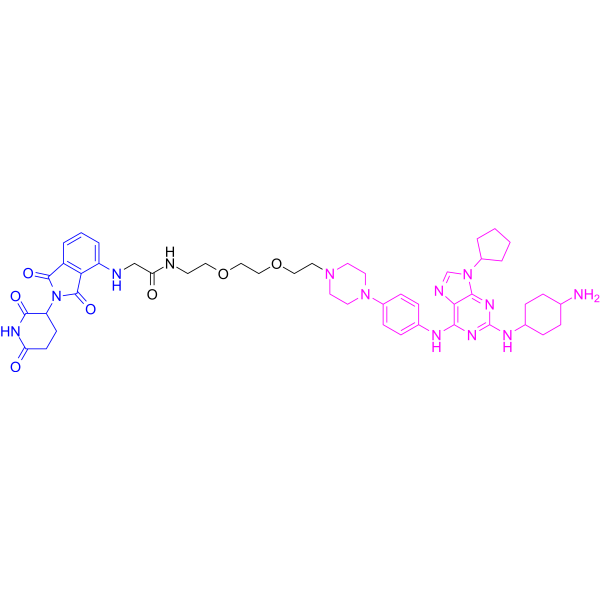 0 ImagesCat. No.: HY-148521CAS No.: 3033084-05-5
-
Multi-target kinase-IN-7
 0 ImagesCat. No.: HY-178157CAS No.: 301820-47-3Multi-target kinase-IN-7 (Compound 1e) is an orally active multi-target kinase inhibitor (IC50 values: CDK2=0.314 μM, EGFR=0.183 μM, HER-2=0.197 μM, VEGFR-2=0.235 μM). Multi-target kinase-IN-7 is promising for research of solid tumors (e.g., lung, breast, prostate cancer).
-
VWK147
 0 ImagesCat. No.: HY-181062VWK147 is a second-generation HSP90 C-terminal domain (CTD) inhibitor. VWK147 targets the CTD dimerization interface, prevents HSP90 CTD dimerization, disrupts co-chaperone PPID binding to HSP90 CTD, and inhibits HSP90 chaperone function dependent on dimerization. VWK147 reduces protein levels of HSP90 client proteins ULK1, RIPK1, and CDK4 without inducing a heat shock response. VWK147 induces cell death, including apoptosis, in Cisplatin (HY-17394)-sensitive and -resistant urothelial carcinoma cells. VWK147 induces LC3-II accumulation, inhibits autophagosome-lysosome fusion to block canonical autophagy, and induces non-canonical LC3 lipidation independent of ULK1 and PIK3C3 complexes. VWK147 can be used for the research of urothelial carcinoma.
-
SKLB70326
 0 ImagesCat. No.: HY-116204CAS No.: 1257317-77-3SKLB70326 is a small molecule inhibitor of cell cycle progression that induces cell cycle arrest and apoptosis in human hepatocellular carcinoma cells. SKLB70326 is involved in downregulating cyclin-dependent kinase (CDK) 2, CDK4, and CDK6, while also activating PARP, caspase-3, caspase-9, and Bax, and downregulating Bcl-2.
-
CLK3 Recombinant Human Active Protein Kinase
 0 ImagesCat. No.: HY-E70692CLK3 is a nuclear dual-specificity kinase has been shown to undergo conserved alternative splicing to generate catalytically active (Clk) and inactive (ClkT) isoforms. CLK3 Recombinant Human Active Protein Kinase is a recombinant CLK3 protein that can be used to study CLK3-related functions.

-
CDK2/4/6-IN-1
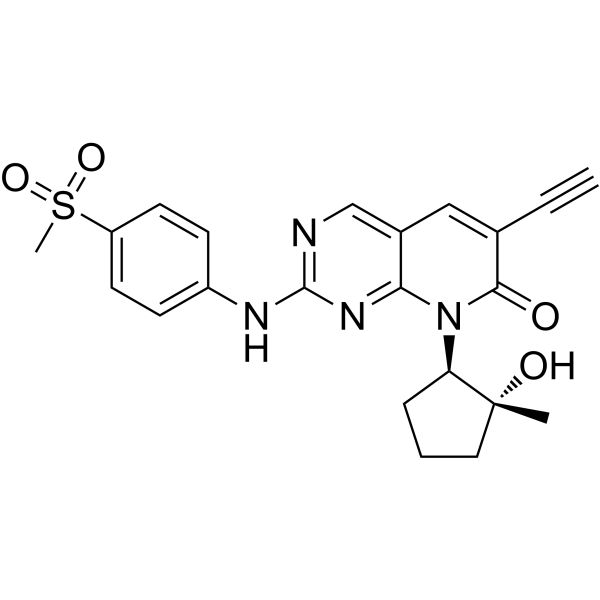 0 ImagesCat. No.: HY-148213CAS No.: 2803837-13-8CDK2/4/6-IN-1(example 29) is a CDK2/4/6 inhibitor with IC50 values of 2.5, 23.7 and 44.3 nM for CDK2, CDK4 and CDK6, respectively. CDK2/4/6-IN-1 can be used in cancer research. CDK2/4/6-IN-1 is a click chemistry reagent, it contains an Alkyne group and can undergo copper-catalyzed azide-alkyne cycloaddition (CuAAc) with molecules containing Azide groups.

-
CDK2-IN-24
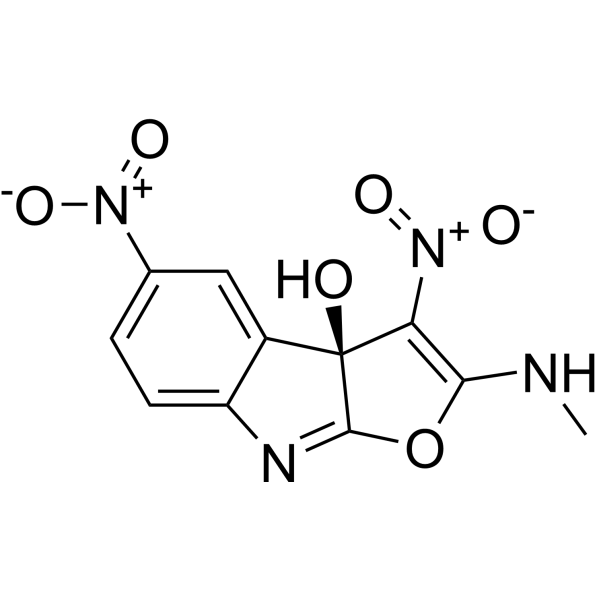 0 ImagesCat. No.: HY-162270CDK2-IN-24 (compound 3f) is an inhibitor of cyclin-dependent kinase 2 with an elevated binding energy value .
-
[pThr3]-CDK5 Substrate
![[pThr3]-CDK5 Substrate](https://file.medchemexpress.com/product_pic/hy-p1906.gif "Click to View [pThr3]-CDK5 Substrate Product Detail") 0 ImagesCat. No.: HY-P1906CAS No.: 1670273-47-8
0 ImagesCat. No.: HY-P1906CAS No.: 1670273-47-8
-
PI3Kα/CDK7-IN-1
 0 ImagesCat. No.: HY-187454PI3Kα/CDK7-IN-1 is a dual-target hybrid inhibitor of PI3Kα and CDK7, with IC50 values of 87.9 nM and 638 nM, respectively. PI3Kα/CDK7-IN-1 acts as a cytotoxic agent and cell death inducer that triggers apoptotic death in cancer cells. PI3Kα/CDK7-IN-1 can be used in cancer research such as colorectal cancer.
-
CDK7-IN-22
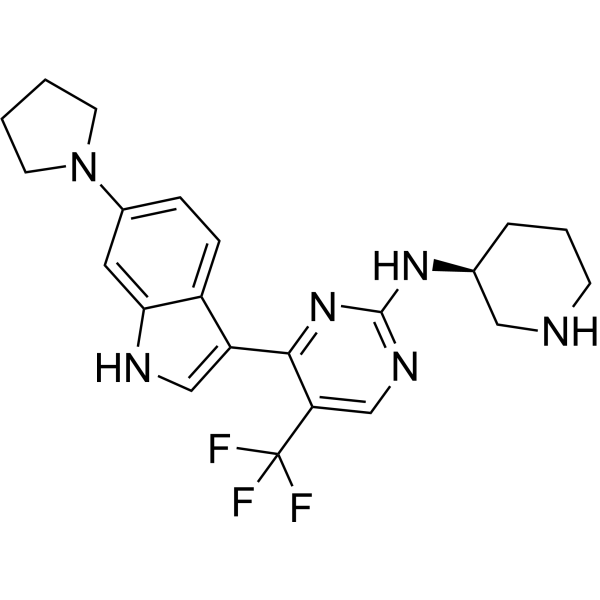 0 ImagesCat. No.: HY-153950CAS No.: 2173190-60-6
-
LBM22
 0 ImagesCat. No.: HY-168209LBM22 is a CDC2-like kinase 2 (CLK2) inhibitor with the IC50 of 3.9 nM. LBM22 has antiproliferative activity and inhibits serine/arginine-rich (SR) protein phosphorylation. LBM22 down-regulates the expression of Wnt-related proteins and anti-apoptotic proteins and can be used for study of non-small cell lung cancer.
-
CDK7-IN-14
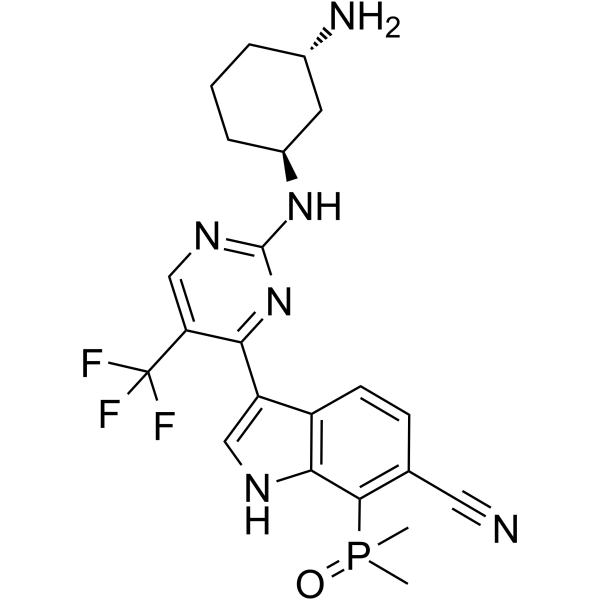 0 ImagesCat. No.: HY-147598CAS No.: 2765676-49-9

-
CDK5-IN-4
 0 ImagesCat. No.: HY-161595CAS No.: 1212711-91-5
-
CDKI-IN-1
 0 ImagesCat. No.: HY-169557CAS No.: 1185726-51-5CDKI-IN-1 (Compound SNX12) is a cyclin-dependent kinase inhibitor (CDKI) inhibitor that can be used for research into degenerative diseases of the central nervous system.
-
Calactin
 0 ImagesCat. No.: HY-167237CAS No.: 20304-47-6Calactin is a glycoside that can be isolated from Asclepias curassavica L.. Calactin activates caspase-3, caspase-8, caspase-9, and phosphorylates ERK. Calactin induces DNA damage, apoptosis, PARP cleavage, G2/M phase cell cycle arrest, shifts Bax/Bcl-2 expression, and shows anti-proliferation effects in leukemia cells. Calactin can be used for the research of leukemia.




