



CDK
Cyclin dependent kinase
CDKs (Cyclin-dependent kinases) are serine-threonine kinases first discovered for their role in regulating the cell cycle. They are also involved in regulating transcription, mRNA processing, and the differentiation of nerve cells. CDKs are relatively small proteins, with molecular weights ranging from 34 to 40 kDa, and contain little more than the kinase domain. In fact, yeast cells can proliferate normally when their CDK gene has been replaced with the homologous human gene. By definition, a CDK binds a regulatory protein called a cyclin. Without cyclin, CDK has little kinase activity; only the cyclin-CDK complex is an active kinase.
There are around 20 Cyclin-dependent kinases (CDK1-20) known till date. CDK1, 4 and 5 are involved in cell cycle, and CDK 7, 8, 9 and 11 are associated with transcription.
CDK levels remain relatively constant throughout the cell cycle and most regulation is post-translational. Most knowledge of CDK structure and function is based on CDKs of S. pombe (Cdc2), S. cerevisia (CDC28), and vertebrates (CDC2 and CDK2). The four major mechanisms of CDK regulation are cyclin binding, CAK phosphorylation, regulatory inhibitory phosphorylation, and binding of CDK inhibitory subunits (CKIs).
CDK Isoform Specific Products
-
CDK
(488)
View all products
-
CDK1
(187)
View all products
-
CDK2
(302)
View all products
-
CDK3
(28)
View all products
-
CDK4
(223)
View all products
-
CDK5
(96)
View all products
-
CDK6
(168)
View all products
-
CDK7
(115)
View all products
-
CDK8
(55)
View all products
-
CDK9
(200)
View all products
-
CDK11
(8)
View all products
-
CDK12
(50)
View all products
-
CDK13
(25)
View all products
-
CDK14
(6)
View all products
-
CDK16
(8)
View all products
-
CDK19
(25)
View all products
-
CDC
(21)
View all products
-
CLK
(31)
View all products
-
Pho85
(1)
View all products
-
CDK10
(1)
View all products
-
CDK15
(1)
View all products
-
CDK17
(2)
View all products
-
CDK18
(1)
View all products
-
CDK20
(1)
View all products
-
PITSLRE
(1)
View all products
All Product Categories
-
CDK Inhibitors
(1060)
View all products
-
CDK Agonists
(3)
View all products
-
CDK Antagonists
(2)
View all products
-
CDK Activators
(15)
View all products
-
CDK Modulators
(14)
View all products
-
CDK Degraders
(83)
View all products
-
CDK Controls
(4)
View all products
-
CDK Substrate
(1)
View all products
-
CDK Ligands
(15)
View all products
-
Cyclin-Dependent Kinases (CDKs) Proteins
(81)
View all products
-
Cyclin Dependent Kinase 1 (CDK1) Proteins
(9)
View all products
-
Cyclin-Dependent Kinase 2 (CDK2) Proteins
(12)
View all products
-
Cyclin-Dependent Kinase 3 (CDK3) Proteins
(6)
View all products
-
Cyclin-Dependent Kinase 4 (CDK4) Proteins
(5)
View all products
-
Cyclin-Dependent Kinase 5 (CDK5) Proteins
(5)
View all products
-
Cyclin-Dependent Kinase 6 (CDK6) Proteins
(6)
View all products
-
Cyclin-Dependent Kinase 7 (CDK7) Proteins
(4)
View all products
-
CDK Related Products (1316)
Related Products (1316)

-
Recombinant Proteins (83)
-
Antibodies (42)
-
CDK Isoform Comparison
-
PKMYT1-IN-15
 0 ImagesCat. No.: HY-187562PKMYT1-IN-15 is an orally active PKMYT1 inhibitor with an IC50 of 6.02 nM. PKMYT1-IN-15 inhibits the phosphorylation of CDK1 at Thr14. As an antiproliferative agent, DNA damage inducer and antitumor agent, PKMYT1-IN-15 triggers replication-associated DNA damage and cell death in CCNE1-amplified cancer cells, and suppresses tumor growth in the OVCAR3 xenograft model. PKMYT1-IN-15 can be used for the research of CCNE1-amplified cancers (e.g., ovarian cancer, breast cancer).
-
CGP-74514 hydrochloride
 0 ImagesCat. No.: HY-118976CAS No.: 481724-82-7Synonyms: CGP-74514ACGP-74514 hydrochloride is a highly selective cyclin-dependent kinase 1 (CDK1) inhibitor (IC50: 25 nM). CGP-74514 hydrochloride inhibits CDK1/cyclin B complex activity, arrests the cell cycle at G2/M phase and induces tumor cell apoptosis. CGP-74514 hydrochloride is promising for research of bladder cancer.
-
SR-2890
 0 ImagesCat. No.: HY-123859CAS No.: 1454584-91-8SR-2890 is a highly selective, ATP-competitive inhibitor of casein kinase CK1δ and CK1ε, with IC50 values of 4 nM and 44 nM, respectively, and a Ki of 14 nM for CK1δ. SR-2890 exhibits antiproliferative effects. SR-2890 blocks the serine/threonine kinase activity of CK1δ and weakly inhibits a few off-target kinases such as FLT3, CDK4. SR-2890 has an oral bioavailability of 10% and a blood-brain barrier penetration rate of <1%. SR-2890 demonstrates stable in vitro metabolism and favorable in vivo pharmacokinetic properties, effectively inhibiting the growth of human A375 melanoma cells. SR-2890 can be used in melanoma research and is also a useful compound for studying CK1δ/ε-related diseases such as Alzheimer's disease.
-
JD128
 0 ImagesCat. No.: HY-183571CAS No.: 1934254-35-9JD128 (Compound 22) is a CDK4/6 inhibitor.
-
Anticancer agent 299
 0 ImagesCat. No.: HY-181130CAS No.: 1414873-26-9Anticancer agent 299 (compound P12) is a cell-cycle inhibitor, senescence inducer, apoptosis inducer, and antiproliferative agent. Anticancer agent 299 exhibits selective activity against cancer cells with minimal effects on non-tumoral chondrocyte cells at relevant concentrations. Anticancer agent 299 can be used for the research of ER+/HER2− breast cancer and BRAF-mutant melanoma.
-
Cdc7-IN-8
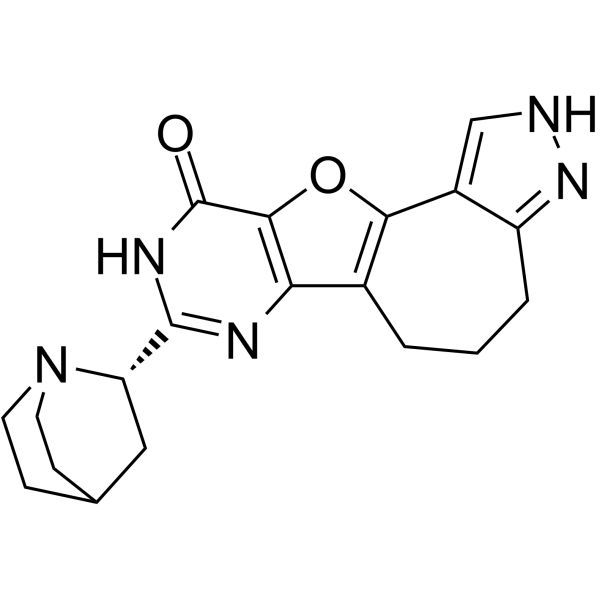 0 ImagesCat. No.: HY-143377CAS No.: 2606780-38-3Cdc7-IN-8 is a potent inhibitor of Cdc7. Cdc7 is a serine/threonine kinase which activates MCM promotion by phosphorylating the microchromosome maintenance protein (MCM protein), an important element of the DNA replication initiator. Cdc7-IN-8 has the potential for the research of cancer diseases (extracted from patent WO2021032170A1, compound 1-1/1-2).
-
GW780056X
 0 ImagesCat. No.: HY-114567CAS No.: 1093294-48-4GW780056X is a CDK12 inhibitor. GW780056X decreases nuclear foci count in DM1 cells. GW780056X can be used for the research of myotonic dystrophy type 1.
-
CDK2/FLT4/PDGFRA-IN-1
 0 ImagesCat. No.: HY-173124CDK2/FLT4/PDGFRA-IN-1 (Compound 4a) is a potent inhibitor of CDK2/cyclin A, FLT4 (VEGFR3) and PDGFRA, with IC50s of 1.672, 0.554, and 0.629 μM, respectively. CDK2/FLT4/PDGFRA-IN-1 exhibits potent antiproliferative effects against cancer cells (lung EBC-1, pancreatic ductal adenocarcinoma AsPC-1, colorectal HT-29 cells). CDK2/FLT4/PDGFRA-IN-1 can also induce apoptosis in cancer cells.

-
CDK8-IN-18
 0 ImagesCat. No.: HY-169541CAS No.: 642002-74-2
-
CDK-IN-20
 0 ImagesCat. No.: HY-184320CAS No.: 2776187-63-2
-
Anticancer agent 29
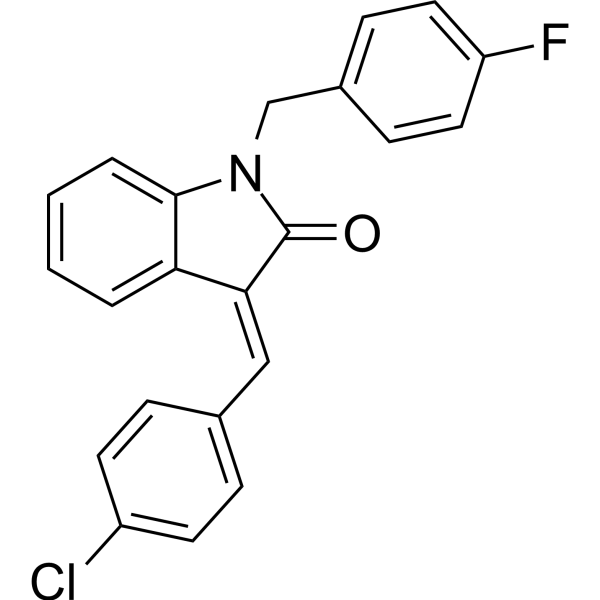 0 ImagesCat. No.: HY-115942CAS No.: 2907774-89-2Anticancer agent 29 (Compd E/Z-6f) is an anticancer agent, with IC50 values of 0.054 μM, 0.127 μM, 0.129 μM, 0.396 μM for CDK2, CDK1, CDK4 and CDK6, respectively.
-
GIT1-IN-1
 0 ImagesCat. No.: HY-181978CAS No.: 844464-54-6GIT1-IN-1 is an inhibitor of ARF GTPase-activating protein 1 (GIT1) with a KD of 6.2 μM. GIT1-IN-1 induces apoptosis (apoptosis) in liver and colon cancer cells, arrests the cell cycle at the G2/M phase, and inhibits cell proliferation, colony formation and migration. GIT1-IN-1 inhibits the activities of MEK and ERK, reduces the expression level of cyclin D1, and stabilizes cyclin B1 protein in liver and colon cancer cells. GIT1-IN-1 can be used in the research of liver cancer and colon cancer.
-
CDK7/9-IN-1
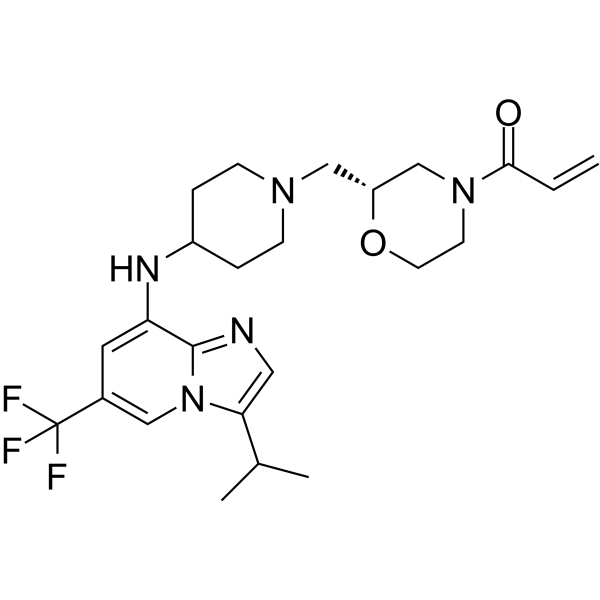 0 ImagesCat. No.: HY-145408CAS No.: 2747919-19-1CDK7/9-IN-1 is a cyclin-dependent kinases 7/9 (CDK7/9) inhibitor. CDK7/9-IN-1 selectively inhibits CDK7 over CDK9. CDK7/9-IN-1 inhibits CDK7 with IC50s of 0.0656 μM and 0.00574 μM without pre-incubation and after 3 hours pre-incubation, respectively. CDK7/9-IN-1 inhibits CDK9 with an IC50 of 2.14 μM after 3 hours pre-incubation. CDK7/9-IN-1 can be used for the research of cancer.

-
Tubulin-IN-65
 0 ImagesCat. No.: HY-181763Tubulin-IN-65 (Compound Imp-18) is a Tubulin inhibitor. Tubulin-IN-65 exhibits tubulin-disrupting activity. Tubulin-IN-65 disrupts microtubule integrity. Tubulin-IN-65 induces Apoptosis and increases the expression of CDK1 and Cyclin B1. Tubulin-IN-65 possesses anticancer activity against breast cancer and colorectal cancer. Tubulin-IN-65 can be used in research related to triple-negative breast cancer and colorectal adenocarcinoma.

-
BAY-958
 0 ImagesCat. No.: HY-121081CAS No.: 1335490-39-5BAY-958 is a potent PTEFb/CDK9 inhibitor with high selectivity demonstrated, particularly within the CDK family. BAY-958 shows strong antiproliferative activity against cancer cell lines such as HeLa and MOLM-13. BAY-958 exhibits good metabolic stability. BAY-958 effectively inhibits tumor growth in mouse xenograft models without significant toxicity.
-
CDK7-IN-26
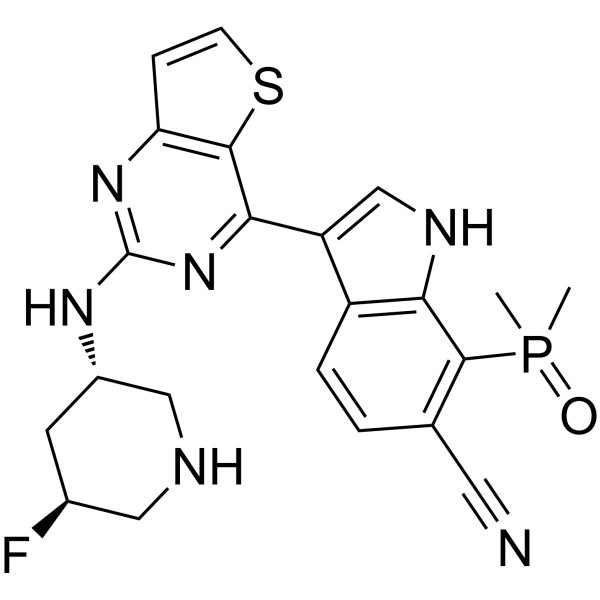 0 ImagesCat. No.: HY-157210CAS No.: 3024545-79-4
-
CDK12-IN-4
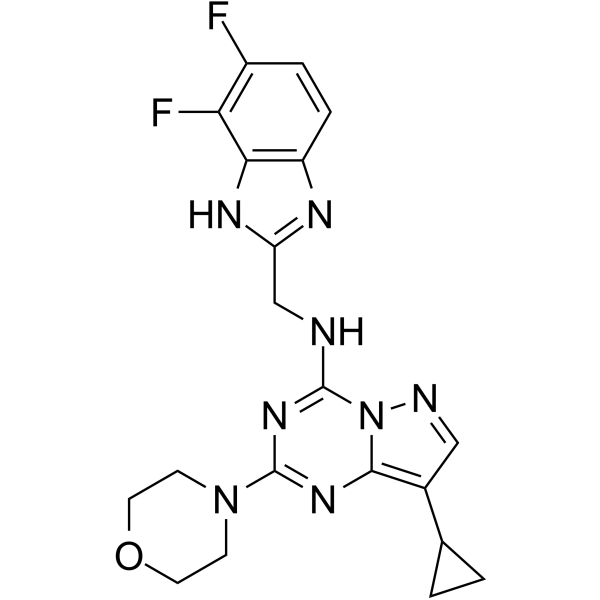 0 ImagesCat. No.: HY-139327CAS No.: 2651196-69-7CDK12-IN-4, a pyrazolotriazine, is a potent CDK12 inhibitor with an IC50 of 0.641 μM at high ATP (2 mM). CDK12-IN-4 has no effect on CDK2/Cyclin E (IC50>20 μM) and CDK9/Cyclin T1 (IC50>20 μM) at high ATP (2 mM) (WO2021116178A1).




