



Pim-1 kinase inhibitor 2
Based on 1 publication(s) in Google Scholar
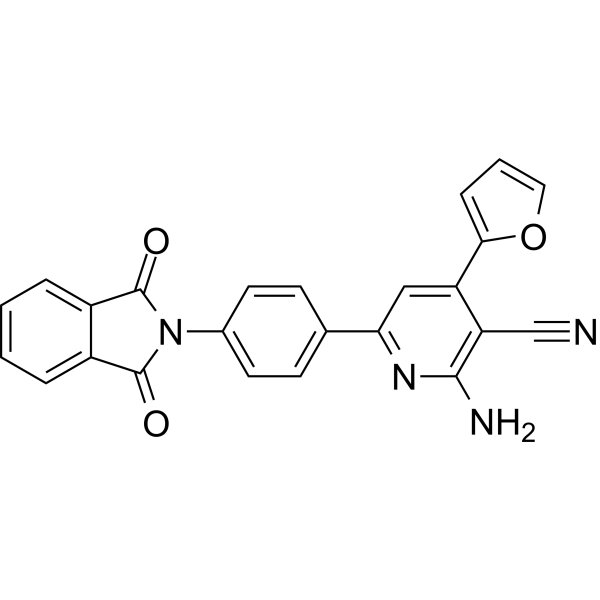
Pim-1 kinase inhibitor 2 is a PIM-1 kinase inhibitor with a human IC50 of 0.63 μM. Pim-1 kinase inhibitor 2 exhibits high selectivity for cancer cells over normal cells. Pim-1 kinase inhibitor 2 induces apoptosis, increases active caspase-3 levels, upregulates BAX, downregulates Bcl-2, and elevates the Bax/Bcl-2 ratio. Pim-1 kinase inhibitor 2 suppresses cancer cell proliferation and induces cell cycle arrest. Pim-1 kinase inhibitor 2 can be used for the research of prostate carcinoma, hepatocellular carcinoma, and breast adenocarcinoma.
For research use only. We do not sell to patients.
- Purity : 99.91%
- CAS No.: 2543624-91-3
- Formula: C24H14N4O3
- Molecular Weight:406.39
-
Storage:Powder -20°C, 3 years , 4°C, 2 years ; In solvent -80°C, 6 months , -20°C, 1 month

To place orders, for customer services and technical support, please contact: MedChemExpress USA
Tel: 609-228-6898 E-mail: [email protected] [email protected]


-
 Biological Activity
-
Chemical Information
-
Solvent & Solubility
- Purity & Documentation
- References
-
 Help & FAQs


Publications Citing Use of MedChemExpress (MCE) Pim-1 kinase inhibitor 2
MoreAll Caspase Isoforms
More

Biological Activity
Description
IC50 & Target
[1]|
human PIM1 0.63 μM (IC50) |
Caspase 3 |
Bax |
Bcl-2 |
Cellular Effect
|
Cell Line

|
Type | Value | Description | References |
|---|---|---|---|---|
| HepG2 | IC50 |
31.07 μM
Compound: 27
|
Antiproliferative activity against human HepG2 cells assessed as inhibition of cell growth incubated for 72 hrs by MTT assay
Antiproliferative activity against human HepG2 cells assessed as inhibition of cell growth incubated for 72 hrs by MTT assay
|
[PMID: 38164076] |
| MCF7 | IC50 |
19.74 μM
Compound: 27
|
Antiproliferative activity against human MCF7 cells assessed as reduction in cell growth incubated for 48 hrs by MTT assay
Antiproliferative activity against human MCF7 cells assessed as reduction in cell growth incubated for 48 hrs by MTT assay
|
[PMID: 38164076] |
| PC-3 | IC50 |
33.45 μM
Compound: 27
|
Anticancer activity against human PC-3 cells assessed as inhibition of cell growth incubated for 24 hrs by MTT assay
Anticancer activity against human PC-3 cells assessed as inhibition of cell growth incubated for 24 hrs by MTT assay
|
[PMID: 38164076] |
| PC-3 | IC50 |
4.82 μM
Compound: 34
|
Antiproliferative activity against human PC-3 cells assessed as reduction in cell growth incubated for 48 hrs by SRB assay
Antiproliferative activity against human PC-3 cells assessed as reduction in cell growth incubated for 48 hrs by SRB assay
|
[PMID: 38071792] |
In Vitro
Pim-1 kinase inhibitor 2 (compound 13) (24 h) potently inhibits proliferation of PC3, HepG2, and MCF-7 cancer cells with IC50 values of 4.82 μM, 5.19 μM, and 16.33 μM respectively, and exhibits high selectivity for cancer cells over normal WI-38 cells[1].
Pim-1 kinase inhibitor 2 potently inhibits PIM-1 kinase with an IC50 of 0.63 μM and 76.43% inhibition at 10 μM[1].
Pim-1 kinase inhibitor 2 (1.96 μM; 24 h) induces G2/M phase arrest and increases apoptotic Pre-G1 phase population in PC3 cells[1].
Pim-1 kinase inhibitor 2 (1.96 μM; 24 h) induces apoptosis in PC3 cells, with 19.64% total apoptotic cells[1].
Pim-1 kinase inhibitor 2 increases active caspase-3 levels in PC3 cells to 352.9 Pg/mL, indicating induction of apoptosis[1].
Pim-1 kinase inhibitor 2 (24 h) upregulates BAX, downregulates Bcl-2, and increases the BAX/Bcl-2 ratio to 115.65 in PC3 cells, promoting apoptosis[1].
MedChemExpress (MCE) has not independently confirmed the accuracy of these methods. They are for reference only.
-
Cell Line:human prostate carcinoma PC3 cells
-
Concentration:1.96 μM
-
Incubation Time:24 h
-
Result:Reduced the proportion of PC3 cells in G0-G1 phase to 33.72% and S phase to 34.29%.
Increased the proportion of PC3 cells in G2/M phase to 31.99% and Pre-G1 (apoptotic) phase to 19.64%, compared to control cells (54.77% G0-G1, 36.41% S, 8.82% G2/M, 1.76% Pre-G1).
-
Cell Line:human prostate carcinoma PC3 cells
-
Concentration:2.04 μM
-
Incubation Time:24 h
-
Result:Increases active caspase-3 levels in PC3 cells to 352.9 Pg/mL, indicating induction of apoptosis.


Chemical Information
-
CAS No. 2543624-91-3
-
Appearance Solid
-
Molecular Weight 406.39
-
Formula C24H14N4O3
-
Color Light yellow to yellow
-
SMILES
N#CC1=C(N=C(C=C1C2=CC=CO2)C3=CC=C(C=C3)N4C(C5=CC=CC=C5C4=O)=O)N
-
Shipping
Room temperature in continental US; may vary elsewhere.
-
Storage
Powder -20°C 3 years 4°C 2 years In solvent -80°C 6 months -20°C 1 month


Publications (1)
-
Journal Impact Factor
-
Most Recent
-
Adv Sci (Weinh)
PIM1 Attenuates Innate Immunity to Foster Coronavirus Replication through Ubiquitin Ligase β-TrCP-Mediated IFNAR1 Degradation. [Abstract]2025 Jul 6:e03487. PMID: 40619619


Solvent & Solubility
In Vitro:
DMSO : 12.5 mg/mL (30.76 mM; ultrasonic and warming and heat to 60°C; Hygroscopic DMSO has a significant impact on the solubility of product, please use newly opened DMSO)
Please refer to the solubility information to select the appropriate solvent. Once prepared, please aliquot and store the solution to prevent product inactivation from repeated freeze-thaw cycles.
Storage method and period of stock solution: -80°C, 6 months; -20°C, 1 month. When stored at -80°C, please use it within 6 months. When stored at -20°C, please use it within 1 month.
Please refer to the solubility information to select the appropriate solvent. Once prepared, please aliquot and store the solution to prevent product inactivation from repeated freeze-thaw cycles.
Storage method and period of stock solution: -80°C, 6 months; -20°C, 1 month. When stored at -80°C, please use it within 6 months. When stored at -20°C, please use it within 1 month.
Concentration (start) × Volume (start) = Concentration (final) × Volume (final)
In Vivo:
Select the appropriate dissolution method based on your experimental animal and administration route.
- For the following dissolution methods, please ensure to first prepare a clear stock solution using an In Vitro approach and then sequentially add co-solvents:
- To ensure reliable experimental results, the clarified stock solution can be appropriately stored based on storage conditions. As for the working solution for In Vivo experiments, it is recommended to prepare freshly and use it on the same day.
- The percentages shown for the solvents indicate their volumetric ratio in the final prepared solution. If precipitation or phase separation occurs during preparation, heat and/or sonication can be used to aid dissolution.
In Vivo Dissolution Calculator
Please enter the basic information of animal experiments:
-
-
-
-
Recommended: Prepare an additional quantity of animals to account for potential losses during experiments.
Please enter your animal formula composition:
-
%DMSO +
Recommended: Keep the proportion of DMSO in working solution below 2% if your animal is weak.
-
%+
-
+%Tween-80 + +
-
%Saline +
The co-solvents required include: DMSO, . All of co-solvents are available by MedChemExpress (MCE). , Tween 80. All of co-solvents are available by MedChemExpress (MCE).
Working solution concentration: 0.22 mg/mL
Method for preparing stock solution: mg drug dissolved in μL DMSO. Stock solution concentration: mg/mL.
1. Take μL DMSO stock solution;
2. Add μL .
μL , mix evenly;
3. Then add μL Tween 80, mix evenly;
4. Then add μL
Please ensure that the stock solution in the first step is dissolved to a clear state, and add co-solvents in sequence. You can use ultrasonic heating (ultrasonic cleaner, recommended frequency 20-40 kHz), vortexing, etc. to assist dissolution.


Purity & Documentation
-
Data Sheet (276 KB)
-
SDS (251 KB)
- English - EN (251 KB)
- Français - FR (251 KB)
- Deutsch - DE (251 KB)
- Norwegian - NO (251 KB)
- Español - ES (251 KB)
- Swedish - SV (251 KB)
- Italian - IT (251 KB)
- Korean - KR (251 KB)
- Portuguese - PT (251 KB)
-
Handling Instructions (2659 KB)
References


Complete Stock Solution Preparation Table
Please refer to the solubility information to select the appropriate solvent. Once prepared, please aliquot and store the solution to prevent product inactivation from repeated freeze-thaw cycles.
Storage method and period of stock solution: -80°C, 6 months; -20°C, 1 month. When stored at -80°C, please use it within 6 months. When stored at -20°C, please use it within 1 month.
| Optional Solvent | Concentration Solvent Mass | 1 mg | 5 mg | 10 mg | 25 mg |
|---|---|---|---|---|---|
| DMSO | 1 mM | 2.4607 mL | 12.3035 mL | 24.6069 mL | 61.5173 mL |
| 5 mM | 0.4921 mL | 2.4607 mL | 4.9214 mL | 12.3035 mL | |
| 10 mM | 0.2461 mL | 1.2303 mL | 2.4607 mL | 6.1517 mL | |
| 15 mM | 0.1640 mL | 0.8202 mL | 1.6405 mL | 4.1012 mL | |
| 20 mM | 0.1230 mL | 0.6152 mL | 1.2303 mL | 3.0759 mL | |
| 25 mM | 0.0984 mL | 0.4921 mL | 0.9843 mL | 2.4607 mL | |
| 30 mM | 0.0820 mL | 0.4101 mL | 0.8202 mL | 2.0506 mL |


Pim-1 kinase inhibitor 2 Related Classifications
HY-147785 Related Classifications
 Powered by Bioz