1. Anti-infection Autophagy
  2. Bacterial Autophagy Antibiotic Parasite
  3. Azithromycin

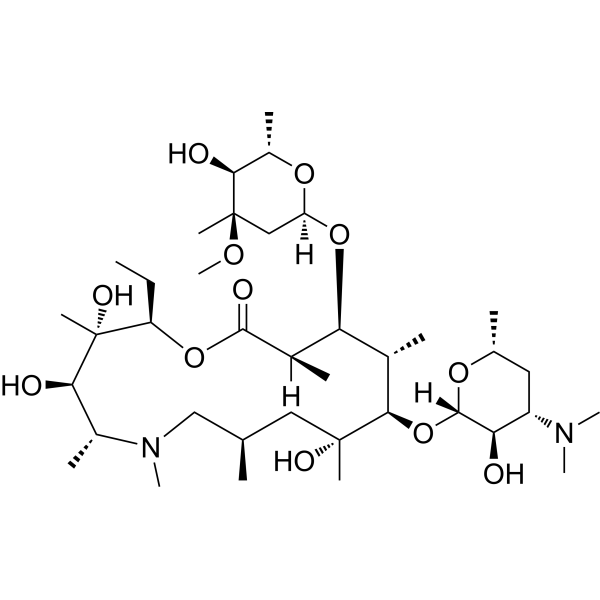
Azithromycin is a macrolide antibiotic useful for the treatment of a number of bacterial infections.

For research use only. We do not sell to patients.

CAS No. : 83905-01-5

Size Price Stock Quantity
Solid + Solvent (Highly Recommended)
10 mM * 1 mL in DMSO
ready for reconstitution
In-stock
Solution
10 mM * 1 mL in DMSO In-stock
Solid
50 mg In-stock
100 mg In-stock
200 mg In-stock
500 mg In-stock
1 g   Get quote  
5 g   Get quote  

* Please select Quantity before adding items.

This product is a controlled substance and not for sale in your territory.

Customer Review

Based on 45 publication(s) in Google Scholar

Other Forms of Azithromycin:

Top Publications Citing Use of Products

45 Publications Citing Use of MCE Azithromycin

Microbiological Assay
RT-PCR
WB
In Vivo Efficacy Study
Histological Imaging/Staining

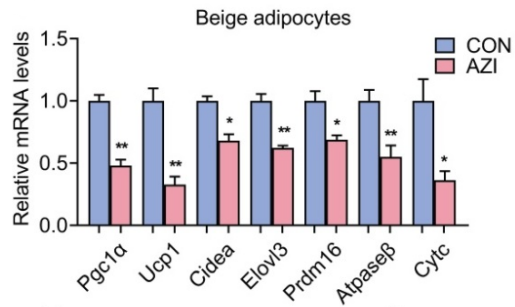
    Azithromycin purchased from MedChemExpress. Usage Cited in: Theranostics. 2022 Jan 1;12(3):1187-1203.  [Abstract]

    mRNA levels of thermogenic and mitochondrial gene programs in immortal beige adipocytes treated with or without Azithromycin (AZI) at 5 μM for 24 and 48 h.

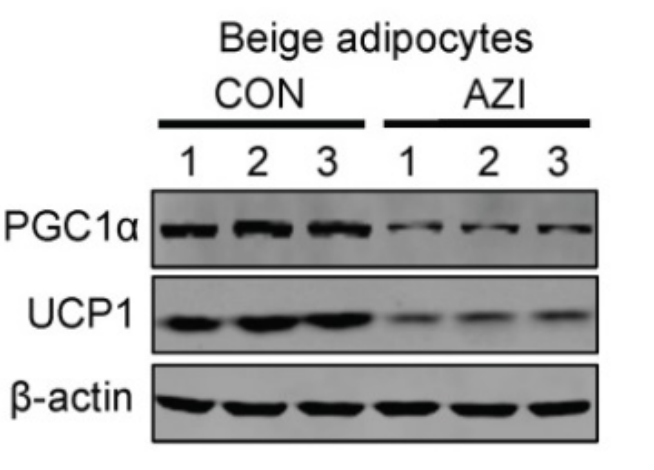
    Azithromycin purchased from MedChemExpress. Usage Cited in: Theranostics. 2022 Jan 1;12(3):1187-1203.  [Abstract]

    UCP1 and PGC1α protein levels in immortal beige adipocytes treated with or without Azithromycin (AZI) at 5 μM for 24 and 48 h.

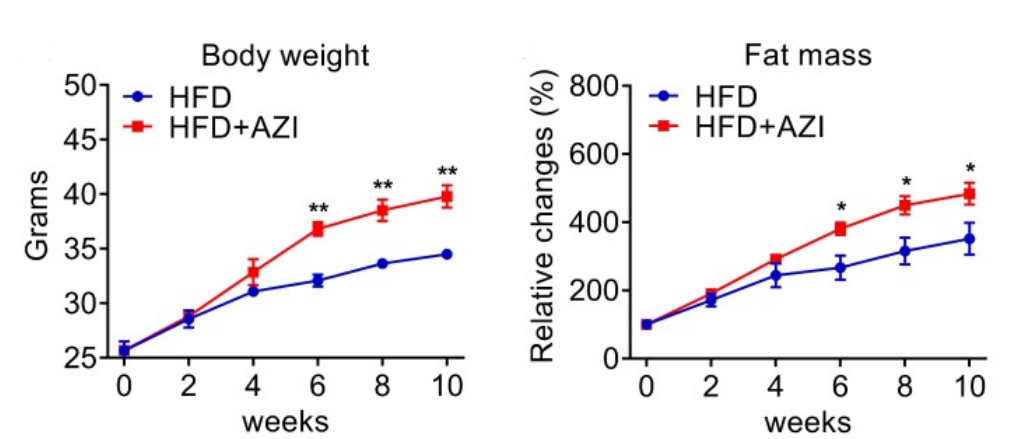
    Azithromycin purchased from MedChemExpress. Usage Cited in: Theranostics. 2022 Jan 1;12(3):1187-1203.  [Abstract]

    Azithromycin treatment induced adiposity and metabolic dysfunctions in mice for HFD. Metabolic performances (relative changes in body weight and body fat) of HFD fed mice treated with or without Azithromycin via drinking water for 12 weeks. (ABX is given throughout the whole process) (ABX: 1.0 g/L; Azithromycin: 50 mg/kg/day) (n = 6 per group).

    Azithromycin purchased from MedChemExpress. Usage Cited in: Theranostics. 2022 Jan 1;12(3):1187-1203.  [Abstract]

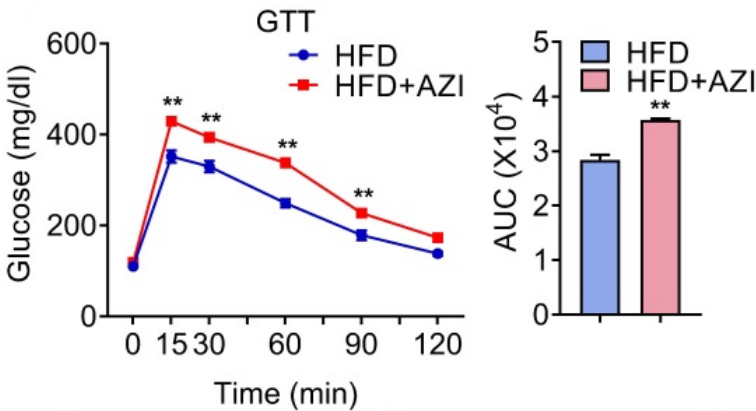
    Azithromycin treatment induced adiposity and metabolic dysfunctions in mice for HFD. Metabolic performances (relative glucose tolerance test (GTT) and area under the curve (AUC) analysis) of HFD fed mice treated with or without Azithromycin via drinking water for 12 weeks. (ABX is given throughout the whole process) (ABX: 1.0 g/L; Azithromycin: 50 mg/kg/day) (n = 6 per group).

    Azithromycin purchased from MedChemExpress. Usage Cited in: Theranostics. 2022 Jan 1;12(3):1187-1203.  [Abstract]

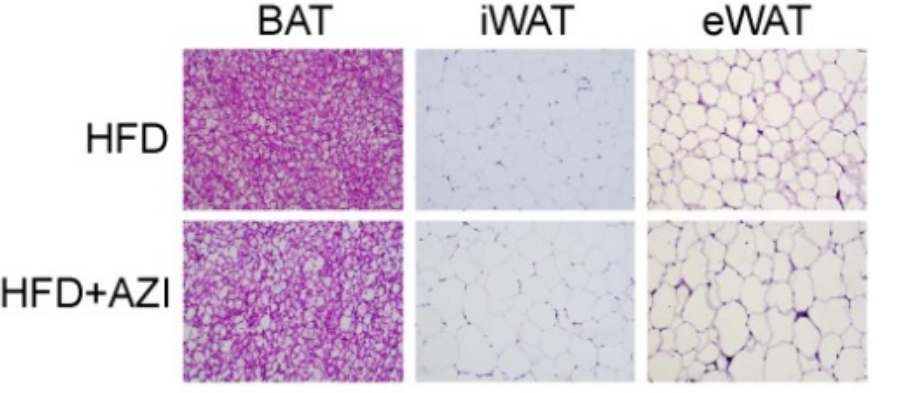
    Azithromycin treatment suppressed energy expenditure and thermogenic capacity in mice for HFD. Metabolic performances of HFD fed mice treated with or without Azithromycin via drinking water for 12 weeks (ABX is given throughout the whole process) (ABX: 1.0 g/L; Azithromycin: 50 mg/kg/day) (n = 6). Representative images of H&E staining of fat tissues.

    Azithromycin purchased from MedChemExpress. Usage Cited in: Acta Pharm Sin B. 2021 Sep;11(9):2850-2858.

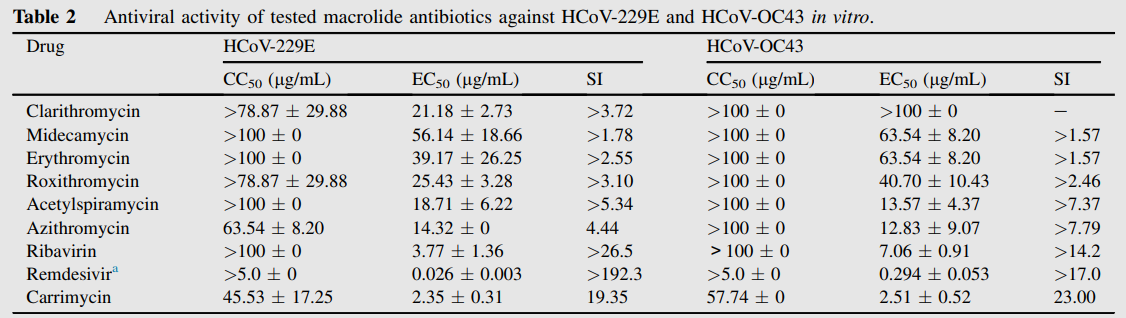
    Antiviral activity of tested macrolide antibiotics against HCoV-229E and HCoV-OC43 in vitro.

    Azithromycin purchased from MedChemExpress. Usage Cited in: Adv Sci (Weinh). 2020 Jul 21;7(17):2001374.  [Abstract]

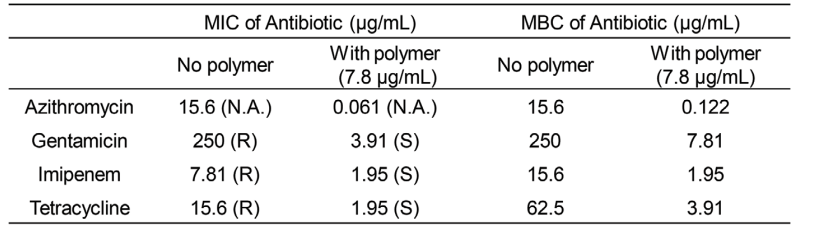
    Guanidin-functionalized polycarbonate pEt_20 with a degree of polymerization (DP) of 20 was more effective than colistin sulfate in reducing the MIC and MBC of Azithromycin against both strains.
    • Biological Activity

    • Protocol

    • Purity & Documentation

    • References

    • Customer Review

    Description

    Azithromycin is a macrolide antibiotic useful for the treatment of a number of bacterial infections.

    IC50 & Target

    Macrolide


    Cellular Effect
    Cell Line Type Value Description References
    A549 CC50
    > 600 μM
    Compound: Azithromycin
    Cytotoxicity against human A549 cells by MTT assay
    Cytotoxicity against human A549 cells by MTT assay
    [PMID: 32871342]
    AML12 CC50
    > 100 μM
    Compound: AZI
    Cytotoxicity against mouse AML12 cells assessed as reduction in cell viability incubated for 48 hrs by MTT assay
    Cytotoxicity against mouse AML12 cells assessed as reduction in cell viability incubated for 48 hrs by MTT assay
    [PMID: 38354519]
    HEp-2 IC50
    0.06 μg/mL
    Compound: AZM
    Antibacterial activity against Chlamydia trachomatis L2 infected in HEp-2 cells assessed as inhibition of infectious progeny incubated for 24 hrs by fluorescence microscopy
    Antibacterial activity against Chlamydia trachomatis L2 infected in HEp-2 cells assessed as inhibition of infectious progeny incubated for 24 hrs by fluorescence microscopy
    [PMID: 36696579]
    HFF CC50
    174 μM
    Compound: 3
    Cytotoxicity against HFF after 48 hrs by MTS assay
    Cytotoxicity against HFF after 48 hrs by MTS assay
    [PMID: 21428405]
    HeLa IC50
    160 μg/mL
    Compound: Azithromycin
    Inhibition of metabolic activity in HeLa cells assessed as MTT reduction after 48 hrs
    Inhibition of metabolic activity in HeLa cells assessed as MTT reduction after 48 hrs
    [PMID: 17088489]
    HeLa IC50
    240 μg/mL
    Compound: Azithromycin
    Antiproliferative effect against HeLa cells after 48 hrs
    Antiproliferative effect against HeLa cells after 48 hrs
    [PMID: 17088489]
    HepG2 IC50
    203 μM
    Compound: AZ
    Cytotoxicity against human HepG2 cells after 24 hrs by MTS assay
    Cytotoxicity against human HepG2 cells after 24 hrs by MTS assay
    [PMID: 22321992]
    HepG2 IC50
    203 μM
    Compound: AZI
    Cytotoxicity against human HepG2 cells after 24 hrs by MTS assay
    Cytotoxicity against human HepG2 cells after 24 hrs by MTS assay
    [PMID: 22380766]
    HepG2 IC50
    > 50 μM
    Compound: 1
    Cytotoxicity against human HepG2 cells after 24 hrs by MTS assay
    Cytotoxicity against human HepG2 cells after 24 hrs by MTS assay
    [PMID: 22148880]
    HepG2 IC50
    > 50 μM
    Compound: 6
    Cytotoxicity against human HepG2 cells after 1 to 4 hrs by MTS assay
    Cytotoxicity against human HepG2 cells after 1 to 4 hrs by MTS assay
    [PMID: 21476508]
    MG-63 IC50
    180 μg/mL
    Compound: Azithromycin
    Inhibition of metabolic activity in MG63 cells assessed as MTT reduction after 48 hrs
    Inhibition of metabolic activity in MG63 cells assessed as MTT reduction after 48 hrs
    [PMID: 17088489]
    MG-63 IC50
    190 μg/mL
    Compound: Azithromycin
    Antiproliferative effect against MG63 cells assessed as BrdU incorporation into DNA after 48 hrs after 48 hrs
    Antiproliferative effect against MG63 cells assessed as BrdU incorporation into DNA after 48 hrs after 48 hrs
    [PMID: 17088489]
    Osteoblast IC50
    160 μg/mL
    Compound: Azithromycin
    Inhibition of metabolic activity in primary human osteoblasts assessed as MTT reduction after 48 hrs
    Inhibition of metabolic activity in primary human osteoblasts assessed as MTT reduction after 48 hrs
    [PMID: 17088489]
    Osteoblast IC50
    25 μg/mL
    Compound: Azithromycin
    Antiproliferative effect against primary human osteoblasts assessed as BrdU incorporation into DNA after 48 hrs
    Antiproliferative effect against primary human osteoblasts assessed as BrdU incorporation into DNA after 48 hrs
    [PMID: 17088489]
    THP-1 EC50
    0.024 mg/L
    Compound: Azithromycin
    Antibacterial activity against methicillin-sensitive Staphylococcus aureus ATCC 25923 infected in human THP1 cells assessed as decrease of CFU after 24 hrs
    Antibacterial activity against methicillin-sensitive Staphylococcus aureus ATCC 25923 infected in human THP1 cells assessed as decrease of CFU after 24 hrs
    [PMID: 19564365]
    THP-1 EC50
    2.86 mg/L
    Compound: Azithromycin
    Antibacterial activity against methicillin-sensitive Listeria monocytogenes EGD infected in human THP1 cells assessed as decrease of CFU after 24 hrs
    Antibacterial activity against methicillin-sensitive Listeria monocytogenes EGD infected in human THP1 cells assessed as decrease of CFU after 24 hrs
    [PMID: 19564365]
    THP-1 IC50
    > 50 μM
    Compound: 6
    Cytotoxicity against human THP1 cells after 1 to 4 hrs by MTS assay
    Cytotoxicity against human THP1 cells after 1 to 4 hrs by MTS assay
    [PMID: 21476508]
    Vero CC50
    810 μM
    Compound: Azithromycin
    Antiproliferative against African green monkey Vero cells
    Antiproliferative against African green monkey Vero cells
    [PMID: 32871342]
    Vero CC50
    810 μM
    Compound: Azithromycin
    Antiproliferative against African green monkey Vero cells incubated for 40 hrs by Celltiter assay
    Antiproliferative against African green monkey Vero cells incubated for 40 hrs by Celltiter assay
    [PMID: 32871342]
    Vero CC50
    > 130 μM
    Compound: Azithromycin
    Cytotoxicity against African green monkey Vero cells by MTT assay
    Cytotoxicity against African green monkey Vero cells by MTT assay
    [PMID: 32871342]
    Vero CC50
    > 40 μM
    Compound: Azithromycin
    Cytotoxicity against African green monkey Vero cells by Celltiter blue assay
    Cytotoxicity against African green monkey Vero cells by Celltiter blue assay
    [PMID: 32871342]
    Vero C1008 CC50
    > 40 μM
    Compound: Azithromycin
    Cytotoxicity (CC50) determination in Vero E6 cells measured by fluorescence (OD590nm)
    Cytotoxicity (CC50) determination in Vero E6 cells measured by fluorescence (OD590nm)
    10.1101/2020.04.03.023846
    Vero C1008 EC50
    2.12 μM
    Compound: Azithromycin
    Antiviral efficacy against SARS-CoV-2 (strain BavPat1) in Vero E6 cells assessed by inhibition of viral RNA replication measured by RT-PCR after 2 days
    Antiviral efficacy against SARS-CoV-2 (strain BavPat1) in Vero E6 cells assessed by inhibition of viral RNA replication measured by RT-PCR after 2 days
    10.1101/2020.04.03.023846
    In Vitro

    Azithromycin (2 μM) augments rhinovirus-induced IFNβ expression in primary bronchial epithelial cells from asthmatics, which is associated with over-expression of RIG-I like receptors and repression of viral replication. Knockdown of MDA5, but not knockdown of RIG-I, diminishes azithromycin (2 μM)-enhanced viral-induced IFNβ expression in asthmatic primary bronchial epithelial cells[1]. Azithromycin specifically reduces MMP-9 mRNA and protein levels without affecting NF-κB in endotoxin-challenged monocytic THP-1 cells[2].

    MedChemExpress (MCE) has not independently confirmed the accuracy of these methods. They are for reference only.

    In Vivo

    Azithromycin (50 mg/kg) has no effect on bronchoalveolar lavage inflammatory parameters and LDH levels in a mouse model of asthma exacerbation. Azithromycin induces neither general inflammatory parameters nor LDH release in a mouse model of asthma exacerbation, and augments expression of interferon-stimulated genes and the pattern recognition receptor MDA5 but not RIG-I in exacerbating mice[1].

    MedChemExpress (MCE) has not independently confirmed the accuracy of these methods. They are for reference only.

    Molecular Weight

    748.98

    Formula

    C38H72N2O12

    CAS No.
    Appearance

    Solid

    Color

    White to off-white

    SMILES

    C[C@@H]([C@@H]([C@@](C(O[C@@H]([C@@](C)(O)[C@@H]1O)CC)=O)([H])C)O[C@@](O[C@@H](C)[C@@H]2O)([H])C[C@@]2(C)OC)[C@H]([C@](O)(C[C@H](CN([C@@H]1C)C)C)C)O[C@@](O[C@H](C)C[C@@H]3N(C)C)([H])[C@@H]3O

    Shipping

    Room temperature in continental US; may vary elsewhere.

    Storage
    Powder -20°C 3 years
    4°C 2 years
    In solvent -80°C 2 years
    -20°C 1 year
    Solvent & Solubility
    In Vitro: 

    DMSO : ≥ 100 mg/mL (133.51 mM; Hygroscopic DMSO has a significant impact on the solubility of product, please use newly opened DMSO)

    *"≥" means soluble, but saturation unknown.

    Preparing
    Stock Solutions
    Concentration Solvent Mass 1 mg 5 mg 10 mg
    1 mM 1.3351 mL 6.6757 mL 13.3515 mL
    5 mM 0.2670 mL 1.3351 mL 2.6703 mL
    View the Complete Stock Solution Preparation Table

    * Please refer to the solubility information to select the appropriate solvent. Once prepared, please aliquot and store the solution to prevent product inactivation from repeated freeze-thaw cycles.
    Storage method and period of stock solution: -80°C, 2 years; -20°C, 1 year. When stored at -80°C, please use it within 2 years. When stored at -20°C, please use it within 1 year.

    • Molarity Calculator

    • Dilution Calculator

    Mass (g) = Concentration (mol/L) × Volume (L) × Molecular Weight (g/mol)

    Mass
    =
    Concentration
    ×
    Volume
    ×
    Molecular Weight *

    Concentration (start) × Volume (start) = Concentration (final) × Volume (final)

    This equation is commonly abbreviated as: C1V1 = C2V2

    Concentration (start)

    C1

    ×
    Volume (start)

    V1

    =
    Concentration (final)

    C2

    ×
    Volume (final)

    V2

    In Vivo:

    Select the appropriate dissolution method based on your experimental animal and administration route.

    For the following dissolution methods, please ensure to first prepare a clear stock solution using an In Vitro approach and then sequentially add co-solvents:
    To ensure reliable experimental results, the clarified stock solution can be appropriately stored based on storage conditions. As for the working solution for in vivo experiments, it is recommended to prepare freshly and use it on the same day.
    The percentages shown for the solvents indicate their volumetric ratio in the final prepared solution. If precipitation or phase separation occurs during preparation, heat and/or sonication can be used to aid dissolution.

    • Protocol 1

      Add each solvent one by one:  10% DMSO    40% PEG300    5% Tween-80    45% Saline

      Solubility: ≥ 2.5 mg/mL (3.34 mM); Clear solution

      This protocol yields a clear solution of ≥ 2.5 mg/mL (saturation unknown).

      Taking 1 mL working solution as an example, add 100 μL DMSO stock solution (25.0 mg/mL) to 400 μL PEG300, and mix evenly; then add 50 μL Tween-80 and mix evenly; then add 450 μL Saline to adjust the volume to 1 mL.

      Preparation of Saline: Dissolve 0.9 g sodium chloride in ddH₂O and dilute to 100 mL to obtain a clear Saline solution.
    • Protocol 2

      Add each solvent one by one:  10% DMSO    90% (20% SBE-β-CD in Saline)

      Solubility: 2.5 mg/mL (3.34 mM); Suspended solution; Need ultrasonic

      This protocol yields a suspended solution of 2.5 mg/mL. Suspended solution can be used for oral and intraperitoneal injection.

      Taking 1 mL working solution as an example, add 100 μL DMSO stock solution (25.0 mg/mL) to 900 μL 20% SBE-β-CD in Saline, and mix evenly.

      Preparation of 20% SBE-β-CD in Saline (4°C, storage for one week): 2 g SBE-β-CD powder is dissolved in 10 mL Saline, completely dissolve until clear.
    In Vivo Dissolution Calculator

    Please enter the basic information of animal experiments:

    Dosage

    mg/kg

    Animal weight
    (per animal)

    g

    Dosing volume
    (per animal)

    μL

    Number of animals

    Recommended: Prepare an additional quantity of animals to account for potential losses during experiments.
    Please enter your animal formula composition:
    %
    DMSO +
    +
    %
    Tween-80 +
    %
    Saline
    Recommended: Keep the proportion of DMSO in working solution below 2% if your animal is weak.
    The co-solvents required include: DMSO, . All of co-solvents are available by MedChemExpress (MCE). , Tween 80. All of co-solvents are available by MedChemExpress (MCE).
    Calculation results:
    Working solution concentration: mg/mL
    Method for preparing stock solution: mg drug dissolved in μL  DMSO (Stock solution concentration: mg/mL).
    The concentration of the stock solution you require exceeds the measured solubility. The following solution is for reference only. If necessary, please contact MedChemExpress (MCE).
    Method for preparing in vivo working solution for animal experiments: Take μL DMSO stock solution, add μL . μL , mix evenly, next add μL Tween 80, mix evenly, then add μL Saline.
     If the continuous dosing period exceeds half a month, please choose this protocol carefully.
    Please ensure that the stock solution in the first step is dissolved to a clear state, and add co-solvents in sequence. You can use ultrasonic heating (ultrasonic cleaner, recommended frequency 20-40 kHz), vortexing, etc. to assist dissolution.
    Purity & Documentation

    Purity: 98.0%

    References
    Cell Assay
    [2]

    THP-1 cells (106 cells in 1 mL RPMI medium, without antibiotics, growth factors or serum) are seeded in each well of 24-well plates and allowed to settle for 1 hour. Next, 50 μL of the test compound is added followed by 50 μL of LPS (final concentration of 10 μg/mL). After 24h (37°C and 5% CO2) the supernatants and cell pellets are collected (1200 rpm, 5 min). THP-1 cell viability is tested using 3-(4,5-dimethylthiazol-2-yl)-2,5-diphenyltetrazolium bromide (MTT). MTT is dissolved at 2 mg/mL in PBS and aliquots are stored at -20°C. The MTT assay is performed according to the suppliers instructions. Absorbance of MTT converted into formazan is measured at a wavelength of 570 nm with background subtraction at 630 nm.

    MCE has not independently confirmed the accuracy of these methods. They are for reference only.

    References

    Complete Stock Solution Preparation Table

    * Please refer to the solubility information to select the appropriate solvent. Once prepared, please aliquot and store the solution to prevent product inactivation from repeated freeze-thaw cycles.
    Storage method and period of stock solution: -80°C, 2 years; -20°C, 1 year. When stored at -80°C, please use it within 2 years. When stored at -20°C, please use it within 1 year.

    Optional Solvent Concentration Solvent Mass 1 mg 5 mg 10 mg 25 mg
    DMSO 1 mM 1.3351 mL 6.6757 mL 13.3515 mL 33.3787 mL
    5 mM 0.2670 mL 1.3351 mL 2.6703 mL 6.6757 mL
    10 mM 0.1335 mL 0.6676 mL 1.3351 mL 3.3379 mL
    15 mM 0.0890 mL 0.4450 mL 0.8901 mL 2.2252 mL
    20 mM 0.0668 mL 0.3338 mL 0.6676 mL 1.6689 mL
    25 mM 0.0534 mL 0.2670 mL 0.5341 mL 1.3351 mL
    30 mM 0.0445 mL 0.2225 mL 0.4450 mL 1.1126 mL
    40 mM 0.0334 mL 0.1669 mL 0.3338 mL 0.8345 mL
    50 mM 0.0267 mL 0.1335 mL 0.2670 mL 0.6676 mL
    60 mM 0.0223 mL 0.1113 mL 0.2225 mL 0.5563 mL
    80 mM 0.0167 mL 0.0834 mL 0.1669 mL 0.4172 mL
    100 mM 0.0134 mL 0.0668 mL 0.1335 mL 0.3338 mL
    • No file chosen (Maximum size is: 1024 Kb)
    • If you have published this work, please enter the PubMed ID.
    • Your name will appear on the site.
    Help & FAQs
    • Do most proteins show cross-species activity?

      Species cross-reactivity must be investigated individually for each product. Many human cytokines will produce a nice response in mouse cell lines, and many mouse proteins will show activity on human cells. Other proteins may have a lower specific activity when used in the opposite species.

    Your Recently Viewed Products:

    Inquiry Online

    Your information is safe with us. * Required Fields.

    Product Name


    Requested Quantity *

    Applicant Name *


    Salutation

    Email Address *


    Phone Number *

    Department


    Organization Name *

    City

    State

    Country or Region *


    Remarks

    Bulk Inquiry

    Inquiry Information

    Product Name:
    Azithromycin
    Cat. No.:
    HY-17506
    Quantity:
    MCE Japan Authorized Agent: