1. NF-κB TGF-beta/Smad Metabolic Enzyme/Protease Immunology/Inflammation Protein Tyrosine Kinase/RTK PI3K/Akt/mTOR Anti-infection
  2. NF-κB TGF-β Receptor Reactive Oxygen Species (ROS) Insulin Receptor Akt Parasite
  3. Sequoyitol

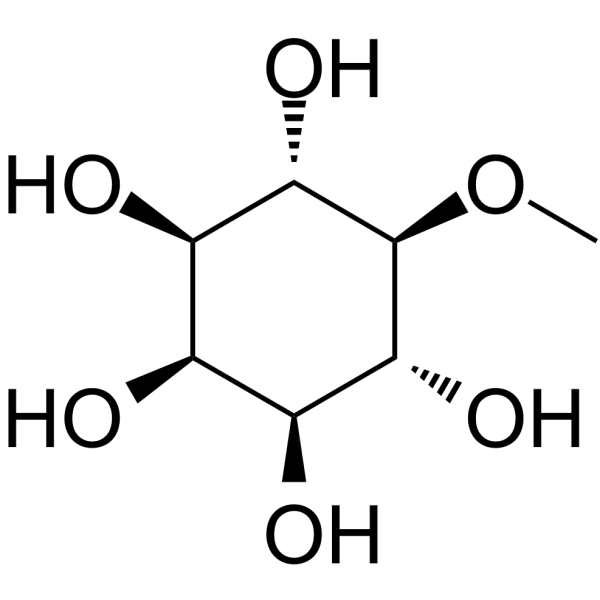
Sequoyitol  (Synonyms: 5-O-Methyl-myo-inositol)

Cat. No.: HY-N2421 Purity: 98.0%
Handling Instructions Technical Support

Sequoyitol (5-O-Methyl-myo-inositol) is an orally active hypoglycemic agent and antioxidant. Sequoyitol can be isolated from herbaceous plants. Sequoyitol downregulates the expression of NF-κB and TGF-β1, reduces ROS production and malondialdehyde levels, and enhances total antioxidant capacity. Sequoyitol activates the insulin signaling pathway, including the phosphorylation of IR, IRS1 and Akt. Sequoyitol increases serum insulin levels, inhibits hepatic glucose production, and promotes cellular glucose uptake. Sequoyitol antagonizes TNFα-induced inhibition of the insulin signaling pathway, and decreases blood urea nitrogen and serum creatinine levels. Sequoyitol elicits potential peaks in the chemosensors of adult and larval Atrophaneura alcinous, and acts as an oviposition stimulant for female Atrophaneura alcinous. Sequoyitol can be used in research related to type 2 diabetes, insulin resistance, hyperglycemia, impaired glucose tolerance and diabetic nephropathy.

For research use only. We do not sell to patients.

Sequoyitol

Sequoyitol Chemical Structure

CAS No. : 523-92-2

Size Price Stock Quantity
1 mg In-stock
5 mg In-stock
10 mg In-stock
50 mg   Get quote  
100 mg   Get quote  

* Please select Quantity before adding items.

This product is a controlled substance and not for sale in your territory.

Customer Review

Based on 1 publication(s) in Google Scholar

Top Publications Citing Use of Products

1 Publications Citing Use of MCE Sequoyitol

View All NF-κB Isoform Specific Products:

View All TGF-β Receptor Isoform Specific Products:

View All Akt Isoform Specific Products:

View All Parasite Isoform Specific Products:

  • Biological Activity

  • Purity & Documentation

  • References

  • Customer Review

Description

Sequoyitol (5-O-Methyl-myo-inositol) is an orally active hypoglycemic agent and antioxidant. Sequoyitol can be isolated from herbaceous plants. Sequoyitol downregulates the expression of NF-κB and TGF-β1, reduces ROS production and malondialdehyde levels, and enhances total antioxidant capacity. Sequoyitol activates the insulin signaling pathway, including the phosphorylation of IR, IRS1 and Akt. Sequoyitol increases serum insulin levels, inhibits hepatic glucose production, and promotes cellular glucose uptake. Sequoyitol antagonizes TNFα-induced inhibition of the insulin signaling pathway, and decreases blood urea nitrogen and serum creatinine levels. Sequoyitol elicits potential peaks in the chemosensors of adult and larval Atrophaneura alcinous, and acts as an oviposition stimulant for female Atrophaneura alcinous. Sequoyitol can be used in research related to type 2 diabetes, insulin resistance, hyperglycemia, impaired glucose tolerance and diabetic nephropathy[1][2][3].

In Vitro

Sequoyitol (1-10 μmol·L−1; added 1 hour prior to the addition of high-glucose medium) protects rat mesangial cells from high-glucose-induced loss of viability, with the 10 μmol·L−1 dose exerting a stronger protective effect[1].
Sequoyitol (1-10 μmol·L−1; added 1 hour prior to the addition of high-glucose medium) reduces excessive ROS production induced by high glucose in rat mesangial cells, with the 10 μmol·L−1 dose exerting a more significant inhibitory effect on ROS levels[1].
Sequoyitol (1-10 μmol·L−1) reduces the level of high glucose-induced lipid peroxidation in rat mesangial cells, as evidenced by decreased MDA levels, with the inhibitory effect being stronger at the dose of 10 μmol·L−1[1].
Sequoyitol (1-10 μmol·L−1) enhances the cellular antioxidant capacity of rat mesangial cells exposed to high glucose, with the 10 μmol·L−1 dose exerting a more significant enhancing effect[1].
Sequoyitol (100 μM; 12 h) directly enhances the insulin signaling pathway in HepG2 cells, including the phosphorylation of IRS1 and Akt, and reverses TNF-α-induced insulin resistance[2].
Sequoyitol (100 μM; 16 h) directly suppresses DB-cAMP-stimulated gluconeogenesis in primary mouse hepatocytes in vitro in an insulin-independent manner, and exerts additive or synergistic effects to inhibit gluconeogenesis when combined with insulin[2].
Sequoyitol (100 μM; 12 h) directly enhances the insulin signaling pathway in 3T3-L1 adipocytes, including the phosphorylation of IR, IRS1 and Akt, and reverses TNF-α-induced insulin resistance[2].
Sequoyitol (5-10 mg/mL; 3-6 h) dose-dependently protects INS-1 pancreatic β-cells against STZ (HY-13753)- and H2O2-induced damage, and enhances the insulin signaling pathway in these cells[2].
Sequoyitol (15 mM) induces single-amplitude action potentials in the lateral styloconic sensilla of fifth-instar Atrophaneura alcinous larvae, elicits a small number of small action potentials in the epipharyngeal sensilla, but causes no evoked responses in the medial styloconic sensilla[3].

MedChemExpress (MCE) has not independently confirmed the accuracy of these methods. They are for reference only.

Western Blot Analysis[2]

Cell Line: human hepatoblastoma HepG2 cells
Concentration: 100 μM
Incubation Time: 12 h (pretreatment before 5 min insulin stimulation); 12 h (pretreatment with TNF-α before 5 min insulin stimulation)
Result: Increased insulin-stimulated phosphorylation of IRS1 by 114% and Akt (pSer473) by 54% compared to control.
Increased insulin-stimulated phosphorylation of IR by 46%, IRS1 by 48%, and Akt (pSer473) by 61% in TNF-α-treated cells compared to TNF-α-only control.

Western Blot Analysis[2]

Cell Line: 3T3-L1 mouse adipocytes
Concentration: 100 μM
Incubation Time: 12 h (pretreatment before 5 min insulin stimulation); 12 h (pretreatment with TNF-α before 5 min insulin stimulation)
Result: Increased insulin-stimulated phosphorylation of IR by 31% and IRS1 by 73% compared to control.
Increased insulin-stimulated phosphorylation of IR by 53%, IRS1 by 69%, and Akt by 74% in TNF-α-treated cells compared to TNF-α-only control.
In Vivo

Sequoyitol (12.5-50.0 mg/kg; p.o.; daily; 6 weeks) ameliorates diabetic nephropathy in high-fat diet and streptozotocin-induced diabetic rats by reducing hyperglycemia, improving renal function, decreasing oxidative stress, and downregulating the expression of pro-fibrotic and pro-inflammatory mediators, with the highest dose producing the most significant effects[1].
Sequoyitol (0.5 nmol/h; s.c.; continuous; 23 days) improves hyperglycemia, hyperinsulinemia, insulin resistance, and glucose intolerance in ob/ob mice by enhancing insulin signaling, including increasing Akt phosphorylation and reducing IRS1 Ser307 phosphorylation[2].
Sequoyitol (40 mg/kg; p.o.; twice daily; up to 31 days) improves hyperglycemia and glucose intolerance in ob/ob mice of both sexes by enhancing insulin sensitivity without altering body weight or plasma insulin levels[2].
Sequoyitol (70-100 mg·kg-1·day-1; p.o.; continuous; 31 days) reduces hyperglycemia, improves glucose intolerance, and increases plasma insulin levels in STZ-induced insulin-deficient C57BL/6 mice[2].

MedChemExpress (MCE) has not independently confirmed the accuracy of these methods. They are for reference only.

Animal Model: Sprague-Dawley (male, 6-8 weeks old, 180-220 g, induced by 4-week high-fat diet + intraperitoneal streptozotocin injection)[1]
Dosage: 12.5 mg/kg; 25.0 mg/kg; 50.0 mg/kg
Administration: p.o.; daily; 6 weeks
Result: Significantly decreased fasting blood glucose levels compared to the diabetic model group, with 25.0 mg/kg and 50.0 mg/kg doses showing statistically significant reductions (# P < 0.05, ## P < 0.01).
Significantly increased plasma insulin levels compared to the diabetic model group, with 25.0 mg/kg and 50.0 mg/kg doses showing statistically significant elevations (# P < 0.05, ## P < 0.01).
Significantly decreased serum creatinine (SCr) and blood urea nitrogen (BUN) levels compared to the diabetic model group, with 50.0 mg/kg dose producing statistically significant reduction in SCr (## P < 0.01) and all doses producing statistically significant reductions in BUN (# P < 0.05, ## P < 0.01).
Improved renal histopathology, reducing glomerular hypertrophy, mesangial cell proliferation, and extracellular matrix accumulation compared to the diabetic model group.
Significantly decreased renal collagen IV mRNA and protein expression compared to the diabetic model group, with 50.0 mg/kg dose producing statistically significant reductions (## P < 0.01).
Significantly decreased renal p22phox and p47phox mRNA and protein expression compared to the diabetic model group, with 25.0 mg/kg and 50.0 mg/kg doses producing statistically significant reductions (## P < 0.01).
Significantly decreased renal malondialdehyde (MDA) levels and increased total antioxidative capacity (T-AOC) compared to the diabetic model group, with 50.0 mg/kg dose producing statistically significant changes (## P < 0.01).
Significantly decreased renal NF-κB mRNA and protein expression compared to the diabetic model group, with 50.0 mg/kg dose producing statistically significant reductions (## P < 0.01).
Significantly decreased renal TGF-β1 mRNA and protein expression compared to the diabetic model group, with 25.0 mg/kg and 50.0 mg/kg doses producing statistically significant reductions (## P < 0.01).
Animal Model: ob/ob (male and female, 8-9 wk old, genetic obesity/insulin resistance model)[2]
Dosage: 40 mg/kg
Administration: p.o.; twice daily; up to 31 days
Result: Did not alter body weight in males or females.
Reduced fasting blood glucose significantly in males (P=0.014) and reduced in females (P=0.08) compared to controls.
Lowered blood glucose levels significantly at multiple time points post-glucose injection during GTT in both sexes.
Maintained plasma insulin levels similar to control groups.
Lowered blood glucose levels significantly at 15, 30, and 60 minutes post-insulin injection during ITT in both males and females.
Animal Model: C57BL/6 (male, 9 wk old, insulin deficiency model induced by streptozotocin injection)[2]
Dosage: 70-100 mg·kg-1·day-1
Administration: p.o.
Result: Did not alter body weight.
Reduced random-fed blood glucose significantly at days 22 and 31 post-treatment, with a 26% reduction at day 31 compared to controls.
Increased plasma insulin levels by 155% compared to controls.
Lowered blood glucose levels significantly at 60 and 120 minutes post-glucose injection during GTT.
Reduced AUC during GTT significantly.
Molecular Weight

194.18

Formula

C7H14O6

CAS No.
Appearance

Solid

Color

White to off-white

SMILES

CO[C@@H]1[C@H]([C@@H]([C@H](O)[C@H](O)[C@H]1O)O)O

Structure Classification
Initial Source
Shipping

Room temperature in continental US; may vary elsewhere.

Storage

4°C, protect from light

*In solvent : -80°C, 6 months; -20°C, 1 month (protect from light)

Solvent & Solubility
In Vitro: 

H2O : 100 mg/mL (514.99 mM; Need ultrasonic)

Preparing
Stock Solutions
Concentration Solvent Mass 1 mg 5 mg 10 mg
1 mM 5.1499 mL 25.7493 mL 51.4986 mL
5 mM 1.0300 mL 5.1499 mL 10.2997 mL
View the Complete Stock Solution Preparation Table

* Please refer to the solubility information to select the appropriate solvent. Once prepared, please aliquot and store the solution to prevent product inactivation from repeated freeze-thaw cycles.
Storage method and period of stock solution: -80°C, 6 months; -20°C, 1 month (protect from light). When stored at -80°C, please use it within 6 months. When stored at -20°C, please use it within 1 month.

* Note: If you choose water as the stock solution, please dilute it to the working solution, then filter and sterilize it with a 0.22 μm filter before use.

  • Molarity Calculator

  • Dilution Calculator

Mass (g) = Concentration (mol/L) × Volume (L) × Molecular Weight (g/mol)

Mass
=
Concentration
×
Volume
×
Molecular Weight *

Concentration (start) × Volume (start) = Concentration (final) × Volume (final)

This equation is commonly abbreviated as: C1V1 = C2V2

Concentration (start)

C1

×
Volume (start)

V1

=
Concentration (final)

C2

×
Volume (final)

V2

In Vivo:

For the following dissolution methods, please prepare the working solution directly. It is recommended to prepare fresh solutions and use them promptly within a short period of time.
The percentages shown for the solvents indicate their volumetric ratio in the final prepared solution. If precipitation or phase separation occurs during preparation, heat and/or sonication can be used to aid dissolution.

  • Protocol 1

    Add each solvent one by one:  PBS

    Solubility: 100 mg/mL (514.99 mM); Clear solution; Need ultrasonic

In Vivo Dissolution Calculator
Please enter the basic information of animal experiments:

Dosage

mg/kg

Animal weight
(per animal)

g

Dosing volume
(per animal)

μL

Number of animals

Recommended: Prepare an additional quantity of animals to account for potential losses during experiments.
Calculation results:
Working solution concentration: mg/mL
This product has good water solubility, please refer to the measured solubility data in water/PBS/Saline for details.
The concentration of the stock solution you require exceeds the measured solubility. The following solution is for reference only.If necessary, please contact MedChemExpress (MCE).
Purity & Documentation
References

Complete Stock Solution Preparation Table

* Please refer to the solubility information to select the appropriate solvent. Once prepared, please aliquot and store the solution to prevent product inactivation from repeated freeze-thaw cycles.
Storage method and period of stock solution: -80°C, 6 months; -20°C, 1 month (protect from light). When stored at -80°C, please use it within 6 months. When stored at -20°C, please use it within 1 month.

Optional Solvent Concentration Solvent Mass 1 mg 5 mg 10 mg 25 mg
H2O 1 mM 5.1499 mL 25.7493 mL 51.4986 mL 128.7465 mL
5 mM 1.0300 mL 5.1499 mL 10.2997 mL 25.7493 mL
10 mM 0.5150 mL 2.5749 mL 5.1499 mL 12.8747 mL
15 mM 0.3433 mL 1.7166 mL 3.4332 mL 8.5831 mL
20 mM 0.2575 mL 1.2875 mL 2.5749 mL 6.4373 mL
25 mM 0.2060 mL 1.0300 mL 2.0599 mL 5.1499 mL
30 mM 0.1717 mL 0.8583 mL 1.7166 mL 4.2916 mL
40 mM 0.1287 mL 0.6437 mL 1.2875 mL 3.2187 mL
50 mM 0.1030 mL 0.5150 mL 1.0300 mL 2.5749 mL
60 mM 0.0858 mL 0.4292 mL 0.8583 mL 2.1458 mL
80 mM 0.0644 mL 0.3219 mL 0.6437 mL 1.6093 mL
100 mM 0.0515 mL 0.2575 mL 0.5150 mL 1.2875 mL

* Note: If you choose water as the stock solution, please dilute it to the working solution, then filter and sterilize it with a 0.22 μm filter before use.

  • No file chosen (Maximum size is: 1024 Kb)
  • If you have published this work, please enter the PubMed ID.
  • Your name will appear on the site.
Help & FAQs
  • Do most proteins show cross-species activity?

    Species cross-reactivity must be investigated individually for each product. Many human cytokines will produce a nice response in mouse cell lines, and many mouse proteins will show activity on human cells. Other proteins may have a lower specific activity when used in the opposite species.

Your Recently Viewed Products:

Inquiry Online

Your information is safe with us. * Required Fields.

Product Name


Requested Quantity *

Applicant Name *


Salutation

Email Address *


Phone Number *

Department


Organization Name *

City

State

Country or Region *


Remarks

Bulk Inquiry

Inquiry Information

Product Name:
Sequoyitol
Cat. No.:
HY-N2421
Quantity:
MCE Japan Authorized Agent: