



CDK
Cyclin dependent kinase
CDKs (Cyclin-dependent kinases) are serine-threonine kinases first discovered for their role in regulating the cell cycle. They are also involved in regulating transcription, mRNA processing, and the differentiation of nerve cells. CDKs are relatively small proteins, with molecular weights ranging from 34 to 40 kDa, and contain little more than the kinase domain. In fact, yeast cells can proliferate normally when their CDK gene has been replaced with the homologous human gene. By definition, a CDK binds a regulatory protein called a cyclin. Without cyclin, CDK has little kinase activity; only the cyclin-CDK complex is an active kinase.
There are around 20 Cyclin-dependent kinases (CDK1-20) known till date. CDK1, 4 and 5 are involved in cell cycle, and CDK 7, 8, 9 and 11 are associated with transcription.
CDK levels remain relatively constant throughout the cell cycle and most regulation is post-translational. Most knowledge of CDK structure and function is based on CDKs of S. pombe (Cdc2), S. cerevisia (CDC28), and vertebrates (CDC2 and CDK2). The four major mechanisms of CDK regulation are cyclin binding, CAK phosphorylation, regulatory inhibitory phosphorylation, and binding of CDK inhibitory subunits (CKIs).
CDK Isoform Specific Products
-
CDK
(487)
View all products
-
CDK1
(196)
View all products
-
CDK2
(315)
View all products
-
CDK3
(28)
View all products
-
CDK4
(233)
View all products
-
CDK5
(98)
View all products
-
CDK6
(178)
View all products
-
CDK7
(119)
View all products
-
CDK8
(57)
View all products
-
CDK9
(205)
View all products
-
CDK11
(9)
View all products
-
CDK12
(53)
View all products
-
CDK13
(27)
View all products
-
CDK14
(6)
View all products
-
CDK16
(8)
View all products
-
CDK19
(25)
View all products
-
CDC
(21)
View all products
-
CLK
(31)
View all products
-
Pho85
(1)
View all products
-
CDK10
(1)
View all products
-
CDK15
(1)
View all products
-
CDK17
(2)
View all products
-
CDK18
(1)
View all products
-
CDK20
(1)
View all products
-
PITSLRE
(1)
View all products
All Product Categories
-
CDK Inhibitors
(1077)
View all products
-
CDK Agonists
(3)
View all products
-
CDK Antagonists
(2)
View all products
-
CDK Activators
(18)
View all products
-
CDK Modulators
(15)
View all products
-
CDK Degraders
(95)
View all products
-
CDK Controls
(4)
View all products
-
CDK Substrate
(1)
View all products
-
CDK Ligands
(16)
View all products
-
Cyclin-Dependent Kinases (CDKs) Proteins
(80)
View all products
-
Cyclin Dependent Kinase 1 (CDK1) Proteins
(9)
View all products
-
Cyclin-Dependent Kinase 2 (CDK2) Proteins
(12)
View all products
-
Cyclin-Dependent Kinase 3 (CDK3) Proteins
(6)
View all products
-
Cyclin-Dependent Kinase 4 (CDK4) Proteins
(4)
View all products
-
Cyclin-Dependent Kinase 5 (CDK5) Proteins
(5)
View all products
-
Cyclin-Dependent Kinase 6 (CDK6) Proteins
(6)
View all products
-
Cyclin-Dependent Kinase 7 (CDK7) Proteins
(4)
View all products
-
CDK Related Products (1353)
Related Products (1353)

-
Recombinant Proteins (82)
-
Antibodies (42)
-
CDK Isoform Comparison
-
CDK9 degrader-1
 0 ImagesCat. No.: HY-176451CDK9 degrader-1 is a HyT-type CDK9 degrader that selectively induces protein degradation by recruiting ATG101 (with a DC50 of 0.4073 μM in HCT116 cells). CDK9 degrader-1 recruits ATG101 to initiate the autophagy-lysosome pathway, forming LC3-containing autophagosomes that fuse with lysosomes to degrade CDK9. CDK9 degrader-1 mediates the degradation of Cyclin T1 via the same autophagy-lysosome pathway. CDK9 degrader-1 induces downstream phenotypic effects associated with CDK9 degradation. CDK9 degrader-1 can be used in the research of colorectal cancer (Blue: hydrophobic group; Pnk: CDK9 ligand (HY-50940); Black: linker (HY-N0420)).
-
Crozbaciclib fumarate
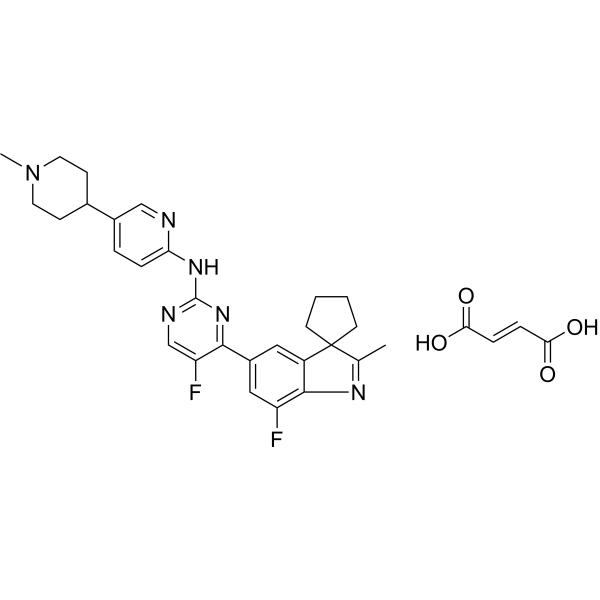 0 ImagesCrozbaciclib fumarate is a CDK4/6 inhibitor with IC50s of 3 and 1 nM, respectively.
-
CDK9 ligand 1
 0 ImagesCat. No.: HY-150889CAS No.: 2118356-94-6CDK9 ligand 1 is a CDK9-targeting ligand. CDK9 ligand 1 can be used for PROTAC synthesis, and serves as the target protein ligand for PROTAC CDK9 Degrader-1 (HY-103628).
-
Radicicol 6-oxime
 0 ImagesCat. No.: HY-186321CAS No.: 501124-40-9Synonyms: KF25706Radicicol 6-oxime (KF25706) is an Hsp90 inhibitor with an EC50 of 5.5 nM against human Hsp90. Radicicol 6-oxime binds to Hsp90 and disrupts its chaperone function, leading to destabilization and depletion of Hsp90-associated signaling molecules. Radicicol 6-oxime depletes Hsp90-associated signaling proteins such as Raf-1, v-src, p185erbB2, Cdk4, and mutant p53, thereby inhibiting K-ras and v-src signaling pathways. Radicicol 6-oxime exhibits antiproliferative activity against various tumor cells. Radicicol 6-oxime inhibits tumor growth in mouse tumor xenograft models. Radicicol 6-oxime can be used for research on breast cancer, colon cancer, and vulvar epidermoid carcinoma.
-
Otviciclib
 0 ImagesCat. No.: HY-177501CAS No.: 2228039-87-8Otviciclib (Compound 86) is a CDK inhibitor. Otviciclib has potent anti-proliferative activity against solid tumor cells (such as HCT116, NCIH82 and DU145 cells) with no significant toxicity to normal cells, and effectively induces the G2/M phase cells arrest and apoptosis. Otviciclib has a broad-spectrum anticancer activity, such as colon, pancreatic and lung cancer.
-
CDK4/CycD1 Recombinant Human Active Protein Kinase
 0 ImagesCat. No.: HY-E70681CDK4 has a well-established role in cell-cycle controland CDK4-cyclin complexes are commonly deregulated in tumorigenesis. CDK4/CycD1 Recombinant Human Active Protein Kinase is an ortholog of CDK4.
-
Dehydrodiisoeugenol-d4
 0 ImagesCat. No.: HY-N0589SDehydrodiisoeugenol-d4 is the deuterium labeled Dehydrodiisoeugenol (HY-N0589). Dehydrodiisoeugenol is an orally active anti-inflammatory and anti-tumor agent. Dehydrodiisoeugenol inhibits the proliferation of colorectal cancer cells, and induces apoptosis, autophagy, endoplasmic reticulum stress and cell cycle arrest. Dehydrodiisoeugenol also exerts anti-inflammatory effects by inhibiting the activation of NF-κB and the expression of COX-2. Dehydrodiisoeugenol can be used in the research related to colorectal cancer, inflammatory diseases and ulcerative colitis.
-
Lenoremycin
 0 ImagesCat. No.: HY-129694CAS No.: 51257-84-2Synonyms: Ro 21-6150; Antibiotic A-130-ALenoremycin (Ro 21-6150) is a microbial metabolite. Lenoremycin decreases β-catenin and cyclin D1 proteins levels. Lenoremycin decreases cancer stem cells (CSCs) populations via inducing reactive oxygen species production.
-
CDK9-IN-24
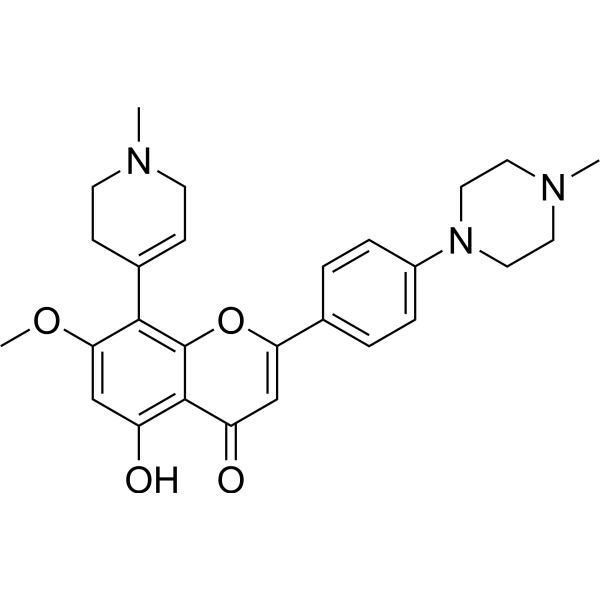 0 ImagesCat. No.: HY-155153CAS No.: 3052935-72-2CDK9-IN-24 (compound 21a) is a highly selective CDK9 inhibitor with significant inhibitory effect on tumor growth. CDK9-IN-24 effectively blocks cell proliferation and induces apoptosis by downregulating Mcl-1 and c-Myc, and can be used in acute myeloid leukemia research.

-
BAY-1112054 hydrochloride
 0 ImagesCat. No.: HY-121081ACAS No.: 1424871-27-1Synonyms: BAY-958 hydrochlorideBAY-1112054 (BAY-958) hydrochloride is a potent PTEFb/CDK9 inhibitor with high selectivity demonstrated, particularly within the CDK family. BAY-1112054 hydrochloride shows strong antiproliferative activity against cancer cell lines such as HeLa and MOLM-13. BAY-1112054 hydrochloride exhibits good metabolic stability. BAY-1112054 hydrochloride effectively inhibits tumor growth in mouse xenograft models without significant toxicity.
-
CDK8-IN-2
 0 ImagesCat. No.: HY-114178CAS No.: 1879980-97-8
-
CDK4/6-IN-29
 0 ImagesCat. No.: HY-184707CDK4/6-IN-29 is an orally active and highly selective CDK4/6 inhibitor, with an IC50 of 3.17 nM against CDK4 and an IC50 of 4.91 nM against CDK6. CDK4/6-IN-29 induces apoptosis in non-small cell lung cancer cells, inhibits cancer cell migration, induces G1-phase cell cycle arrest, and exhibits anti-tumor efficacy in vivo. CDK4/6-IN-29 can be used for research related to non-small cell lung cancer.
-
CDK4-IN-5
 0 ImagesCat. No.: HY-183297CDK4-IN-5 is a potent, orally active and selective CDK4 inhibitor. CDK4-IN-5 suppresses CDK4 expression and downregulates the CDK4/CyclinD1 complex. CDK4-IN-5 induces G0/G1 phase cell cycle arrest in bladder cancer cells via CyclinD1 expression suppression. CDK4-IN-5 selectively exerts activity against bladder cancer cells. CDK4-IN-5 can be used for the research of bladder cancer.
-
CDK2/4/6-IN-3
 0 ImagesCat. No.: HY-181501CDK2/4/6-IN-3 (compound 32a) is a CDK2/4/6 inhibitor. CDK2/4/6-IN-3 can be used as a target protein ligand for the synthesis of PROTAC WWZ-11-098 (HY-181490).

-
JAK1/CDK7-IN-1
 0 ImagesCat. No.: HY-181528JAK1/CDK7-IN-1 is a JAK1/CDK7 inhibitor. JAK1/CDK7-IN-1 forms a stable and tightly bound complex with JAK1. JAK1/CDK7-IN-1 disrupts the cell cycle, induces G2/M phase arrest, and increases the proportion of pre-G1 phase cells. JAK1/CDK7-IN-1 induces cellular apoptosis (apoptosis) and necrosis. JAK1/CDK7-IN-1 is applicable to research related to breast cancer and prostate cancer.
-
Indazole 1
 0 ImagesCat. No.: HY-125201CAS No.: 2252153-37-8Indazole 1 is a potent CDC2-like kinase 2 (CLK2) inhibitor (IC50=12.3 nM). Indazole 1 inhibits the phosphorylation of SR proteins (e.g., SRSF1, SRSF3) and modulates alternative splicing of Wnt signaling-related genes. Indazole 1 is promising for research of osteoarthritis.
-
CDK15/CycA2 Recombinant Human Active Protein Kinase
 0 ImagesCat. No.: HY-E70662CDK15 is a cell cycle-dependent kinase that is involved in tumor progression. CDK15/CycA2 Recombinant Human Active Protein Kinase is an ortholog of CDK15.
-
CDK4/6/BRD4-IN-2
 0 ImagesCat. No.: HY-174088CDK4/6/BRD4-IN-2 (Compound PJ2) is a dual inhibitor of CDK4/6 and BRD4 with IC50 values for CDK4, CDK6, BRD4 (BD1), and BRD4 (BD2) of 168.75, 292.45, 23.17, and 3.12 nM respectively. CDK4/6/BRD4-IN-2 has a strong inhibitory effect on non-small cell lung cancer (NSCLC) cell lines. CDK4/6/BRD4-IN-2 induces cell cycle arrest, senescence and apoptosis through ROS-mediated DNA damage. CDK4/6/BRD4-IN-2 can also effectively inhibit the migration and invasion of NCI-H358 cells. CDK4/6-IN-2 can be used for the study of KRAS-mutated NSCLC.




