Delivery of temperature sensitive items including proteins and kits will be paused on 6/19 for the Juneteenth holiday. For urgent orders please contact customer service.
Gemtuzumab ozogamicin is an antibody-drug conjugate (ADC) consisting of a humanized immunoglobulin (IgG4) antibody directed against CD33 that is conjugated to the cytotoxic agent Calicheamicin (HY-19609). The antibody portion is Gemtuzumab (HY-P99971), and the drug-linker conjugate for ADC is N-Ac-γ-Calicheamicin-AcBut-NHS ester (HY-103688). Gemtuzumab ozogamicin can be used for the research of acute myeloid leukemia (AML) .
Vadastuximab (Anti-Human CD33 Recombinant Antibody) is a humanized monoclonal antibody targeting CD33. Vadastuximab can be used to synthesize an ADC compound, Vadastuximab talirine .
Gemtuzumab is a monoclonal IgG4-κ antibody targeting CD33 antigen. Gemtuzumab affects cell necrosis by specifically targeting CD33 expressed on the surface of leukaemic cell blasts in acute myeloid leukemia (AML). Gemtuzumab can be used for synthesis of antibody-drug conjugate (ADC), Gemtuzumab ozogamicin (HY-109539). Gemtuzumab ozogamicin consists of a cytotoxic derivative of Calicheamicin (a cytotoxic antibiotic), and a monoclonal antibody. Gemtuzumab ozogamicin can be used for the research of acute myeloid leukemia. Recommend Isotype Controls: Human IgG4 (S228P) kappa, Isotype Control (HY-P99003) .
BMS-986497 (ORM-6151) is a CD33-targeting antibody-conjugated GSPT1 degrader. BMS-986497 delivers the GSPT1 degrader SMol006 to CD33-expressing cells and induces GSPT1 protein degradation. BMS-986497 shows potential for research on acute myeloid leukemia (AML) .
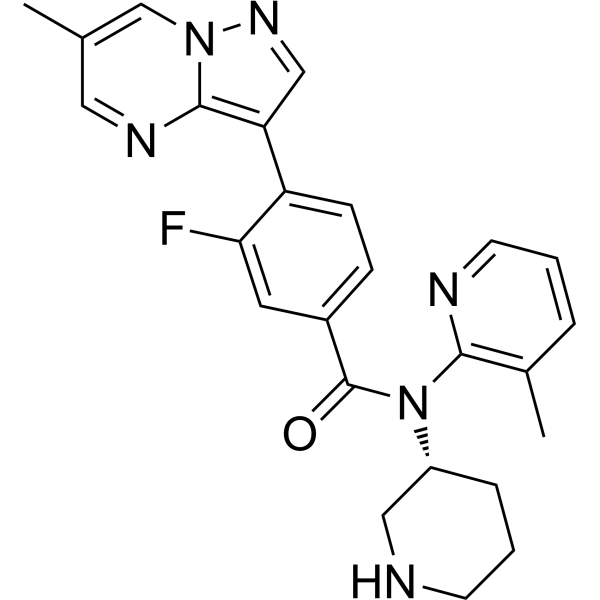
CD33 splicing modulator 1 (Compound 1) is a CD33 splicing modulator. CD33/Siglec 3 is a myeloid lineage cell surface receptor that is known to regulate microglia activity. CD33 splicing modulator 1 increases exon 2 skipping in cellular mRNA pools. CD33 splicing modulator 1 has the potential for the research of neurodegenerative disease including Alzheimer's disease .
Eluvixtamab (AMG-330) is a bispecific T-cell engager. Eluvixtamab binds to CD33 and CD3 on T cells, thereby promoting T cell-mediated cytotoxicity against CD33+ cells. Eluvixtamab can be used in the research of tumors such as relapsed/refractory acute myeloid leukemia .
Lintuzumab (HUM-195) is an anti-CD33 humanized monoclonal antibody. Lintuzumab reduces the production of TNFα-induced pro-inflammatory cytokines and chemokines by AML cells. Lintuzumab promotes tumor cell killing through antibody-dependent cellular cytotoxicity (ADCC) and phagocytosis (ADCP) activities against MDR and MDR+ AML cell lines and primary AML patient samples. Lintuzumab enhances survival and reduces tumor burden in mice .
Vixtimotamab (AMV-564; TandAb T564) is a bispecific tetravalent tandem diabody (TandAb) that targets human CD33 and human CD3 antigens. Vixtimotamab can be used for the research of acute myeloid leukemia (AML) .
BI-836858 is a fully human anti-CD33 monoclonal antibody. BI-836858 reduces CD33+ cells via antibody-dependent cellular cytotoxicity (ADCC), blocks downstream signaling of S100A9/CD33, decreases the secretion of immunosuppressive cytokines and reactive oxygen species-induced genomic instability, and restores bone marrow hematopoietic function. BI-836858 is applicable to the research of myelodysplastic syndrome (MDS) and AML .
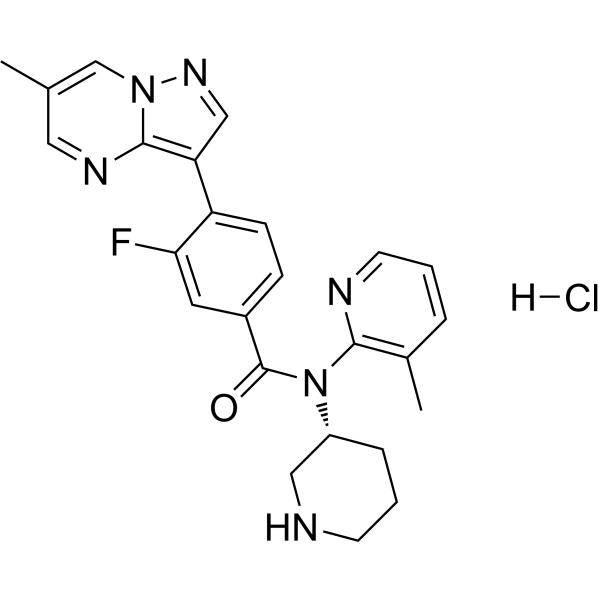
CD33 splicing modulator 1 (Compound 1) hydrochloride is a CD33 splicing modulator. CD33/Siglec 3 is a myeloid cell surface receptor known to regulate microglial activity. CD33 splicing modulator 1 hydrochloride increases exon 2 skipping in the cellular mRNA pool and can be used to study neurodegenerative diseases including Alzheimer's disease .
Aldastotug (PYX-106; BSI-060T) is a human monoclonal antibody (mAb) targeting Siglec-15/CD33L3. Aldastotug reverses Siglec-15-mediated immunosuppression and enhances T-cell proliferation. Aldastotug induces significantly increased levels of IFNγ and TNFα in T cells. Aldastotug can be used in cancer immunity research. Recommended isotype control: Human IgG1 kappa, Isotype Control (HY-P99001) .
Cd33 Rat Pre-designed siRNA Set A contains three designed siRNAs for Cd33 gene (Rat), as well as a negative control, a positive control, and a FAM-labeled negative control.
CD33 Human Pre-designed siRNA Set A contains three designed siRNAs for CD33 gene (Human), as well as a negative control, a positive control, and a FAM-labeled negative control.
Cd33 Mouse Pre-designed siRNA Set A contains three designed siRNAs for Cd33 gene (Mouse), as well as a negative control, a positive control, and a FAM-labeled negative control.
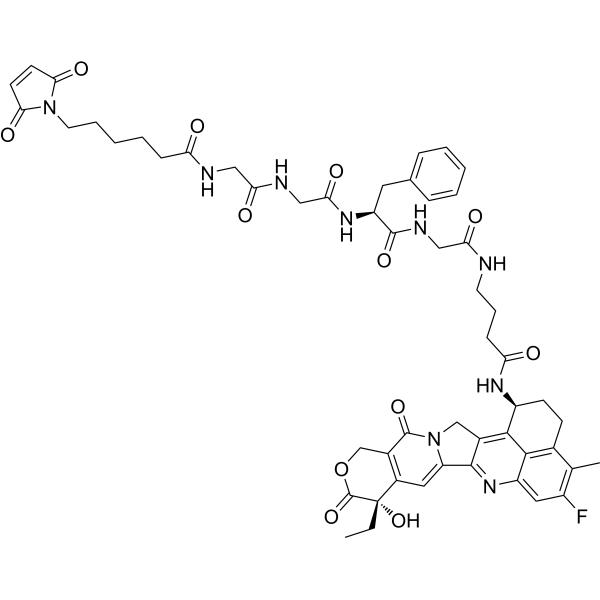
MC-Gly-Gly-Phe-Gly-GABA-Exatecan is an agent linker conjugate for ADC, with an inhibitor for Topoisomerase Exatecan (HY-13631) with IC50 of 22 μM. MC-Gly-Gly-Phe-Gly-GABA-Exatecan targets various antibodies, exhibits cytotoxic and antitumor efficacy in vitro and in vivo .
Anti-CD33 Antibody (OR000283) (ORM-6151 Antibody; BMS-986497 Antibody) is an antibody targeting CD33. It is generated by grafting the FAb (H&L) sequence of Gemtuzumab (HY-P99971) onto an IgG1 Fc carrying the N297A mutation, which inhibits Fc-γR binding. Anti-CD33 Antibody (OR000283) can be used to construct degrader-antibody conjugates (DACs), such as ORM-6151 (HY-171792) .
The Anti-Siglec-15/CD33L3 Antibody is a human-derived antibody expressed in CHO cells, targeting Siglec-15/CD33L3. The Anti-Siglec-15/CD33L3 Antibody contains a huIgG1 heavy chain and a huλ light chain, with a predicted molecular weight (MW) of 146.02 kDa. The isotype control for the Anti-Siglec-15/CD33L3 Antibody can be referenced as Human IgG1 kappa, Isotype Control (HY-P99001).
DS-1501 is a human monoclonal antibody (mAb) targeting Siglec-15/CD33L3. DS-1501 inhibits osteoclastogenesis. DS-1501 suppresses the decrease of lumbar spine bone mineral density (BMD) in ovariectomized (OVX) rats. DS-1501 can be used in Osteoporosis research. Recommended isotype control: Human IgG1 kappa, Isotype Control (HY-P99001) .
Vadastuximab (Anti-Human CD33 Recombinant Antibody) is a humanized monoclonal antibody targeting CD33. Vadastuximab can be used to synthesize an ADC compound, Vadastuximab talirine .
Gemtuzumab is a monoclonal IgG4-κ antibody targeting CD33 antigen. Gemtuzumab affects cell necrosis by specifically targeting CD33 expressed on the surface of leukaemic cell blasts in acute myeloid leukemia (AML). Gemtuzumab can be used for synthesis of antibody-drug conjugate (ADC), Gemtuzumab ozogamicin (HY-109539). Gemtuzumab ozogamicin consists of a cytotoxic derivative of Calicheamicin (a cytotoxic antibiotic), and a monoclonal antibody. Gemtuzumab ozogamicin can be used for the research of acute myeloid leukemia. Recommend Isotype Controls: Human IgG4 (S228P) kappa, Isotype Control (HY-P99003) .
Eluvixtamab (AMG-330) is a bispecific T-cell engager. Eluvixtamab binds to CD33 and CD3 on T cells, thereby promoting T cell-mediated cytotoxicity against CD33+ cells. Eluvixtamab can be used in the research of tumors such as relapsed/refractory acute myeloid leukemia .
Lintuzumab (HUM-195) is an anti-CD33 humanized monoclonal antibody. Lintuzumab reduces the production of TNFα-induced pro-inflammatory cytokines and chemokines by AML cells. Lintuzumab promotes tumor cell killing through antibody-dependent cellular cytotoxicity (ADCC) and phagocytosis (ADCP) activities against MDR and MDR+ AML cell lines and primary AML patient samples. Lintuzumab enhances survival and reduces tumor burden in mice .
Vixtimotamab (AMV-564; TandAb T564) is a bispecific tetravalent tandem diabody (TandAb) that targets human CD33 and human CD3 antigens. Vixtimotamab can be used for the research of acute myeloid leukemia (AML) .
BI-836858 is a fully human anti-CD33 monoclonal antibody. BI-836858 reduces CD33+ cells via antibody-dependent cellular cytotoxicity (ADCC), blocks downstream signaling of S100A9/CD33, decreases the secretion of immunosuppressive cytokines and reactive oxygen species-induced genomic instability, and restores bone marrow hematopoietic function. BI-836858 is applicable to the research of myelodysplastic syndrome (MDS) and AML .
Anti-CD33 Antibody (IMGN-779 antibody) is a CHO-expressed humanized antibody targeting Siglec-3/CD33. Anti-CD33 Antibody carries a huIgG1 heavy chain and a huκ light chain, with a predicted molecular weight (MW) of 144.6 kDa. The isotype control for Anti-CD33 Antibody can refer to Human IgG1 kappa, Isotype Control (HY-P99001).
Aldastotug (PYX-106; BSI-060T) is a human monoclonal antibody (mAb) targeting Siglec-15/CD33L3. Aldastotug reverses Siglec-15-mediated immunosuppression and enhances T-cell proliferation. Aldastotug induces significantly increased levels of IFNγ and TNFα in T cells. Aldastotug can be used in cancer immunity research. Recommended isotype control: Human IgG1 kappa, Isotype Control (HY-P99001) .
NC-318 (5G-12) is a human-derived antibody expressed by CHO, targeting Siglec-15/CD33L3. NC-318 (5G-12) has a huIgG1 type heavy chain and a huκ type light chain, with a predicted molecular weight (MW) of 146.98 kDa. The isotype control for NC-318 (5G-12) can be referenced as Human IgG1 kappa, Isotype Control (HY-P99001).
Anti-CD33 Antibody (OR000283) (ORM-6151 Antibody; BMS-986497 Antibody) is an antibody targeting CD33. It is generated by grafting the FAb (H&L) sequence of Gemtuzumab (HY-P99971) onto an IgG1 Fc carrying the N297A mutation, which inhibits Fc-γR binding. Anti-CD33 Antibody (OR000283) can be used to construct degrader-antibody conjugates (DACs), such as ORM-6151 (HY-171792) .
The Anti-Siglec-15/CD33L3 Antibody is a human-derived antibody expressed in CHO cells, targeting Siglec-15/CD33L3. The Anti-Siglec-15/CD33L3 Antibody contains a huIgG1 heavy chain and a huλ light chain, with a predicted molecular weight (MW) of 146.02 kDa. The isotype control for the Anti-Siglec-15/CD33L3 Antibody can be referenced as Human IgG1 kappa, Isotype Control (HY-P99001).
DS-1501 is a human monoclonal antibody (mAb) targeting Siglec-15/CD33L3. DS-1501 inhibits osteoclastogenesis. DS-1501 suppresses the decrease of lumbar spine bone mineral density (BMD) in ovariectomized (OVX) rats. DS-1501 can be used in Osteoporosis research. Recommended isotype control: Human IgG1 kappa, Isotype Control (HY-P99001) .
AB-25E9 is a humanized antibody expressed in CHO, targeting Siglec-15/CD33L3. The predicted molecular weight (MW) of AB-25E9 is 150 kDa. The isotype control for AB-25E9 can refer to Human IgG1 kappa, Isotype Control (HY-P99001).
Siglec-3/CD33, a sialic-acid-binding lectin, crucially mediates cell-cell interactions and immune cell quiescence. Preferring sialic acid on specific mucins, it forms homodimers, interacting with PTPN6/SHP-1 and PTPN11/SHP-2 upon phosphorylation. CD33 also engages C1QA through its C-terminus, activating CD33 inhibitory motifs. Siglec-3/CD33 Protein, Human (HEK293) is the recombinant human-derived Siglec-3/CD33 protein, expressed by HEK293 , with tag free.
Siglec-3/CD33, a sialic-acid-binding lectin, crucially mediates cell-cell interactions and immune cell quiescence. Preferring sialic acid on specific mucins, it forms homodimers, interacting with PTPN6/SHP-1 and PTPN11/SHP-2 upon phosphorylation. CD33 also engages C1QA through its C-terminus, activating CD33 inhibitory motifs. Siglec-3/CD33 Protein, Mouse (HEK293) is the recombinant mouse-derived Siglec-3/CD33 protein, expressed by HEK293 , with tag free.
Siglec-3/CD33, a sialic-acid-binding lectin, crucially mediates cell-cell interactions and immune cell quiescence. Preferring sialic acid on specific mucins, it forms homodimers, interacting with PTPN6/SHP-1 and PTPN11/SHP-2 upon phosphorylation. CD33 also engages C1QA through its C-terminus, activating CD33 inhibitory motifs. Siglec-3/CD33 Protein, Mouse (HEK293, Fc) is the recombinant mouse-derived Siglec-3/CD33 protein, expressed by HEK293 , with C-hFc labeled tag.
Siglec-3/CD33, a sialic-acid-binding lectin, crucially mediates cell-cell interactions and immune cell quiescence. Preferring sialic acid on specific mucins, it forms homodimers, interacting with PTPN6/SHP-1 and PTPN11/SHP-2 upon phosphorylation. CD33 also engages C1QA through its C-terminus, activating CD33 inhibitory motifs. Siglec-3/CD33 Protein, Human (HEK293, His) is the recombinant human-derived Siglec-3/CD33 protein, expressed by HEK293 , with C-His labeled tag.
Siglec-3/CD33, a sialic-acid-binding lectin, crucially mediates cell-cell interactions and immune cell quiescence. Preferring sialic acid on specific mucins, it forms homodimers, interacting with PTPN6/SHP-1 and PTPN11/SHP-2 upon phosphorylation. CD33 also engages C1QA through its C-terminus, activating CD33 inhibitory motifs. Siglec-3/CD33 Protein, Human (Biotinylated, HEK293, His) is the recombinant human-derived Siglec-3/CD33 protein, expressed by HEK293 , with C-His labeled tag.
Siglec-3/CD33 protein is a sialic acid-binding lectin that mediates cell-cell interactions and maintains immune cell quiescence. It prefers α-2,3- and α-2,6-linked glycans with sialic acid. Siglec-3/CD33 Protein, Human (HEK293, hFc) is the recombinant human-derived Siglec-3/CD33 protein, expressed by HEK293 , with C-hFc labeled tag.
Siglec-3/CD33, a sialic-acid-binding lectin, crucially mediates cell-cell interactions and immune cell quiescence. Preferring sialic acid on specific mucins, it forms homodimers, interacting with PTPN6/SHP-1 and PTPN11/SHP-2 upon phosphorylation. CD33 also engages C1QA through its C-terminus, activating CD33 inhibitory motifs. Siglec-3/CD33 Protein, Cynomolgus/Rhesus Macaque (HEK293, His) is the recombinant Rhesus Macaque-derived Siglec-3/CD33 protein, expressed by HEK293 , with C-His labeled tag.
Siglec-3/CD33 protein is a sialic acid-binding lectin that mediates cell-cell interactions and maintains immune cell quiescence. It prefers α-2,3- and α-2,6-linked glycans with sialic acid. Siglec-3/CD33 Protein, Human (HEK293, His-Avi) is the recombinant human-derived Siglec-3/CD33 protein, expressed by HEK293 , with C-Avi, C-His labeled tag.
Siglec-3/CD33, a sialic-acid-binding lectin, crucially mediates cell-cell interactions and immune cell quiescence. Preferring sialic acid on specific mucins, it forms homodimers, interacting with PTPN6/SHP-1 and PTPN11/SHP-2 upon phosphorylation. CD33 also engages C1QA through its C-terminus, activating CD33 inhibitory motifs. Siglec-3/CD33 Protein, Cynomolgus/Rhesus Macaque (Biotinylated, HEK293, His) is the recombinant Rhesus Macaque-derived Siglec-3/CD33 protein, expressed by HEK293 , with C-His labeled tag.
Siglec-3/CD33 protein is a sialic acid-binding lectin that mediates cell-cell interactions and maintains immune cell quiescence. It prefers α-2,3- and α-2,6-linked glycans with sialic acid. Siglec-3/CD33 Protein, Human (Biotinylated, HEK293, His-Avi) is the recombinant human-derived Siglec-3/CD33 protein, expressed by HEK293 , with C-Avi, C-His labeled tag.
Siglec-3/CD33 protein is a sialic acid-binding lectin that mediates cell-cell interactions and maintains immune cell quiescence. It prefers α-2,3- and α-2,6-linked glycans with sialic acid. FITC-Labeled Siglec-3/CD33 Protein, Human (HEK293, His-Avi) is the recombinant human-derived FITC-Labeled Siglec-3/CD33 protein, expressed by HEK293 , with C-Avi, C-His labeled tag.
Siglec-3/CD33 protein is a sialic acid-binding lectin that mediates cell-cell interactions and maintains immune cell quiescence. It prefers α-2,3- and α-2,6-linked glycans with sialic acid. FITC-Labeled Siglec-3/CD33 Protein, Human (HEK293, Fc) is the recombinant human-derived FITC-Labeled Siglec-3/CD33 protein, expressed by HEK293 , with Fc labeled tag.
Siglec-3/CD33, a sialic-acid-binding lectin, crucially mediates cell-cell interactions and immune cell quiescence. Preferring sialic acid on specific mucins, it forms homodimers, interacting with PTPN6/SHP-1 and PTPN11/SHP-2 upon phosphorylation. CD33 also engages C1QA through its C-terminus, activating CD33 inhibitory motifs. Siglec-3/CD33 Protein, Mouse (HEK293, His) is the recombinant mouse-derived Siglec-3/CD33 protein, expressed by HEK293 , with C-6*His labeled tag.
Siglec-3/CD33, a sialic-acid-binding lectin, crucially mediates cell-cell interactions and immune cell quiescence. Preferring sialic acid on specific mucins, it forms homodimers, interacting with PTPN6/SHP-1 and PTPN11/SHP-2 upon phosphorylation. CD33 also engages C1QA through its C-terminus, activating CD33 inhibitory motifs. Siglec-3/CD33 Protein, Human (HEK293, Fc-His) is the recombinant human-derived Siglec-3/CD33 protein, expressed by HEK293 , with C-hFc, C-6*His labeled tag.
Siglec-3/CD33 protein is a sialic acid-binding lectin that mediates cell-cell interactions and maintains immune cell quiescence. It prefers α-2,3- and α-2,6-linked glycans with sialic acid. Siglec-3/CD33 Protein, Human (HEK293, Fc-Myc) is the recombinant human-derived Siglec-3/CD33 protein, expressed by HEK293 , with C-Myc, C-Fc labeled tag.
Siglec-15 Protein, a Siglec family member and type-1 transmembrane protein, is constitutively expressed in osteoclasts, macrophages and dendritic cells. Siglec-15 plays a pivotal role in the development and differentiation of osteoclastogenesis, inhibiting antigen-specific T cell responses in vitro and in vivo. Siglec-15 Protein, Mouse (Biotinylated, HEK293, His) is the recombinant mouse-derived Siglec-15 protein, expressed by HEK293 , with C-His labeled tag.
Siglec-15 Protein, a Siglec family member and type-1 transmembrane protein, is constitutively expressed in osteoclasts, macrophages and dendritic cells. Siglec-15 plays a pivotal role in the development and differentiation of osteoclastogenesis, inhibiting antigen-specific T cell responses in vitro and in vivo. Siglec-15 Protein, Cynomolgus (HEK293, His-Avi) is the recombinant cynomolgus-derived Siglec-15 protein, expressed by HEK293 , with C-His, C-Avi labeled tag.
The Siglec-15 protein plays a critical role in cellular interactions, selectively binding to sialylated glycoproteins with affinity for sialic acid residues. Binding to TYROBP and HCST suggests involvement in complex signaling pathways. Siglec-15 Protein, Human (HEK293, His-Avi) is the recombinant human-derived Siglec-15 protein, expressed by HEK293 , with C-Avi, C-His labeled tag.
The Siglec-15 protein plays a critical role in cellular interactions, selectively binding to sialylated glycoproteins with affinity for sialic acid residues. Binding to TYROBP and HCST suggests involvement in complex signaling pathways. Siglec-15 Protein, Cynomolgus (Biotinylated, 263a.a, HEK293, His-Avi) is the recombinant cynomolgus-derived Siglec-15 protein, expressed by HEK293 , with C-Avi, C-His labeled tag.
The Siglec-15 protein plays a critical role in cellular interactions, selectively binding to sialylated glycoproteins with affinity for sialic acid residues. Binding to TYROBP and HCST suggests involvement in complex signaling pathways. Siglec-15 Protein, Human (HEK293, Fc) is the recombinant human-derived Siglec-15 protein, expressed by HEK293 , with C-hFc labeled tag.
The Siglec-15 protein plays a critical role in cellular interactions, selectively binding to sialylated glycoproteins with affinity for sialic acid residues. Binding to TYROBP and HCST suggests involvement in complex signaling pathways. Siglec-15 Protein, Human (HEK293, mFc) is the recombinant human-derived Siglec-15 protein, expressed by HEK293 , with C-mFc labeled tag.
Siglec-15 Protein, a Siglec family member and type-1 transmembrane protein, is constitutively expressed in osteoclasts, macrophages and dendritic cells. Siglec-15 plays a pivotal role in the development and differentiation of osteoclastogenesis, inhibiting antigen-specific T cell responses in vitro and in vivo. Siglec-15 Protein, Cynomolgus (HEK293, His) is the recombinant cynomolgus-derived Siglec-15 protein, expressed by HEK293 , with C-6*His labeled tag.
Siglec-15 Protein, a Siglec family member and type-1 transmembrane protein, is constitutively expressed in osteoclasts, macrophages and dendritic cells. Siglec-15 plays a pivotal role in the development and differentiation of osteoclastogenesis, inhibiting antigen-specific T cell responses in vitro and in vivo. Siglec-15 Protein, Mouse (HEK293, His) is the recombinant mouse-derived Siglec-15 protein, expressed by HEK293 , with C-6*His labeled tag.
Siglec-6 Protein, a putative adhesion molecule, facilitates sialic acid-dependent binding to cells, specifically binding to alpha-2,6-linked sialic acid. Its sialic acid recognition site may be masked by cis interactions with sialic acids on the same cell surface. Siglec-6 interacts with LEP. Siglec-6 Protein, Human (HEK293, Fc) is the recombinant human-derived Siglec-6 protein, expressed by HEK293 , with C-hFc labeled tag.
The Siglec-15 protein plays a critical role in cellular interactions, selectively binding to sialylated glycoproteins with affinity for sialic acid residues. Binding to TYROBP and HCST suggests involvement in complex signaling pathways. Siglec-15 Protein, Human (HEK293, His) is the recombinant human-derived Siglec-15 protein, expressed by HEK293 , with C-6*His labeled tag.
Siglec-F Protein, a putative adhesion molecule, crucially mediates sialic-acid dependent binding to cells with a preferential affinity for alpha-2,3-linked sialic acid. Notably, its sialic acid recognition site may be concealed through cis interactions with sialic acids on the same cell surface. Siglec-5 Protein, Mouse (HEK293, His) is the recombinant mouse-derived Siglec-5 protein, expressed by HEK293 , with C-His labeled tag.
Siglec-6 Protein, a putative adhesion molecule, facilitates sialic acid-dependent binding to cells, specifically binding to alpha-2,6-linked sialic acid. Its sialic acid recognition site may be masked by cis interactions with sialic acids on the same cell surface. Siglec-6 interacts with LEP. Siglec-6 Protein, Human (HEK293, His-Avi) is the recombinant human-derived Siglec-6 protein, expressed by HEK293 , with C-Avi, C-His labeled tag.
Siglec-5 Protein, a putative adhesion molecule, participates in sialic-acid dependent cellular binding, showing equal affinity for alpha-2,3-linked and alpha-2,6-linked sialic acid. Its sialic acid recognition site may be masked through cis interactions with sialic acids on the same cell surface. Siglec-5 Protein, Human (Biotinylated, HEK293, Fc) is the recombinant human-derived Siglec-5 protein, expressed by HEK293 , with C-hFc labeled tag.
Siglec-5 Protein, a putative adhesion molecule, participates in sialic-acid dependent cellular binding, showing equal affinity for alpha-2,3-linked and alpha-2,6-linked sialic acid. Its sialic acid recognition site may be masked through cis interactions with sialic acids on the same cell surface. Siglec-5 Protein, Human (HEK293, His-Avi) is the recombinant human-derived Siglec-5 protein, expressed by HEK293 , with C-Avi, C-His labeled tag.
The Siglec-15 protein plays a critical role in cellular interactions, selectively binding to sialylated glycoproteins with affinity for sialic acid residues. Binding to TYROBP and HCST suggests involvement in complex signaling pathways. Siglec-15 Protein, Human (Biotinylated, HEK293, Fc-Avi) is the recombinant human-derived Siglec-15 protein, expressed by HEK293 , with C-Avi, C-hFc labeled tag.
Siglec-5 Protein, a putative adhesion molecule, participates in sialic-acid dependent cellular binding, showing equal affinity for alpha-2,3-linked and alpha-2,6-linked sialic acid. Its sialic acid recognition site may be masked through cis interactions with sialic acids on the same cell surface. Siglec-5 Protein, Human (Biotinylated, HEK293, His-Avi) is the recombinant human-derived Siglec-5 protein, expressed by HEK293 , with C-Avi, C-His labeled tag.
The Siglec-15 protein plays a critical role in cellular interactions, selectively binding to sialylated glycoproteins with affinity for sialic acid residues. Binding to TYROBP and HCST suggests involvement in complex signaling pathways. Siglec-15 Protein, Human (Biotinylated, HEK293, His-Avi) is the recombinant human-derived Siglec-15 protein, expressed by HEK293 , with C-Avi, C-His labeled tag.
Siglec-5 Protein, a putative adhesion molecule, participates in sialic-acid dependent cellular binding, showing equal affinity for alpha-2,3-linked and alpha-2,6-linked sialic acid. Its sialic acid recognition site may be masked through cis interactions with sialic acids on the same cell surface. Siglec-5 Protein, Human (HEK293, Fc) is the recombinant human-derived Siglec-5 protein, expressed by HEK293 , with C-hFc labeled tag.
Siglec-5 Protein, a putative adhesion molecule, participates in sialic-acid dependent cellular binding, showing equal affinity for alpha-2,3-linked and alpha-2,6-linked sialic acid. Its sialic acid recognition site may be masked through cis interactions with sialic acids on the same cell surface. Siglec-5 Protein, Human (HEK293, His-Flag-Fc) is the recombinant human-derived Siglec-5 protein, expressed by HEK293 , with C-hFc, C-Flag, C-6*His labeled tag.
Cd33 Rat Pre-designed siRNA Set A contains three designed siRNAs for Cd33 gene (Rat), as well as a negative control, a positive control, and a FAM-labeled negative control.
CD33 Human Pre-designed siRNA Set A contains three designed siRNAs for CD33 gene (Human), as well as a negative control, a positive control, and a FAM-labeled negative control.
Cd33 Mouse Pre-designed siRNA Set A contains three designed siRNAs for Cd33 gene (Mouse), as well as a negative control, a positive control, and a FAM-labeled negative control.
Inquiry Online
Your information is safe with us. * Required Fields.
Western blot analysis of extracts from THP-1(lane 2(20μg), Jurkat (lane 3(20μg) and NIH3T3(lane 4(20μg) using FOXO1A (HY-P80132) Rabbit mAb. Proteins were transferred
to a PVDF membrane and blocked with 5% non-fat milk in TBST for 2 hour at room temperature. The primary antibody (1/1000) and Loading control antibody (Beta Actin, HY-P80438, 1/10000) was
used in 5% non-fat milk in TBST at 4°C overnight. Goat Anti-Mouse/Rabbit IgG-HRP Secondary Antibody (1/10000) was used for 1 hour at room temperature.
Western blot analysis of extracts from THP-1(lane 2(20μg), Jurkat (lane 3(20μg) and NIH3T3(lane 4(20μg) using FOXO1A (HY-P80132) Rabbit mAb. Proteins were transferred
to a PVDF membrane and blocked with 5% non-fat milk in TBST for 2 hour at room temperature. The primary antibody (1/1000) and Loading control antibody (Beta Actin, HY-P80438, 1/10000) was
used in 5% non-fat milk in TBST at 4°C overnight. Goat Anti-Mouse/Rabbit IgG-HRP Secondary Antibody (1/10000) was used for 1 hour at room temperature.
Western blot analysis of extracts from THP-1(lane 2(20μg), Jurkat (lane 3(20μg) and NIH3T3(lane 4(20μg) using FOXO1A (HY-P80132) Rabbit mAb. Proteins were transferred
to a PVDF membrane and blocked with 5% non-fat milk in TBST for 2 hour at room temperature. The primary antibody (1/1000) and Loading control antibody (Beta Actin, HY-P80438, 1/10000) was
used in 5% non-fat milk in TBST at 4°C overnight. Goat Anti-Mouse/Rabbit IgG-HRP Secondary Antibody (1/10000) was used for 1 hour at room temperature.
Western blot analysis of extracts from THP-1(lane 2(20μg), Jurkat (lane 3(20μg) and NIH3T3(lane 4(20μg) using FOXO1A (HY-P80132) Rabbit mAb. Proteins were transferred
to a PVDF membrane and blocked with 5% non-fat milk in TBST for 2 hour at room temperature. The primary antibody (1/1000) and Loading control antibody (Beta Actin, HY-P80438, 1/10000) was
MedchemExpress Validation 03
Western blot analysis of extracts from THP-1(lane 2(20μg), Jurkat (lane 3(20μg) and NIH3T3(lane 4(20μg) using FOXO1A (HY-P80132) Rabbit mAb. Proteins were transferred
MedchemExpress Validation 04
Western blot analysis of extracts from THP-1(lane 2(20μg), Jurkat (lane 3(20μg) and NIH3T3(lane 4(20μg) using FOXO1A (HY-P80132) Rabbit mAb. Proteins were transferred
to a PVDF membrane and blocked with 5% non-fat milk in TBST for 2 hour at room temperature. The primary antibody (1/1000) and Loading control antibody (Beta Actin, HY-P80438, 1/10000) was
used in 5% non-fat milk in TBST at 4°C overnight. Goat Anti-Mouse/Rabbit IgG-HRP Secondary Antibody (1/10000) was used for 1 hour at room temperature.
MedchemExpress Validation
Western blot analysis of extracts from THP-1(lane 2(20μg), Jurkat (lane 3(20μg) and NIH3T3(lane 4(20μg) using FOXO1A (HY-P80132) Rabbit mAb. Proteins were transferred
to a PVDF membrane and blocked with 5% non-fat milk in TBST for 2 hour at room temperature. The primary antibody (1/1000) and Loading control antibody (Beta Actin, HY-P80438, 1/10000) was
used in 5% non-fat milk in TBST at 4°C overnight. Goat Anti-Mouse/Rabbit IgG-HRP Secondary Antibody (1/10000) was used for 1 hour at room temperature.
Western blot analysis of extracts from THP-1(lane 2(20μg), Jurkat (lane 3(20μg) and NIH3T3(lane 4(20μg) using FOXO1A (HY-P80132) Rabbit mAb. Proteins were transferred
to a PVDF membrane and blocked with 5% non-fat milk in TBST for 2 hour at room temperature. The primary antibody (1/1000) and Loading control antibody (Beta Actin, HY-P80438, 1/10000) was
used in 5% non-fat milk in TBST at 4°C overnight. Goat Anti-Mouse/Rabbit IgG-HRP Secondary Antibody (1/10000) was used for 1 hour at room temperature.
MedchemExpress Validation
Western blot analysis of extracts from THP-1(lane 2(20μg), Jurkat (lane 3(20μg) and NIH3T3(lane 4(20μg) using FOXO1A (HY-P80132) Rabbit mAb. Proteins were transferred
to a PVDF membrane and blocked with 5% non-fat milk in TBST for 2 hour at room temperature. The primary antibody (1/1000) and Loading control antibody (Beta Actin, HY-P80438, 1/10000) was
used in 5% non-fat milk in TBST at 4°C overnight. Goat Anti-Mouse/Rabbit IgG-HRP Secondary Antibody (1/10000) was used for 1 hour at room temperature.
MedchemExpress Validation
Western blot analysis of extracts from THP-1(lane 2(20μg), Jurkat (lane 3(20μg) and NIH3T3(lane 4(20μg) using FOXO1A (HY-P80132) Rabbit mAb. Proteins were transferred
to a PVDF membrane and blocked with 5% non-fat milk in TBST for 2 hour at room temperature. The primary antibody (1/1000) and Loading control antibody (Beta Actin, HY-P80438, 1/10000) was
used in 5% non-fat milk in TBST at 4°C overnight. Goat Anti-Mouse/Rabbit IgG-HRP Secondary Antibody (1/10000) was used for 1 hour at room temperature.
MedchemExpress Validation
Western blot analysis of extracts from THP-1(lane 2(20μg), Jurkat (lane 3(20μg) and NIH3T3(lane 4(20μg) using FOXO1A (HY-P80132) Rabbit mAb. Proteins were transferred
to a PVDF membrane and blocked with 5% non-fat milk in TBST for 2 hour at room temperature. The primary antibody (1/1000) and Loading control antibody (Beta Actin, HY-P80438, 1/10000) was
used in 5% non-fat milk in TBST at 4°C overnight. Goat Anti-Mouse/Rabbit IgG-HRP Secondary Antibody (1/10000) was used for 1 hour at room temperature.
MedchemExpress Validation
Western blot analysis of extracts from THP-1(lane 2(20μg), Jurkat (lane 3(20μg) and NIH3T3(lane 4(20μg) using FOXO1A (HY-P80132) Rabbit mAb. Proteins were transferred
to a PVDF membrane and blocked with 5% non-fat milk in TBST for 2 hour at room temperature. The primary antibody (1/1000) and Loading control antibody (Beta Actin, HY-P80438, 1/10000) was
used in 5% non-fat milk in TBST at 4°C overnight. Goat Anti-Mouse/Rabbit IgG-HRP Secondary Antibody (1/10000) was used for 1 hour at room temperature.
MedchemExpress Validation
Western blot analysis of extracts from THP-1(lane 2(20μg), Jurkat (lane 3(20μg) and NIH3T3(lane 4(20μg) using FOXO1A (HY-P80132) Rabbit mAb. Proteins were transferred
to a PVDF membrane and blocked with 5% non-fat milk in TBST for 2 hour at room temperature. The primary antibody (1/1000) and Loading control antibody (Beta Actin, HY-P80438, 1/10000) was
used in 5% non-fat milk in TBST at 4°C overnight. Goat Anti-Mouse/Rabbit IgG-HRP Secondary Antibody (1/10000) was used for 1 hour at room temperature.
MedchemExpress Validation
Western blot analysis of extracts from THP-1(lane 2(20μg), Jurkat (lane 3(20μg) and NIH3T3(lane 4(20μg) using FOXO1A (HY-P80132) Rabbit mAb. Proteins were transferred
to a PVDF membrane and blocked with 5% non-fat milk in TBST for 2 hour at room temperature. The primary antibody (1/1000) and Loading control antibody (Beta Actin, HY-P80438, 1/10000) was
used in 5% non-fat milk in TBST at 4°C overnight. Goat Anti-Mouse/Rabbit IgG-HRP Secondary Antibody (1/10000) was used for 1 hour at room temperature.
MedChemExpress values your privacy and your trust is important to us. We use cookies to enhance your website experience. Some cookies are necessary to run the website.
Privacy and Cookie Policy